SUBSCRIBE TO OUR FREE NEWSLETTER
Daily news & progressive opinion—funded by the people, not the corporations—delivered straight to your inbox.
5
#000000
#FFFFFF
To donate by check, phone, or other method, see our More Ways to Give page.
Daily news & progressive opinion—funded by the people, not the corporations—delivered straight to your inbox.
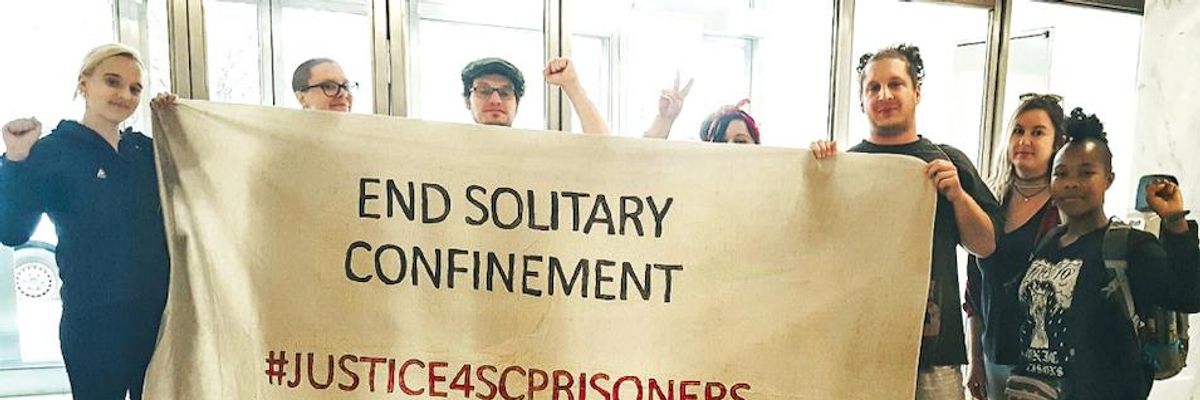
Organizers in Washington D.C. with D.C. Abolition Coalition and the D.C. Incarcerated Workers Organizing Committee deliver the demands of South Carolina Prisoners to the local United Nations Office. (Image: Fight Toxic Prisons)
Prison rights activists and advocates are appealing to the United Nations Wednesday for relief of conditions under which prisoners in South Carolina are suffering--conditions that are creating a sitution where all prisoners are effectively living in solitary confinement.
"For years, prisoners and their families have been decrying the notoriously bad conditions within South Carolina prisons, as the U.S. Department of Justice has demonstrated through reports and consent decrees with states in violation of basic human rights protections," the Campaign to Fight Toxic Prisons said in a statement.
"However," the group added, "this process has not produced notable improvements in prison conditions."
Human rights campaigners around the country are taking their case to the U.N., they say, because inaction on the part of state and federal officials has left South Carolina prisoners with "no other path to redress."
"Beyond the basic level of terror in U.S. prison conditions, conditions in South Carolina have been specifically repressive for a few years now," Jared Ware, a prisoner rights advocate, told Common Dreams.
Detainees in general population report windows being blocked with metal plating, infrequent weekly shower access, and no outdoor recreation. The conditions were at least in part to blame for a riot at the Lee Correctional Institution in Bishopville in 2018 that claimed seven lives, campaigners said, and only deteriorated further after that.
"After the violence at Lee, the conditions got worse," said Ware. "Facilities were placed either on lockdowns or modified lockdowns. Sometimes SCDC would leave one 'privilege' or 'character' dorm off lockdown so that they could deny the whole facility was on lockdown. But for the majority of prisoners in each facility, they were locked down, with no access to sunlight or the outdoors, and at best weekly access to showers."
Petitions calling for relief are being delivered to U.N. offices in New York, Washington, London, and Kingston, Jamaica Wednesday. The demands include opening the windows, outdoor recreation, nutrious food, and vocational and academic programs for inmates. The letter also calls for a Special Rappporteur to "investigate the torturous, cruel, and inhumane punishment of prisoners in South Carolina."
As Common Dreams has reported, U.S. prisons have been on the U.N.'s radar for years. In 2015, former U.N. Special Rapporteur on Torture Juan Mendez implied the U.S. was holding him back from visiting prisons in the country because of the conditions in the facilities.
"It's simply outrageous that it's taking such a long time to provide access to American detention facilities," Mendez said at the time. "This begs the question: is the United States hiding something?"
Videos and photos from Fight Toxic Prisons Wednesday show activists delivering petitions to the U.N.
"When incarcerated people can no longer find a basis for hope they struggle to see a path forward," said Campaign to Fight Toxic Prisons. "South Carolina's prison system has reached a breaking point, and right now it is breaking the mind, bodies, and spirits of human beings. Today, these prisoners have reached out to the world to urge international humanitarian intervention by the U.N., in an attempt to ease the harsh conditions in South Carolina prisons."
Dear Common Dreams reader, It’s been nearly 30 years since I co-founded Common Dreams with my late wife, Lina Newhouser. We had the radical notion that journalism should serve the public good, not corporate profits. It was clear to us from the outset what it would take to build such a project. No paid advertisements. No corporate sponsors. No millionaire publisher telling us what to think or do. Many people said we wouldn't last a year, but we proved those doubters wrong. Together with a tremendous team of journalists and dedicated staff, we built an independent media outlet free from the constraints of profits and corporate control. Our mission has always been simple: To inform. To inspire. To ignite change for the common good. Building Common Dreams was not easy. Our survival was never guaranteed. When you take on the most powerful forces—Wall Street greed, fossil fuel industry destruction, Big Tech lobbyists, and uber-rich oligarchs who have spent billions upon billions rigging the economy and democracy in their favor—the only bulwark you have is supporters who believe in your work. But here’s the urgent message from me today. It's never been this bad out there. And it's never been this hard to keep us going. At the very moment Common Dreams is most needed, the threats we face are intensifying. We need your support now more than ever. We don't accept corporate advertising and never will. We don't have a paywall because we don't think people should be blocked from critical news based on their ability to pay. Everything we do is funded by the donations of readers like you. When everyone does the little they can afford, we are strong. But if that support retreats or dries up, so do we. Will you donate now to make sure Common Dreams not only survives but thrives? —Craig Brown, Co-founder |
Prison rights activists and advocates are appealing to the United Nations Wednesday for relief of conditions under which prisoners in South Carolina are suffering--conditions that are creating a sitution where all prisoners are effectively living in solitary confinement.
"For years, prisoners and their families have been decrying the notoriously bad conditions within South Carolina prisons, as the U.S. Department of Justice has demonstrated through reports and consent decrees with states in violation of basic human rights protections," the Campaign to Fight Toxic Prisons said in a statement.
"However," the group added, "this process has not produced notable improvements in prison conditions."
Human rights campaigners around the country are taking their case to the U.N., they say, because inaction on the part of state and federal officials has left South Carolina prisoners with "no other path to redress."
"Beyond the basic level of terror in U.S. prison conditions, conditions in South Carolina have been specifically repressive for a few years now," Jared Ware, a prisoner rights advocate, told Common Dreams.
Detainees in general population report windows being blocked with metal plating, infrequent weekly shower access, and no outdoor recreation. The conditions were at least in part to blame for a riot at the Lee Correctional Institution in Bishopville in 2018 that claimed seven lives, campaigners said, and only deteriorated further after that.
"After the violence at Lee, the conditions got worse," said Ware. "Facilities were placed either on lockdowns or modified lockdowns. Sometimes SCDC would leave one 'privilege' or 'character' dorm off lockdown so that they could deny the whole facility was on lockdown. But for the majority of prisoners in each facility, they were locked down, with no access to sunlight or the outdoors, and at best weekly access to showers."
Petitions calling for relief are being delivered to U.N. offices in New York, Washington, London, and Kingston, Jamaica Wednesday. The demands include opening the windows, outdoor recreation, nutrious food, and vocational and academic programs for inmates. The letter also calls for a Special Rappporteur to "investigate the torturous, cruel, and inhumane punishment of prisoners in South Carolina."
As Common Dreams has reported, U.S. prisons have been on the U.N.'s radar for years. In 2015, former U.N. Special Rapporteur on Torture Juan Mendez implied the U.S. was holding him back from visiting prisons in the country because of the conditions in the facilities.
"It's simply outrageous that it's taking such a long time to provide access to American detention facilities," Mendez said at the time. "This begs the question: is the United States hiding something?"
Videos and photos from Fight Toxic Prisons Wednesday show activists delivering petitions to the U.N.
"When incarcerated people can no longer find a basis for hope they struggle to see a path forward," said Campaign to Fight Toxic Prisons. "South Carolina's prison system has reached a breaking point, and right now it is breaking the mind, bodies, and spirits of human beings. Today, these prisoners have reached out to the world to urge international humanitarian intervention by the U.N., in an attempt to ease the harsh conditions in South Carolina prisons."
Prison rights activists and advocates are appealing to the United Nations Wednesday for relief of conditions under which prisoners in South Carolina are suffering--conditions that are creating a sitution where all prisoners are effectively living in solitary confinement.
"For years, prisoners and their families have been decrying the notoriously bad conditions within South Carolina prisons, as the U.S. Department of Justice has demonstrated through reports and consent decrees with states in violation of basic human rights protections," the Campaign to Fight Toxic Prisons said in a statement.
"However," the group added, "this process has not produced notable improvements in prison conditions."
Human rights campaigners around the country are taking their case to the U.N., they say, because inaction on the part of state and federal officials has left South Carolina prisoners with "no other path to redress."
"Beyond the basic level of terror in U.S. prison conditions, conditions in South Carolina have been specifically repressive for a few years now," Jared Ware, a prisoner rights advocate, told Common Dreams.
Detainees in general population report windows being blocked with metal plating, infrequent weekly shower access, and no outdoor recreation. The conditions were at least in part to blame for a riot at the Lee Correctional Institution in Bishopville in 2018 that claimed seven lives, campaigners said, and only deteriorated further after that.
"After the violence at Lee, the conditions got worse," said Ware. "Facilities were placed either on lockdowns or modified lockdowns. Sometimes SCDC would leave one 'privilege' or 'character' dorm off lockdown so that they could deny the whole facility was on lockdown. But for the majority of prisoners in each facility, they were locked down, with no access to sunlight or the outdoors, and at best weekly access to showers."
Petitions calling for relief are being delivered to U.N. offices in New York, Washington, London, and Kingston, Jamaica Wednesday. The demands include opening the windows, outdoor recreation, nutrious food, and vocational and academic programs for inmates. The letter also calls for a Special Rappporteur to "investigate the torturous, cruel, and inhumane punishment of prisoners in South Carolina."
As Common Dreams has reported, U.S. prisons have been on the U.N.'s radar for years. In 2015, former U.N. Special Rapporteur on Torture Juan Mendez implied the U.S. was holding him back from visiting prisons in the country because of the conditions in the facilities.
"It's simply outrageous that it's taking such a long time to provide access to American detention facilities," Mendez said at the time. "This begs the question: is the United States hiding something?"
Videos and photos from Fight Toxic Prisons Wednesday show activists delivering petitions to the U.N.
"When incarcerated people can no longer find a basis for hope they struggle to see a path forward," said Campaign to Fight Toxic Prisons. "South Carolina's prison system has reached a breaking point, and right now it is breaking the mind, bodies, and spirits of human beings. Today, these prisoners have reached out to the world to urge international humanitarian intervention by the U.N., in an attempt to ease the harsh conditions in South Carolina prisons."