
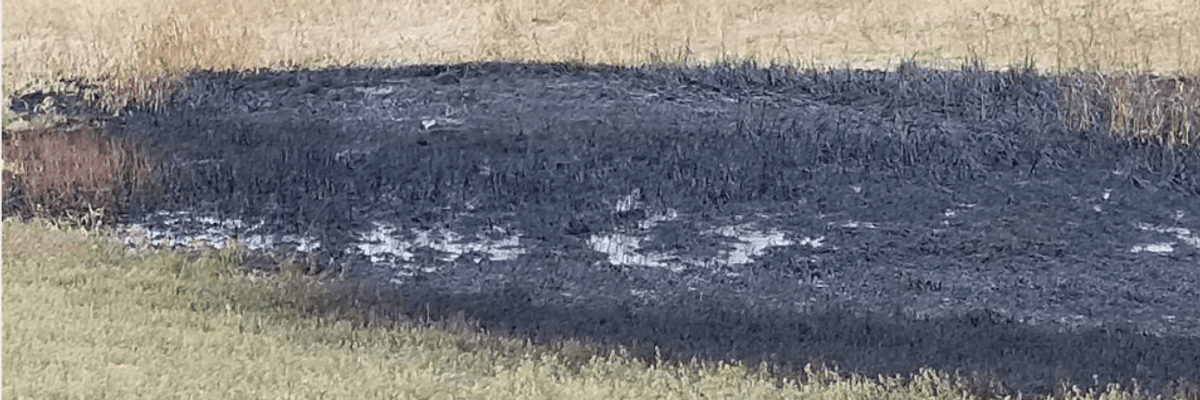
An oil spill from the Keystone pipeline in the rural Edinburg area northwest of Grafton, North Dakota on Wednesday, October 30, 2019. (Photo via The Grand Forks Herald)
'It Happens Over and Over and Over and Over': Keystone Pipeline Leaks (at Least) 383,000 Gallons of Crude Oil in North Dakota
"History has shown us time and again that there is no safe way to transport fossil fuels, and pipelines are no exception."
Environmentalists were outraged but not at all surprised to learn Thursday that the Keystone pipeline sprung yet another massive leak, this time spilling 383,000 gallons of crude oil in North Dakota.
"I wish I could say I was shocked, but a major spill from the Keystone pipeline is exactly what multiple experts predicted would happen," Greenpeace USA senior research specialist Tim Donaghy said in a statement. "In fact, this is the fourth significant spill from the Keystone pipeline in less than ten years of operation. History has shown us time and again that there is no safe way to transport fossil fuels, and pipelines are no exception."
"We've always said it's not a question of whether a pipeline will spill, but when, and once again TC Energy has made our case for us."
--Catherine Collentine, Sierra Club
As 350.org founder Bill McKibben tweeted in response to the leak, "It happens over and over and over and over and over."
The latest Keystone spill was first detected Tuesday night by TC Energy, the pipeline's owner, and the extent of the damage to the surrounding areas is not yet known to the public. According to Greenpeace, the leak "is already the eighth-largest pipeline oil spill of the last decade."
Brent Nelson, emergency manager for Walsh County, North Dakota, told the local Grand Forks Herald that the cleanup process could take months.
"The roads around the spill area have been closed to assist with the cleanup," the Herald reported. "Walsh County Sheriff Ronald Jurgens asks the public to avoid the area so the cleanup process can proceed. On-site security will stop and fine any driver ignoring the closed road signs."
TC Energy, previously known as TransCanada, denied that the spill had any impact on drinking water, a claim that was met with skepticism.
Keystone Pipeline leak spills oil in northeastern North Dakota
Corp says the oil hasn't contaminated any drinking water & they're cleaning it up but anyone who drives to the site will be fined by their security so who knows what's going on. #NOKXL https://t.co/7H6Dcz4bsm
-- Ruth Hopkins (@RuthH_Hopkins) October 31, 2019
Catherine Collentine, associate director of Sierra Club's Beyond Dirty Fuels initiative, said "this is not the first time this pipeline has spilled toxic tar sands, and it won't be the last."
"We've always said it's not a question of whether a pipeline will spill, but when," said Collentine, "and once again TC Energy has made our case for us."
Keystone's leak in North Dakota was detected just hours after the U.S. State Department held a public hearing in Billings, Montana to solicit comments on the department's new analysis (pdf) of the potential environmental impact of the Keystone XL project.
The Trump administration has worked hard to approve and accelerate the project over the protests and legal challenges of indigenous rights organizations and green groups.
Joye Braun, frontline community organizer with the Indigenous Environmental Network, said the State Department meeting on Keystone XL "seemed more like an industry showcase rather than public comment hearing."
"We stand firm in opposing this project as the latest spill is further evidence of just how dangerous pipelines are," said Braun.
We are at a crossroads
This country and this world are at a monumental crossroads. In a few short weeks, US voters will have an opportunity to beat back the forces of fascism and confront the billionaires who are rigging the economy, our media system, and our democracy, making it increasingly impossible for ordinary people to get by. We’re not just talking about the election. We’re talking about what must be done once these fascist elements are vanquished from power. We need a bolder set of solutions than what either major party has so far been willing to offer and a working-class movement ready to fight like hell for it. Trump didn't emerge from nowhere. The conditions that fueled MAGA authoritarianism were created by decades of radical neoliberal economic policies and a corrupt political system dominated by corporate interests. They slashed taxes on the super-rich, promising that the benefits would trickle down. They said giveaways to the corporate titans would make life more affordable for the rest of us. It was all bullshit. And when a bitter, betrayed populace searches for someone to blame, right-wing demagogues have little trouble finding scapegoats. People know when they're being lied to, but you won't hear any of this from the corporate media. Only independent journalism—powered and funded by people who believe in building a better world—can deliver truly trustworthy daily news. Our Fall Campaign is underway, and we need your help. To power our newsroom through the rest of the year, we need to raise $125,000 by midnight on October 31. So if you share our vision, please contribute whatever you can to sustain our work. |
Environmentalists were outraged but not at all surprised to learn Thursday that the Keystone pipeline sprung yet another massive leak, this time spilling 383,000 gallons of crude oil in North Dakota.
"I wish I could say I was shocked, but a major spill from the Keystone pipeline is exactly what multiple experts predicted would happen," Greenpeace USA senior research specialist Tim Donaghy said in a statement. "In fact, this is the fourth significant spill from the Keystone pipeline in less than ten years of operation. History has shown us time and again that there is no safe way to transport fossil fuels, and pipelines are no exception."
"We've always said it's not a question of whether a pipeline will spill, but when, and once again TC Energy has made our case for us."
--Catherine Collentine, Sierra Club
As 350.org founder Bill McKibben tweeted in response to the leak, "It happens over and over and over and over and over."
The latest Keystone spill was first detected Tuesday night by TC Energy, the pipeline's owner, and the extent of the damage to the surrounding areas is not yet known to the public. According to Greenpeace, the leak "is already the eighth-largest pipeline oil spill of the last decade."
Brent Nelson, emergency manager for Walsh County, North Dakota, told the local Grand Forks Herald that the cleanup process could take months.
"The roads around the spill area have been closed to assist with the cleanup," the Herald reported. "Walsh County Sheriff Ronald Jurgens asks the public to avoid the area so the cleanup process can proceed. On-site security will stop and fine any driver ignoring the closed road signs."
TC Energy, previously known as TransCanada, denied that the spill had any impact on drinking water, a claim that was met with skepticism.
Keystone Pipeline leak spills oil in northeastern North Dakota
Corp says the oil hasn't contaminated any drinking water & they're cleaning it up but anyone who drives to the site will be fined by their security so who knows what's going on. #NOKXL https://t.co/7H6Dcz4bsm
-- Ruth Hopkins (@RuthH_Hopkins) October 31, 2019
Catherine Collentine, associate director of Sierra Club's Beyond Dirty Fuels initiative, said "this is not the first time this pipeline has spilled toxic tar sands, and it won't be the last."
"We've always said it's not a question of whether a pipeline will spill, but when," said Collentine, "and once again TC Energy has made our case for us."
Keystone's leak in North Dakota was detected just hours after the U.S. State Department held a public hearing in Billings, Montana to solicit comments on the department's new analysis (pdf) of the potential environmental impact of the Keystone XL project.
The Trump administration has worked hard to approve and accelerate the project over the protests and legal challenges of indigenous rights organizations and green groups.
Joye Braun, frontline community organizer with the Indigenous Environmental Network, said the State Department meeting on Keystone XL "seemed more like an industry showcase rather than public comment hearing."
"We stand firm in opposing this project as the latest spill is further evidence of just how dangerous pipelines are," said Braun.
Environmentalists were outraged but not at all surprised to learn Thursday that the Keystone pipeline sprung yet another massive leak, this time spilling 383,000 gallons of crude oil in North Dakota.
"I wish I could say I was shocked, but a major spill from the Keystone pipeline is exactly what multiple experts predicted would happen," Greenpeace USA senior research specialist Tim Donaghy said in a statement. "In fact, this is the fourth significant spill from the Keystone pipeline in less than ten years of operation. History has shown us time and again that there is no safe way to transport fossil fuels, and pipelines are no exception."
"We've always said it's not a question of whether a pipeline will spill, but when, and once again TC Energy has made our case for us."
--Catherine Collentine, Sierra Club
As 350.org founder Bill McKibben tweeted in response to the leak, "It happens over and over and over and over and over."
The latest Keystone spill was first detected Tuesday night by TC Energy, the pipeline's owner, and the extent of the damage to the surrounding areas is not yet known to the public. According to Greenpeace, the leak "is already the eighth-largest pipeline oil spill of the last decade."
Brent Nelson, emergency manager for Walsh County, North Dakota, told the local Grand Forks Herald that the cleanup process could take months.
"The roads around the spill area have been closed to assist with the cleanup," the Herald reported. "Walsh County Sheriff Ronald Jurgens asks the public to avoid the area so the cleanup process can proceed. On-site security will stop and fine any driver ignoring the closed road signs."
TC Energy, previously known as TransCanada, denied that the spill had any impact on drinking water, a claim that was met with skepticism.
Keystone Pipeline leak spills oil in northeastern North Dakota
Corp says the oil hasn't contaminated any drinking water & they're cleaning it up but anyone who drives to the site will be fined by their security so who knows what's going on. #NOKXL https://t.co/7H6Dcz4bsm
-- Ruth Hopkins (@RuthH_Hopkins) October 31, 2019
Catherine Collentine, associate director of Sierra Club's Beyond Dirty Fuels initiative, said "this is not the first time this pipeline has spilled toxic tar sands, and it won't be the last."
"We've always said it's not a question of whether a pipeline will spill, but when," said Collentine, "and once again TC Energy has made our case for us."
Keystone's leak in North Dakota was detected just hours after the U.S. State Department held a public hearing in Billings, Montana to solicit comments on the department's new analysis (pdf) of the potential environmental impact of the Keystone XL project.
The Trump administration has worked hard to approve and accelerate the project over the protests and legal challenges of indigenous rights organizations and green groups.
Joye Braun, frontline community organizer with the Indigenous Environmental Network, said the State Department meeting on Keystone XL "seemed more like an industry showcase rather than public comment hearing."
"We stand firm in opposing this project as the latest spill is further evidence of just how dangerous pipelines are," said Braun.