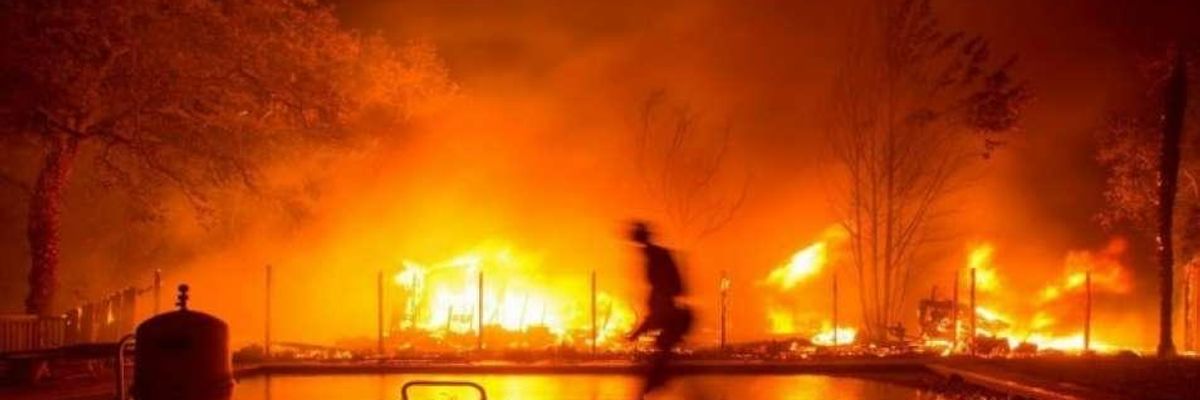
A firefighter walks near a pool as a neighboring home burns in the Napa wine region in California in 2017. (Josh Edelson/AFP/Getty Images)
After Hottest Decade Since Records Began, WMO Warns World May Face 5degC Rise by Century's End
The impacts of the climate crisis "are real and happening now and place huge pressures on communities and countries," climate scientists said.
As the decade comes to a close, the world's top climate scientists warned Tuesday that policymakers' continued failure to curb the warming of the planet could lead to a global temperature increase of 5deg Celsius by the end of the century and put the world "nowhere near on track" to avoid the worst impacts of the climate crisis.
2019 is expected to be the second or third warmest year ever recorded, according to the World Meteorological Organization (WMO), while the past five-year and ten-year periods are "almost certain to be the highest on record."
The organization's report on the State of the Global Climate shows that carbon dioxide levels in the atmosphere hit record levels in 2018 and then rose again in 2019, with average global temperatures this past year rising to 1.1deg Celsius (1.98deg Fahrenheit) above pre-industrial levels.
The WMO repeated urgent calls by thousands of climate experts as well global campaigners for concrete action by world leaders to end the fossil fuel extraction that is contributing to carbon emissions and the warming of the globe.
"If we do not take urgent climate action now, then we are heading for a temperature increase of more than 3degC by the end of the century, with ever more harmful impacts on human wellbeing," said WMO Secretary-General Petteri Taalas.
"We are nowhere near on track to meet the Paris Agreement target" of a 1.5degC rise, Taalas added.
The report was released as the United Nations Framework Convention on Climate Change (COP25) began in Madrid and campaigners staged demonstrations to demand alternatives to market-driven approaches to the climate crisis.
The European Union declared a climate emergency last week, but world leaders have continued to allow big polluters to extract fossil fuels and contribute to carbon emissions that have led to record ocean temperatures, high ocean acidity, and rapidly melting sea ice in Antarctica and the Arctic.
"If we do not take urgent climate action now, then we are heading for a temperature increase of more than 3degC by the end of the century, with ever more harmful impacts on human wellbeing."
--Petteri Taalas, WMO Secretary-General
"If we wanted to reach a 1.5deg increase we would need to bend emissions and at the moment countries haven't been following on their Paris pledges," Taalas told reporters in Madrid on Tuesday.
A 4deg temperature rise, according to the Potsdam Institute for Climate Impact Research in Germany, would lead to the disappearance of many of the world's rainforests and the ice at the North and South Poles, as well as rising sea levels flooding even non-coastal regions.
The WMO report also warned about numerous effects on human health if global temperatures are allowed to rise above 1.5deg Celsius, including increased transmission of illnesses like Dengue virus, which about half the world is now at risk for amid warmer weather; more frequent exposure of vulnerable populations to extreme heatwaves; and the continued rise of global hunger, which affected 820 million people in 2018.
"It's shocking how much climate change in 2019 has already lead to lives lost, poor health, food insecurity, and displaced populations," Dr. Joanna House of the Cabot Institute of the Environment at University of Bristol said of the report's findings. "Even as a climate scientist who knows the evidence and the projections, I find this deeply upsetting. What is more shocking is how long very little has been done about this. We have the information, the solutions, what we need now is urgent action."
Climate scientists praised the WMO for conveying the urgency of the crisis.
"These impacts are real and happening now and place huge pressures on communities and countries--put simply, these impacts make for a more unstable world," said Grant Allen, professor of atmospheric physics at the University of Manchester in England.
"It is already well over time to rapidly restructure our economies away from greenhouse gas emitting industries and practices," he added, "and adapt and mitigate for current and future change already locked into the climate system."
We are at a crossroads
This country and this world are at a monumental crossroads. In a few short weeks, US voters will have an opportunity to beat back the forces of fascism and confront the billionaires who are rigging the economy, our media system, and our democracy, making it increasingly impossible for ordinary people to get by. We’re not just talking about the election. We’re talking about what must be done once these fascist elements are vanquished from power. We need a bolder set of solutions than what either major party has so far been willing to offer and a working-class movement ready to fight like hell for it. Trump didn't emerge from nowhere. The conditions that fueled MAGA authoritarianism were created by decades of radical neoliberal economic policies and a corrupt political system dominated by corporate interests. They slashed taxes on the super-rich, promising that the benefits would trickle down. They said giveaways to the corporate titans would make life more affordable for the rest of us. It was all bullshit. And when a bitter, betrayed populace searches for someone to blame, right-wing demagogues have little trouble finding scapegoats. People know when they're being lied to, but you won't hear any of this from the corporate media. Only independent journalism—powered and funded by people who believe in building a better world—can deliver truly trustworthy daily news. Our Fall Campaign is underway, and we need your help. To power our newsroom through the rest of the year, we need to raise $125,000 by midnight on October 31. So if you share our vision, please contribute whatever you can to sustain our work. |
As the decade comes to a close, the world's top climate scientists warned Tuesday that policymakers' continued failure to curb the warming of the planet could lead to a global temperature increase of 5deg Celsius by the end of the century and put the world "nowhere near on track" to avoid the worst impacts of the climate crisis.
2019 is expected to be the second or third warmest year ever recorded, according to the World Meteorological Organization (WMO), while the past five-year and ten-year periods are "almost certain to be the highest on record."
The organization's report on the State of the Global Climate shows that carbon dioxide levels in the atmosphere hit record levels in 2018 and then rose again in 2019, with average global temperatures this past year rising to 1.1deg Celsius (1.98deg Fahrenheit) above pre-industrial levels.
The WMO repeated urgent calls by thousands of climate experts as well global campaigners for concrete action by world leaders to end the fossil fuel extraction that is contributing to carbon emissions and the warming of the globe.
"If we do not take urgent climate action now, then we are heading for a temperature increase of more than 3degC by the end of the century, with ever more harmful impacts on human wellbeing," said WMO Secretary-General Petteri Taalas.
"We are nowhere near on track to meet the Paris Agreement target" of a 1.5degC rise, Taalas added.
The report was released as the United Nations Framework Convention on Climate Change (COP25) began in Madrid and campaigners staged demonstrations to demand alternatives to market-driven approaches to the climate crisis.
The European Union declared a climate emergency last week, but world leaders have continued to allow big polluters to extract fossil fuels and contribute to carbon emissions that have led to record ocean temperatures, high ocean acidity, and rapidly melting sea ice in Antarctica and the Arctic.
"If we do not take urgent climate action now, then we are heading for a temperature increase of more than 3degC by the end of the century, with ever more harmful impacts on human wellbeing."
--Petteri Taalas, WMO Secretary-General
"If we wanted to reach a 1.5deg increase we would need to bend emissions and at the moment countries haven't been following on their Paris pledges," Taalas told reporters in Madrid on Tuesday.
A 4deg temperature rise, according to the Potsdam Institute for Climate Impact Research in Germany, would lead to the disappearance of many of the world's rainforests and the ice at the North and South Poles, as well as rising sea levels flooding even non-coastal regions.
The WMO report also warned about numerous effects on human health if global temperatures are allowed to rise above 1.5deg Celsius, including increased transmission of illnesses like Dengue virus, which about half the world is now at risk for amid warmer weather; more frequent exposure of vulnerable populations to extreme heatwaves; and the continued rise of global hunger, which affected 820 million people in 2018.
"It's shocking how much climate change in 2019 has already lead to lives lost, poor health, food insecurity, and displaced populations," Dr. Joanna House of the Cabot Institute of the Environment at University of Bristol said of the report's findings. "Even as a climate scientist who knows the evidence and the projections, I find this deeply upsetting. What is more shocking is how long very little has been done about this. We have the information, the solutions, what we need now is urgent action."
Climate scientists praised the WMO for conveying the urgency of the crisis.
"These impacts are real and happening now and place huge pressures on communities and countries--put simply, these impacts make for a more unstable world," said Grant Allen, professor of atmospheric physics at the University of Manchester in England.
"It is already well over time to rapidly restructure our economies away from greenhouse gas emitting industries and practices," he added, "and adapt and mitigate for current and future change already locked into the climate system."
As the decade comes to a close, the world's top climate scientists warned Tuesday that policymakers' continued failure to curb the warming of the planet could lead to a global temperature increase of 5deg Celsius by the end of the century and put the world "nowhere near on track" to avoid the worst impacts of the climate crisis.
2019 is expected to be the second or third warmest year ever recorded, according to the World Meteorological Organization (WMO), while the past five-year and ten-year periods are "almost certain to be the highest on record."
The organization's report on the State of the Global Climate shows that carbon dioxide levels in the atmosphere hit record levels in 2018 and then rose again in 2019, with average global temperatures this past year rising to 1.1deg Celsius (1.98deg Fahrenheit) above pre-industrial levels.
The WMO repeated urgent calls by thousands of climate experts as well global campaigners for concrete action by world leaders to end the fossil fuel extraction that is contributing to carbon emissions and the warming of the globe.
"If we do not take urgent climate action now, then we are heading for a temperature increase of more than 3degC by the end of the century, with ever more harmful impacts on human wellbeing," said WMO Secretary-General Petteri Taalas.
"We are nowhere near on track to meet the Paris Agreement target" of a 1.5degC rise, Taalas added.
The report was released as the United Nations Framework Convention on Climate Change (COP25) began in Madrid and campaigners staged demonstrations to demand alternatives to market-driven approaches to the climate crisis.
The European Union declared a climate emergency last week, but world leaders have continued to allow big polluters to extract fossil fuels and contribute to carbon emissions that have led to record ocean temperatures, high ocean acidity, and rapidly melting sea ice in Antarctica and the Arctic.
"If we do not take urgent climate action now, then we are heading for a temperature increase of more than 3degC by the end of the century, with ever more harmful impacts on human wellbeing."
--Petteri Taalas, WMO Secretary-General
"If we wanted to reach a 1.5deg increase we would need to bend emissions and at the moment countries haven't been following on their Paris pledges," Taalas told reporters in Madrid on Tuesday.
A 4deg temperature rise, according to the Potsdam Institute for Climate Impact Research in Germany, would lead to the disappearance of many of the world's rainforests and the ice at the North and South Poles, as well as rising sea levels flooding even non-coastal regions.
The WMO report also warned about numerous effects on human health if global temperatures are allowed to rise above 1.5deg Celsius, including increased transmission of illnesses like Dengue virus, which about half the world is now at risk for amid warmer weather; more frequent exposure of vulnerable populations to extreme heatwaves; and the continued rise of global hunger, which affected 820 million people in 2018.
"It's shocking how much climate change in 2019 has already lead to lives lost, poor health, food insecurity, and displaced populations," Dr. Joanna House of the Cabot Institute of the Environment at University of Bristol said of the report's findings. "Even as a climate scientist who knows the evidence and the projections, I find this deeply upsetting. What is more shocking is how long very little has been done about this. We have the information, the solutions, what we need now is urgent action."
Climate scientists praised the WMO for conveying the urgency of the crisis.
"These impacts are real and happening now and place huge pressures on communities and countries--put simply, these impacts make for a more unstable world," said Grant Allen, professor of atmospheric physics at the University of Manchester in England.
"It is already well over time to rapidly restructure our economies away from greenhouse gas emitting industries and practices," he added, "and adapt and mitigate for current and future change already locked into the climate system."