SUBSCRIBE TO OUR FREE NEWSLETTER
Daily news & progressive opinion—funded by the people, not the corporations—delivered straight to your inbox.
5
#000000
#FFFFFF
To donate by check, phone, or other method, see our More Ways to Give page.
Daily news & progressive opinion—funded by the people, not the corporations—delivered straight to your inbox.
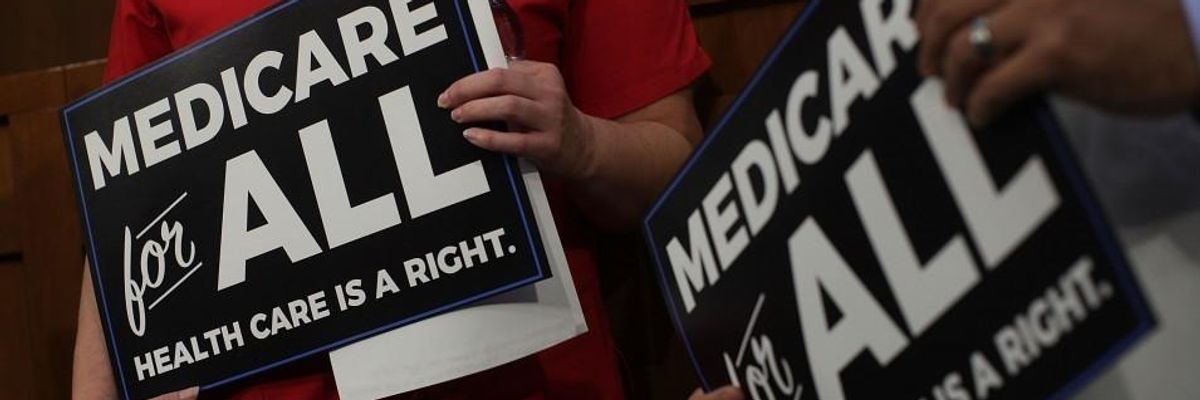
Advocates hold signs at the second-ever congressional hearing on Medicare for All. (Photo: Alex Wong/Getty Images)
Rep. Pramila Jayapal on Tuesday cheered what she called "Another victory for Medicare For All" after the House Energy and Commerce Committee announced a hearing next week on healthcare coverage that will include her proposal for a single-payer system.
The health subcommittee's hearing, entitled "Proposals to Achieve Universal Health Care Coverage," will take place Tuesday.
Jayapal, a Washington Democrat, called the upcoming hearing--which will be the fourth House hearing to address Medicare for All--a sign of the swelling momentum for the desire to switch from the current for-profit system to one which provides universal access to everyone in the country.
In addition to considering Jayapal's H.R.1384, the Medicare for All Act of 2019, the subcommittee hearing will address six other pieces of proposed healthcare legislation which would not guarantee a single national health insurance program to cover everyone. Those proposals include H.R. 2463, the Choose Medicare Act, introduced by Rep. Cedric Richmond (D-La), and H.R. 2000, the Medicare-X Choice Act of 2019, introduced by Rep. Antonio Delgado (D-N.Y.).
The number of co-sponsors on Jayapal's Medicare for All legislation--118--dwarfs the number of co-sponsors on any of the others that will be discussed during Tuesday's hearing. Rep. Ben Ray Lujan's (D-N.M.) H.R. 1277, the "State Public Option Act," has the second highest number at 51. Rep. Richmond's "Choose Medicare Act" has a mere five co-sponsors.
When Japayal's legislation got its 118th co-sponsor in August, meaning it's supported by a majority of the House Democratic caucus, activist and Bernie Sanders supporter Shaun King called the development "a huge deal."
Medicare for All is also supported by three-quarters of Democratic voters and two senators vying for the 2020 Democratic ticket: Sanders (I-Vt.) and Elizabeth Warren (D-Mass.).
Speaker Nancy Pelosi (D-Calif.), however, declared last month that she is "not a big fan of Medicare for All," and two other Democratic White House hopefuls--former Vice President Joe Biden and South Bend, Indiana Mayor Pete Buttigieg--have attacked the proposal.
Jayapal has criticized her own party for parroting industry and GOP talking points to dismiss Medicare for All, and the proposal is already facing and an industry "army" intent on killing it.
Speaking to the press last month, the Washington Democrat framed Medicare for All as not only the right approach from a humane perspective but also just good economics.
"We spend 18% of our GDP each year on healthcare--almost double per person compared to most other nations--and our costs are only increasing. This makes Medicare for All not only a human and a moral imperative, but also an economic imperative," said Jayapal.
"Our current health system, designed to line the pockets of for-profit companies, is a massive anchor that drags down our economy. Medicare for All, on the other hand, would actually guarantee comprehensive coverage for everyone and bring down overall health expenditures," she continued, "saving American families money and allowing businesses to compete and thrive in the global economy."
Dear Common Dreams reader, It’s been nearly 30 years since I co-founded Common Dreams with my late wife, Lina Newhouser. We had the radical notion that journalism should serve the public good, not corporate profits. It was clear to us from the outset what it would take to build such a project. No paid advertisements. No corporate sponsors. No millionaire publisher telling us what to think or do. Many people said we wouldn't last a year, but we proved those doubters wrong. Together with a tremendous team of journalists and dedicated staff, we built an independent media outlet free from the constraints of profits and corporate control. Our mission has always been simple: To inform. To inspire. To ignite change for the common good. Building Common Dreams was not easy. Our survival was never guaranteed. When you take on the most powerful forces—Wall Street greed, fossil fuel industry destruction, Big Tech lobbyists, and uber-rich oligarchs who have spent billions upon billions rigging the economy and democracy in their favor—the only bulwark you have is supporters who believe in your work. But here’s the urgent message from me today. It's never been this bad out there. And it's never been this hard to keep us going. At the very moment Common Dreams is most needed, the threats we face are intensifying. We need your support now more than ever. We don't accept corporate advertising and never will. We don't have a paywall because we don't think people should be blocked from critical news based on their ability to pay. Everything we do is funded by the donations of readers like you. When everyone does the little they can afford, we are strong. But if that support retreats or dries up, so do we. Will you donate now to make sure Common Dreams not only survives but thrives? —Craig Brown, Co-founder |
Rep. Pramila Jayapal on Tuesday cheered what she called "Another victory for Medicare For All" after the House Energy and Commerce Committee announced a hearing next week on healthcare coverage that will include her proposal for a single-payer system.
The health subcommittee's hearing, entitled "Proposals to Achieve Universal Health Care Coverage," will take place Tuesday.
Jayapal, a Washington Democrat, called the upcoming hearing--which will be the fourth House hearing to address Medicare for All--a sign of the swelling momentum for the desire to switch from the current for-profit system to one which provides universal access to everyone in the country.
In addition to considering Jayapal's H.R.1384, the Medicare for All Act of 2019, the subcommittee hearing will address six other pieces of proposed healthcare legislation which would not guarantee a single national health insurance program to cover everyone. Those proposals include H.R. 2463, the Choose Medicare Act, introduced by Rep. Cedric Richmond (D-La), and H.R. 2000, the Medicare-X Choice Act of 2019, introduced by Rep. Antonio Delgado (D-N.Y.).
The number of co-sponsors on Jayapal's Medicare for All legislation--118--dwarfs the number of co-sponsors on any of the others that will be discussed during Tuesday's hearing. Rep. Ben Ray Lujan's (D-N.M.) H.R. 1277, the "State Public Option Act," has the second highest number at 51. Rep. Richmond's "Choose Medicare Act" has a mere five co-sponsors.
When Japayal's legislation got its 118th co-sponsor in August, meaning it's supported by a majority of the House Democratic caucus, activist and Bernie Sanders supporter Shaun King called the development "a huge deal."
Medicare for All is also supported by three-quarters of Democratic voters and two senators vying for the 2020 Democratic ticket: Sanders (I-Vt.) and Elizabeth Warren (D-Mass.).
Speaker Nancy Pelosi (D-Calif.), however, declared last month that she is "not a big fan of Medicare for All," and two other Democratic White House hopefuls--former Vice President Joe Biden and South Bend, Indiana Mayor Pete Buttigieg--have attacked the proposal.
Jayapal has criticized her own party for parroting industry and GOP talking points to dismiss Medicare for All, and the proposal is already facing and an industry "army" intent on killing it.
Speaking to the press last month, the Washington Democrat framed Medicare for All as not only the right approach from a humane perspective but also just good economics.
"We spend 18% of our GDP each year on healthcare--almost double per person compared to most other nations--and our costs are only increasing. This makes Medicare for All not only a human and a moral imperative, but also an economic imperative," said Jayapal.
"Our current health system, designed to line the pockets of for-profit companies, is a massive anchor that drags down our economy. Medicare for All, on the other hand, would actually guarantee comprehensive coverage for everyone and bring down overall health expenditures," she continued, "saving American families money and allowing businesses to compete and thrive in the global economy."
Rep. Pramila Jayapal on Tuesday cheered what she called "Another victory for Medicare For All" after the House Energy and Commerce Committee announced a hearing next week on healthcare coverage that will include her proposal for a single-payer system.
The health subcommittee's hearing, entitled "Proposals to Achieve Universal Health Care Coverage," will take place Tuesday.
Jayapal, a Washington Democrat, called the upcoming hearing--which will be the fourth House hearing to address Medicare for All--a sign of the swelling momentum for the desire to switch from the current for-profit system to one which provides universal access to everyone in the country.
In addition to considering Jayapal's H.R.1384, the Medicare for All Act of 2019, the subcommittee hearing will address six other pieces of proposed healthcare legislation which would not guarantee a single national health insurance program to cover everyone. Those proposals include H.R. 2463, the Choose Medicare Act, introduced by Rep. Cedric Richmond (D-La), and H.R. 2000, the Medicare-X Choice Act of 2019, introduced by Rep. Antonio Delgado (D-N.Y.).
The number of co-sponsors on Jayapal's Medicare for All legislation--118--dwarfs the number of co-sponsors on any of the others that will be discussed during Tuesday's hearing. Rep. Ben Ray Lujan's (D-N.M.) H.R. 1277, the "State Public Option Act," has the second highest number at 51. Rep. Richmond's "Choose Medicare Act" has a mere five co-sponsors.
When Japayal's legislation got its 118th co-sponsor in August, meaning it's supported by a majority of the House Democratic caucus, activist and Bernie Sanders supporter Shaun King called the development "a huge deal."
Medicare for All is also supported by three-quarters of Democratic voters and two senators vying for the 2020 Democratic ticket: Sanders (I-Vt.) and Elizabeth Warren (D-Mass.).
Speaker Nancy Pelosi (D-Calif.), however, declared last month that she is "not a big fan of Medicare for All," and two other Democratic White House hopefuls--former Vice President Joe Biden and South Bend, Indiana Mayor Pete Buttigieg--have attacked the proposal.
Jayapal has criticized her own party for parroting industry and GOP talking points to dismiss Medicare for All, and the proposal is already facing and an industry "army" intent on killing it.
Speaking to the press last month, the Washington Democrat framed Medicare for All as not only the right approach from a humane perspective but also just good economics.
"We spend 18% of our GDP each year on healthcare--almost double per person compared to most other nations--and our costs are only increasing. This makes Medicare for All not only a human and a moral imperative, but also an economic imperative," said Jayapal.
"Our current health system, designed to line the pockets of for-profit companies, is a massive anchor that drags down our economy. Medicare for All, on the other hand, would actually guarantee comprehensive coverage for everyone and bring down overall health expenditures," she continued, "saving American families money and allowing businesses to compete and thrive in the global economy."