

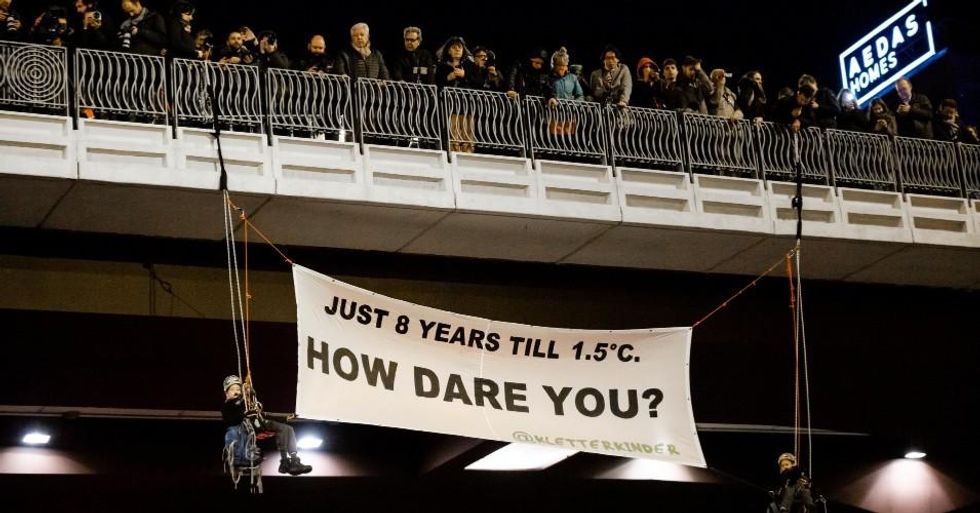
Climate action advocates who had spent two weeks demanding action from the COP 25 climate summit emerged from the conference Sunday stunned and angry over its conclusion, which was deemed a "lost opportunity" by the United Nations secretary-general.
Because of the refusal of some of the world's wealthiest countries to commit to more ambitious targets to reduce their climate-warming carbon emissions, Secretary-General Antonio Guterres said, "The international community lost an important opportunity to show increased ambition on mitigation, adaptation, and finance to tackle the climate crisis."
As Common Dreams reported Saturday, the summit was intended to wrap up Friday but negotiations lasted two extra days as delegations debated provisions for carbon markets.
The final deal acknowledged there was a "significant gap" between countries' pledges to reduce their carbon emissions to limit global warming to 1.5 degrees Celsius above pre-industrial levels, and government's ability to achieve that reduction.
Countries were urged in the final text to honor their emissions-reduction commitments, but high-polluting countries including China, India, and the U.S. argued they saw no need to set more ambitious reduction plans for themselves.
In the final hours of negotiations, Papua New Guinea's climate envoy, Kevin Conrad, told Euronews, "90% of the participants have not been involved in this process."
Developing countries especially took issue with the absence of language that the U.S. successfully stonewalled, which would have addressed how the U.S. should be held liable to island nations for the damage the climate crisis has already caused to them, thanks in part to the activities of the world's biggest carbon emitter historically.
The Tuvalu delegation reportedly said Sunday that the United States' refusal to compensate other countries for loss and damage "could be considered a crime against humanity."
"Unfortunately, the new text we adopted this morning does not reflect anything near what we would have wanted. It is the bare minimum and we regret that countries could not agree on a more ambitious text," said Tina Eonemto Stege, climate envoy for the Marshall Islands.
"With 11 months remaining, only some of the most vulnerable countries are showing the leadership and responsibility required to keep global temperature rise below 1.5C. This contrasts with the countries and actors most responsible for the climate crisis that have shown they have no intention of solving it," said Sebastien Duyck, Senior Attorney at the Center for International Environmental Law (CIEL).
On social media, observers denounced the U.S. and other wealthy countries which had demonstrated, one critic said, that "the first civilization casualty of the climate crisis is government."
The global climate action group Friends of the Earth (FOE) noted that the failure to reach a final agreement on carbon markets could be seen as a small victory.
Several larger countries wanted language allowing carbon markets to "offset" instead of cut emissions, but the debate was pushed to next year's COP 26 meeting in Glasgow, Scotland.
The decision to put the provision off was made "despite a last minute attempt by developed countries and a few big developing countries to push through a destructive deal that would have flooded the system with old carbon credits and opened the door to huge new trading mechanisms," said Sara Shaw, climate justice and energy coordinator for FOE. "This is a small victory, with an even bigger fight ahead into COP 26 next year."
"The bad news is virtually everything else--there is no new finance for loss and damage for developing countries hit hard by climate change, nor is there any agreed provision of long term climate finance," she added.
In the coming year and at Glasgow next year, as the Paris climate accord officially goes into effect, countries must decide whether they want to stand on the side of millions of campaigners who have demonstrated at climate strikes on a weekly basis for over a year and of countries which are bearing the brunt of the climate emergency's effects--or of big polluters.
"World leaders have a clear choice: stand by the blockers of progress such as the United States and Brazil that prioritize the profits of the fossil fuel polluters and big agribusiness over the well-being of their citizens, or listen to the voices of their people; the scientific community; and youth, indigenous, labor, business, environmental, social justice, faith and other leaders working hard to create a better world for current and future generations," said Alden Meyer, director of strategy at the Union of Concerned Scientists.
"It's time to choose."
Climate action advocates who had spent two weeks demanding action from the COP 25 climate summit emerged from the conference Sunday stunned and angry over its conclusion, which was deemed a "lost opportunity" by the United Nations secretary-general.
Because of the refusal of some of the world's wealthiest countries to commit to more ambitious targets to reduce their climate-warming carbon emissions, Secretary-General Antonio Guterres said, "The international community lost an important opportunity to show increased ambition on mitigation, adaptation, and finance to tackle the climate crisis."
As Common Dreams reported Saturday, the summit was intended to wrap up Friday but negotiations lasted two extra days as delegations debated provisions for carbon markets.
The final deal acknowledged there was a "significant gap" between countries' pledges to reduce their carbon emissions to limit global warming to 1.5 degrees Celsius above pre-industrial levels, and government's ability to achieve that reduction.
Countries were urged in the final text to honor their emissions-reduction commitments, but high-polluting countries including China, India, and the U.S. argued they saw no need to set more ambitious reduction plans for themselves.
In the final hours of negotiations, Papua New Guinea's climate envoy, Kevin Conrad, told Euronews, "90% of the participants have not been involved in this process."
Developing countries especially took issue with the absence of language that the U.S. successfully stonewalled, which would have addressed how the U.S. should be held liable to island nations for the damage the climate crisis has already caused to them, thanks in part to the activities of the world's biggest carbon emitter historically.
The Tuvalu delegation reportedly said Sunday that the United States' refusal to compensate other countries for loss and damage "could be considered a crime against humanity."
"Unfortunately, the new text we adopted this morning does not reflect anything near what we would have wanted. It is the bare minimum and we regret that countries could not agree on a more ambitious text," said Tina Eonemto Stege, climate envoy for the Marshall Islands.
"With 11 months remaining, only some of the most vulnerable countries are showing the leadership and responsibility required to keep global temperature rise below 1.5C. This contrasts with the countries and actors most responsible for the climate crisis that have shown they have no intention of solving it," said Sebastien Duyck, Senior Attorney at the Center for International Environmental Law (CIEL).
On social media, observers denounced the U.S. and other wealthy countries which had demonstrated, one critic said, that "the first civilization casualty of the climate crisis is government."
The global climate action group Friends of the Earth (FOE) noted that the failure to reach a final agreement on carbon markets could be seen as a small victory.
Several larger countries wanted language allowing carbon markets to "offset" instead of cut emissions, but the debate was pushed to next year's COP 26 meeting in Glasgow, Scotland.
The decision to put the provision off was made "despite a last minute attempt by developed countries and a few big developing countries to push through a destructive deal that would have flooded the system with old carbon credits and opened the door to huge new trading mechanisms," said Sara Shaw, climate justice and energy coordinator for FOE. "This is a small victory, with an even bigger fight ahead into COP 26 next year."
"The bad news is virtually everything else--there is no new finance for loss and damage for developing countries hit hard by climate change, nor is there any agreed provision of long term climate finance," she added.
In the coming year and at Glasgow next year, as the Paris climate accord officially goes into effect, countries must decide whether they want to stand on the side of millions of campaigners who have demonstrated at climate strikes on a weekly basis for over a year and of countries which are bearing the brunt of the climate emergency's effects--or of big polluters.
"World leaders have a clear choice: stand by the blockers of progress such as the United States and Brazil that prioritize the profits of the fossil fuel polluters and big agribusiness over the well-being of their citizens, or listen to the voices of their people; the scientific community; and youth, indigenous, labor, business, environmental, social justice, faith and other leaders working hard to create a better world for current and future generations," said Alden Meyer, director of strategy at the Union of Concerned Scientists.
"It's time to choose."
Climate action advocates who had spent two weeks demanding action from the COP 25 climate summit emerged from the conference Sunday stunned and angry over its conclusion, which was deemed a "lost opportunity" by the United Nations secretary-general.
Because of the refusal of some of the world's wealthiest countries to commit to more ambitious targets to reduce their climate-warming carbon emissions, Secretary-General Antonio Guterres said, "The international community lost an important opportunity to show increased ambition on mitigation, adaptation, and finance to tackle the climate crisis."
As Common Dreams reported Saturday, the summit was intended to wrap up Friday but negotiations lasted two extra days as delegations debated provisions for carbon markets.
The final deal acknowledged there was a "significant gap" between countries' pledges to reduce their carbon emissions to limit global warming to 1.5 degrees Celsius above pre-industrial levels, and government's ability to achieve that reduction.
Countries were urged in the final text to honor their emissions-reduction commitments, but high-polluting countries including China, India, and the U.S. argued they saw no need to set more ambitious reduction plans for themselves.
In the final hours of negotiations, Papua New Guinea's climate envoy, Kevin Conrad, told Euronews, "90% of the participants have not been involved in this process."
Developing countries especially took issue with the absence of language that the U.S. successfully stonewalled, which would have addressed how the U.S. should be held liable to island nations for the damage the climate crisis has already caused to them, thanks in part to the activities of the world's biggest carbon emitter historically.
The Tuvalu delegation reportedly said Sunday that the United States' refusal to compensate other countries for loss and damage "could be considered a crime against humanity."
"Unfortunately, the new text we adopted this morning does not reflect anything near what we would have wanted. It is the bare minimum and we regret that countries could not agree on a more ambitious text," said Tina Eonemto Stege, climate envoy for the Marshall Islands.
"With 11 months remaining, only some of the most vulnerable countries are showing the leadership and responsibility required to keep global temperature rise below 1.5C. This contrasts with the countries and actors most responsible for the climate crisis that have shown they have no intention of solving it," said Sebastien Duyck, Senior Attorney at the Center for International Environmental Law (CIEL).
On social media, observers denounced the U.S. and other wealthy countries which had demonstrated, one critic said, that "the first civilization casualty of the climate crisis is government."
The global climate action group Friends of the Earth (FOE) noted that the failure to reach a final agreement on carbon markets could be seen as a small victory.
Several larger countries wanted language allowing carbon markets to "offset" instead of cut emissions, but the debate was pushed to next year's COP 26 meeting in Glasgow, Scotland.
The decision to put the provision off was made "despite a last minute attempt by developed countries and a few big developing countries to push through a destructive deal that would have flooded the system with old carbon credits and opened the door to huge new trading mechanisms," said Sara Shaw, climate justice and energy coordinator for FOE. "This is a small victory, with an even bigger fight ahead into COP 26 next year."
"The bad news is virtually everything else--there is no new finance for loss and damage for developing countries hit hard by climate change, nor is there any agreed provision of long term climate finance," she added.
In the coming year and at Glasgow next year, as the Paris climate accord officially goes into effect, countries must decide whether they want to stand on the side of millions of campaigners who have demonstrated at climate strikes on a weekly basis for over a year and of countries which are bearing the brunt of the climate emergency's effects--or of big polluters.
"World leaders have a clear choice: stand by the blockers of progress such as the United States and Brazil that prioritize the profits of the fossil fuel polluters and big agribusiness over the well-being of their citizens, or listen to the voices of their people; the scientific community; and youth, indigenous, labor, business, environmental, social justice, faith and other leaders working hard to create a better world for current and future generations," said Alden Meyer, director of strategy at the Union of Concerned Scientists.
"It's time to choose."