SUBSCRIBE TO OUR FREE NEWSLETTER
Daily news & progressive opinion—funded by the people, not the corporations—delivered straight to your inbox.
5
#000000
#FFFFFF
To donate by check, phone, or other method, see our More Ways to Give page.


Daily news & progressive opinion—funded by the people, not the corporations—delivered straight to your inbox.

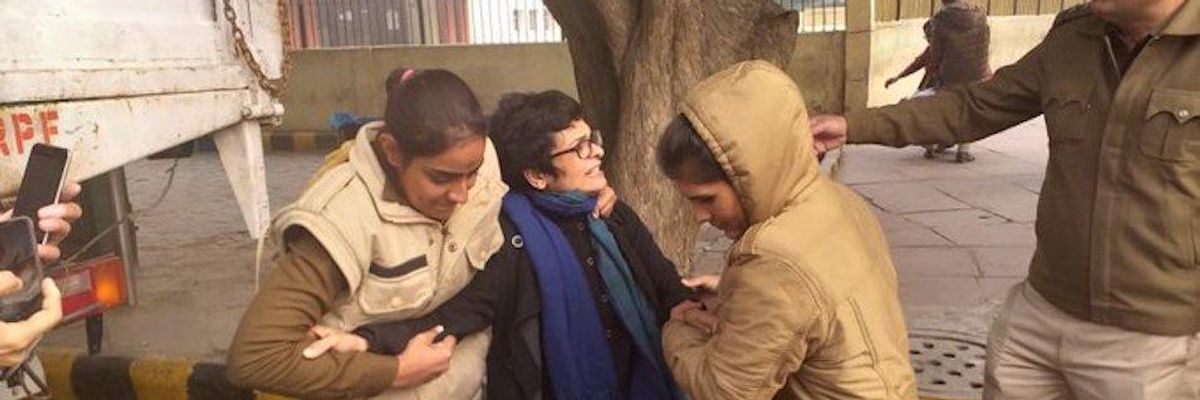
University of Delhi English professor Ira Raja was detained by police Thursday during a protest against the Indian government's citizenship law. (Photo: Archis Mohan/Twitter)
The crackdown by Indian authorities against those protesting the country's new citizenship laws escalated Thursday as government security forces shut down internet across some cities, detained at least 1,200 people, killed at least three demonstrators, and pulled prominent intellectuals off the street.
Common Dreams reported on the growing protest movement Monday, which at that point was concentrated in universities across India. Thursday's demonstrations were broader in scope and contended with security forces using Section 144, a law from colonial British rule stating that more than four people meeting in one place constitutes an unlawful assembly, to shut down dissent after the protest movement exploded around the country.
In the city of New Delhi, according to reports, 1,200 protesters were detained.
"It's a shameful thing," Indian leftist author and activist Arundhati Roy said. "This whole business of Section 144, suspending the internet, and arresting people."
"They are turning India into Kashmir," Roy added, referring to the Indian government's brutal repression of the semi-autnomous region to the north.
There have been three deaths due to security forces attacking protesters, according to the BBC:
Two people died in the city of Mangalore after officers opened fire on demonstrators allegedly trying to set fire to a police station. Commissioner Dr. PS Harsha told reporters that a curfew is in place in the city, and that he was waiting for a post mortem before announcing the cause of death for either man.
Another man also died in the city of Lucknow, where violent clashes between demonstrators and police earlier in the day saw buses set alight.
Video from around India showed demonstrators of all ages joining in the movement.
"I think the government was completely unprepared for the anger that this particular passage of the law was going to present," said Al Jazeera reporter Sohail Rahman.
Indian authorities shut down certain area's internet access, continuing a pattern that The New York Times noted Thursday is unique to the south Asian country among democracies.
"India tops the world--by far--in the number of digital lockdowns it has imposed, outpacing authoritarian governments such as Syria and Turkey," the paper reported.
Images and video on social media showed historian Ramachandra Guha and University of Delhi English professor Ira Raja--prominent intellectuals in India--being detained by security forces.
"The police are working under directions from central government," Guha told reporters in the seconds before he was dragged away by police in the southern city of Bengaluru. "We are protesting non-violently against a discriminatory act, in a disciplined way."
India's unrest is due to the government's recently-passed Citizenship Amendment Bill, which effectively bars Muslims--but not other groups--from becoming naturalized through onerous requirements aimed at the religion. The country's 200 million-strong Muslim minority fears that the bill is another part of an ongoing effort by Prime Minister Narendra Modi's ruling Bharatiya Janata Party (BJP) to marginalize their community.
As the Times reported, the bill is likely only the beginning:
Amit Shah, the home minister and Mr. Modi's right-hand man, has vowed to expand a contentious citizenship review process that has already left nearly two million people, from one state in northeastern India, potentially without a country.
Mr. Shah and other party officials have said the policy is not intended to discriminate against Indian Muslims. Rather, they say, it is needed to expel illegal immigrants from Bangladesh, India's poorer, predominantly Muslim neighbor.
"This government wants to turn us into second-class citizens," 70-year-old protester Fasiur Rehman told Al Jazeera.

Dear Common Dreams reader, It’s been nearly 30 years since I co-founded Common Dreams with my late wife, Lina Newhouser. We had the radical notion that journalism should serve the public good, not corporate profits. It was clear to us from the outset what it would take to build such a project. No paid advertisements. No corporate sponsors. No millionaire publisher telling us what to think or do. Many people said we wouldn't last a year, but we proved those doubters wrong. Together with a tremendous team of journalists and dedicated staff, we built an independent media outlet free from the constraints of profits and corporate control. Our mission has always been simple: To inform. To inspire. To ignite change for the common good. Building Common Dreams was not easy. Our survival was never guaranteed. When you take on the most powerful forces—Wall Street greed, fossil fuel industry destruction, Big Tech lobbyists, and uber-rich oligarchs who have spent billions upon billions rigging the economy and democracy in their favor—the only bulwark you have is supporters who believe in your work. But here’s the urgent message from me today. It's never been this bad out there. And it's never been this hard to keep us going. At the very moment Common Dreams is most needed, the threats we face are intensifying. We need your support now more than ever. We don't accept corporate advertising and never will. We don't have a paywall because we don't think people should be blocked from critical news based on their ability to pay. Everything we do is funded by the donations of readers like you. When everyone does the little they can afford, we are strong. But if that support retreats or dries up, so do we. Will you donate now to make sure Common Dreams not only survives but thrives? —Craig Brown, Co-founder |
The crackdown by Indian authorities against those protesting the country's new citizenship laws escalated Thursday as government security forces shut down internet across some cities, detained at least 1,200 people, killed at least three demonstrators, and pulled prominent intellectuals off the street.
Common Dreams reported on the growing protest movement Monday, which at that point was concentrated in universities across India. Thursday's demonstrations were broader in scope and contended with security forces using Section 144, a law from colonial British rule stating that more than four people meeting in one place constitutes an unlawful assembly, to shut down dissent after the protest movement exploded around the country.
In the city of New Delhi, according to reports, 1,200 protesters were detained.
"It's a shameful thing," Indian leftist author and activist Arundhati Roy said. "This whole business of Section 144, suspending the internet, and arresting people."
"They are turning India into Kashmir," Roy added, referring to the Indian government's brutal repression of the semi-autnomous region to the north.
There have been three deaths due to security forces attacking protesters, according to the BBC:
Two people died in the city of Mangalore after officers opened fire on demonstrators allegedly trying to set fire to a police station. Commissioner Dr. PS Harsha told reporters that a curfew is in place in the city, and that he was waiting for a post mortem before announcing the cause of death for either man.
Another man also died in the city of Lucknow, where violent clashes between demonstrators and police earlier in the day saw buses set alight.
Video from around India showed demonstrators of all ages joining in the movement.
"I think the government was completely unprepared for the anger that this particular passage of the law was going to present," said Al Jazeera reporter Sohail Rahman.
Indian authorities shut down certain area's internet access, continuing a pattern that The New York Times noted Thursday is unique to the south Asian country among democracies.
"India tops the world--by far--in the number of digital lockdowns it has imposed, outpacing authoritarian governments such as Syria and Turkey," the paper reported.
Images and video on social media showed historian Ramachandra Guha and University of Delhi English professor Ira Raja--prominent intellectuals in India--being detained by security forces.
"The police are working under directions from central government," Guha told reporters in the seconds before he was dragged away by police in the southern city of Bengaluru. "We are protesting non-violently against a discriminatory act, in a disciplined way."
India's unrest is due to the government's recently-passed Citizenship Amendment Bill, which effectively bars Muslims--but not other groups--from becoming naturalized through onerous requirements aimed at the religion. The country's 200 million-strong Muslim minority fears that the bill is another part of an ongoing effort by Prime Minister Narendra Modi's ruling Bharatiya Janata Party (BJP) to marginalize their community.
As the Times reported, the bill is likely only the beginning:
Amit Shah, the home minister and Mr. Modi's right-hand man, has vowed to expand a contentious citizenship review process that has already left nearly two million people, from one state in northeastern India, potentially without a country.
Mr. Shah and other party officials have said the policy is not intended to discriminate against Indian Muslims. Rather, they say, it is needed to expel illegal immigrants from Bangladesh, India's poorer, predominantly Muslim neighbor.
"This government wants to turn us into second-class citizens," 70-year-old protester Fasiur Rehman told Al Jazeera.

The crackdown by Indian authorities against those protesting the country's new citizenship laws escalated Thursday as government security forces shut down internet across some cities, detained at least 1,200 people, killed at least three demonstrators, and pulled prominent intellectuals off the street.
Common Dreams reported on the growing protest movement Monday, which at that point was concentrated in universities across India. Thursday's demonstrations were broader in scope and contended with security forces using Section 144, a law from colonial British rule stating that more than four people meeting in one place constitutes an unlawful assembly, to shut down dissent after the protest movement exploded around the country.
In the city of New Delhi, according to reports, 1,200 protesters were detained.
"It's a shameful thing," Indian leftist author and activist Arundhati Roy said. "This whole business of Section 144, suspending the internet, and arresting people."
"They are turning India into Kashmir," Roy added, referring to the Indian government's brutal repression of the semi-autnomous region to the north.
There have been three deaths due to security forces attacking protesters, according to the BBC:
Two people died in the city of Mangalore after officers opened fire on demonstrators allegedly trying to set fire to a police station. Commissioner Dr. PS Harsha told reporters that a curfew is in place in the city, and that he was waiting for a post mortem before announcing the cause of death for either man.
Another man also died in the city of Lucknow, where violent clashes between demonstrators and police earlier in the day saw buses set alight.
Video from around India showed demonstrators of all ages joining in the movement.
"I think the government was completely unprepared for the anger that this particular passage of the law was going to present," said Al Jazeera reporter Sohail Rahman.
Indian authorities shut down certain area's internet access, continuing a pattern that The New York Times noted Thursday is unique to the south Asian country among democracies.
"India tops the world--by far--in the number of digital lockdowns it has imposed, outpacing authoritarian governments such as Syria and Turkey," the paper reported.
Images and video on social media showed historian Ramachandra Guha and University of Delhi English professor Ira Raja--prominent intellectuals in India--being detained by security forces.
"The police are working under directions from central government," Guha told reporters in the seconds before he was dragged away by police in the southern city of Bengaluru. "We are protesting non-violently against a discriminatory act, in a disciplined way."
India's unrest is due to the government's recently-passed Citizenship Amendment Bill, which effectively bars Muslims--but not other groups--from becoming naturalized through onerous requirements aimed at the religion. The country's 200 million-strong Muslim minority fears that the bill is another part of an ongoing effort by Prime Minister Narendra Modi's ruling Bharatiya Janata Party (BJP) to marginalize their community.
As the Times reported, the bill is likely only the beginning:
Amit Shah, the home minister and Mr. Modi's right-hand man, has vowed to expand a contentious citizenship review process that has already left nearly two million people, from one state in northeastern India, potentially without a country.
Mr. Shah and other party officials have said the policy is not intended to discriminate against Indian Muslims. Rather, they say, it is needed to expel illegal immigrants from Bangladesh, India's poorer, predominantly Muslim neighbor.
"This government wants to turn us into second-class citizens," 70-year-old protester Fasiur Rehman told Al Jazeera.