SUBSCRIBE TO OUR FREE NEWSLETTER
Daily news & progressive opinion—funded by the people, not the corporations—delivered straight to your inbox.
5
#000000
#FFFFFF
To donate by check, phone, or other method, see our More Ways to Give page.
Daily news & progressive opinion—funded by the people, not the corporations—delivered straight to your inbox.
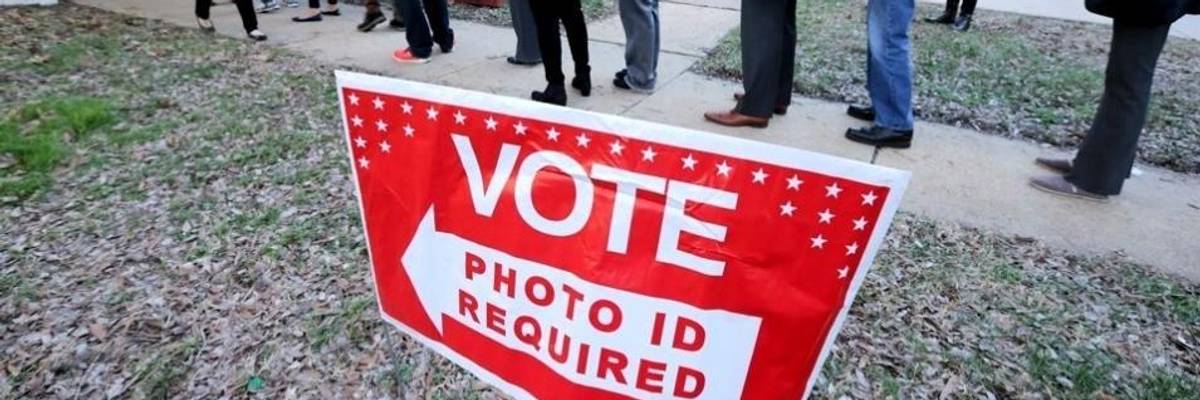
A federal judge in North Carolina on Tuesday struck down the state's voter ID law, which was pushed through the legislature by Republican lawmakers last year. (Photo: Getty)
Civil rights advocates on Tuesday praised a federal judge in North Carolina who struck down the state's new voter ID law, saying in her ruling that there was likely "discriminatory intent" behind state Republicans' attempt to force voters to present specific forms of identification at the polls.
U.S. District Judge Loretta Biggs wrote in her ruling that the law, S.B. 824, was the latest example of North Carolina's "sordid history of racial discrimination and voter suppression stretching back to the time of slavery, through the era of Jim Crow, and, crucially, continuing up to the present day."
GOP lawmakers overrode Democratic Gov. Roy Cooper's veto of the law in 2019, two years after a federal appeals court struck down an earlier voter ID law which it said had cut many black North Carolinians out of the democratic process "with almost surgical precision"--as voter turnout among African Americans dropped by six percent when it was in effect.
Biggs noted Tuesday that S.B. 824 had been pushed forward by many of the same legislators who had passed the earlier law.
The latest effort by Republicans to require specific forms of identification at the polls would have allowed voters to present a driver's license, passport, or military ID in order to vote, but not a public assistance ID card. Biggs described the latter stipulation as "particularly suspect," as nearly 29 percent of North Carolinians who use SNAP benefits are black.
"The evidence suggests that minority voters are not just less likely to have an acceptable form of ID, but that the legislature excluded photographic ID that could have greatly reduced that discrepancy," the judge wrote.
Political reporter Will Doran of the News & Observer noted that the federal court had announced its plans to strike down S.B. 824 last week, but it hadn't been clear that the law would be blocked for all of the 2020 election.
"We knew this was coming, but not in such a sweeping fashion," tweeted Doran.
Rev. T. Anthony Spearman, president of the North Carolina conference of the NAACP, called the strong language Biggs used in her ruling "so appropriate" considering the stakes of the 2020 elections.
"I hope it is something that will encourage people who have not exercised their right to vote to cast their votes," Spearman told the Washington Post.
Biggs also ordered state officials to publicize the news that voter IDs would not be needed to vote in the March 3 presidential primary and other state elections for the time being.
Dear Common Dreams reader, It’s been nearly 30 years since I co-founded Common Dreams with my late wife, Lina Newhouser. We had the radical notion that journalism should serve the public good, not corporate profits. It was clear to us from the outset what it would take to build such a project. No paid advertisements. No corporate sponsors. No millionaire publisher telling us what to think or do. Many people said we wouldn't last a year, but we proved those doubters wrong. Together with a tremendous team of journalists and dedicated staff, we built an independent media outlet free from the constraints of profits and corporate control. Our mission has always been simple: To inform. To inspire. To ignite change for the common good. Building Common Dreams was not easy. Our survival was never guaranteed. When you take on the most powerful forces—Wall Street greed, fossil fuel industry destruction, Big Tech lobbyists, and uber-rich oligarchs who have spent billions upon billions rigging the economy and democracy in their favor—the only bulwark you have is supporters who believe in your work. But here’s the urgent message from me today. It's never been this bad out there. And it's never been this hard to keep us going. At the very moment Common Dreams is most needed, the threats we face are intensifying. We need your support now more than ever. We don't accept corporate advertising and never will. We don't have a paywall because we don't think people should be blocked from critical news based on their ability to pay. Everything we do is funded by the donations of readers like you. When everyone does the little they can afford, we are strong. But if that support retreats or dries up, so do we. Will you donate now to make sure Common Dreams not only survives but thrives? —Craig Brown, Co-founder |
Civil rights advocates on Tuesday praised a federal judge in North Carolina who struck down the state's new voter ID law, saying in her ruling that there was likely "discriminatory intent" behind state Republicans' attempt to force voters to present specific forms of identification at the polls.
U.S. District Judge Loretta Biggs wrote in her ruling that the law, S.B. 824, was the latest example of North Carolina's "sordid history of racial discrimination and voter suppression stretching back to the time of slavery, through the era of Jim Crow, and, crucially, continuing up to the present day."
GOP lawmakers overrode Democratic Gov. Roy Cooper's veto of the law in 2019, two years after a federal appeals court struck down an earlier voter ID law which it said had cut many black North Carolinians out of the democratic process "with almost surgical precision"--as voter turnout among African Americans dropped by six percent when it was in effect.
Biggs noted Tuesday that S.B. 824 had been pushed forward by many of the same legislators who had passed the earlier law.
The latest effort by Republicans to require specific forms of identification at the polls would have allowed voters to present a driver's license, passport, or military ID in order to vote, but not a public assistance ID card. Biggs described the latter stipulation as "particularly suspect," as nearly 29 percent of North Carolinians who use SNAP benefits are black.
"The evidence suggests that minority voters are not just less likely to have an acceptable form of ID, but that the legislature excluded photographic ID that could have greatly reduced that discrepancy," the judge wrote.
Political reporter Will Doran of the News & Observer noted that the federal court had announced its plans to strike down S.B. 824 last week, but it hadn't been clear that the law would be blocked for all of the 2020 election.
"We knew this was coming, but not in such a sweeping fashion," tweeted Doran.
Rev. T. Anthony Spearman, president of the North Carolina conference of the NAACP, called the strong language Biggs used in her ruling "so appropriate" considering the stakes of the 2020 elections.
"I hope it is something that will encourage people who have not exercised their right to vote to cast their votes," Spearman told the Washington Post.
Biggs also ordered state officials to publicize the news that voter IDs would not be needed to vote in the March 3 presidential primary and other state elections for the time being.
Civil rights advocates on Tuesday praised a federal judge in North Carolina who struck down the state's new voter ID law, saying in her ruling that there was likely "discriminatory intent" behind state Republicans' attempt to force voters to present specific forms of identification at the polls.
U.S. District Judge Loretta Biggs wrote in her ruling that the law, S.B. 824, was the latest example of North Carolina's "sordid history of racial discrimination and voter suppression stretching back to the time of slavery, through the era of Jim Crow, and, crucially, continuing up to the present day."
GOP lawmakers overrode Democratic Gov. Roy Cooper's veto of the law in 2019, two years after a federal appeals court struck down an earlier voter ID law which it said had cut many black North Carolinians out of the democratic process "with almost surgical precision"--as voter turnout among African Americans dropped by six percent when it was in effect.
Biggs noted Tuesday that S.B. 824 had been pushed forward by many of the same legislators who had passed the earlier law.
The latest effort by Republicans to require specific forms of identification at the polls would have allowed voters to present a driver's license, passport, or military ID in order to vote, but not a public assistance ID card. Biggs described the latter stipulation as "particularly suspect," as nearly 29 percent of North Carolinians who use SNAP benefits are black.
"The evidence suggests that minority voters are not just less likely to have an acceptable form of ID, but that the legislature excluded photographic ID that could have greatly reduced that discrepancy," the judge wrote.
Political reporter Will Doran of the News & Observer noted that the federal court had announced its plans to strike down S.B. 824 last week, but it hadn't been clear that the law would be blocked for all of the 2020 election.
"We knew this was coming, but not in such a sweeping fashion," tweeted Doran.
Rev. T. Anthony Spearman, president of the North Carolina conference of the NAACP, called the strong language Biggs used in her ruling "so appropriate" considering the stakes of the 2020 elections.
"I hope it is something that will encourage people who have not exercised their right to vote to cast their votes," Spearman told the Washington Post.
Biggs also ordered state officials to publicize the news that voter IDs would not be needed to vote in the March 3 presidential primary and other state elections for the time being.