

SUBSCRIBE TO OUR FREE NEWSLETTER
Daily news & progressive opinion—funded by the people, not the corporations—delivered straight to your inbox.
5
#000000
#FFFFFF
To donate by check, phone, or other method, see our More Ways to Give page.
Daily news & progressive opinion—funded by the people, not the corporations—delivered straight to your inbox.
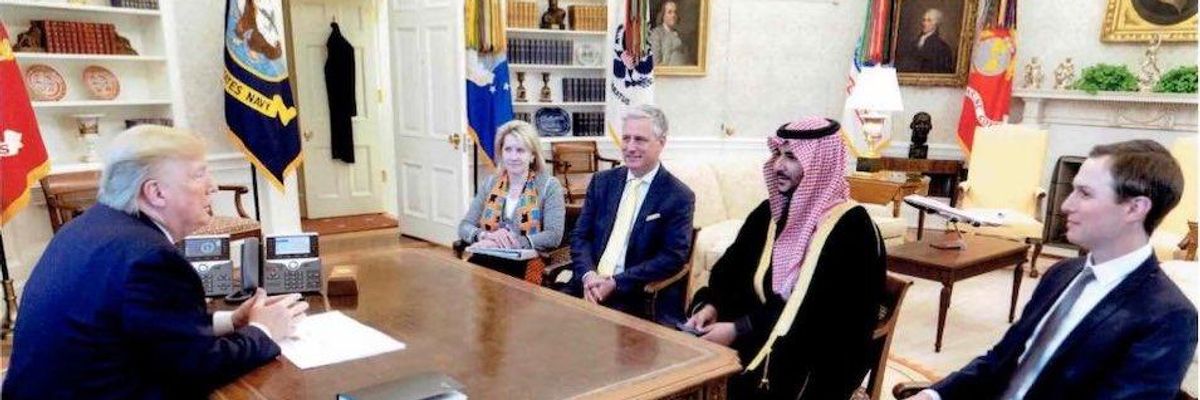
U.S. President Donald Trump and Saudi Arabia's Vice Minister of Defense Khalid bin Salman meet Monday in the Oval Office. (Photo: Khalid bin Salman/Twitter)
President Donald Trump came under fire Tuesday from journalists after a meeting at the White House with Saudi Arabia's Vice Minister of Defense Khalid bin Salman on Monday was not disclosed and only discovered after the minister posted pictures from the Oval Office online.
"A meeting with a foreign leader in the Oval Office should, at the very least, be on the public schedule with a read-out of the meeting released after it is over," Jonathan Karl, president of the White House Correspondents Association, said in a statement. "This has been the long-standing precedent for presidents of both political parties."
"It is disturbing to see the government of Saudi Arabia have more transparency than the White House about a meeting with the President in the Oval Office," Karl added.
The details of what was discussed at the meeting remain unclear, though a photo shared on social media by the Saudi minister shows Trump advisor and son-in-law Jared Kushner in attendance.
Trump took to Twitter shortly after the photos were released to say the two discussed "trade, military, oil prices,security, and stability in the Middle East."
The looming U.S. war with Iran, which became more likely last week after Trump's ordered assassination of Iranian military commander Qasem Soleimani, was likely on the minister's mind; Iran and Saudi Arabia have been in a low-level conflict for decades, including a long-running proxy war in Yemen.
This country and this world are at a monumental crossroads. US voters have an opportunity to beat back the forces of fascism and confront the billionaires who are rigging the economy, our media system, and our democracy, making it increasingly impossible for ordinary people to get by. We’re not just talking about the election. We’re talking about what must be done once these fascist elements are vanquished from power. We need a bolder set of solutions than what either major party has so far been willing to offer and a working-class movement ready to fight like hell for it. Trump didn't emerge from nowhere. The conditions that fueled MAGA authoritarianism were created by decades of radical neoliberal economic policies and a corrupt political system dominated by corporate interests. They slashed taxes on the super-rich, promising that the benefits would trickle down. They said giveaways to the corporate titans would make life more affordable for the rest of us. It was all bullshit. And when a bitter, betrayed populace searches for someone to blame, right-wing demagogues have little trouble finding scapegoats. People know when they're being lied to, but you won't hear any of this from the corporate media. Only independent journalism—powered and funded by people who believe in building a better world—can deliver truly trustworthy daily news. If you share our vision, please contribute whatever you can to sustain our work. |
President Donald Trump came under fire Tuesday from journalists after a meeting at the White House with Saudi Arabia's Vice Minister of Defense Khalid bin Salman on Monday was not disclosed and only discovered after the minister posted pictures from the Oval Office online.
"A meeting with a foreign leader in the Oval Office should, at the very least, be on the public schedule with a read-out of the meeting released after it is over," Jonathan Karl, president of the White House Correspondents Association, said in a statement. "This has been the long-standing precedent for presidents of both political parties."
"It is disturbing to see the government of Saudi Arabia have more transparency than the White House about a meeting with the President in the Oval Office," Karl added.
The details of what was discussed at the meeting remain unclear, though a photo shared on social media by the Saudi minister shows Trump advisor and son-in-law Jared Kushner in attendance.
Trump took to Twitter shortly after the photos were released to say the two discussed "trade, military, oil prices,security, and stability in the Middle East."
The looming U.S. war with Iran, which became more likely last week after Trump's ordered assassination of Iranian military commander Qasem Soleimani, was likely on the minister's mind; Iran and Saudi Arabia have been in a low-level conflict for decades, including a long-running proxy war in Yemen.

