SUBSCRIBE TO OUR FREE NEWSLETTER
Daily news & progressive opinion—funded by the people, not the corporations—delivered straight to your inbox.
5
#000000
#FFFFFF
To donate by check, phone, or other method, see our More Ways to Give page.
Daily news & progressive opinion—funded by the people, not the corporations—delivered straight to your inbox.
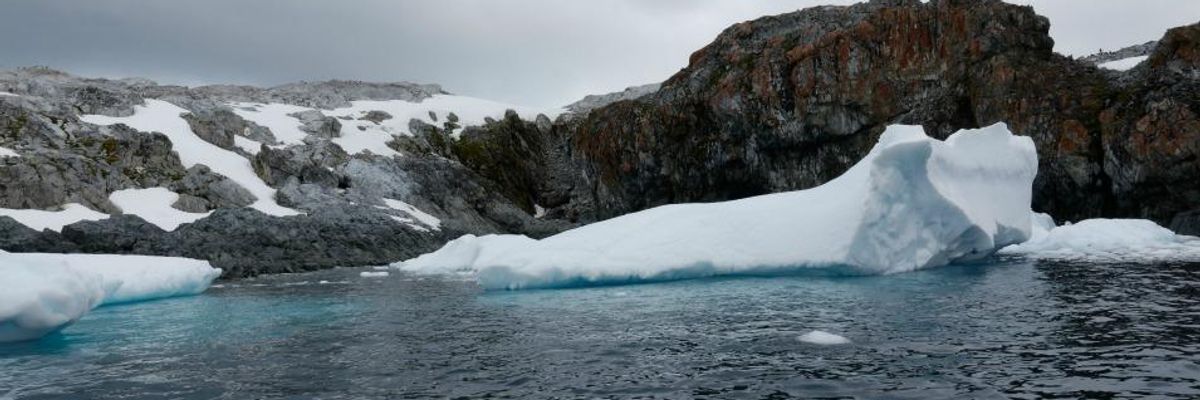
Climate scientists on Friday revealed the latest troubling new observation in Antarctica, illustrating the consequences of the rapid warming of the area brought on by the manmade climate crisis.
As The Guardian reported Friday, researchers stationed at the Esperanza research station at the northern tip of the Antarctic peninsula found that temperatures reached 64.9o Fahrenheit (18.3o Celsius)--the highest temperature logged since scientists began recording the continent's temperature in 1961.
The record-breaking temperature was logged a week after scientists at New York University and the British Antarctic Survey reported that the grounding line of the Thwaites glacier in Antarctica--where the ice meets ocean water--was 32o Fahrenheit.
The record-warm temperature was recorded in one of the fastest-warming regions of the world.
Lewis Pugh, an endurance swimmer and advocate for the world's oceans, posted an image on social media of a swim he took in East Antarctica "to demonstrate how it is changing."
"We need urgent and ambitious action to tackle this climate crisis!" Pugh tweeted.
Podcast host and climate advocate Assaad Razzouk added that when the researchers at the Esperanza station recorded the record-warm temperature, the Antarctic peninsula was warmer than the United Kingdom.
The peninsula has warmed by about 5.4o Fahrenheit over the past 50 years. The latest reading broke the previous record of 63.5o Fahrenheit (17.5o Celsius), which was recorded in March 2015.
"The reading is impressive as it's only five years since the previous record was set and this is almost one degree centigrade higher," James Fenwick, a climate scientist at Victoria University of Wellington in New Zealand, told The Guardian. "It's a sign of the warming that has been happening there that's much faster than the global average."
Even minor increases in temperatures in Antarctica alarm climate scientists, especially as researchers have observed the retreat of glaciers and even a massive cavity beneath the Thwaites glacier a year ago.
The consequences of such warm temperatures "are the collapse of the ice shelves along the peninsula," Nerilie Abram, a climate scientist at the Australian National University, told The Guardian.
The void found beneath the Thwaites glacier last year intensified concerns among climate scientists that Antarctica is melting faster than experts have previously believed.
The collapse of the glacier is "completely plausible," Ted Scambos, a scientist at the National Snow and Ice Data Center in Boulder, Colorado, who was not involved with the recent studies, told NBC News at the time.
"Thwaites has a really perfect storm going for it," he added, referencing the findings of Pietro Milillo, a scientist at NASA's Jet Propulsion Laboratory, who last year in a study pointed to "different mechanisms of retreat" leading to the glacier's melting.
While temperatures on the Antarctic peninsula have warmed and the cavity beneath Thwaites has formed, the glacier is retreating at a rate of about 650 feet per year. The melting of the glacier can be attributed to about 4% of global sea level rise, Scambos told NBC News.
Thwaits is often called the "Doomsday Glacier" by scientists, as the collapse of the ice mass could lead to a global sea level rise of two feet, flooding coastal cities all over the world.
Dear Common Dreams reader, It’s been nearly 30 years since I co-founded Common Dreams with my late wife, Lina Newhouser. We had the radical notion that journalism should serve the public good, not corporate profits. It was clear to us from the outset what it would take to build such a project. No paid advertisements. No corporate sponsors. No millionaire publisher telling us what to think or do. Many people said we wouldn't last a year, but we proved those doubters wrong. Together with a tremendous team of journalists and dedicated staff, we built an independent media outlet free from the constraints of profits and corporate control. Our mission has always been simple: To inform. To inspire. To ignite change for the common good. Building Common Dreams was not easy. Our survival was never guaranteed. When you take on the most powerful forces—Wall Street greed, fossil fuel industry destruction, Big Tech lobbyists, and uber-rich oligarchs who have spent billions upon billions rigging the economy and democracy in their favor—the only bulwark you have is supporters who believe in your work. But here’s the urgent message from me today. It's never been this bad out there. And it's never been this hard to keep us going. At the very moment Common Dreams is most needed, the threats we face are intensifying. We need your support now more than ever. We don't accept corporate advertising and never will. We don't have a paywall because we don't think people should be blocked from critical news based on their ability to pay. Everything we do is funded by the donations of readers like you. When everyone does the little they can afford, we are strong. But if that support retreats or dries up, so do we. Will you donate now to make sure Common Dreams not only survives but thrives? —Craig Brown, Co-founder |
Climate scientists on Friday revealed the latest troubling new observation in Antarctica, illustrating the consequences of the rapid warming of the area brought on by the manmade climate crisis.
As The Guardian reported Friday, researchers stationed at the Esperanza research station at the northern tip of the Antarctic peninsula found that temperatures reached 64.9o Fahrenheit (18.3o Celsius)--the highest temperature logged since scientists began recording the continent's temperature in 1961.
The record-breaking temperature was logged a week after scientists at New York University and the British Antarctic Survey reported that the grounding line of the Thwaites glacier in Antarctica--where the ice meets ocean water--was 32o Fahrenheit.
The record-warm temperature was recorded in one of the fastest-warming regions of the world.
Lewis Pugh, an endurance swimmer and advocate for the world's oceans, posted an image on social media of a swim he took in East Antarctica "to demonstrate how it is changing."
"We need urgent and ambitious action to tackle this climate crisis!" Pugh tweeted.
Podcast host and climate advocate Assaad Razzouk added that when the researchers at the Esperanza station recorded the record-warm temperature, the Antarctic peninsula was warmer than the United Kingdom.
The peninsula has warmed by about 5.4o Fahrenheit over the past 50 years. The latest reading broke the previous record of 63.5o Fahrenheit (17.5o Celsius), which was recorded in March 2015.
"The reading is impressive as it's only five years since the previous record was set and this is almost one degree centigrade higher," James Fenwick, a climate scientist at Victoria University of Wellington in New Zealand, told The Guardian. "It's a sign of the warming that has been happening there that's much faster than the global average."
Even minor increases in temperatures in Antarctica alarm climate scientists, especially as researchers have observed the retreat of glaciers and even a massive cavity beneath the Thwaites glacier a year ago.
The consequences of such warm temperatures "are the collapse of the ice shelves along the peninsula," Nerilie Abram, a climate scientist at the Australian National University, told The Guardian.
The void found beneath the Thwaites glacier last year intensified concerns among climate scientists that Antarctica is melting faster than experts have previously believed.
The collapse of the glacier is "completely plausible," Ted Scambos, a scientist at the National Snow and Ice Data Center in Boulder, Colorado, who was not involved with the recent studies, told NBC News at the time.
"Thwaites has a really perfect storm going for it," he added, referencing the findings of Pietro Milillo, a scientist at NASA's Jet Propulsion Laboratory, who last year in a study pointed to "different mechanisms of retreat" leading to the glacier's melting.
While temperatures on the Antarctic peninsula have warmed and the cavity beneath Thwaites has formed, the glacier is retreating at a rate of about 650 feet per year. The melting of the glacier can be attributed to about 4% of global sea level rise, Scambos told NBC News.
Thwaits is often called the "Doomsday Glacier" by scientists, as the collapse of the ice mass could lead to a global sea level rise of two feet, flooding coastal cities all over the world.
Climate scientists on Friday revealed the latest troubling new observation in Antarctica, illustrating the consequences of the rapid warming of the area brought on by the manmade climate crisis.
As The Guardian reported Friday, researchers stationed at the Esperanza research station at the northern tip of the Antarctic peninsula found that temperatures reached 64.9o Fahrenheit (18.3o Celsius)--the highest temperature logged since scientists began recording the continent's temperature in 1961.
The record-breaking temperature was logged a week after scientists at New York University and the British Antarctic Survey reported that the grounding line of the Thwaites glacier in Antarctica--where the ice meets ocean water--was 32o Fahrenheit.
The record-warm temperature was recorded in one of the fastest-warming regions of the world.
Lewis Pugh, an endurance swimmer and advocate for the world's oceans, posted an image on social media of a swim he took in East Antarctica "to demonstrate how it is changing."
"We need urgent and ambitious action to tackle this climate crisis!" Pugh tweeted.
Podcast host and climate advocate Assaad Razzouk added that when the researchers at the Esperanza station recorded the record-warm temperature, the Antarctic peninsula was warmer than the United Kingdom.
The peninsula has warmed by about 5.4o Fahrenheit over the past 50 years. The latest reading broke the previous record of 63.5o Fahrenheit (17.5o Celsius), which was recorded in March 2015.
"The reading is impressive as it's only five years since the previous record was set and this is almost one degree centigrade higher," James Fenwick, a climate scientist at Victoria University of Wellington in New Zealand, told The Guardian. "It's a sign of the warming that has been happening there that's much faster than the global average."
Even minor increases in temperatures in Antarctica alarm climate scientists, especially as researchers have observed the retreat of glaciers and even a massive cavity beneath the Thwaites glacier a year ago.
The consequences of such warm temperatures "are the collapse of the ice shelves along the peninsula," Nerilie Abram, a climate scientist at the Australian National University, told The Guardian.
The void found beneath the Thwaites glacier last year intensified concerns among climate scientists that Antarctica is melting faster than experts have previously believed.
The collapse of the glacier is "completely plausible," Ted Scambos, a scientist at the National Snow and Ice Data Center in Boulder, Colorado, who was not involved with the recent studies, told NBC News at the time.
"Thwaites has a really perfect storm going for it," he added, referencing the findings of Pietro Milillo, a scientist at NASA's Jet Propulsion Laboratory, who last year in a study pointed to "different mechanisms of retreat" leading to the glacier's melting.
While temperatures on the Antarctic peninsula have warmed and the cavity beneath Thwaites has formed, the glacier is retreating at a rate of about 650 feet per year. The melting of the glacier can be attributed to about 4% of global sea level rise, Scambos told NBC News.
Thwaits is often called the "Doomsday Glacier" by scientists, as the collapse of the ice mass could lead to a global sea level rise of two feet, flooding coastal cities all over the world.