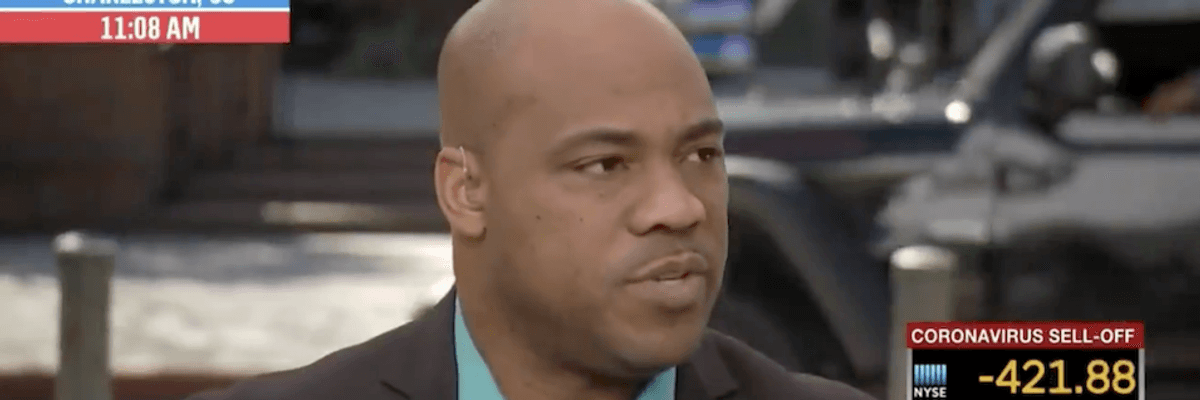
Democratic operative Anton Gunn is under fire for comments made on MSNBC wherein he suggested the party elite should have more of a voice in the presidential primary nominating process than the public. (Image: screenshot/MSNBC)
"The Public Doesn't Really Decide": MSNBC Guest Under Fire for Saying Voters Won't Choose Dem Nominee
Anton Gunn, a longtime South Carolina political operative, is on the board of anti-Bernie Sanders group the Democratic Majority for Israel.
Hours after a New York Times report Thursday quoted Democratic Party elites plotting to deny Sen. Bernie Sanders the party's 2020 presidential nomination if he enters this summer's convention in Milwaukee with only a plurality of delegates, a party operative from South Carolina on MSNBC downplayed the role of the public in selecting the nominee, drawing outrage from Sanders supporters.
Anton J. Gunn, a one-time advisor to former President Barack Obama and a a former South Carolina state representative, made the comments to MSNBC's Craig Melvin Thursday morning.
"The party decides its nominee," said Gunn. "The public doesn't really decide the nominee."
Gunn added that super-delegates, party elites with an outsized influence in the process of selecting a nominee after the first round of voting at the convention, were "very influential in the party."
"So apparently the new line is 'the public doesn't really decide the nominee,'" Sanders speechwriter David Sirota tweeted in response.
Sanders supporter Shaun King piled on, saying that the comments were "utter foolishness."
"I can hardly believe he formed his lips to say this out loud," said King.
Gunn said in 2015 that Sanders "just [sounds] angry" and suggested that the senator would have difficulty in the Palmetto State because Vermont was the farthest place possible from South Carolina voters.
He is also a board member of the group the Democratic Majority for Israel, an AIPAC-affiliated organization that aired multiple attack ads aimed at Sanders in Iowa and Nevada, though he does not disclose that relationship during appearances on MSNBC, as Electronic Intifada's Michael F. Brown pointed out on February 24.
"Gunn ought to explain his connection to the organization and should consider either stepping away from DMFI during the presidential campaign or insist that his affiliation with the group be prominently noted during his television speaking engagements," wrote Brown.
In June 2019, Gunn told journalist Michael Tracey that Sanders "should've never been allowed in the Democratic primary."
"He's never been a Democrat, till it became politically expedient for him to say, I'm a Democrat," said Gunn. "He chose to be an interloper."
Though he is the longest serving independent in Congress, Sanders has always caucused with the Democrats, serves as a member of the Senate Democratic leadership, and is running for president as a Democrat.
As Common Dreams reported, the Times article on super-delegate plots to overrule the party's voters in a brokered convention sparked anger and dismay from Sanders supporters Thursday morning.
"If that's what our party leaders are going to do, you'll see rebellion not just in the presidential race, but in down-ballot races as well," warned Nebraska Democratic Party chairwoman Jane Kleeb.
Predictions that such a move could prove disastrous continued across social media throughout the afternoon.
"If Bernie made it to the convention with a plurality of the delegates but not a majority and was denied the nomination, it would rip the party apart, plain and simple," said New York Times columnist Charles Blow.
FINAL DAY! This is urgent.
Dear Common Dreams reader, It’s been nearly 30 years since I co-founded Common Dreams with my late wife, Lina Newhouser. We had the radical notion that journalism should serve the public good, not corporate profits. It was clear to us from the outset what it would take to build such a project. No paid advertisements. No corporate sponsors. No millionaire publisher telling us what to think or do. Many people said we wouldn't last a year, but we proved those doubters wrong. Together with a tremendous team of journalists and dedicated staff, we built an independent media outlet free from the constraints of profits and corporate control. Our mission from the outset was simple. To inform. To inspire. To ignite change for the common good. Building Common Dreams was not easy. Our survival was never guaranteed. When you take on the most powerful forces—Wall Street greed, fossil fuel industry destruction, Big Tech lobbyists, and uber-rich oligarchs who have spent billions upon billions rigging the economy and democracy in their favor—the only bulwark you have is supporters who believe in your work. But here’s the urgent message from me today. It’s never been this bad out there. And it’s never been this hard to keep us going. At the very moment Common Dreams is most needed and doing some of its best and most important work, the threats we face are intensifying. Right now, with just hours left in our Spring Campaign, we're still falling short of our make-or-break goal. When everyone does the little they can afford, we are strong. But if that support retreats or dries up, so do we. Can you make a gift right now to make sure Common Dreams not only survives but thrives? There is no backup plan or rainy day fund. There is only you. —Craig Brown, Co-founder |
Hours after a New York Times report Thursday quoted Democratic Party elites plotting to deny Sen. Bernie Sanders the party's 2020 presidential nomination if he enters this summer's convention in Milwaukee with only a plurality of delegates, a party operative from South Carolina on MSNBC downplayed the role of the public in selecting the nominee, drawing outrage from Sanders supporters.
Anton J. Gunn, a one-time advisor to former President Barack Obama and a a former South Carolina state representative, made the comments to MSNBC's Craig Melvin Thursday morning.
"The party decides its nominee," said Gunn. "The public doesn't really decide the nominee."
Gunn added that super-delegates, party elites with an outsized influence in the process of selecting a nominee after the first round of voting at the convention, were "very influential in the party."
"So apparently the new line is 'the public doesn't really decide the nominee,'" Sanders speechwriter David Sirota tweeted in response.
Sanders supporter Shaun King piled on, saying that the comments were "utter foolishness."
"I can hardly believe he formed his lips to say this out loud," said King.
Gunn said in 2015 that Sanders "just [sounds] angry" and suggested that the senator would have difficulty in the Palmetto State because Vermont was the farthest place possible from South Carolina voters.
He is also a board member of the group the Democratic Majority for Israel, an AIPAC-affiliated organization that aired multiple attack ads aimed at Sanders in Iowa and Nevada, though he does not disclose that relationship during appearances on MSNBC, as Electronic Intifada's Michael F. Brown pointed out on February 24.
"Gunn ought to explain his connection to the organization and should consider either stepping away from DMFI during the presidential campaign or insist that his affiliation with the group be prominently noted during his television speaking engagements," wrote Brown.
In June 2019, Gunn told journalist Michael Tracey that Sanders "should've never been allowed in the Democratic primary."
"He's never been a Democrat, till it became politically expedient for him to say, I'm a Democrat," said Gunn. "He chose to be an interloper."
Though he is the longest serving independent in Congress, Sanders has always caucused with the Democrats, serves as a member of the Senate Democratic leadership, and is running for president as a Democrat.
As Common Dreams reported, the Times article on super-delegate plots to overrule the party's voters in a brokered convention sparked anger and dismay from Sanders supporters Thursday morning.
"If that's what our party leaders are going to do, you'll see rebellion not just in the presidential race, but in down-ballot races as well," warned Nebraska Democratic Party chairwoman Jane Kleeb.
Predictions that such a move could prove disastrous continued across social media throughout the afternoon.
"If Bernie made it to the convention with a plurality of the delegates but not a majority and was denied the nomination, it would rip the party apart, plain and simple," said New York Times columnist Charles Blow.
Hours after a New York Times report Thursday quoted Democratic Party elites plotting to deny Sen. Bernie Sanders the party's 2020 presidential nomination if he enters this summer's convention in Milwaukee with only a plurality of delegates, a party operative from South Carolina on MSNBC downplayed the role of the public in selecting the nominee, drawing outrage from Sanders supporters.
Anton J. Gunn, a one-time advisor to former President Barack Obama and a a former South Carolina state representative, made the comments to MSNBC's Craig Melvin Thursday morning.
"The party decides its nominee," said Gunn. "The public doesn't really decide the nominee."
Gunn added that super-delegates, party elites with an outsized influence in the process of selecting a nominee after the first round of voting at the convention, were "very influential in the party."
"So apparently the new line is 'the public doesn't really decide the nominee,'" Sanders speechwriter David Sirota tweeted in response.
Sanders supporter Shaun King piled on, saying that the comments were "utter foolishness."
"I can hardly believe he formed his lips to say this out loud," said King.
Gunn said in 2015 that Sanders "just [sounds] angry" and suggested that the senator would have difficulty in the Palmetto State because Vermont was the farthest place possible from South Carolina voters.
He is also a board member of the group the Democratic Majority for Israel, an AIPAC-affiliated organization that aired multiple attack ads aimed at Sanders in Iowa and Nevada, though he does not disclose that relationship during appearances on MSNBC, as Electronic Intifada's Michael F. Brown pointed out on February 24.
"Gunn ought to explain his connection to the organization and should consider either stepping away from DMFI during the presidential campaign or insist that his affiliation with the group be prominently noted during his television speaking engagements," wrote Brown.
In June 2019, Gunn told journalist Michael Tracey that Sanders "should've never been allowed in the Democratic primary."
"He's never been a Democrat, till it became politically expedient for him to say, I'm a Democrat," said Gunn. "He chose to be an interloper."
Though he is the longest serving independent in Congress, Sanders has always caucused with the Democrats, serves as a member of the Senate Democratic leadership, and is running for president as a Democrat.
As Common Dreams reported, the Times article on super-delegate plots to overrule the party's voters in a brokered convention sparked anger and dismay from Sanders supporters Thursday morning.
"If that's what our party leaders are going to do, you'll see rebellion not just in the presidential race, but in down-ballot races as well," warned Nebraska Democratic Party chairwoman Jane Kleeb.
Predictions that such a move could prove disastrous continued across social media throughout the afternoon.
"If Bernie made it to the convention with a plurality of the delegates but not a majority and was denied the nomination, it would rip the party apart, plain and simple," said New York Times columnist Charles Blow.