SUBSCRIBE TO OUR FREE NEWSLETTER
Daily news & progressive opinion—funded by the people, not the corporations—delivered straight to your inbox.
5
#000000
#FFFFFF
To donate by check, phone, or other method, see our More Ways to Give page.
Daily news & progressive opinion—funded by the people, not the corporations—delivered straight to your inbox.
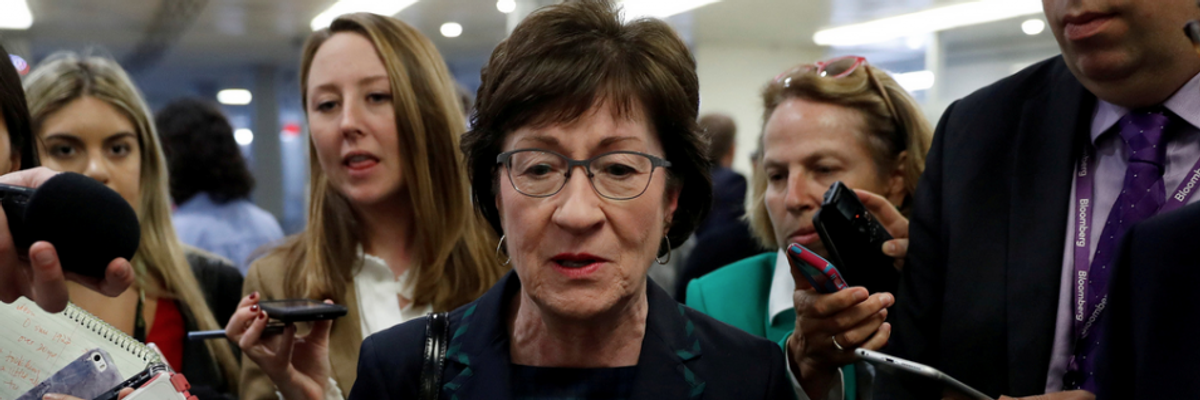
Sen. Susan Collins (R-Maine) in 2009 opposed funding for future pandemic preparedness as part of an economic stimulus package during the Great Recession. (Photo: Aaron Bernstein/Bangor Daily News)
Political observers on social media pointed to an overlooked vote by Sen. Susan Collins from over a decade ago as one example of Republicans' disregard for public health, which has helped the coronavirus outbreak rapidly spin out of control in the U.S. as the government lags behind other industrialized countries in tracking and controlling the spread of the disease.
Roll Call correspondent Niels Lesniewski highlighted an April 2009 article from the publication in which Collins was forced to defend her refusal to include pandemic flu funding in an economic stimulus package two months earlier, several months into the Great Recession.
Michael Grunwald of Politico also remembered reporting on the vote:
Democrats warned at the time that the loss of $870 million in pandemic funds from the $787 billion package would result in an inability to effectively fight an infectious disease outbreak--but Collins insisted the funds should not be included in an appropriations bill because they "do not boost our economy."
"Senator Collins went out of her way to stop funds from going to pandemic preparedness, and now Mainers are concerned because of Collins' history of opposing funding for situations exactly like this," said Willy Ritch, executive director of Maine-based grassroots advocacy group 16 Counties Coalition. "We need to tell Senator Collins to stop playing games with our health and vote to protect Maine families."
Others, including Democrat Betsy Sweet, who is running for Collins's Senate seat, echoed the criticism:
The April 2009 article was published as an outbreak of H1N1 began. The outbreak would kill more than 12,000 people in the U.S. before it was declared over the following year.
During the debate over the stimulus bill, Collins was one of three Republican senators planning to vote for the package. As Steven T. Dennis wrote at Roll Call, "Collins wielded enormous influence...and the trio demanded substantial cuts from bills that passed the House and Senate as the price of their support. The flu funding, originally sought by House Appropriations Chairman David Obey (D-Wis.), was a high-profile casualty, one that Collins herself cited on the Senate floor."
As the H1N1 outbreak began, Obey denounced his colleague's move.
"Whether or not this influenza strain turns out to have pandemic potential, sooner or later some strain will," Obey told the Washington Times at the time. "We are not prepared today. Let's hope we don't need to be."
On Twitter, Collins's staffer, Annie Clark, pushed back on the discussion about the senator's key role in eliminating the pandemic funding, saying Collins said in 2009 that she simply objected to including the funds in the stimulus package and that funding was passed later that year.
Dan Aibel of the blog Collins Watch called Clark's claim "disingenuous."
"Collins didn't just 'say' the funding should be removed from the stimulus; she made removal of pandemic flu preparedness funding A CONDITION OF HER VOTE," Aibel wrote. "And was quite open about it. This was widely reported at the time."
Dear Common Dreams reader, It’s been nearly 30 years since I co-founded Common Dreams with my late wife, Lina Newhouser. We had the radical notion that journalism should serve the public good, not corporate profits. It was clear to us from the outset what it would take to build such a project. No paid advertisements. No corporate sponsors. No millionaire publisher telling us what to think or do. Many people said we wouldn't last a year, but we proved those doubters wrong. Together with a tremendous team of journalists and dedicated staff, we built an independent media outlet free from the constraints of profits and corporate control. Our mission has always been simple: To inform. To inspire. To ignite change for the common good. Building Common Dreams was not easy. Our survival was never guaranteed. When you take on the most powerful forces—Wall Street greed, fossil fuel industry destruction, Big Tech lobbyists, and uber-rich oligarchs who have spent billions upon billions rigging the economy and democracy in their favor—the only bulwark you have is supporters who believe in your work. But here’s the urgent message from me today. It's never been this bad out there. And it's never been this hard to keep us going. At the very moment Common Dreams is most needed, the threats we face are intensifying. We need your support now more than ever. We don't accept corporate advertising and never will. We don't have a paywall because we don't think people should be blocked from critical news based on their ability to pay. Everything we do is funded by the donations of readers like you. When everyone does the little they can afford, we are strong. But if that support retreats or dries up, so do we. Will you donate now to make sure Common Dreams not only survives but thrives? —Craig Brown, Co-founder |
Political observers on social media pointed to an overlooked vote by Sen. Susan Collins from over a decade ago as one example of Republicans' disregard for public health, which has helped the coronavirus outbreak rapidly spin out of control in the U.S. as the government lags behind other industrialized countries in tracking and controlling the spread of the disease.
Roll Call correspondent Niels Lesniewski highlighted an April 2009 article from the publication in which Collins was forced to defend her refusal to include pandemic flu funding in an economic stimulus package two months earlier, several months into the Great Recession.
Michael Grunwald of Politico also remembered reporting on the vote:
Democrats warned at the time that the loss of $870 million in pandemic funds from the $787 billion package would result in an inability to effectively fight an infectious disease outbreak--but Collins insisted the funds should not be included in an appropriations bill because they "do not boost our economy."
"Senator Collins went out of her way to stop funds from going to pandemic preparedness, and now Mainers are concerned because of Collins' history of opposing funding for situations exactly like this," said Willy Ritch, executive director of Maine-based grassroots advocacy group 16 Counties Coalition. "We need to tell Senator Collins to stop playing games with our health and vote to protect Maine families."
Others, including Democrat Betsy Sweet, who is running for Collins's Senate seat, echoed the criticism:
The April 2009 article was published as an outbreak of H1N1 began. The outbreak would kill more than 12,000 people in the U.S. before it was declared over the following year.
During the debate over the stimulus bill, Collins was one of three Republican senators planning to vote for the package. As Steven T. Dennis wrote at Roll Call, "Collins wielded enormous influence...and the trio demanded substantial cuts from bills that passed the House and Senate as the price of their support. The flu funding, originally sought by House Appropriations Chairman David Obey (D-Wis.), was a high-profile casualty, one that Collins herself cited on the Senate floor."
As the H1N1 outbreak began, Obey denounced his colleague's move.
"Whether or not this influenza strain turns out to have pandemic potential, sooner or later some strain will," Obey told the Washington Times at the time. "We are not prepared today. Let's hope we don't need to be."
On Twitter, Collins's staffer, Annie Clark, pushed back on the discussion about the senator's key role in eliminating the pandemic funding, saying Collins said in 2009 that she simply objected to including the funds in the stimulus package and that funding was passed later that year.
Dan Aibel of the blog Collins Watch called Clark's claim "disingenuous."
"Collins didn't just 'say' the funding should be removed from the stimulus; she made removal of pandemic flu preparedness funding A CONDITION OF HER VOTE," Aibel wrote. "And was quite open about it. This was widely reported at the time."
Political observers on social media pointed to an overlooked vote by Sen. Susan Collins from over a decade ago as one example of Republicans' disregard for public health, which has helped the coronavirus outbreak rapidly spin out of control in the U.S. as the government lags behind other industrialized countries in tracking and controlling the spread of the disease.
Roll Call correspondent Niels Lesniewski highlighted an April 2009 article from the publication in which Collins was forced to defend her refusal to include pandemic flu funding in an economic stimulus package two months earlier, several months into the Great Recession.
Michael Grunwald of Politico also remembered reporting on the vote:
Democrats warned at the time that the loss of $870 million in pandemic funds from the $787 billion package would result in an inability to effectively fight an infectious disease outbreak--but Collins insisted the funds should not be included in an appropriations bill because they "do not boost our economy."
"Senator Collins went out of her way to stop funds from going to pandemic preparedness, and now Mainers are concerned because of Collins' history of opposing funding for situations exactly like this," said Willy Ritch, executive director of Maine-based grassroots advocacy group 16 Counties Coalition. "We need to tell Senator Collins to stop playing games with our health and vote to protect Maine families."
Others, including Democrat Betsy Sweet, who is running for Collins's Senate seat, echoed the criticism:
The April 2009 article was published as an outbreak of H1N1 began. The outbreak would kill more than 12,000 people in the U.S. before it was declared over the following year.
During the debate over the stimulus bill, Collins was one of three Republican senators planning to vote for the package. As Steven T. Dennis wrote at Roll Call, "Collins wielded enormous influence...and the trio demanded substantial cuts from bills that passed the House and Senate as the price of their support. The flu funding, originally sought by House Appropriations Chairman David Obey (D-Wis.), was a high-profile casualty, one that Collins herself cited on the Senate floor."
As the H1N1 outbreak began, Obey denounced his colleague's move.
"Whether or not this influenza strain turns out to have pandemic potential, sooner or later some strain will," Obey told the Washington Times at the time. "We are not prepared today. Let's hope we don't need to be."
On Twitter, Collins's staffer, Annie Clark, pushed back on the discussion about the senator's key role in eliminating the pandemic funding, saying Collins said in 2009 that she simply objected to including the funds in the stimulus package and that funding was passed later that year.
Dan Aibel of the blog Collins Watch called Clark's claim "disingenuous."
"Collins didn't just 'say' the funding should be removed from the stimulus; she made removal of pandemic flu preparedness funding A CONDITION OF HER VOTE," Aibel wrote. "And was quite open about it. This was widely reported at the time."