SUBSCRIBE TO OUR FREE NEWSLETTER
Daily news & progressive opinion—funded by the people, not the corporations—delivered straight to your inbox.
5
#000000
#FFFFFF
To donate by check, phone, or other method, see our More Ways to Give page.
Daily news & progressive opinion—funded by the people, not the corporations—delivered straight to your inbox.
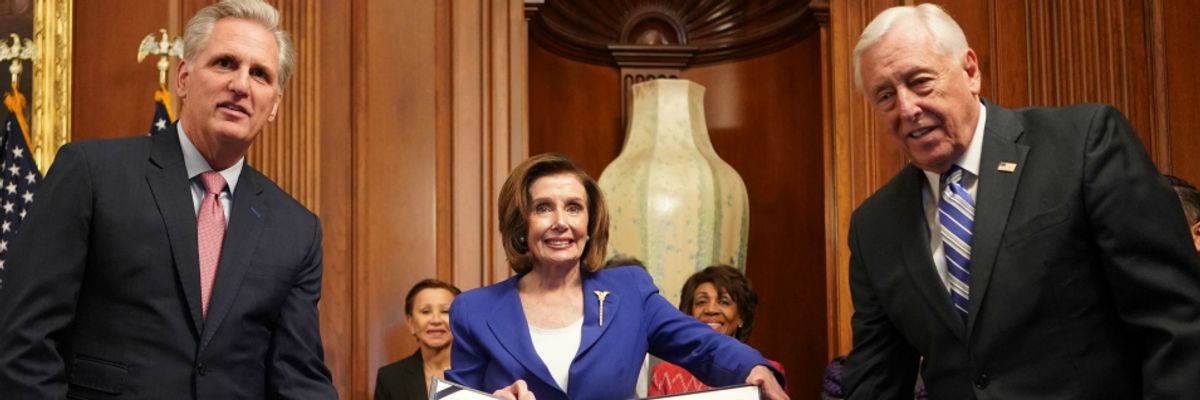
US Speaker of the House Nancy Pelosi (C) and Representatives Kevin McCarthy (L) and Steny Hoyer show the bill to the press after the House passed a $2 trillion stimulus bill, on March 27, 2020, at the US Capitol in Washington, DC - The House approved by a voice vote a $2.2 trillion rescue package, the largest economic stimulus package in American history, to aid a US economy and health care system battered by the coronavirus pandemic. (Photo: Alex Edelman/AFP/Getty Images)
Progressives on Friday said the passage by the U.S. House of Representatives of the Coronavirus Aid, Relief, and Economic Security Act--which offers some measure of relief to working families while delivering trillions in bailout funds to corporations--was a first step to avoiding an economic meltdown that could render millions of Americans destitute, but urged Congress to pass another bill as soon as possible that centers the interests and concerns of the working class.
"No one should be left out or left behind." --Rep. Ayanna Pressley
"We just passed a necessary relief package for working families," tweeted Rep. Mark Pocan (D-Wis.), co-chair of the Congressional Progressive Caucus. "It's not perfect. We know that. But we're not done."
The CARES Act promises payouts of up to $1,200 for each American and $500 per child and expands unemployment benefits for those left out of work by the coronavirus outbreak. It also provides $130 billion for hospitals as the U.S. healthcare system struggles to manage the influx of patients with the virus, also known as COVID-19.
Rep. Ilhan Omar (D-Minn.) said she was supporting the bill "not because it's perfect or even sufficient, but because the lives and the livelihoods of Americans are at risk."
The legislation has been denounced by progressives as a cash giveaway to corporations and the rich. It contains a $500 billion slush fund for large corporations to be overseen by Treasury Secretary Steve Mnuchin including bailouts for the airline and other industries.
In response to the passage of the bill--subsequently signed by President Donald Trump into law--Thea M. Lee, president of the Economic Policy Institute, wrote that the CARES Act's deficiencies, while not enough to urge the bill's rejection, are glaring.
"The single biggest tranche of money goes toward industry bailouts without adequate safeguards to ensure that taxpayer dollars are used to save the jobs and wages of typical workers, rather than to preserve the wealth of shareholders, creditors, and corporate executives," said Lee. "It also egregiously fails to include explicit protections for worker safety during this epidemic in industries seeking federal relief."
"Though the CARES Act will alleviate hardship for millions, it does not fully protect U.S. workers and their families from the economic consequences of the coronavirus, and it will not set the stage for the economy to reboot quickly once the public health crisis ends," Lee added.
CPC co-chair Rep. Pramila Jayapal (D-Wash.), in a statement, said she and her colleagues were focused on the next step.
"We are already at work immediately on the next package to ensure it includes provisions we fought for but did not get this time," said Jayapal. "This is a crisis of epic proportions and we must continue to do everything we can to respond with the scale sufficient to meet the suffering of people across our country."
In a statement from national policy director Angel Padilla, progressive advocacy group Indivisible called on the House to immediately return to work and put forth a comprehensive bill to help working Americans.
"The clock has already started on a fourth bill and we expect and demand that House Democrats fight to ensure that the needs of all communities are met," said Padilla. "Congress must work immediately to fill the gaps from the previous three COVID packages, and go further to reduce the inequality that put so many families at risk in the first place."
"Let's not forget, COVID might be the current crisis we're facing, but these problems are structural," Padilla added. "We find ourselves here because of decades of failed policies that have deepened inequality, undermined worker protections, weakened our social safety net, and put profits over people. We will need big changes to address the current crisis and to prevent the next one."
Rep. Ayanna Pressley (D-Mass), in a statement on the bill's passage, made clear she and her colleagues would work to ensure the next bill was comprehensive in addressing the concerns of working and marginalized people.
"Our work is far from over," said Pressley. "As Congress moves to begin working on the next relief package, I will continue to fight to center the most vulnerable members of our community. No one should be left out or left behind."
Dear Common Dreams reader, It’s been nearly 30 years since I co-founded Common Dreams with my late wife, Lina Newhouser. We had the radical notion that journalism should serve the public good, not corporate profits. It was clear to us from the outset what it would take to build such a project. No paid advertisements. No corporate sponsors. No millionaire publisher telling us what to think or do. Many people said we wouldn't last a year, but we proved those doubters wrong. Together with a tremendous team of journalists and dedicated staff, we built an independent media outlet free from the constraints of profits and corporate control. Our mission has always been simple: To inform. To inspire. To ignite change for the common good. Building Common Dreams was not easy. Our survival was never guaranteed. When you take on the most powerful forces—Wall Street greed, fossil fuel industry destruction, Big Tech lobbyists, and uber-rich oligarchs who have spent billions upon billions rigging the economy and democracy in their favor—the only bulwark you have is supporters who believe in your work. But here’s the urgent message from me today. It's never been this bad out there. And it's never been this hard to keep us going. At the very moment Common Dreams is most needed, the threats we face are intensifying. We need your support now more than ever. We don't accept corporate advertising and never will. We don't have a paywall because we don't think people should be blocked from critical news based on their ability to pay. Everything we do is funded by the donations of readers like you. When everyone does the little they can afford, we are strong. But if that support retreats or dries up, so do we. Will you donate now to make sure Common Dreams not only survives but thrives? —Craig Brown, Co-founder |
Progressives on Friday said the passage by the U.S. House of Representatives of the Coronavirus Aid, Relief, and Economic Security Act--which offers some measure of relief to working families while delivering trillions in bailout funds to corporations--was a first step to avoiding an economic meltdown that could render millions of Americans destitute, but urged Congress to pass another bill as soon as possible that centers the interests and concerns of the working class.
"No one should be left out or left behind." --Rep. Ayanna Pressley
"We just passed a necessary relief package for working families," tweeted Rep. Mark Pocan (D-Wis.), co-chair of the Congressional Progressive Caucus. "It's not perfect. We know that. But we're not done."
The CARES Act promises payouts of up to $1,200 for each American and $500 per child and expands unemployment benefits for those left out of work by the coronavirus outbreak. It also provides $130 billion for hospitals as the U.S. healthcare system struggles to manage the influx of patients with the virus, also known as COVID-19.
Rep. Ilhan Omar (D-Minn.) said she was supporting the bill "not because it's perfect or even sufficient, but because the lives and the livelihoods of Americans are at risk."
The legislation has been denounced by progressives as a cash giveaway to corporations and the rich. It contains a $500 billion slush fund for large corporations to be overseen by Treasury Secretary Steve Mnuchin including bailouts for the airline and other industries.
In response to the passage of the bill--subsequently signed by President Donald Trump into law--Thea M. Lee, president of the Economic Policy Institute, wrote that the CARES Act's deficiencies, while not enough to urge the bill's rejection, are glaring.
"The single biggest tranche of money goes toward industry bailouts without adequate safeguards to ensure that taxpayer dollars are used to save the jobs and wages of typical workers, rather than to preserve the wealth of shareholders, creditors, and corporate executives," said Lee. "It also egregiously fails to include explicit protections for worker safety during this epidemic in industries seeking federal relief."
"Though the CARES Act will alleviate hardship for millions, it does not fully protect U.S. workers and their families from the economic consequences of the coronavirus, and it will not set the stage for the economy to reboot quickly once the public health crisis ends," Lee added.
CPC co-chair Rep. Pramila Jayapal (D-Wash.), in a statement, said she and her colleagues were focused on the next step.
"We are already at work immediately on the next package to ensure it includes provisions we fought for but did not get this time," said Jayapal. "This is a crisis of epic proportions and we must continue to do everything we can to respond with the scale sufficient to meet the suffering of people across our country."
In a statement from national policy director Angel Padilla, progressive advocacy group Indivisible called on the House to immediately return to work and put forth a comprehensive bill to help working Americans.
"The clock has already started on a fourth bill and we expect and demand that House Democrats fight to ensure that the needs of all communities are met," said Padilla. "Congress must work immediately to fill the gaps from the previous three COVID packages, and go further to reduce the inequality that put so many families at risk in the first place."
"Let's not forget, COVID might be the current crisis we're facing, but these problems are structural," Padilla added. "We find ourselves here because of decades of failed policies that have deepened inequality, undermined worker protections, weakened our social safety net, and put profits over people. We will need big changes to address the current crisis and to prevent the next one."
Rep. Ayanna Pressley (D-Mass), in a statement on the bill's passage, made clear she and her colleagues would work to ensure the next bill was comprehensive in addressing the concerns of working and marginalized people.
"Our work is far from over," said Pressley. "As Congress moves to begin working on the next relief package, I will continue to fight to center the most vulnerable members of our community. No one should be left out or left behind."
Progressives on Friday said the passage by the U.S. House of Representatives of the Coronavirus Aid, Relief, and Economic Security Act--which offers some measure of relief to working families while delivering trillions in bailout funds to corporations--was a first step to avoiding an economic meltdown that could render millions of Americans destitute, but urged Congress to pass another bill as soon as possible that centers the interests and concerns of the working class.
"No one should be left out or left behind." --Rep. Ayanna Pressley
"We just passed a necessary relief package for working families," tweeted Rep. Mark Pocan (D-Wis.), co-chair of the Congressional Progressive Caucus. "It's not perfect. We know that. But we're not done."
The CARES Act promises payouts of up to $1,200 for each American and $500 per child and expands unemployment benefits for those left out of work by the coronavirus outbreak. It also provides $130 billion for hospitals as the U.S. healthcare system struggles to manage the influx of patients with the virus, also known as COVID-19.
Rep. Ilhan Omar (D-Minn.) said she was supporting the bill "not because it's perfect or even sufficient, but because the lives and the livelihoods of Americans are at risk."
The legislation has been denounced by progressives as a cash giveaway to corporations and the rich. It contains a $500 billion slush fund for large corporations to be overseen by Treasury Secretary Steve Mnuchin including bailouts for the airline and other industries.
In response to the passage of the bill--subsequently signed by President Donald Trump into law--Thea M. Lee, president of the Economic Policy Institute, wrote that the CARES Act's deficiencies, while not enough to urge the bill's rejection, are glaring.
"The single biggest tranche of money goes toward industry bailouts without adequate safeguards to ensure that taxpayer dollars are used to save the jobs and wages of typical workers, rather than to preserve the wealth of shareholders, creditors, and corporate executives," said Lee. "It also egregiously fails to include explicit protections for worker safety during this epidemic in industries seeking federal relief."
"Though the CARES Act will alleviate hardship for millions, it does not fully protect U.S. workers and their families from the economic consequences of the coronavirus, and it will not set the stage for the economy to reboot quickly once the public health crisis ends," Lee added.
CPC co-chair Rep. Pramila Jayapal (D-Wash.), in a statement, said she and her colleagues were focused on the next step.
"We are already at work immediately on the next package to ensure it includes provisions we fought for but did not get this time," said Jayapal. "This is a crisis of epic proportions and we must continue to do everything we can to respond with the scale sufficient to meet the suffering of people across our country."
In a statement from national policy director Angel Padilla, progressive advocacy group Indivisible called on the House to immediately return to work and put forth a comprehensive bill to help working Americans.
"The clock has already started on a fourth bill and we expect and demand that House Democrats fight to ensure that the needs of all communities are met," said Padilla. "Congress must work immediately to fill the gaps from the previous three COVID packages, and go further to reduce the inequality that put so many families at risk in the first place."
"Let's not forget, COVID might be the current crisis we're facing, but these problems are structural," Padilla added. "We find ourselves here because of decades of failed policies that have deepened inequality, undermined worker protections, weakened our social safety net, and put profits over people. We will need big changes to address the current crisis and to prevent the next one."
Rep. Ayanna Pressley (D-Mass), in a statement on the bill's passage, made clear she and her colleagues would work to ensure the next bill was comprehensive in addressing the concerns of working and marginalized people.
"Our work is far from over," said Pressley. "As Congress moves to begin working on the next relief package, I will continue to fight to center the most vulnerable members of our community. No one should be left out or left behind."