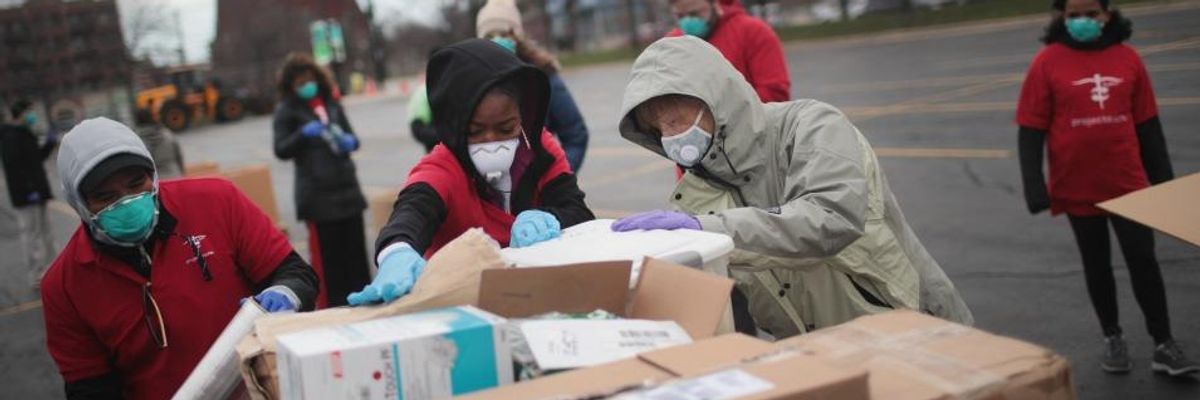
Staff and volunteers with Project C.U.R.E hold a drive outside the United Center to collect donations of Personal Protective Equipment (PPE) from the community which will be used to supply hospitals and clinics that are experiencing shortages due to the COVID-19 pandemic on March 29, 2020 in Chicago, Illinois. (Photo: Scott Olson/Getty Images)
New Evidence Shows Trump--Who Says He Knew Covid-19 'Going to Be Horrible'--Allowed Exports of Crucial Supplies to Continue
"In the absence of early detection and purchasing agreements, crucial medical supplies have been ferried out from American manufacturers for foreign markets."
While countries in Europe and Asia spent the first several weeks of the year preparing their healthcare systems and populations for the coronavirus outbreak by stockpiling crucial medical supplies, the Trump administration spent that same time sending dozens of medical shipments overseas as President Donald Trump denied the coronavirus would have much of an impact on the United States.
As The Intercept reported Wednesday, while the new coronavirus ravaged countries including China, Italy, and Iran in February and early March, U.S. manufacturers were sending large shipments of respirators, ventilators, and protective medical equipment to Germany, Belgium, and Japan.
A "steady flow of the medical equipment needed to treat the coronavirus [was] being shipped abroad as recently as March 17," wrote Lee Fang at The Intercept, while Trump first claimed the severity of the coronavirus pandemic was a "hoax" perpetrated by Democrats, then compared it to the seasonal flu and insisting it would likely disappear once spring arrived.
Even though Trump said during a press conference on Tuesday that he knew more than a month ago that the crisis was "going to be horrible," the new evidence shows that he and his administration did not move swiftly enough at the time to lock down supplies or reconsider the manner in which crucial equipment was being exported.
By March 17, 37 states had closed their public schools, nearly eight million California residents had been told to shelter in place to stop the spread of the virus, and state officials were sounding alarms about medical supply shortages while Trump told governors to acquire supplies themselves without relying on the federal government.
The critical supply shortages now being reported in hospitals across the country "is the result of a combination of factors, including poor planning by the U.S. government," wrote Fang. "In the absence of early detection and purchasing agreements, crucial medical supplies have been ferried out from American manufacturers for foreign markets."
The Trump administration's "unwillingness to read the cards" in January and February while dozens of other countries were anticipating crises and placing moratoriums on medical supply exports is partially to blame for the current state of chaos being faced by healthcare providers, Olivia Webb of the American Economic Liberties Project told The Intercept.
"An ideal policy would demand corporations give the U.S. government and U.S. health care entities the right of first refusal for PPE and related equipment during a national emergency," Webb said.
The Intercept's report is just the latest regarding the administration's failure to support U.S. hospitals as more than 200,000 people in the country have contracted the virus. As Common Dreams reported Tuesday, the federal government has seized shipments of medical supplies going to several states and has outbid governors as states have tried to procure equipment from manufacturers.
As ProPublica reported Monday, Trump's Health and Human Services Department has also allowed an American company that was contracted to produce low-cost ventilators to overlook the need for the equipment in the U.S., instead shipping them to European countries at higher prices over the past two months.
Meanwhile, as Politico reported Tuesday, the administration issued a plea to Thailand for a medical supply shipment last week--only to be told that the U.S. had just sent two large shipments of equipment to Bangkok. The mix-up prompted Vice President Mike Pence to put in place a new review process for USAID deliveries of personal protective equipment (PPE) to developing countries--effectively freezing aid packages that were meant for countries including Honduras and Bangladesh.
An Urgent Message From Our Co-Founder
Dear Common Dreams reader, It’s been nearly 30 years since I co-founded Common Dreams with my late wife, Lina Newhouser. We had the radical notion that journalism should serve the public good, not corporate profits. It was clear to us from the outset what it would take to build such a project. No paid advertisements. No corporate sponsors. No millionaire publisher telling us what to think or do. Many people said we wouldn't last a year, but we proved those doubters wrong. Together with a tremendous team of journalists and dedicated staff, we built an independent media outlet free from the constraints of profits and corporate control. Our mission has always been simple: To inform. To inspire. To ignite change for the common good. Building Common Dreams was not easy. Our survival was never guaranteed. When you take on the most powerful forces—Wall Street greed, fossil fuel industry destruction, Big Tech lobbyists, and uber-rich oligarchs who have spent billions upon billions rigging the economy and democracy in their favor—the only bulwark you have is supporters who believe in your work. But here’s the urgent message from me today. It's never been this bad out there. And it's never been this hard to keep us going. At the very moment Common Dreams is most needed, the threats we face are intensifying. We need your support now more than ever. We don't accept corporate advertising and never will. We don't have a paywall because we don't think people should be blocked from critical news based on their ability to pay. Everything we do is funded by the donations of readers like you. When everyone does the little they can afford, we are strong. But if that support retreats or dries up, so do we. Will you donate now to make sure Common Dreams not only survives but thrives? —Craig Brown, Co-founder |
While countries in Europe and Asia spent the first several weeks of the year preparing their healthcare systems and populations for the coronavirus outbreak by stockpiling crucial medical supplies, the Trump administration spent that same time sending dozens of medical shipments overseas as President Donald Trump denied the coronavirus would have much of an impact on the United States.
As The Intercept reported Wednesday, while the new coronavirus ravaged countries including China, Italy, and Iran in February and early March, U.S. manufacturers were sending large shipments of respirators, ventilators, and protective medical equipment to Germany, Belgium, and Japan.
A "steady flow of the medical equipment needed to treat the coronavirus [was] being shipped abroad as recently as March 17," wrote Lee Fang at The Intercept, while Trump first claimed the severity of the coronavirus pandemic was a "hoax" perpetrated by Democrats, then compared it to the seasonal flu and insisting it would likely disappear once spring arrived.
Even though Trump said during a press conference on Tuesday that he knew more than a month ago that the crisis was "going to be horrible," the new evidence shows that he and his administration did not move swiftly enough at the time to lock down supplies or reconsider the manner in which crucial equipment was being exported.
By March 17, 37 states had closed their public schools, nearly eight million California residents had been told to shelter in place to stop the spread of the virus, and state officials were sounding alarms about medical supply shortages while Trump told governors to acquire supplies themselves without relying on the federal government.
The critical supply shortages now being reported in hospitals across the country "is the result of a combination of factors, including poor planning by the U.S. government," wrote Fang. "In the absence of early detection and purchasing agreements, crucial medical supplies have been ferried out from American manufacturers for foreign markets."
The Trump administration's "unwillingness to read the cards" in January and February while dozens of other countries were anticipating crises and placing moratoriums on medical supply exports is partially to blame for the current state of chaos being faced by healthcare providers, Olivia Webb of the American Economic Liberties Project told The Intercept.
"An ideal policy would demand corporations give the U.S. government and U.S. health care entities the right of first refusal for PPE and related equipment during a national emergency," Webb said.
The Intercept's report is just the latest regarding the administration's failure to support U.S. hospitals as more than 200,000 people in the country have contracted the virus. As Common Dreams reported Tuesday, the federal government has seized shipments of medical supplies going to several states and has outbid governors as states have tried to procure equipment from manufacturers.
As ProPublica reported Monday, Trump's Health and Human Services Department has also allowed an American company that was contracted to produce low-cost ventilators to overlook the need for the equipment in the U.S., instead shipping them to European countries at higher prices over the past two months.
Meanwhile, as Politico reported Tuesday, the administration issued a plea to Thailand for a medical supply shipment last week--only to be told that the U.S. had just sent two large shipments of equipment to Bangkok. The mix-up prompted Vice President Mike Pence to put in place a new review process for USAID deliveries of personal protective equipment (PPE) to developing countries--effectively freezing aid packages that were meant for countries including Honduras and Bangladesh.
While countries in Europe and Asia spent the first several weeks of the year preparing their healthcare systems and populations for the coronavirus outbreak by stockpiling crucial medical supplies, the Trump administration spent that same time sending dozens of medical shipments overseas as President Donald Trump denied the coronavirus would have much of an impact on the United States.
As The Intercept reported Wednesday, while the new coronavirus ravaged countries including China, Italy, and Iran in February and early March, U.S. manufacturers were sending large shipments of respirators, ventilators, and protective medical equipment to Germany, Belgium, and Japan.
A "steady flow of the medical equipment needed to treat the coronavirus [was] being shipped abroad as recently as March 17," wrote Lee Fang at The Intercept, while Trump first claimed the severity of the coronavirus pandemic was a "hoax" perpetrated by Democrats, then compared it to the seasonal flu and insisting it would likely disappear once spring arrived.
Even though Trump said during a press conference on Tuesday that he knew more than a month ago that the crisis was "going to be horrible," the new evidence shows that he and his administration did not move swiftly enough at the time to lock down supplies or reconsider the manner in which crucial equipment was being exported.
By March 17, 37 states had closed their public schools, nearly eight million California residents had been told to shelter in place to stop the spread of the virus, and state officials were sounding alarms about medical supply shortages while Trump told governors to acquire supplies themselves without relying on the federal government.
The critical supply shortages now being reported in hospitals across the country "is the result of a combination of factors, including poor planning by the U.S. government," wrote Fang. "In the absence of early detection and purchasing agreements, crucial medical supplies have been ferried out from American manufacturers for foreign markets."
The Trump administration's "unwillingness to read the cards" in January and February while dozens of other countries were anticipating crises and placing moratoriums on medical supply exports is partially to blame for the current state of chaos being faced by healthcare providers, Olivia Webb of the American Economic Liberties Project told The Intercept.
"An ideal policy would demand corporations give the U.S. government and U.S. health care entities the right of first refusal for PPE and related equipment during a national emergency," Webb said.
The Intercept's report is just the latest regarding the administration's failure to support U.S. hospitals as more than 200,000 people in the country have contracted the virus. As Common Dreams reported Tuesday, the federal government has seized shipments of medical supplies going to several states and has outbid governors as states have tried to procure equipment from manufacturers.
As ProPublica reported Monday, Trump's Health and Human Services Department has also allowed an American company that was contracted to produce low-cost ventilators to overlook the need for the equipment in the U.S., instead shipping them to European countries at higher prices over the past two months.
Meanwhile, as Politico reported Tuesday, the administration issued a plea to Thailand for a medical supply shipment last week--only to be told that the U.S. had just sent two large shipments of equipment to Bangkok. The mix-up prompted Vice President Mike Pence to put in place a new review process for USAID deliveries of personal protective equipment (PPE) to developing countries--effectively freezing aid packages that were meant for countries including Honduras and Bangladesh.