SUBSCRIBE TO OUR FREE NEWSLETTER
Daily news & progressive opinion—funded by the people, not the corporations—delivered straight to your inbox.
5
#000000
#FFFFFF
To donate by check, phone, or other method, see our More Ways to Give page.
Daily news & progressive opinion—funded by the people, not the corporations—delivered straight to your inbox.
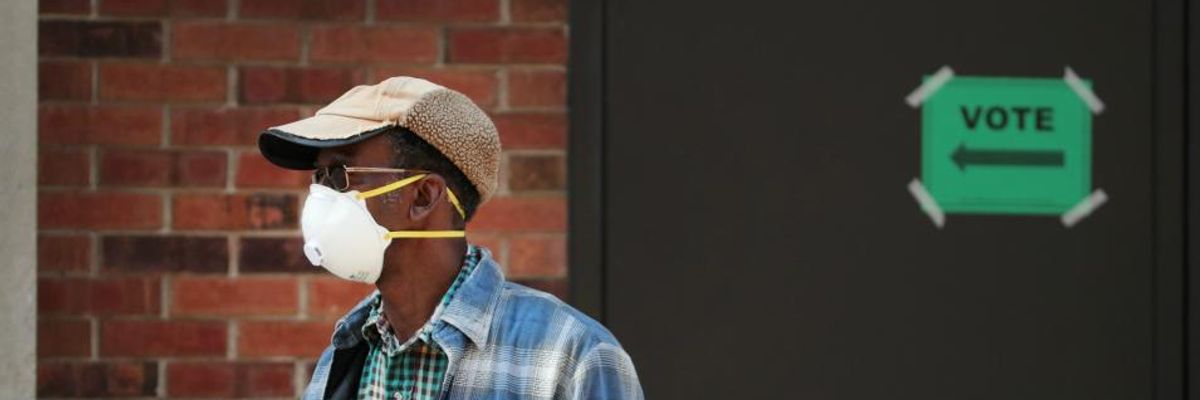
A resident waits in line to vote at a polling place at Riverside University High School on April 7, 2020 in Milwaukee, Wisconsin. Residents waited sometimes more than two hours to vote at the school, one of the few polling places open in the city after most were consolidated due to a shortage of poll workers fearful of contracting COVID-19. (Photo: Scott Olson/Getty Images)
Calls are mounting from rights advocates for Congress to fully fund a nationwide shift to mail-in voting during the coronavirus pandemic after a "civic catastrophe" in Wisconsin Tuesday, when the state's Republican legislative leaders and Supreme Court forced people to vote in-person despite the serious threat to public health.
Aquene Freechild, co-director of Public Citizen's Democracy Is For People Campaign, said in a statement earlier this week that the situation in Wisconsin highlighted the need for the country to better prepare for the general election in November.
"Every voter deserves a chance to cast their ballot safely by mail, drop box or curbside, or to be able to vote early," she said. "Forcing voters to choose between preserving their health and casting a ballot is unconscionable."
Echoing Freechild, Common Cause president Karen Hobert Flynn declared Wednesday that "every American deserves to have their voice heard on election day, but voters should never be forced to risk their personal safety in order to cast a ballot."
"The decision to hold an in-person election in Wisconsin yesterday was reckless and irresponsible, endangering the lives of tens of thousands of Wisconsinites and needlessly disenfranchising thousands more," she added. "Congress must investigate this matter thoroughly and look for ways to ensure something like what happened yesterday is not repeated in November or ever again."
Common Cause sent a letter (pdf) to the Committee on House Administration and the Senate Rules and Administration Committee, urging those committees' Democratic and Republican leaders to hold emergency hearings on how Wisconsin and other states have handled elections during the ongoing virus outbreak.
"The sight of residents in Milwaukee, Green Bay, Waukesha, and other cities standing in lines that extended blocks amidst a pandemic was both inspiring and heartbreaking because it never should have happened," said Jay Heck, executive director of Common Cause Wisconsin. "The people of Wisconsin deserve better and America deserves answers in order to ensure this is never allowed to happen again."
As Reuters reported Wednesday:
The drama in Wisconsin foreshadows legal battles and political showdowns looming in upcoming primaries across the country, and heading into the all-important November presidential election, as the worst public health crisis in a century upends voting, Democratic officials, non-partisan voter advocates, and election watchdogs say.
They are particularly concerned about the potential impact in closely fought battlegrounds such as Wisconsin, Michigan, and Pennsylvania, whose contests were decided in Republican President Donald Trump's favor by razor-thin margins in 2016.
Trump--who is set to face off against former Vice President Joe Biden, the Democratic Party's presumptive nominee, in November--has baselessly stoked fears about the security of vote-by-mail in recent days.
Citing Trump's comments and Wisconsin's Tuesday election, E.J. Dionne Jr. wrote in a column for the Washington Post Wednesday:
Now we know that, for Republicans, voter suppression is part of the party's game plan. Just ask President Trump, who is petrified of the efforts of congressional Democrats to secure financing for nationwide mail-in voting. He complained about levels of voting such that, "if you'd ever agreed to it, you'd never have a Republican elected in this country again." On Wednesday, Trump--who himself voted by mail in 2018 and in last month's Florida primary--tweeted that voting by mail "for whatever reason, doesn't work out well for Republicans." Yes: More voters mean fewer Republican electoral victories.
The president's attacks on mail-in voting have provoked swift and sharp condemnation from experts and advocates.
"Donald Trump's attack on vote-by-mail is dangerous, wrong, and a blatant attempt to suppress the vote in the middle of a pandemic," Stand Up America founder and president Sean Eldridge said in a statement last week. "Vote-my-mail is not about partisanship--it's about allowing every eligible American to safely cast their ballot. Trump wants voters to have to choose between their health and participating in our democracy."
"Congress must demand better than that," he continued, "and do everything it can to provide states with the resources they need--including at least $2 billion in election assistance funding--to effectively implement vote-by-mail, online registration, and expanded early voting."
Stand Up America last month launched a national campaign pressuring Congress to provide billions of dollars in election assistance. Common Cause, the Brennan Center for Justice at New York University Law School, and the Leadership Conference on Civil and Human Rights are also supporting that demand.
The Republican-controlled Senate adjourned Thursday without striking a deal on phase four of coronavirus relief; Senate Majority Leader Mitch McConnell (R-Ky.) had fought for the GOP's plan to provide $250 billion more in funding for small businesses while Sen. Chris Van Hollen (D-Md.) pushed the Democrats' proposal to tie that to $250 billion more for hospitals and local governments.
Some progressive Democrats have joined rights advocates' calls for mail-in voting:
"While Congress works to provide economic relief to the American people and small businesses, lawmakers cannot ignore the impact this pandemic will have on our democracy," Eldridge said Thursday. "While Trump is recklessly attacking vote-by-mail, Democrats in Congress have leverage right now, and they should use it to ensure that every voter can safely cast their ballot."
"The disastrous election in Wisconsin is an urgent reminder of what could happen nationwide if Congress doesn't act," he said. Referencing an estimate from House Speaker Nancy Pelosi (D-Calif.), Eldridge added, "states need $4 billion right now to be able to implement vote-by-mail, expand online registration, and extend early voting."
Dear Common Dreams reader, It’s been nearly 30 years since I co-founded Common Dreams with my late wife, Lina Newhouser. We had the radical notion that journalism should serve the public good, not corporate profits. It was clear to us from the outset what it would take to build such a project. No paid advertisements. No corporate sponsors. No millionaire publisher telling us what to think or do. Many people said we wouldn't last a year, but we proved those doubters wrong. Together with a tremendous team of journalists and dedicated staff, we built an independent media outlet free from the constraints of profits and corporate control. Our mission has always been simple: To inform. To inspire. To ignite change for the common good. Building Common Dreams was not easy. Our survival was never guaranteed. When you take on the most powerful forces—Wall Street greed, fossil fuel industry destruction, Big Tech lobbyists, and uber-rich oligarchs who have spent billions upon billions rigging the economy and democracy in their favor—the only bulwark you have is supporters who believe in your work. But here’s the urgent message from me today. It's never been this bad out there. And it's never been this hard to keep us going. At the very moment Common Dreams is most needed, the threats we face are intensifying. We need your support now more than ever. We don't accept corporate advertising and never will. We don't have a paywall because we don't think people should be blocked from critical news based on their ability to pay. Everything we do is funded by the donations of readers like you. When everyone does the little they can afford, we are strong. But if that support retreats or dries up, so do we. Will you donate now to make sure Common Dreams not only survives but thrives? —Craig Brown, Co-founder |
Calls are mounting from rights advocates for Congress to fully fund a nationwide shift to mail-in voting during the coronavirus pandemic after a "civic catastrophe" in Wisconsin Tuesday, when the state's Republican legislative leaders and Supreme Court forced people to vote in-person despite the serious threat to public health.
Aquene Freechild, co-director of Public Citizen's Democracy Is For People Campaign, said in a statement earlier this week that the situation in Wisconsin highlighted the need for the country to better prepare for the general election in November.
"Every voter deserves a chance to cast their ballot safely by mail, drop box or curbside, or to be able to vote early," she said. "Forcing voters to choose between preserving their health and casting a ballot is unconscionable."
Echoing Freechild, Common Cause president Karen Hobert Flynn declared Wednesday that "every American deserves to have their voice heard on election day, but voters should never be forced to risk their personal safety in order to cast a ballot."
"The decision to hold an in-person election in Wisconsin yesterday was reckless and irresponsible, endangering the lives of tens of thousands of Wisconsinites and needlessly disenfranchising thousands more," she added. "Congress must investigate this matter thoroughly and look for ways to ensure something like what happened yesterday is not repeated in November or ever again."
Common Cause sent a letter (pdf) to the Committee on House Administration and the Senate Rules and Administration Committee, urging those committees' Democratic and Republican leaders to hold emergency hearings on how Wisconsin and other states have handled elections during the ongoing virus outbreak.
"The sight of residents in Milwaukee, Green Bay, Waukesha, and other cities standing in lines that extended blocks amidst a pandemic was both inspiring and heartbreaking because it never should have happened," said Jay Heck, executive director of Common Cause Wisconsin. "The people of Wisconsin deserve better and America deserves answers in order to ensure this is never allowed to happen again."
As Reuters reported Wednesday:
The drama in Wisconsin foreshadows legal battles and political showdowns looming in upcoming primaries across the country, and heading into the all-important November presidential election, as the worst public health crisis in a century upends voting, Democratic officials, non-partisan voter advocates, and election watchdogs say.
They are particularly concerned about the potential impact in closely fought battlegrounds such as Wisconsin, Michigan, and Pennsylvania, whose contests were decided in Republican President Donald Trump's favor by razor-thin margins in 2016.
Trump--who is set to face off against former Vice President Joe Biden, the Democratic Party's presumptive nominee, in November--has baselessly stoked fears about the security of vote-by-mail in recent days.
Citing Trump's comments and Wisconsin's Tuesday election, E.J. Dionne Jr. wrote in a column for the Washington Post Wednesday:
Now we know that, for Republicans, voter suppression is part of the party's game plan. Just ask President Trump, who is petrified of the efforts of congressional Democrats to secure financing for nationwide mail-in voting. He complained about levels of voting such that, "if you'd ever agreed to it, you'd never have a Republican elected in this country again." On Wednesday, Trump--who himself voted by mail in 2018 and in last month's Florida primary--tweeted that voting by mail "for whatever reason, doesn't work out well for Republicans." Yes: More voters mean fewer Republican electoral victories.
The president's attacks on mail-in voting have provoked swift and sharp condemnation from experts and advocates.
"Donald Trump's attack on vote-by-mail is dangerous, wrong, and a blatant attempt to suppress the vote in the middle of a pandemic," Stand Up America founder and president Sean Eldridge said in a statement last week. "Vote-my-mail is not about partisanship--it's about allowing every eligible American to safely cast their ballot. Trump wants voters to have to choose between their health and participating in our democracy."
"Congress must demand better than that," he continued, "and do everything it can to provide states with the resources they need--including at least $2 billion in election assistance funding--to effectively implement vote-by-mail, online registration, and expanded early voting."
Stand Up America last month launched a national campaign pressuring Congress to provide billions of dollars in election assistance. Common Cause, the Brennan Center for Justice at New York University Law School, and the Leadership Conference on Civil and Human Rights are also supporting that demand.
The Republican-controlled Senate adjourned Thursday without striking a deal on phase four of coronavirus relief; Senate Majority Leader Mitch McConnell (R-Ky.) had fought for the GOP's plan to provide $250 billion more in funding for small businesses while Sen. Chris Van Hollen (D-Md.) pushed the Democrats' proposal to tie that to $250 billion more for hospitals and local governments.
Some progressive Democrats have joined rights advocates' calls for mail-in voting:
"While Congress works to provide economic relief to the American people and small businesses, lawmakers cannot ignore the impact this pandemic will have on our democracy," Eldridge said Thursday. "While Trump is recklessly attacking vote-by-mail, Democrats in Congress have leverage right now, and they should use it to ensure that every voter can safely cast their ballot."
"The disastrous election in Wisconsin is an urgent reminder of what could happen nationwide if Congress doesn't act," he said. Referencing an estimate from House Speaker Nancy Pelosi (D-Calif.), Eldridge added, "states need $4 billion right now to be able to implement vote-by-mail, expand online registration, and extend early voting."
Calls are mounting from rights advocates for Congress to fully fund a nationwide shift to mail-in voting during the coronavirus pandemic after a "civic catastrophe" in Wisconsin Tuesday, when the state's Republican legislative leaders and Supreme Court forced people to vote in-person despite the serious threat to public health.
Aquene Freechild, co-director of Public Citizen's Democracy Is For People Campaign, said in a statement earlier this week that the situation in Wisconsin highlighted the need for the country to better prepare for the general election in November.
"Every voter deserves a chance to cast their ballot safely by mail, drop box or curbside, or to be able to vote early," she said. "Forcing voters to choose between preserving their health and casting a ballot is unconscionable."
Echoing Freechild, Common Cause president Karen Hobert Flynn declared Wednesday that "every American deserves to have their voice heard on election day, but voters should never be forced to risk their personal safety in order to cast a ballot."
"The decision to hold an in-person election in Wisconsin yesterday was reckless and irresponsible, endangering the lives of tens of thousands of Wisconsinites and needlessly disenfranchising thousands more," she added. "Congress must investigate this matter thoroughly and look for ways to ensure something like what happened yesterday is not repeated in November or ever again."
Common Cause sent a letter (pdf) to the Committee on House Administration and the Senate Rules and Administration Committee, urging those committees' Democratic and Republican leaders to hold emergency hearings on how Wisconsin and other states have handled elections during the ongoing virus outbreak.
"The sight of residents in Milwaukee, Green Bay, Waukesha, and other cities standing in lines that extended blocks amidst a pandemic was both inspiring and heartbreaking because it never should have happened," said Jay Heck, executive director of Common Cause Wisconsin. "The people of Wisconsin deserve better and America deserves answers in order to ensure this is never allowed to happen again."
As Reuters reported Wednesday:
The drama in Wisconsin foreshadows legal battles and political showdowns looming in upcoming primaries across the country, and heading into the all-important November presidential election, as the worst public health crisis in a century upends voting, Democratic officials, non-partisan voter advocates, and election watchdogs say.
They are particularly concerned about the potential impact in closely fought battlegrounds such as Wisconsin, Michigan, and Pennsylvania, whose contests were decided in Republican President Donald Trump's favor by razor-thin margins in 2016.
Trump--who is set to face off against former Vice President Joe Biden, the Democratic Party's presumptive nominee, in November--has baselessly stoked fears about the security of vote-by-mail in recent days.
Citing Trump's comments and Wisconsin's Tuesday election, E.J. Dionne Jr. wrote in a column for the Washington Post Wednesday:
Now we know that, for Republicans, voter suppression is part of the party's game plan. Just ask President Trump, who is petrified of the efforts of congressional Democrats to secure financing for nationwide mail-in voting. He complained about levels of voting such that, "if you'd ever agreed to it, you'd never have a Republican elected in this country again." On Wednesday, Trump--who himself voted by mail in 2018 and in last month's Florida primary--tweeted that voting by mail "for whatever reason, doesn't work out well for Republicans." Yes: More voters mean fewer Republican electoral victories.
The president's attacks on mail-in voting have provoked swift and sharp condemnation from experts and advocates.
"Donald Trump's attack on vote-by-mail is dangerous, wrong, and a blatant attempt to suppress the vote in the middle of a pandemic," Stand Up America founder and president Sean Eldridge said in a statement last week. "Vote-my-mail is not about partisanship--it's about allowing every eligible American to safely cast their ballot. Trump wants voters to have to choose between their health and participating in our democracy."
"Congress must demand better than that," he continued, "and do everything it can to provide states with the resources they need--including at least $2 billion in election assistance funding--to effectively implement vote-by-mail, online registration, and expanded early voting."
Stand Up America last month launched a national campaign pressuring Congress to provide billions of dollars in election assistance. Common Cause, the Brennan Center for Justice at New York University Law School, and the Leadership Conference on Civil and Human Rights are also supporting that demand.
The Republican-controlled Senate adjourned Thursday without striking a deal on phase four of coronavirus relief; Senate Majority Leader Mitch McConnell (R-Ky.) had fought for the GOP's plan to provide $250 billion more in funding for small businesses while Sen. Chris Van Hollen (D-Md.) pushed the Democrats' proposal to tie that to $250 billion more for hospitals and local governments.
Some progressive Democrats have joined rights advocates' calls for mail-in voting:
"While Congress works to provide economic relief to the American people and small businesses, lawmakers cannot ignore the impact this pandemic will have on our democracy," Eldridge said Thursday. "While Trump is recklessly attacking vote-by-mail, Democrats in Congress have leverage right now, and they should use it to ensure that every voter can safely cast their ballot."
"The disastrous election in Wisconsin is an urgent reminder of what could happen nationwide if Congress doesn't act," he said. Referencing an estimate from House Speaker Nancy Pelosi (D-Calif.), Eldridge added, "states need $4 billion right now to be able to implement vote-by-mail, expand online registration, and extend early voting."