SUBSCRIBE TO OUR FREE NEWSLETTER
Daily news & progressive opinion—funded by the people, not the corporations—delivered straight to your inbox.
5
#000000
#FFFFFF
To donate by check, phone, or other method, see our More Ways to Give page.


Daily news & progressive opinion—funded by the people, not the corporations—delivered straight to your inbox.

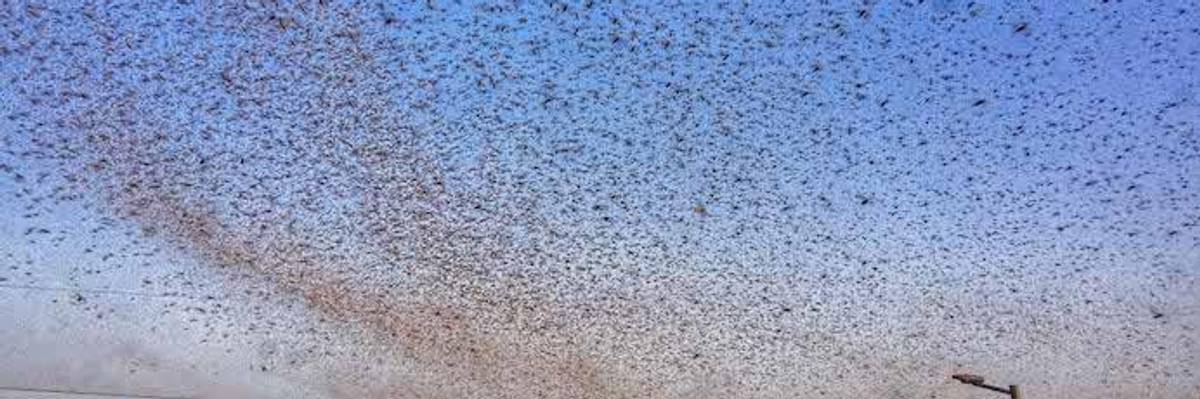
Swarms of locust attack in the residential areas of Jaipur, Rajasthan, Monday, May 25, 2020. More than half of Rajasthan's 33 districts are affected by invasion by these crop-munching insects.(Photo: Vishal Bhatnagar/NurPhoto via Getty Images)
Farmers in India and Pakistan fear potentially catastrophic crop damage as another wave of locust swarms wreaks havoc on the two nations as they continue to battle coronavirus pandemic.
Locusts, as CBS News reported, are "considered the most destructive migratory pest in the world, with a small swarm of about 40 million locusts capable of gobbling up enough food for 35,000 people."
For India, the current invasion marks the "worst plague in nearly three decades," Agence France-Presse reported.
"Usually they arrive from Pakistan between July and October and remain focused in Rajasthan," added CBS. "This time, however, weather conditions have helped the swarms spread into neighboring states."
The grasshopper-like creatures "have engulfed around 35,000 hectares in India's seven heartland states, threatening some vegetable and pulse crops," Reuters reported Tuesday, citing information from government officials and farm experts.
The swarms began entering the country last month through neighboring Pakistan's Sindh province, and farmers fear another June wave of locusts could decimate crops.
The Associated Press reported that India is facing three disasters at once--locusts, Covid-19, and "eviscerating heat." From the AP:
Temperatures soared to 118 degrees Fahrenheit (47.6 degrees Celsius) in the capital New Delhi this week, marking the warmest May day in 18 years, and 122 F (50 C) in the desert state of Rajasthan, after the world's hottest April on record.
India suffers from severe water shortages and tens of millions lack running water and air conditioning, leaving many to seek relief under shady trees in public parks and stepwells, the ancient structures used to harvest rainwater.
Though many people continued wearing masks properly, others pushed them onto chins, or had foregone them altogether.
K.L. Gurjar, deputy director of India's Locust Warning Organization, said Pakistan may have been overwhelmed by the huge number of locusts.
Pakistan's farmers have borne the brunt of the damage from the swarms.
Mir Gul Muhammad, who farms in the province of Balochistan, told the Guardian that the invasions have been the worst he's seen in this lifetime. "As a farmer, it will take years to recover from this loss," he said.
From the Guardian:
Ismail Rahoo, state minister of agriculture for Sindh, described the plague as a "dangerous and catastrophic threat to the economy, agriculture, and food security in Pakistan."
"This year it will be ten times worse than last year. They are attacking from three sides," he said. "The locusts and their eggs have now covered 50,000 square kilometres of farmland. We are expecting them to infest more than 5m hectares. And they are not just attacking Sindh province, but also the agricultural areas of Punjab and Balochistan."
The Food and Agriculture Organization (FAO) warned back in January that the swarms then hitting the Horn of Africa represented "an unprecedented threat to food security and livelihoods." The agency issued another warning in April as a second wave was spotted that the numbers could surge.
In a statement last week on the locusts affecting the Sahel, Southwest Asia, the Horn of Africa, and Yemen, the FAO expressed concern about the likelihood of new swarms forming in June, saying that "the battle is long and is spreading to new areas."
"The locusts, combined with the impacts of Covid-19, could have catastrophic consequences on livelihoods and food security," said FAO Director-Genera Qu Dongyu.

Dear Common Dreams reader, It’s been nearly 30 years since I co-founded Common Dreams with my late wife, Lina Newhouser. We had the radical notion that journalism should serve the public good, not corporate profits. It was clear to us from the outset what it would take to build such a project. No paid advertisements. No corporate sponsors. No millionaire publisher telling us what to think or do. Many people said we wouldn't last a year, but we proved those doubters wrong. Together with a tremendous team of journalists and dedicated staff, we built an independent media outlet free from the constraints of profits and corporate control. Our mission has always been simple: To inform. To inspire. To ignite change for the common good. Building Common Dreams was not easy. Our survival was never guaranteed. When you take on the most powerful forces—Wall Street greed, fossil fuel industry destruction, Big Tech lobbyists, and uber-rich oligarchs who have spent billions upon billions rigging the economy and democracy in their favor—the only bulwark you have is supporters who believe in your work. But here’s the urgent message from me today. It's never been this bad out there. And it's never been this hard to keep us going. At the very moment Common Dreams is most needed, the threats we face are intensifying. We need your support now more than ever. We don't accept corporate advertising and never will. We don't have a paywall because we don't think people should be blocked from critical news based on their ability to pay. Everything we do is funded by the donations of readers like you. When everyone does the little they can afford, we are strong. But if that support retreats or dries up, so do we. Will you donate now to make sure Common Dreams not only survives but thrives? —Craig Brown, Co-founder |
Farmers in India and Pakistan fear potentially catastrophic crop damage as another wave of locust swarms wreaks havoc on the two nations as they continue to battle coronavirus pandemic.
Locusts, as CBS News reported, are "considered the most destructive migratory pest in the world, with a small swarm of about 40 million locusts capable of gobbling up enough food for 35,000 people."
For India, the current invasion marks the "worst plague in nearly three decades," Agence France-Presse reported.
"Usually they arrive from Pakistan between July and October and remain focused in Rajasthan," added CBS. "This time, however, weather conditions have helped the swarms spread into neighboring states."
The grasshopper-like creatures "have engulfed around 35,000 hectares in India's seven heartland states, threatening some vegetable and pulse crops," Reuters reported Tuesday, citing information from government officials and farm experts.
The swarms began entering the country last month through neighboring Pakistan's Sindh province, and farmers fear another June wave of locusts could decimate crops.
The Associated Press reported that India is facing three disasters at once--locusts, Covid-19, and "eviscerating heat." From the AP:
Temperatures soared to 118 degrees Fahrenheit (47.6 degrees Celsius) in the capital New Delhi this week, marking the warmest May day in 18 years, and 122 F (50 C) in the desert state of Rajasthan, after the world's hottest April on record.
India suffers from severe water shortages and tens of millions lack running water and air conditioning, leaving many to seek relief under shady trees in public parks and stepwells, the ancient structures used to harvest rainwater.
Though many people continued wearing masks properly, others pushed them onto chins, or had foregone them altogether.
K.L. Gurjar, deputy director of India's Locust Warning Organization, said Pakistan may have been overwhelmed by the huge number of locusts.
Pakistan's farmers have borne the brunt of the damage from the swarms.
Mir Gul Muhammad, who farms in the province of Balochistan, told the Guardian that the invasions have been the worst he's seen in this lifetime. "As a farmer, it will take years to recover from this loss," he said.
From the Guardian:
Ismail Rahoo, state minister of agriculture for Sindh, described the plague as a "dangerous and catastrophic threat to the economy, agriculture, and food security in Pakistan."
"This year it will be ten times worse than last year. They are attacking from three sides," he said. "The locusts and their eggs have now covered 50,000 square kilometres of farmland. We are expecting them to infest more than 5m hectares. And they are not just attacking Sindh province, but also the agricultural areas of Punjab and Balochistan."
The Food and Agriculture Organization (FAO) warned back in January that the swarms then hitting the Horn of Africa represented "an unprecedented threat to food security and livelihoods." The agency issued another warning in April as a second wave was spotted that the numbers could surge.
In a statement last week on the locusts affecting the Sahel, Southwest Asia, the Horn of Africa, and Yemen, the FAO expressed concern about the likelihood of new swarms forming in June, saying that "the battle is long and is spreading to new areas."
"The locusts, combined with the impacts of Covid-19, could have catastrophic consequences on livelihoods and food security," said FAO Director-Genera Qu Dongyu.

Farmers in India and Pakistan fear potentially catastrophic crop damage as another wave of locust swarms wreaks havoc on the two nations as they continue to battle coronavirus pandemic.
Locusts, as CBS News reported, are "considered the most destructive migratory pest in the world, with a small swarm of about 40 million locusts capable of gobbling up enough food for 35,000 people."
For India, the current invasion marks the "worst plague in nearly three decades," Agence France-Presse reported.
"Usually they arrive from Pakistan between July and October and remain focused in Rajasthan," added CBS. "This time, however, weather conditions have helped the swarms spread into neighboring states."
The grasshopper-like creatures "have engulfed around 35,000 hectares in India's seven heartland states, threatening some vegetable and pulse crops," Reuters reported Tuesday, citing information from government officials and farm experts.
The swarms began entering the country last month through neighboring Pakistan's Sindh province, and farmers fear another June wave of locusts could decimate crops.
The Associated Press reported that India is facing three disasters at once--locusts, Covid-19, and "eviscerating heat." From the AP:
Temperatures soared to 118 degrees Fahrenheit (47.6 degrees Celsius) in the capital New Delhi this week, marking the warmest May day in 18 years, and 122 F (50 C) in the desert state of Rajasthan, after the world's hottest April on record.
India suffers from severe water shortages and tens of millions lack running water and air conditioning, leaving many to seek relief under shady trees in public parks and stepwells, the ancient structures used to harvest rainwater.
Though many people continued wearing masks properly, others pushed them onto chins, or had foregone them altogether.
K.L. Gurjar, deputy director of India's Locust Warning Organization, said Pakistan may have been overwhelmed by the huge number of locusts.
Pakistan's farmers have borne the brunt of the damage from the swarms.
Mir Gul Muhammad, who farms in the province of Balochistan, told the Guardian that the invasions have been the worst he's seen in this lifetime. "As a farmer, it will take years to recover from this loss," he said.
From the Guardian:
Ismail Rahoo, state minister of agriculture for Sindh, described the plague as a "dangerous and catastrophic threat to the economy, agriculture, and food security in Pakistan."
"This year it will be ten times worse than last year. They are attacking from three sides," he said. "The locusts and their eggs have now covered 50,000 square kilometres of farmland. We are expecting them to infest more than 5m hectares. And they are not just attacking Sindh province, but also the agricultural areas of Punjab and Balochistan."
The Food and Agriculture Organization (FAO) warned back in January that the swarms then hitting the Horn of Africa represented "an unprecedented threat to food security and livelihoods." The agency issued another warning in April as a second wave was spotted that the numbers could surge.
In a statement last week on the locusts affecting the Sahel, Southwest Asia, the Horn of Africa, and Yemen, the FAO expressed concern about the likelihood of new swarms forming in June, saying that "the battle is long and is spreading to new areas."
"The locusts, combined with the impacts of Covid-19, could have catastrophic consequences on livelihoods and food security," said FAO Director-Genera Qu Dongyu.