SUBSCRIBE TO OUR FREE NEWSLETTER
Daily news & progressive opinion—funded by the people, not the corporations—delivered straight to your inbox.
5
#000000
#FFFFFF
To donate by check, phone, or other method, see our More Ways to Give page.
Daily news & progressive opinion—funded by the people, not the corporations—delivered straight to your inbox.
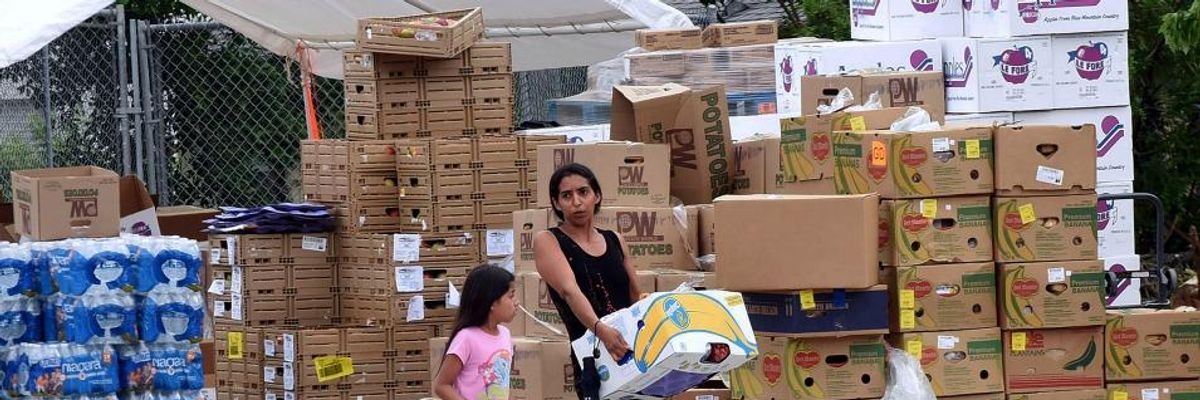
A woman with a child carries a box of food assistance she received from the Second Harvest Food Bank of Central Florida at a mobile food drop event at the Impact Outreach Ministry on April 6, 2020 in Orlando, Florida. While donations are down, many food banks across the country are scrambling to keep up with a skyrocketing demand for food due to job losses as businesses furlough workers due to the COVID-19 pandemic. (Photo: Paul Hennessy/NurPhoto via Getty Images)
A poll released by the U.S. Census Bureau this week revealed that at least nine million American households that include children are unsure whether they'll be able to access enough food in the next four weeks and millions more are experiencing housing insecurity during the coronavirus pandemic.
The bureau's weekly Household Pulse Survey, taken between May 14 and 19, asked respondents about their loss of employment, food security, overall health, and other issues they are facing during the pandemic.
According to the data, more than nine million households are "not at all confident" that they will be able to afford food in the next month, and more than 18 million are only "somewhat confident" about their food security.
The Census also asked respondents whether they had experienced food insecurity prior to March 13, when President Donald Trump declared the pandemic a national emergency and schools across the country shut down.
Just over two million people had "often" not had enough to eat before the pandemic forced state and local economies to shut down, which was followed by little economic relief for families from the federal government.
Since the coronavirus outbreak began spreading across the country in March, food banks have reported skyrocketing numbers of Americans relying on their services, including many who had never before needed assistance accessing food. With 74% of U.S. families living paycheck-to-paycheck--including one in four households that earn at least $150,000 per year--the pandemic and the federal government's reluctance to offer more than a one-time direct payment of $1,200 to most Americans plunged millions into desperate situations overnight.
As Common Dreams reported Wednesday, the same Household Pulse Survey revealed that a quarter of respondents weren't able to pay their rent or mortgage in May or were concerned they wouldn't be able to pay in June.
Intercept journalist Rachel Cohen pointed out on social media that the widespread economic uncertainty that's grown out of the pandemic is having reverberating effects on Americans' overall wellbeing.
A Census survey taken earlier this month found that a third of Americans are showing signs of clinical anxiety or depression since the pandemic began.
The data released by the Census Bureau in its weekly surveys has intensified calls for government intervention to ensure people are not evicted from their homes if they can't pay their rent due to job loss, to provide Americans with more robust direct payments for the duration of the crisis, and to prioritize making sure people have access to the medical and mental healthcare they need.
"Now that the government knows how widely people are suffering, the question is what are they going to do about it," psychiatrist Maria A. Oquendo told the Washington Post on Wednesday.
Dear Common Dreams reader, It’s been nearly 30 years since I co-founded Common Dreams with my late wife, Lina Newhouser. We had the radical notion that journalism should serve the public good, not corporate profits. It was clear to us from the outset what it would take to build such a project. No paid advertisements. No corporate sponsors. No millionaire publisher telling us what to think or do. Many people said we wouldn't last a year, but we proved those doubters wrong. Together with a tremendous team of journalists and dedicated staff, we built an independent media outlet free from the constraints of profits and corporate control. Our mission has always been simple: To inform. To inspire. To ignite change for the common good. Building Common Dreams was not easy. Our survival was never guaranteed. When you take on the most powerful forces—Wall Street greed, fossil fuel industry destruction, Big Tech lobbyists, and uber-rich oligarchs who have spent billions upon billions rigging the economy and democracy in their favor—the only bulwark you have is supporters who believe in your work. But here’s the urgent message from me today. It's never been this bad out there. And it's never been this hard to keep us going. At the very moment Common Dreams is most needed, the threats we face are intensifying. We need your support now more than ever. We don't accept corporate advertising and never will. We don't have a paywall because we don't think people should be blocked from critical news based on their ability to pay. Everything we do is funded by the donations of readers like you. When everyone does the little they can afford, we are strong. But if that support retreats or dries up, so do we. Will you donate now to make sure Common Dreams not only survives but thrives? —Craig Brown, Co-founder |
A poll released by the U.S. Census Bureau this week revealed that at least nine million American households that include children are unsure whether they'll be able to access enough food in the next four weeks and millions more are experiencing housing insecurity during the coronavirus pandemic.
The bureau's weekly Household Pulse Survey, taken between May 14 and 19, asked respondents about their loss of employment, food security, overall health, and other issues they are facing during the pandemic.
According to the data, more than nine million households are "not at all confident" that they will be able to afford food in the next month, and more than 18 million are only "somewhat confident" about their food security.
The Census also asked respondents whether they had experienced food insecurity prior to March 13, when President Donald Trump declared the pandemic a national emergency and schools across the country shut down.
Just over two million people had "often" not had enough to eat before the pandemic forced state and local economies to shut down, which was followed by little economic relief for families from the federal government.
Since the coronavirus outbreak began spreading across the country in March, food banks have reported skyrocketing numbers of Americans relying on their services, including many who had never before needed assistance accessing food. With 74% of U.S. families living paycheck-to-paycheck--including one in four households that earn at least $150,000 per year--the pandemic and the federal government's reluctance to offer more than a one-time direct payment of $1,200 to most Americans plunged millions into desperate situations overnight.
As Common Dreams reported Wednesday, the same Household Pulse Survey revealed that a quarter of respondents weren't able to pay their rent or mortgage in May or were concerned they wouldn't be able to pay in June.
Intercept journalist Rachel Cohen pointed out on social media that the widespread economic uncertainty that's grown out of the pandemic is having reverberating effects on Americans' overall wellbeing.
A Census survey taken earlier this month found that a third of Americans are showing signs of clinical anxiety or depression since the pandemic began.
The data released by the Census Bureau in its weekly surveys has intensified calls for government intervention to ensure people are not evicted from their homes if they can't pay their rent due to job loss, to provide Americans with more robust direct payments for the duration of the crisis, and to prioritize making sure people have access to the medical and mental healthcare they need.
"Now that the government knows how widely people are suffering, the question is what are they going to do about it," psychiatrist Maria A. Oquendo told the Washington Post on Wednesday.
A poll released by the U.S. Census Bureau this week revealed that at least nine million American households that include children are unsure whether they'll be able to access enough food in the next four weeks and millions more are experiencing housing insecurity during the coronavirus pandemic.
The bureau's weekly Household Pulse Survey, taken between May 14 and 19, asked respondents about their loss of employment, food security, overall health, and other issues they are facing during the pandemic.
According to the data, more than nine million households are "not at all confident" that they will be able to afford food in the next month, and more than 18 million are only "somewhat confident" about their food security.
The Census also asked respondents whether they had experienced food insecurity prior to March 13, when President Donald Trump declared the pandemic a national emergency and schools across the country shut down.
Just over two million people had "often" not had enough to eat before the pandemic forced state and local economies to shut down, which was followed by little economic relief for families from the federal government.
Since the coronavirus outbreak began spreading across the country in March, food banks have reported skyrocketing numbers of Americans relying on their services, including many who had never before needed assistance accessing food. With 74% of U.S. families living paycheck-to-paycheck--including one in four households that earn at least $150,000 per year--the pandemic and the federal government's reluctance to offer more than a one-time direct payment of $1,200 to most Americans plunged millions into desperate situations overnight.
As Common Dreams reported Wednesday, the same Household Pulse Survey revealed that a quarter of respondents weren't able to pay their rent or mortgage in May or were concerned they wouldn't be able to pay in June.
Intercept journalist Rachel Cohen pointed out on social media that the widespread economic uncertainty that's grown out of the pandemic is having reverberating effects on Americans' overall wellbeing.
A Census survey taken earlier this month found that a third of Americans are showing signs of clinical anxiety or depression since the pandemic began.
The data released by the Census Bureau in its weekly surveys has intensified calls for government intervention to ensure people are not evicted from their homes if they can't pay their rent due to job loss, to provide Americans with more robust direct payments for the duration of the crisis, and to prioritize making sure people have access to the medical and mental healthcare they need.
"Now that the government knows how widely people are suffering, the question is what are they going to do about it," psychiatrist Maria A. Oquendo told the Washington Post on Wednesday.