SUBSCRIBE TO OUR FREE NEWSLETTER
Daily news & progressive opinion—funded by the people, not the corporations—delivered straight to your inbox.
5
#000000
#FFFFFF
To donate by check, phone, or other method, see our More Ways to Give page.
Daily news & progressive opinion—funded by the people, not the corporations—delivered straight to your inbox.
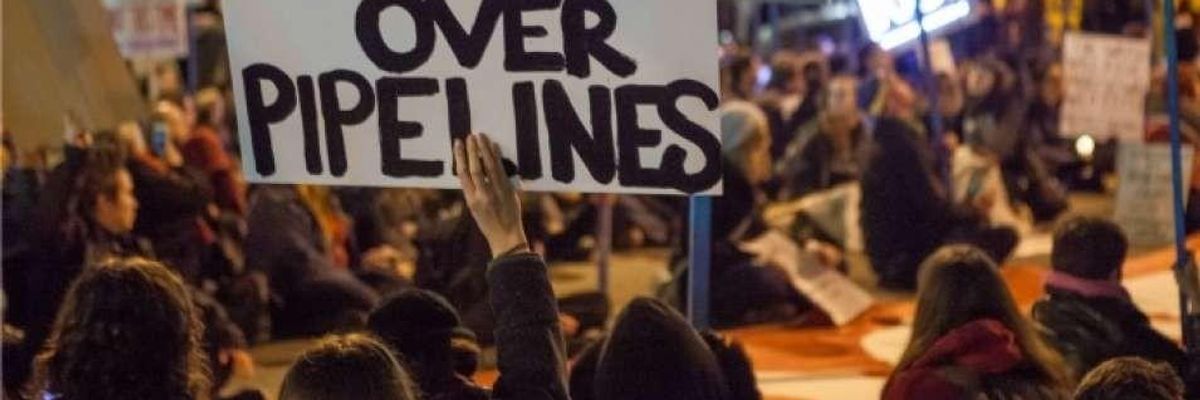
A national coalition sued the White House Wednesday over its neutering of the National Environmental Policy Act (NEPA). (Photo: Pax Ahimsa Gethen/Flickr/cc)
A coalition of 20 organizations filed a lawsuit on Wednesday seeking to block the Trump administration's gutting of a law dubbed the "Magna Carta" of U.S. environmental legislation.
The National Environmental Policy Act (NEPA), a five-decade old law, "embodies our nation's environmental conscience" and "expressly commands the federal government to 'fulfill the responsibilities of each generation as trustee of the environment for succeeding generations,'" according to the filing (pdf).
The White House announced earlier this month its revisions to the bedrock law affecting infrastructure including pipelines and dams, a revamp that Kristen Boyles, an Earthjustice attorney and co-counsel on the case, framed as the Trump administration wanting "to make it easier to silence people's voices and give polluters a free pass to bulldoze through our neighborhoods."
"That's why we're taking them to court," said Boyes.
Western Environmental Law Center joins Earthjustice in representing the groups including WE ACT for Environmental Justice, The Wilderness Society, and Alaska Community Action on Toxics--a coalition linked in their reliance "on NEPA to protect their varied interests in human health and the environment."
The groups name the Council on Environmental Quality (CEQ), which oversees implementation of NEPA, as plaintiff along with CEQ chairman Mary Neumayr.
The filing states that the "current administration explicitly admitted that it placed the interests of pipelines, fossil fuel energy production, and road building over that of environmental and public health," and explains that:
More than an update, the Final Rule upends virtually every aspect of NEPA and its longstanding practice, contradicts decades of court interpretations of NEPA's mandates, and undercuts the reliance placed on NEPA by the public, decision-makers, and project proponents. The Final Rule limits the scope of actions to which NEPA applies, eviscerates the thorough environmental analysis that lies at the heart of the statute, reduces the ability of the public to participate in federal agency decision-making, and seeks to limit judicial review of agency NEPA compliance. All told, the Final Rule frustrates Congress's manifest intent in enacting NEPA and threatens human health and the environment.
"We won't allow the Trump administration's scorched-earth attack on this bedrock environmental law to stand," Brett Hartl, government affairs director at Center for Biological Diversity, said in a statement.
"NEPA was designed to protect the most vulnerable among us and give folks a voice in what happens in their communities," said Hartl, and "was intended to ensure a healthy environment and safeguard wildlife for generations to come."
The law "was never about making special interests richer, until now," he said.
Susan Jane Brown, Western Environmental Law Center co-counsel, says her group is more than ready for the legal battle ahead.
"We have consistently defeated this administration's relentless, vicious dismantling of safeguards for people and the environment," she said, "and we will do so again for this critically important law."
Dear Common Dreams reader, It’s been nearly 30 years since I co-founded Common Dreams with my late wife, Lina Newhouser. We had the radical notion that journalism should serve the public good, not corporate profits. It was clear to us from the outset what it would take to build such a project. No paid advertisements. No corporate sponsors. No millionaire publisher telling us what to think or do. Many people said we wouldn't last a year, but we proved those doubters wrong. Together with a tremendous team of journalists and dedicated staff, we built an independent media outlet free from the constraints of profits and corporate control. Our mission has always been simple: To inform. To inspire. To ignite change for the common good. Building Common Dreams was not easy. Our survival was never guaranteed. When you take on the most powerful forces—Wall Street greed, fossil fuel industry destruction, Big Tech lobbyists, and uber-rich oligarchs who have spent billions upon billions rigging the economy and democracy in their favor—the only bulwark you have is supporters who believe in your work. But here’s the urgent message from me today. It's never been this bad out there. And it's never been this hard to keep us going. At the very moment Common Dreams is most needed, the threats we face are intensifying. We need your support now more than ever. We don't accept corporate advertising and never will. We don't have a paywall because we don't think people should be blocked from critical news based on their ability to pay. Everything we do is funded by the donations of readers like you. When everyone does the little they can afford, we are strong. But if that support retreats or dries up, so do we. Will you donate now to make sure Common Dreams not only survives but thrives? —Craig Brown, Co-founder |
A coalition of 20 organizations filed a lawsuit on Wednesday seeking to block the Trump administration's gutting of a law dubbed the "Magna Carta" of U.S. environmental legislation.
The National Environmental Policy Act (NEPA), a five-decade old law, "embodies our nation's environmental conscience" and "expressly commands the federal government to 'fulfill the responsibilities of each generation as trustee of the environment for succeeding generations,'" according to the filing (pdf).
The White House announced earlier this month its revisions to the bedrock law affecting infrastructure including pipelines and dams, a revamp that Kristen Boyles, an Earthjustice attorney and co-counsel on the case, framed as the Trump administration wanting "to make it easier to silence people's voices and give polluters a free pass to bulldoze through our neighborhoods."
"That's why we're taking them to court," said Boyes.
Western Environmental Law Center joins Earthjustice in representing the groups including WE ACT for Environmental Justice, The Wilderness Society, and Alaska Community Action on Toxics--a coalition linked in their reliance "on NEPA to protect their varied interests in human health and the environment."
The groups name the Council on Environmental Quality (CEQ), which oversees implementation of NEPA, as plaintiff along with CEQ chairman Mary Neumayr.
The filing states that the "current administration explicitly admitted that it placed the interests of pipelines, fossil fuel energy production, and road building over that of environmental and public health," and explains that:
More than an update, the Final Rule upends virtually every aspect of NEPA and its longstanding practice, contradicts decades of court interpretations of NEPA's mandates, and undercuts the reliance placed on NEPA by the public, decision-makers, and project proponents. The Final Rule limits the scope of actions to which NEPA applies, eviscerates the thorough environmental analysis that lies at the heart of the statute, reduces the ability of the public to participate in federal agency decision-making, and seeks to limit judicial review of agency NEPA compliance. All told, the Final Rule frustrates Congress's manifest intent in enacting NEPA and threatens human health and the environment.
"We won't allow the Trump administration's scorched-earth attack on this bedrock environmental law to stand," Brett Hartl, government affairs director at Center for Biological Diversity, said in a statement.
"NEPA was designed to protect the most vulnerable among us and give folks a voice in what happens in their communities," said Hartl, and "was intended to ensure a healthy environment and safeguard wildlife for generations to come."
The law "was never about making special interests richer, until now," he said.
Susan Jane Brown, Western Environmental Law Center co-counsel, says her group is more than ready for the legal battle ahead.
"We have consistently defeated this administration's relentless, vicious dismantling of safeguards for people and the environment," she said, "and we will do so again for this critically important law."
A coalition of 20 organizations filed a lawsuit on Wednesday seeking to block the Trump administration's gutting of a law dubbed the "Magna Carta" of U.S. environmental legislation.
The National Environmental Policy Act (NEPA), a five-decade old law, "embodies our nation's environmental conscience" and "expressly commands the federal government to 'fulfill the responsibilities of each generation as trustee of the environment for succeeding generations,'" according to the filing (pdf).
The White House announced earlier this month its revisions to the bedrock law affecting infrastructure including pipelines and dams, a revamp that Kristen Boyles, an Earthjustice attorney and co-counsel on the case, framed as the Trump administration wanting "to make it easier to silence people's voices and give polluters a free pass to bulldoze through our neighborhoods."
"That's why we're taking them to court," said Boyes.
Western Environmental Law Center joins Earthjustice in representing the groups including WE ACT for Environmental Justice, The Wilderness Society, and Alaska Community Action on Toxics--a coalition linked in their reliance "on NEPA to protect their varied interests in human health and the environment."
The groups name the Council on Environmental Quality (CEQ), which oversees implementation of NEPA, as plaintiff along with CEQ chairman Mary Neumayr.
The filing states that the "current administration explicitly admitted that it placed the interests of pipelines, fossil fuel energy production, and road building over that of environmental and public health," and explains that:
More than an update, the Final Rule upends virtually every aspect of NEPA and its longstanding practice, contradicts decades of court interpretations of NEPA's mandates, and undercuts the reliance placed on NEPA by the public, decision-makers, and project proponents. The Final Rule limits the scope of actions to which NEPA applies, eviscerates the thorough environmental analysis that lies at the heart of the statute, reduces the ability of the public to participate in federal agency decision-making, and seeks to limit judicial review of agency NEPA compliance. All told, the Final Rule frustrates Congress's manifest intent in enacting NEPA and threatens human health and the environment.
"We won't allow the Trump administration's scorched-earth attack on this bedrock environmental law to stand," Brett Hartl, government affairs director at Center for Biological Diversity, said in a statement.
"NEPA was designed to protect the most vulnerable among us and give folks a voice in what happens in their communities," said Hartl, and "was intended to ensure a healthy environment and safeguard wildlife for generations to come."
The law "was never about making special interests richer, until now," he said.
Susan Jane Brown, Western Environmental Law Center co-counsel, says her group is more than ready for the legal battle ahead.
"We have consistently defeated this administration's relentless, vicious dismantling of safeguards for people and the environment," she said, "and we will do so again for this critically important law."