

SUBSCRIBE TO OUR FREE NEWSLETTER
Daily news & progressive opinion—funded by the people, not the corporations—delivered straight to your inbox.
5
#000000
#FFFFFF
To donate by check, phone, or other method, see our More Ways to Give page.
Daily news & progressive opinion—funded by the people, not the corporations—delivered straight to your inbox.
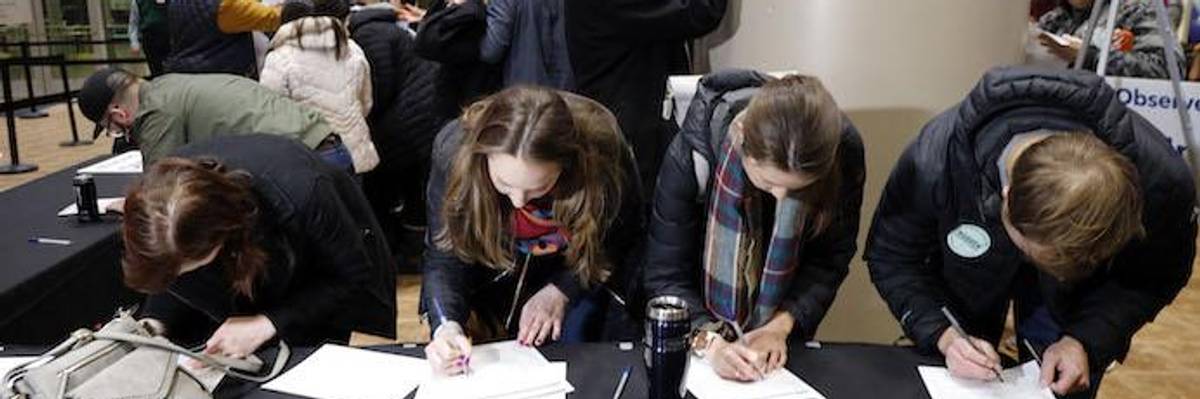
Democratic voters attend the caucus at the Wells Fargo Arena in Des Moines, Iowa, the United States, Feb. 3, 2020. (Photo: Li Muzi/Xinhua via Getty) (Xinhua/Li Muzi via Getty Images)
In a development heralded as "a historic sea change," Iowa Gov. Kim Reynolds signed an executive order on Wednesday overturning the state's policy of permanently banning those with felony convictions from voting.
"Today we take a significant step forward in acknowledging the importance of redemption, second chances, and the need to address inequalities in our justice system," said Reynolds, a Republican, whose order (pdf) is expected to restore voting rights to roughly 40,000 people.
Vanita Gupta, president and CEO of The Leadership Conference on Civil and Human Rights, welcomed the order.
"This is a big deal," Gupta tweeted. "Iowa was the last remaining state that permanently and categorically banned people with former convictions from voting."
Previously, those who'd completed felony sentences had to individually appeal to the governor for possible re-enfranchisement.
Eliza Sweren-Becke, voting rights and elections counsel at the Brennan Center for Justice, responded similarly to the order, tweeting, "This is a HUGE--now NO state in the country has a policy of permanently and categorically banning people from voting because of past convictions--a historic sea change."
The change is also good news for racial justice.
"This action will benefit people regardless of race or ethnicity, but with the grave racial disparities in our criminal justice system, it will very significantly benefit African Americans and other people of color," Betty C. Andrews, president of the Iowa-Nebraska NAACP, said in a statement.
As KPBS reported:
Reynolds' order restores voting rights to felons who have completed their sentence, including probation, parole, and special sentences that are associated with sex offenses. Reynolds' order does not require payment of victim restitution or any other fines or fees as a condition of being able to vote, a point of contention in Florida that has been caught up in court.
The order doesn't cover those convicted of felony homicide offenses--an exclusion lamented by ACLU of Iowa executive director Mark Stringer, who said his group would "continue to work to ensure that all Iowans who have completed their sentences can once again participate in the democracy that so profoundly affects them."
Voting rights advocates also recognized that Wednesday's win could be easily yanked away--they saw that happen in 2011 when then-Gov. Terry Branstad rescinded a 2005 executive order that had restored voting rights to Iowans who had completed sentences for felony convictions.
As such, said Stringer, "it's important that we continue to pursue a more permanent fix to the problem of felony disenfranchisement in our state. Another governor could issue a different executive order to reverse this current executive order."
"That's why we'll continue to advocate for an amendment to the Iowa Constitution," he said.
Dear Common Dreams reader, It’s been nearly 30 years since I co-founded Common Dreams with my late wife, Lina Newhouser. We had the radical notion that journalism should serve the public good, not corporate profits. It was clear to us from the outset what it would take to build such a project. No paid advertisements. No corporate sponsors. No millionaire publisher telling us what to think or do. Many people said we wouldn't last a year, but we proved those doubters wrong. Together with a tremendous team of journalists and dedicated staff, we built an independent media outlet free from the constraints of profits and corporate control. Our mission has always been simple: To inform. To inspire. To ignite change for the common good. Building Common Dreams was not easy. Our survival was never guaranteed. When you take on the most powerful forces—Wall Street greed, fossil fuel industry destruction, Big Tech lobbyists, and uber-rich oligarchs who have spent billions upon billions rigging the economy and democracy in their favor—the only bulwark you have is supporters who believe in your work. But here’s the urgent message from me today. It's never been this bad out there. And it's never been this hard to keep us going. At the very moment Common Dreams is most needed, the threats we face are intensifying. We need your support now more than ever. We don't accept corporate advertising and never will. We don't have a paywall because we don't think people should be blocked from critical news based on their ability to pay. Everything we do is funded by the donations of readers like you. When everyone does the little they can afford, we are strong. But if that support retreats or dries up, so do we. Will you donate now to make sure Common Dreams not only survives but thrives? —Craig Brown, Co-founder |
In a development heralded as "a historic sea change," Iowa Gov. Kim Reynolds signed an executive order on Wednesday overturning the state's policy of permanently banning those with felony convictions from voting.
"Today we take a significant step forward in acknowledging the importance of redemption, second chances, and the need to address inequalities in our justice system," said Reynolds, a Republican, whose order (pdf) is expected to restore voting rights to roughly 40,000 people.
Vanita Gupta, president and CEO of The Leadership Conference on Civil and Human Rights, welcomed the order.
"This is a big deal," Gupta tweeted. "Iowa was the last remaining state that permanently and categorically banned people with former convictions from voting."
Previously, those who'd completed felony sentences had to individually appeal to the governor for possible re-enfranchisement.
Eliza Sweren-Becke, voting rights and elections counsel at the Brennan Center for Justice, responded similarly to the order, tweeting, "This is a HUGE--now NO state in the country has a policy of permanently and categorically banning people from voting because of past convictions--a historic sea change."
The change is also good news for racial justice.
"This action will benefit people regardless of race or ethnicity, but with the grave racial disparities in our criminal justice system, it will very significantly benefit African Americans and other people of color," Betty C. Andrews, president of the Iowa-Nebraska NAACP, said in a statement.
As KPBS reported:
Reynolds' order restores voting rights to felons who have completed their sentence, including probation, parole, and special sentences that are associated with sex offenses. Reynolds' order does not require payment of victim restitution or any other fines or fees as a condition of being able to vote, a point of contention in Florida that has been caught up in court.
The order doesn't cover those convicted of felony homicide offenses--an exclusion lamented by ACLU of Iowa executive director Mark Stringer, who said his group would "continue to work to ensure that all Iowans who have completed their sentences can once again participate in the democracy that so profoundly affects them."
Voting rights advocates also recognized that Wednesday's win could be easily yanked away--they saw that happen in 2011 when then-Gov. Terry Branstad rescinded a 2005 executive order that had restored voting rights to Iowans who had completed sentences for felony convictions.
As such, said Stringer, "it's important that we continue to pursue a more permanent fix to the problem of felony disenfranchisement in our state. Another governor could issue a different executive order to reverse this current executive order."
"That's why we'll continue to advocate for an amendment to the Iowa Constitution," he said.
In a development heralded as "a historic sea change," Iowa Gov. Kim Reynolds signed an executive order on Wednesday overturning the state's policy of permanently banning those with felony convictions from voting.
"Today we take a significant step forward in acknowledging the importance of redemption, second chances, and the need to address inequalities in our justice system," said Reynolds, a Republican, whose order (pdf) is expected to restore voting rights to roughly 40,000 people.
Vanita Gupta, president and CEO of The Leadership Conference on Civil and Human Rights, welcomed the order.
"This is a big deal," Gupta tweeted. "Iowa was the last remaining state that permanently and categorically banned people with former convictions from voting."
Previously, those who'd completed felony sentences had to individually appeal to the governor for possible re-enfranchisement.
Eliza Sweren-Becke, voting rights and elections counsel at the Brennan Center for Justice, responded similarly to the order, tweeting, "This is a HUGE--now NO state in the country has a policy of permanently and categorically banning people from voting because of past convictions--a historic sea change."
The change is also good news for racial justice.
"This action will benefit people regardless of race or ethnicity, but with the grave racial disparities in our criminal justice system, it will very significantly benefit African Americans and other people of color," Betty C. Andrews, president of the Iowa-Nebraska NAACP, said in a statement.
As KPBS reported:
Reynolds' order restores voting rights to felons who have completed their sentence, including probation, parole, and special sentences that are associated with sex offenses. Reynolds' order does not require payment of victim restitution or any other fines or fees as a condition of being able to vote, a point of contention in Florida that has been caught up in court.
The order doesn't cover those convicted of felony homicide offenses--an exclusion lamented by ACLU of Iowa executive director Mark Stringer, who said his group would "continue to work to ensure that all Iowans who have completed their sentences can once again participate in the democracy that so profoundly affects them."
Voting rights advocates also recognized that Wednesday's win could be easily yanked away--they saw that happen in 2011 when then-Gov. Terry Branstad rescinded a 2005 executive order that had restored voting rights to Iowans who had completed sentences for felony convictions.
As such, said Stringer, "it's important that we continue to pursue a more permanent fix to the problem of felony disenfranchisement in our state. Another governor could issue a different executive order to reverse this current executive order."
"That's why we'll continue to advocate for an amendment to the Iowa Constitution," he said.

