SUBSCRIBE TO OUR FREE NEWSLETTER
Daily news & progressive opinion—funded by the people, not the corporations—delivered straight to your inbox.
5
#000000
#FFFFFF
To donate by check, phone, or other method, see our More Ways to Give page.
Daily news & progressive opinion—funded by the people, not the corporations—delivered straight to your inbox.
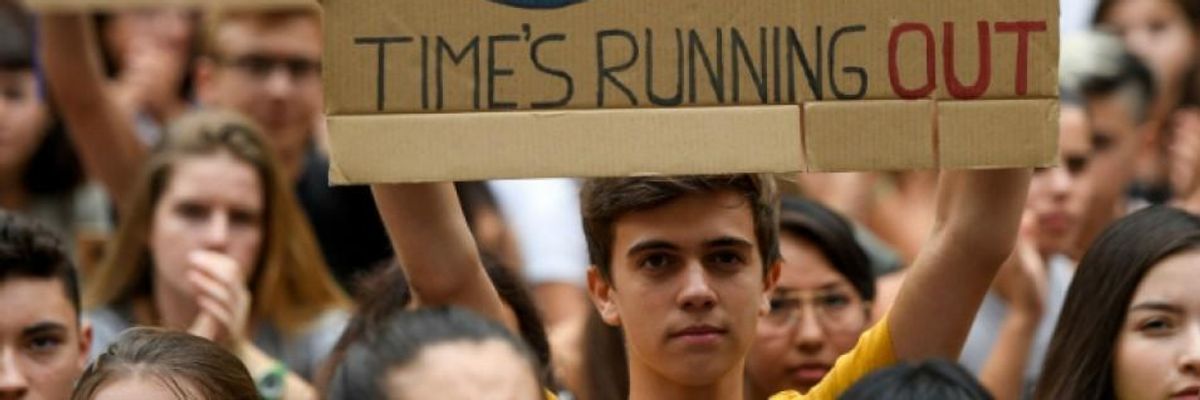
A demonstrator holds a placard reading "time is running out" during a global youth climate action strike in Barcelona, on September 27, 2019 at the end of a global climate change week. (Photo: Josep Lago/AFP via Getty Images)
A temporary fall in planet-warming emissions and pollutants triggered by the coronavirus pandemic will have a "negligible" effect on reining in the climate crisis, according to a study published Friday that underscores the need for a "green stimulus recovery" to fundamentally transform carbon-based economies.
For the study, published in Nature Climate Change, researchers looked at emissions--CO2 and nine others including methane and nitrous oxides--in 123 countries from February to June 2020. The international team estimated emissions fell roughly between 10%-30% globally, with peak emission reductions probably occurring mid-April.
But the blip will do little to address runaway warming and its impacts. The "direct effect of the pandemic-driven response will be negligible," the researchers wrote.
Study lead author Professor Piers Forster, director of the Priestley International Centre for Climate at Britain's University of Leeds, explained at The Conversation Friday:
even if some lockdown measures stay in place for the best part of two years, global temperatures will still only be 0.01degC lower than if we followed an emission pathway where the pandemic never happened.
So rather than helping to tackle climate change, lockdown has left us potentially picking up where we left off. It shows that, even if we lived in a world where the social and economic impacts of lockdown were acceptable, we still need far more serious measures to make a difference--we need structural change.
There's a clear opportunity to change course and right the path towards meeting a key limit of the Paris climate agreement, the researchers said.
While a fossil fuel-based recovery puts the world on a trajectory "to exceed 1.5 degC above pre-industrial limit by 2050," Forster and fellow researchers found that "choosing a pathway with strong green stimulus assumptions, including climate policy measures, has a good chance of keeping global temperature change above pre-industrial within the 1.5deg C limit, saving around 0.3deg C of future warming by 2050."
Study co-author Corinne Le Quere from the University of East Anglia pointed to "government responses [that] could be a turning point if they focus on a green recovery, helping to avoid severe impacts from climate change."
Policymakers are thus looking at a fork in the road--and one of the paths is on fire.
"The choices made now could give us a strong chance of avoiding 0.3@C of additional warming by mid-century, halving the expected warming under current policies. This could mean the difference between success and failure when it comes to avoiding dangerous climate change," Forster said in a statement.
"The study also highlights the opportunities in lowering traffic pollution by encouraging low emissions vehicles, public transport, and cycle lanes," Forster added. "The better air quality will immediately have important health effects--and it will immediately start cooling the climate."
The planning that's happening right now as world leaders hammer out stimulus agreements and progressive activists issue calls to "build back better," said study co-author Joeri Rogelj from the Grantham Institute--Climate Change and the Environment at Imperial College London, will have reverberations for years to come.
"Both sobering and hopeful, the flash crash in global emissions due to lockdown measures will have no measurable impact on global temperatures by 2030, but the decisions we make this year about how to recover from this crisis can put us on a solid track to meet the Paris Agreement," said Rogelj.
"Out of this tragedy comes an opportunity," he said, "but unless it is seized a more polluting next decade is not excluded."
Dear Common Dreams reader, It’s been nearly 30 years since I co-founded Common Dreams with my late wife, Lina Newhouser. We had the radical notion that journalism should serve the public good, not corporate profits. It was clear to us from the outset what it would take to build such a project. No paid advertisements. No corporate sponsors. No millionaire publisher telling us what to think or do. Many people said we wouldn't last a year, but we proved those doubters wrong. Together with a tremendous team of journalists and dedicated staff, we built an independent media outlet free from the constraints of profits and corporate control. Our mission has always been simple: To inform. To inspire. To ignite change for the common good. Building Common Dreams was not easy. Our survival was never guaranteed. When you take on the most powerful forces—Wall Street greed, fossil fuel industry destruction, Big Tech lobbyists, and uber-rich oligarchs who have spent billions upon billions rigging the economy and democracy in their favor—the only bulwark you have is supporters who believe in your work. But here’s the urgent message from me today. It's never been this bad out there. And it's never been this hard to keep us going. At the very moment Common Dreams is most needed, the threats we face are intensifying. We need your support now more than ever. We don't accept corporate advertising and never will. We don't have a paywall because we don't think people should be blocked from critical news based on their ability to pay. Everything we do is funded by the donations of readers like you. When everyone does the little they can afford, we are strong. But if that support retreats or dries up, so do we. Will you donate now to make sure Common Dreams not only survives but thrives? —Craig Brown, Co-founder |
A temporary fall in planet-warming emissions and pollutants triggered by the coronavirus pandemic will have a "negligible" effect on reining in the climate crisis, according to a study published Friday that underscores the need for a "green stimulus recovery" to fundamentally transform carbon-based economies.
For the study, published in Nature Climate Change, researchers looked at emissions--CO2 and nine others including methane and nitrous oxides--in 123 countries from February to June 2020. The international team estimated emissions fell roughly between 10%-30% globally, with peak emission reductions probably occurring mid-April.
But the blip will do little to address runaway warming and its impacts. The "direct effect of the pandemic-driven response will be negligible," the researchers wrote.
Study lead author Professor Piers Forster, director of the Priestley International Centre for Climate at Britain's University of Leeds, explained at The Conversation Friday:
even if some lockdown measures stay in place for the best part of two years, global temperatures will still only be 0.01degC lower than if we followed an emission pathway where the pandemic never happened.
So rather than helping to tackle climate change, lockdown has left us potentially picking up where we left off. It shows that, even if we lived in a world where the social and economic impacts of lockdown were acceptable, we still need far more serious measures to make a difference--we need structural change.
There's a clear opportunity to change course and right the path towards meeting a key limit of the Paris climate agreement, the researchers said.
While a fossil fuel-based recovery puts the world on a trajectory "to exceed 1.5 degC above pre-industrial limit by 2050," Forster and fellow researchers found that "choosing a pathway with strong green stimulus assumptions, including climate policy measures, has a good chance of keeping global temperature change above pre-industrial within the 1.5deg C limit, saving around 0.3deg C of future warming by 2050."
Study co-author Corinne Le Quere from the University of East Anglia pointed to "government responses [that] could be a turning point if they focus on a green recovery, helping to avoid severe impacts from climate change."
Policymakers are thus looking at a fork in the road--and one of the paths is on fire.
"The choices made now could give us a strong chance of avoiding 0.3@C of additional warming by mid-century, halving the expected warming under current policies. This could mean the difference between success and failure when it comes to avoiding dangerous climate change," Forster said in a statement.
"The study also highlights the opportunities in lowering traffic pollution by encouraging low emissions vehicles, public transport, and cycle lanes," Forster added. "The better air quality will immediately have important health effects--and it will immediately start cooling the climate."
The planning that's happening right now as world leaders hammer out stimulus agreements and progressive activists issue calls to "build back better," said study co-author Joeri Rogelj from the Grantham Institute--Climate Change and the Environment at Imperial College London, will have reverberations for years to come.
"Both sobering and hopeful, the flash crash in global emissions due to lockdown measures will have no measurable impact on global temperatures by 2030, but the decisions we make this year about how to recover from this crisis can put us on a solid track to meet the Paris Agreement," said Rogelj.
"Out of this tragedy comes an opportunity," he said, "but unless it is seized a more polluting next decade is not excluded."
A temporary fall in planet-warming emissions and pollutants triggered by the coronavirus pandemic will have a "negligible" effect on reining in the climate crisis, according to a study published Friday that underscores the need for a "green stimulus recovery" to fundamentally transform carbon-based economies.
For the study, published in Nature Climate Change, researchers looked at emissions--CO2 and nine others including methane and nitrous oxides--in 123 countries from February to June 2020. The international team estimated emissions fell roughly between 10%-30% globally, with peak emission reductions probably occurring mid-April.
But the blip will do little to address runaway warming and its impacts. The "direct effect of the pandemic-driven response will be negligible," the researchers wrote.
Study lead author Professor Piers Forster, director of the Priestley International Centre for Climate at Britain's University of Leeds, explained at The Conversation Friday:
even if some lockdown measures stay in place for the best part of two years, global temperatures will still only be 0.01degC lower than if we followed an emission pathway where the pandemic never happened.
So rather than helping to tackle climate change, lockdown has left us potentially picking up where we left off. It shows that, even if we lived in a world where the social and economic impacts of lockdown were acceptable, we still need far more serious measures to make a difference--we need structural change.
There's a clear opportunity to change course and right the path towards meeting a key limit of the Paris climate agreement, the researchers said.
While a fossil fuel-based recovery puts the world on a trajectory "to exceed 1.5 degC above pre-industrial limit by 2050," Forster and fellow researchers found that "choosing a pathway with strong green stimulus assumptions, including climate policy measures, has a good chance of keeping global temperature change above pre-industrial within the 1.5deg C limit, saving around 0.3deg C of future warming by 2050."
Study co-author Corinne Le Quere from the University of East Anglia pointed to "government responses [that] could be a turning point if they focus on a green recovery, helping to avoid severe impacts from climate change."
Policymakers are thus looking at a fork in the road--and one of the paths is on fire.
"The choices made now could give us a strong chance of avoiding 0.3@C of additional warming by mid-century, halving the expected warming under current policies. This could mean the difference between success and failure when it comes to avoiding dangerous climate change," Forster said in a statement.
"The study also highlights the opportunities in lowering traffic pollution by encouraging low emissions vehicles, public transport, and cycle lanes," Forster added. "The better air quality will immediately have important health effects--and it will immediately start cooling the climate."
The planning that's happening right now as world leaders hammer out stimulus agreements and progressive activists issue calls to "build back better," said study co-author Joeri Rogelj from the Grantham Institute--Climate Change and the Environment at Imperial College London, will have reverberations for years to come.
"Both sobering and hopeful, the flash crash in global emissions due to lockdown measures will have no measurable impact on global temperatures by 2030, but the decisions we make this year about how to recover from this crisis can put us on a solid track to meet the Paris Agreement," said Rogelj.
"Out of this tragedy comes an opportunity," he said, "but unless it is seized a more polluting next decade is not excluded."