SUBSCRIBE TO OUR FREE NEWSLETTER
Daily news & progressive opinion—funded by the people, not the corporations—delivered straight to your inbox.
5
#000000
#FFFFFF
To donate by check, phone, or other method, see our More Ways to Give page.
Daily news & progressive opinion—funded by the people, not the corporations—delivered straight to your inbox.
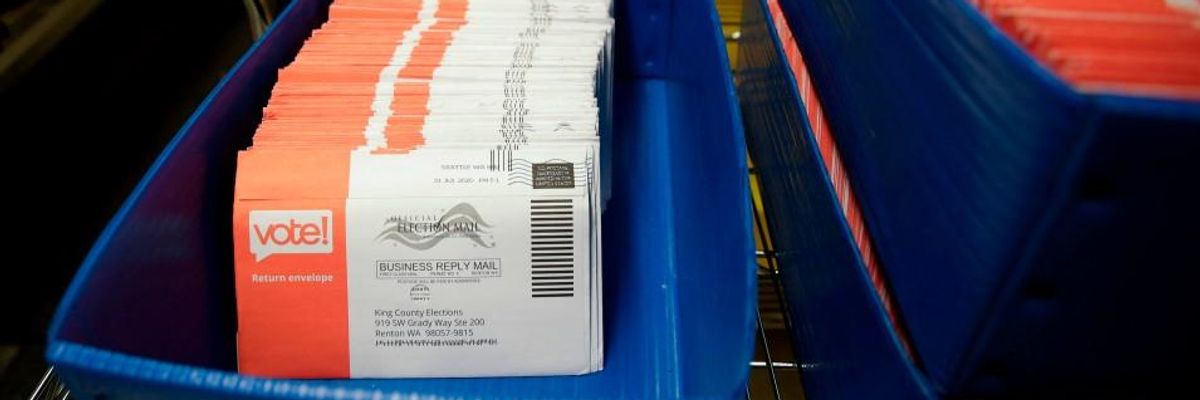
Vote-by-mail ballots for the August 4 Washington state primary are pictured at King County Elections in Renton, Washington on August 3, 2020. (Photo: Jason Redmond/AFP via Getty Images)
The U.S. Postal Service's internal watchdog issued in a report this week detailing a number of concerns about how prepared the service is for the upcoming November elections in which a record number of Americans are expected to vote by mail, with one Democratic lawmaker seizing the findings as further evidence of the need for reforms "to prevent serious election mail delays and voting suppression."
The audit from the USPS Office of the Inspector General (OIG) was released Monday and probed the service's "readiness for timely processing of election and political mail." Among the findings were that 1.6 million pieces of election mail weren't delivered on time from April through June, and over 1 million primary ballots were at "high risk" of not getting back to election boards on time to be counted because they were sent out within seven days of an election.
"The Postal Service plays a vital role in the American democratic process and this role continues to grow as the volume of election and political mail increases," the OIG said.
Reviewed by the watchdog were seven processing and distribution centers (P&DCs)--Santa Clarita, California; Portland; Indianapolis; Baltimore; Charleston, South Carolina; Brooklyn, and Oklahoma City--that were handling materials for primary elections held in May and June 2020.
The audit was conducted before Postmaster General Louis DeJoy, a Trump campaign megadonor, took charge of the service in June and began a rollout of sweeping changes that prompted congressional hearings, demands for DeJoy's ouster, and nationwide rallies to #SaveThePostOffice.
A number of concerns were outlined in the watchdog's report: ballots mailed without barcode mail tracking technology; ballot mail piece designs that result in improper processing; election and political mail likely to be mailed too close to the election, resulting in insufficient time for the Postal Service to process and deliver the mailpieces; postmark requirements for ballots; and voter addresses that are out of date.
"An analysis of data determined the total number of identifiable election and political mail mailpieces not delivered on time from April 2020 through June 2020 for the seven P&DCs was about 1.6 million (8 percent) of 20.2 million mailpieces," the report said.
Actions by election officials were also blamed for problems with processing election materials.
"According to Postal Service management," the report said, "during the primary election season, election boards mailed over 1 million ballots to voters within seven days of an election. This put these ballots at high risk by not allowing sufficient time for delivery to voters and their subsequent delivery back to the election boards."
Sen. Richard Blumenthal (D-Conn.), sharing Wednesday the Washington Post's reporting on IG report, called the findings "more powerful proof that resources and reform are vital right away to prevent serious election mail delays and voting suppression."
"Plain fact and our pleas for action align with findings of this report," tweeted Blumenthal, warning that "a fiasco is clearly foreseeable."
Dear Common Dreams reader, It’s been nearly 30 years since I co-founded Common Dreams with my late wife, Lina Newhouser. We had the radical notion that journalism should serve the public good, not corporate profits. It was clear to us from the outset what it would take to build such a project. No paid advertisements. No corporate sponsors. No millionaire publisher telling us what to think or do. Many people said we wouldn't last a year, but we proved those doubters wrong. Together with a tremendous team of journalists and dedicated staff, we built an independent media outlet free from the constraints of profits and corporate control. Our mission has always been simple: To inform. To inspire. To ignite change for the common good. Building Common Dreams was not easy. Our survival was never guaranteed. When you take on the most powerful forces—Wall Street greed, fossil fuel industry destruction, Big Tech lobbyists, and uber-rich oligarchs who have spent billions upon billions rigging the economy and democracy in their favor—the only bulwark you have is supporters who believe in your work. But here’s the urgent message from me today. It's never been this bad out there. And it's never been this hard to keep us going. At the very moment Common Dreams is most needed, the threats we face are intensifying. We need your support now more than ever. We don't accept corporate advertising and never will. We don't have a paywall because we don't think people should be blocked from critical news based on their ability to pay. Everything we do is funded by the donations of readers like you. When everyone does the little they can afford, we are strong. But if that support retreats or dries up, so do we. Will you donate now to make sure Common Dreams not only survives but thrives? —Craig Brown, Co-founder |
The U.S. Postal Service's internal watchdog issued in a report this week detailing a number of concerns about how prepared the service is for the upcoming November elections in which a record number of Americans are expected to vote by mail, with one Democratic lawmaker seizing the findings as further evidence of the need for reforms "to prevent serious election mail delays and voting suppression."
The audit from the USPS Office of the Inspector General (OIG) was released Monday and probed the service's "readiness for timely processing of election and political mail." Among the findings were that 1.6 million pieces of election mail weren't delivered on time from April through June, and over 1 million primary ballots were at "high risk" of not getting back to election boards on time to be counted because they were sent out within seven days of an election.
"The Postal Service plays a vital role in the American democratic process and this role continues to grow as the volume of election and political mail increases," the OIG said.
Reviewed by the watchdog were seven processing and distribution centers (P&DCs)--Santa Clarita, California; Portland; Indianapolis; Baltimore; Charleston, South Carolina; Brooklyn, and Oklahoma City--that were handling materials for primary elections held in May and June 2020.
The audit was conducted before Postmaster General Louis DeJoy, a Trump campaign megadonor, took charge of the service in June and began a rollout of sweeping changes that prompted congressional hearings, demands for DeJoy's ouster, and nationwide rallies to #SaveThePostOffice.
A number of concerns were outlined in the watchdog's report: ballots mailed without barcode mail tracking technology; ballot mail piece designs that result in improper processing; election and political mail likely to be mailed too close to the election, resulting in insufficient time for the Postal Service to process and deliver the mailpieces; postmark requirements for ballots; and voter addresses that are out of date.
"An analysis of data determined the total number of identifiable election and political mail mailpieces not delivered on time from April 2020 through June 2020 for the seven P&DCs was about 1.6 million (8 percent) of 20.2 million mailpieces," the report said.
Actions by election officials were also blamed for problems with processing election materials.
"According to Postal Service management," the report said, "during the primary election season, election boards mailed over 1 million ballots to voters within seven days of an election. This put these ballots at high risk by not allowing sufficient time for delivery to voters and their subsequent delivery back to the election boards."
Sen. Richard Blumenthal (D-Conn.), sharing Wednesday the Washington Post's reporting on IG report, called the findings "more powerful proof that resources and reform are vital right away to prevent serious election mail delays and voting suppression."
"Plain fact and our pleas for action align with findings of this report," tweeted Blumenthal, warning that "a fiasco is clearly foreseeable."
The U.S. Postal Service's internal watchdog issued in a report this week detailing a number of concerns about how prepared the service is for the upcoming November elections in which a record number of Americans are expected to vote by mail, with one Democratic lawmaker seizing the findings as further evidence of the need for reforms "to prevent serious election mail delays and voting suppression."
The audit from the USPS Office of the Inspector General (OIG) was released Monday and probed the service's "readiness for timely processing of election and political mail." Among the findings were that 1.6 million pieces of election mail weren't delivered on time from April through June, and over 1 million primary ballots were at "high risk" of not getting back to election boards on time to be counted because they were sent out within seven days of an election.
"The Postal Service plays a vital role in the American democratic process and this role continues to grow as the volume of election and political mail increases," the OIG said.
Reviewed by the watchdog were seven processing and distribution centers (P&DCs)--Santa Clarita, California; Portland; Indianapolis; Baltimore; Charleston, South Carolina; Brooklyn, and Oklahoma City--that were handling materials for primary elections held in May and June 2020.
The audit was conducted before Postmaster General Louis DeJoy, a Trump campaign megadonor, took charge of the service in June and began a rollout of sweeping changes that prompted congressional hearings, demands for DeJoy's ouster, and nationwide rallies to #SaveThePostOffice.
A number of concerns were outlined in the watchdog's report: ballots mailed without barcode mail tracking technology; ballot mail piece designs that result in improper processing; election and political mail likely to be mailed too close to the election, resulting in insufficient time for the Postal Service to process and deliver the mailpieces; postmark requirements for ballots; and voter addresses that are out of date.
"An analysis of data determined the total number of identifiable election and political mail mailpieces not delivered on time from April 2020 through June 2020 for the seven P&DCs was about 1.6 million (8 percent) of 20.2 million mailpieces," the report said.
Actions by election officials were also blamed for problems with processing election materials.
"According to Postal Service management," the report said, "during the primary election season, election boards mailed over 1 million ballots to voters within seven days of an election. This put these ballots at high risk by not allowing sufficient time for delivery to voters and their subsequent delivery back to the election boards."
Sen. Richard Blumenthal (D-Conn.), sharing Wednesday the Washington Post's reporting on IG report, called the findings "more powerful proof that resources and reform are vital right away to prevent serious election mail delays and voting suppression."
"Plain fact and our pleas for action align with findings of this report," tweeted Blumenthal, warning that "a fiasco is clearly foreseeable."