SUBSCRIBE TO OUR FREE NEWSLETTER
Daily news & progressive opinion—funded by the people, not the corporations—delivered straight to your inbox.
5
#000000
#FFFFFF
To donate by check, phone, or other method, see our More Ways to Give page.
Daily news & progressive opinion—funded by the people, not the corporations—delivered straight to your inbox.
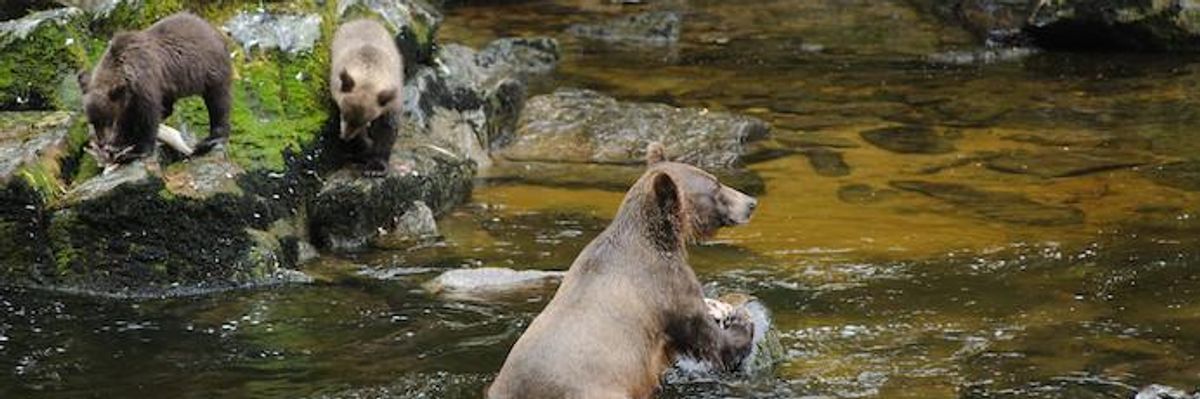
Brown bear and cubs fishing at Anan Creek in Tongass National Forest. (Photo: U.S. Forest Service/Mark Meyer)
The Trump administration on Friday moved closer to its goal of stripping conservation protections from the nation's largest national forest, putting over 9 million acres at risk of clear-cut logging and bulldozing for roads and sparking warnings of "irreversible ecological consequences."
"Forests are our guardians in our fight against the climate crisis, and we need forest protections more than ever if we are to avoid the worst impacts of the growing climate emergency."
--Amy Moas, Greenpeace USAThe proposal targets southeast Alaska's Tongass National Forest, which is described as "the crown jewel of the National Forest System" and "the still-thumping heart of a rainforest that once stretched uninterrupted from Northern California through Oregon, Washington, British Columbia, and Alaska."
"Of all the things our federal government could be devoting resources toward in 2020, slashing a rule to make way for clear-cutting in one of the world's last intact temperate rainforests shouldn't rank as a priority," said Kate Glover, Juneau-based staff attorney with Earthjustice.
The U.S. Forest Service announced (pdf) Friday its Final Environmental Impact Statement (EIS) for the widely-opposed plan to fully strip the area from the Clinton-era Roadless Rule protections. The "preferred alternative" described in the statement "removes all 9.37 million inventoried roadless acres on the Tongass from roadless designation."
The plan "would revert a net total of 168,000 old-growth acres and 20,000 young-growth acres previously identified as unsuitable timber lands to suitable timber lands," the EIS states.
A record of decision finalizing removal of the Roadless Rule is expected in 30 days.
Greenpeace USA senior forests campaigner Dr. Amy Moas warned that the "move by the Trump administration has irreversible ecological consequences, and sets a dangerous precedent for timber industry lobbyists and politicians in other states to secure access to our prized wild places."
"Forests are our guardians in our fight against the climate crisis, and we need forest protections more than ever if we are to avoid the worst impacts of the growing climate emergency," Moas continued. "Greenlighting logging, road building, and other destructive development in previously untouched portions of our national forests will be catastrophic for our future--both increasing pollution and limiting our ability to reduce it."
"What's more," she added, "a healthy Tongass is essential to the wellbeing of Alaska Natives, the local economy in Southeast Alaska, and an abundance of wildlife."
Indeed, the forest is key habitat for species including bears, wolves, and salmon and essential to the food security and way of life for the Tlingit, Haida, and Tsimshian peoples.
Audubon Alaska released a video Friday highlighting the voice of Joel Jackson, president of the Organized Village of Kake, who asks, if the large-scale logging in Tongass is approved, "Are we even going to have future generations?"
With the EIS now released, Greenpeace's Moas said "it's imperative that Congress acts" and pointed to legislation proposed in May as a means to counter the administration's planned assault on Tongass.
"We need our legislators to codify one of the most popular conservation measures of the last century so nothing and no one can threaten our last wild places again. The Roadless Area Conservation Act could reverse this decision and place wildlife, recreation, and the health of our planet at the center of intact wild places instead of the interests of wealthy elites," said Moas.
"Without forests," she added, "we are without a future."
Dear Common Dreams reader, It’s been nearly 30 years since I co-founded Common Dreams with my late wife, Lina Newhouser. We had the radical notion that journalism should serve the public good, not corporate profits. It was clear to us from the outset what it would take to build such a project. No paid advertisements. No corporate sponsors. No millionaire publisher telling us what to think or do. Many people said we wouldn't last a year, but we proved those doubters wrong. Together with a tremendous team of journalists and dedicated staff, we built an independent media outlet free from the constraints of profits and corporate control. Our mission has always been simple: To inform. To inspire. To ignite change for the common good. Building Common Dreams was not easy. Our survival was never guaranteed. When you take on the most powerful forces—Wall Street greed, fossil fuel industry destruction, Big Tech lobbyists, and uber-rich oligarchs who have spent billions upon billions rigging the economy and democracy in their favor—the only bulwark you have is supporters who believe in your work. But here’s the urgent message from me today. It's never been this bad out there. And it's never been this hard to keep us going. At the very moment Common Dreams is most needed, the threats we face are intensifying. We need your support now more than ever. We don't accept corporate advertising and never will. We don't have a paywall because we don't think people should be blocked from critical news based on their ability to pay. Everything we do is funded by the donations of readers like you. When everyone does the little they can afford, we are strong. But if that support retreats or dries up, so do we. Will you donate now to make sure Common Dreams not only survives but thrives? —Craig Brown, Co-founder |
The Trump administration on Friday moved closer to its goal of stripping conservation protections from the nation's largest national forest, putting over 9 million acres at risk of clear-cut logging and bulldozing for roads and sparking warnings of "irreversible ecological consequences."
"Forests are our guardians in our fight against the climate crisis, and we need forest protections more than ever if we are to avoid the worst impacts of the growing climate emergency."
--Amy Moas, Greenpeace USAThe proposal targets southeast Alaska's Tongass National Forest, which is described as "the crown jewel of the National Forest System" and "the still-thumping heart of a rainforest that once stretched uninterrupted from Northern California through Oregon, Washington, British Columbia, and Alaska."
"Of all the things our federal government could be devoting resources toward in 2020, slashing a rule to make way for clear-cutting in one of the world's last intact temperate rainforests shouldn't rank as a priority," said Kate Glover, Juneau-based staff attorney with Earthjustice.
The U.S. Forest Service announced (pdf) Friday its Final Environmental Impact Statement (EIS) for the widely-opposed plan to fully strip the area from the Clinton-era Roadless Rule protections. The "preferred alternative" described in the statement "removes all 9.37 million inventoried roadless acres on the Tongass from roadless designation."
The plan "would revert a net total of 168,000 old-growth acres and 20,000 young-growth acres previously identified as unsuitable timber lands to suitable timber lands," the EIS states.
A record of decision finalizing removal of the Roadless Rule is expected in 30 days.
Greenpeace USA senior forests campaigner Dr. Amy Moas warned that the "move by the Trump administration has irreversible ecological consequences, and sets a dangerous precedent for timber industry lobbyists and politicians in other states to secure access to our prized wild places."
"Forests are our guardians in our fight against the climate crisis, and we need forest protections more than ever if we are to avoid the worst impacts of the growing climate emergency," Moas continued. "Greenlighting logging, road building, and other destructive development in previously untouched portions of our national forests will be catastrophic for our future--both increasing pollution and limiting our ability to reduce it."
"What's more," she added, "a healthy Tongass is essential to the wellbeing of Alaska Natives, the local economy in Southeast Alaska, and an abundance of wildlife."
Indeed, the forest is key habitat for species including bears, wolves, and salmon and essential to the food security and way of life for the Tlingit, Haida, and Tsimshian peoples.
Audubon Alaska released a video Friday highlighting the voice of Joel Jackson, president of the Organized Village of Kake, who asks, if the large-scale logging in Tongass is approved, "Are we even going to have future generations?"
With the EIS now released, Greenpeace's Moas said "it's imperative that Congress acts" and pointed to legislation proposed in May as a means to counter the administration's planned assault on Tongass.
"We need our legislators to codify one of the most popular conservation measures of the last century so nothing and no one can threaten our last wild places again. The Roadless Area Conservation Act could reverse this decision and place wildlife, recreation, and the health of our planet at the center of intact wild places instead of the interests of wealthy elites," said Moas.
"Without forests," she added, "we are without a future."
The Trump administration on Friday moved closer to its goal of stripping conservation protections from the nation's largest national forest, putting over 9 million acres at risk of clear-cut logging and bulldozing for roads and sparking warnings of "irreversible ecological consequences."
"Forests are our guardians in our fight against the climate crisis, and we need forest protections more than ever if we are to avoid the worst impacts of the growing climate emergency."
--Amy Moas, Greenpeace USAThe proposal targets southeast Alaska's Tongass National Forest, which is described as "the crown jewel of the National Forest System" and "the still-thumping heart of a rainforest that once stretched uninterrupted from Northern California through Oregon, Washington, British Columbia, and Alaska."
"Of all the things our federal government could be devoting resources toward in 2020, slashing a rule to make way for clear-cutting in one of the world's last intact temperate rainforests shouldn't rank as a priority," said Kate Glover, Juneau-based staff attorney with Earthjustice.
The U.S. Forest Service announced (pdf) Friday its Final Environmental Impact Statement (EIS) for the widely-opposed plan to fully strip the area from the Clinton-era Roadless Rule protections. The "preferred alternative" described in the statement "removes all 9.37 million inventoried roadless acres on the Tongass from roadless designation."
The plan "would revert a net total of 168,000 old-growth acres and 20,000 young-growth acres previously identified as unsuitable timber lands to suitable timber lands," the EIS states.
A record of decision finalizing removal of the Roadless Rule is expected in 30 days.
Greenpeace USA senior forests campaigner Dr. Amy Moas warned that the "move by the Trump administration has irreversible ecological consequences, and sets a dangerous precedent for timber industry lobbyists and politicians in other states to secure access to our prized wild places."
"Forests are our guardians in our fight against the climate crisis, and we need forest protections more than ever if we are to avoid the worst impacts of the growing climate emergency," Moas continued. "Greenlighting logging, road building, and other destructive development in previously untouched portions of our national forests will be catastrophic for our future--both increasing pollution and limiting our ability to reduce it."
"What's more," she added, "a healthy Tongass is essential to the wellbeing of Alaska Natives, the local economy in Southeast Alaska, and an abundance of wildlife."
Indeed, the forest is key habitat for species including bears, wolves, and salmon and essential to the food security and way of life for the Tlingit, Haida, and Tsimshian peoples.
Audubon Alaska released a video Friday highlighting the voice of Joel Jackson, president of the Organized Village of Kake, who asks, if the large-scale logging in Tongass is approved, "Are we even going to have future generations?"
With the EIS now released, Greenpeace's Moas said "it's imperative that Congress acts" and pointed to legislation proposed in May as a means to counter the administration's planned assault on Tongass.
"We need our legislators to codify one of the most popular conservation measures of the last century so nothing and no one can threaten our last wild places again. The Roadless Area Conservation Act could reverse this decision and place wildlife, recreation, and the health of our planet at the center of intact wild places instead of the interests of wealthy elites," said Moas.
"Without forests," she added, "we are without a future."