SUBSCRIBE TO OUR FREE NEWSLETTER
Daily news & progressive opinion—funded by the people, not the corporations—delivered straight to your inbox.
5
#000000
#FFFFFF
To donate by check, phone, or other method, see our More Ways to Give page.
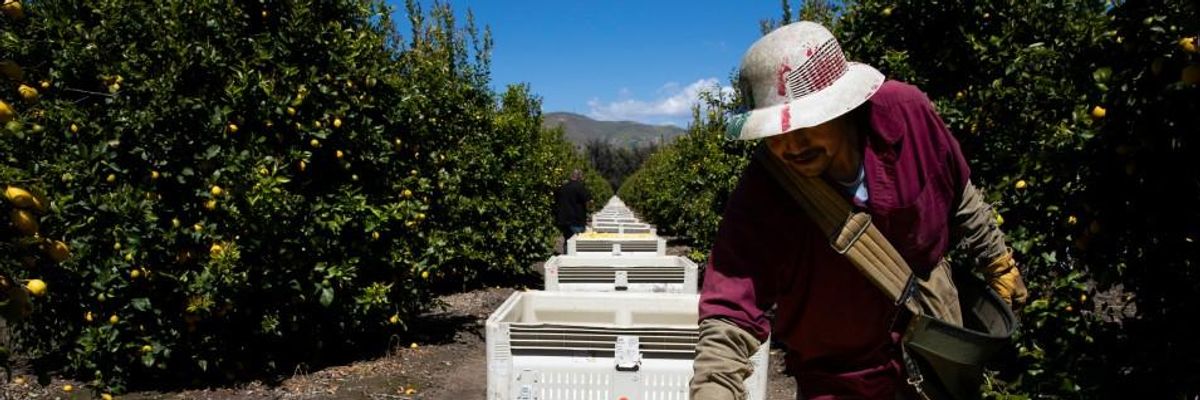
In contrast with the healthcare President Donald Trump and former New Jersey Gov. Chris Christie are receiving after being diagnosed with Covid-19, frontline workers who have put themselves at risk throughout the coronavirus pandemic--such as those in agriculture, meatpacking, construction, restaurants, grocery stores, nursing homes, and home care--are disproportionately less likely to have health insurance, limiting their access to care, according to a Public Citizen analysis published Monday.
"While Trump gets excellent taxpayer-funded care, millions of the frontline workers who are powering America are left without any care at all. This is unacceptable."
--Rep. Pramila JayapalTrump has been at the Walter Reed National Military Medical Center since Friday night--except for a widely criticized drive to greet supporters.
Christie, who prepped the president before his debate last Tuesday against Democratic presidential nominee Joe Biden, announced on Twitter Saturday: "I checked myself into Morristown Medical Center this afternoon. While I am feeling good and only have mild symptoms, due to my history of asthma we decided this is an important precautionary measure."
The president and Christie's hospitalizations have provoked personal stories of loved ones dying from the virus after being denied hospital stays as well as fresh calls for scrapping the United States' for-profit health insurance scheme that is largely based on employment in favor of a Medicare for All system that ensures healthcare to everyone as a human right. As of Monday morning, the U.S. had more than 7.4 million confirmed Covid-19 infections and nearly 210,000 deaths directly tied to the disease.
The new Public Citizen report, entitled Holes in the Safety Net, echoed those calls for a public healthcare system that serves everyone and elicited more demands from single-payer supporters including Rep. Pramila Jayapal (D-Wash.), lead sponsor of Medicare for All legislation in the House. Linking to the analysis, she tweeted Monday about the care Trump is getting while so many frontline workers remain uninsured.
"As Trump receives all-inclusive socialized healthcare at Walter Reed, essential workers are left to suffer," tweeted Public Citizen, highlighting the analysis.
Author Zachary Brown acknowledges in the report that sectors deemed "essential" during the pandemic have long functioned "on the backs of significant numbers of Black and Brown workers" who have faced "low wages, lack of adequate safety protections, and limited access to healthcare." Brown concludes that given the findings on how Covid-19 has impacted people in these industries and their high uninsured rates, "the argument for Medicare for All has never been stronger."
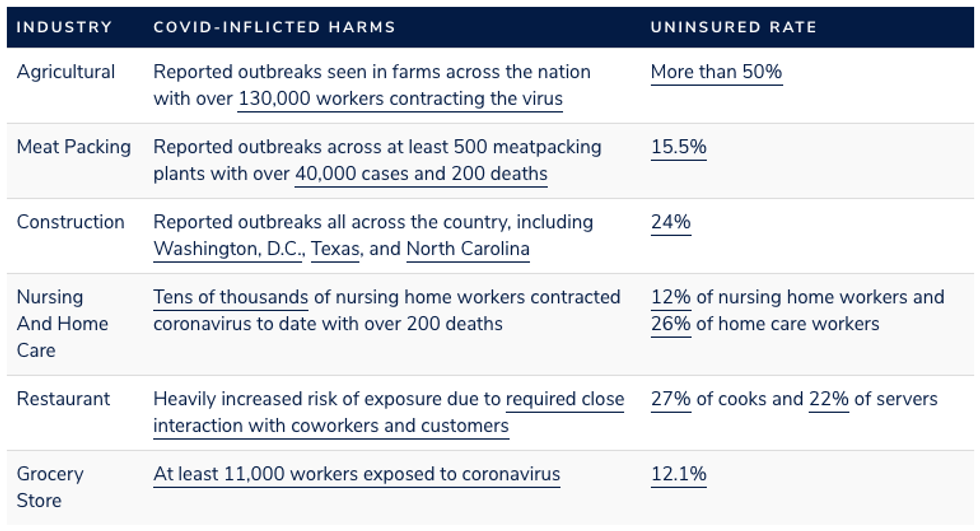
Brown found over half of agricultural workers are uninsured and farms nationwide have seen more than 130,000 contract the virus. About a quarter of restaurant, construction, and home care workers also lack insurance. That's also the case for over 10% of meatpacking and nursing home employees--and each of those industries has seen tens of thousands of Covid-19 cases this year. Among grocery workers, whose uninsured rate exceeds 12%, there have been over 11,000 cases.
"Just as the Trump administration has failed the country on Covid-19, the private health insurance system has failed essential frontline workers," Brown said in a statement. "These workers are risking their lives to ensure we have access to the healthcare, food, and other services we need. The least we could do, as a society, is to ensure they have health insurance so they don't go bankrupt when they get sick."
Brown's report notes that in addition to lacking health insurance, many workers in these fields have wages so low they are living beneath the federal poverty line; that's the case for about 1-in-4 farmworkers, about 13% of meatpacking workers, and 1-in-5 home care workers. On top of low pay, some workers in these key sectors are also facing layoffs, particularly those in the restaurant industry--and because of the employer-based system, losing a job often means losing health insurance too.
As the New York Times reported with a series of infographics Monday, about 12 million people in the United States are now jobless, a figure that has about doubled since January. Unemployment has fallen since its peak in April, but over the past six months, a growing number of people have lost jobs at businesses that have permanently shut down. The newspaper also pointed out that the total figure rises to 19 million when accounting for those not in the labor force but who want a job.
"Jobs numbers could worsen, especially if cases rise significantly, or restaurants or other types of businesses are forced to shut their doors as the weather gets colder," the Times added. "With a presidential election looming, how Americans are personally experiencing these trends will affect the choices they make in November."
As Common Dreams has reported in recent weeks, while Trump has continued to baselessly attack the security of mailed ballots and refused to commit to a peaceful transition of power if he loses to Biden, progressive advocacy groups have urged Americans to make a plan to participate in the election and take advantage of the early in-person and mail-in voting that is already underway in some states.
In contrast with the healthcare President Donald Trump and former New Jersey Gov. Chris Christie are receiving after being diagnosed with Covid-19, frontline workers who have put themselves at risk throughout the coronavirus pandemic--such as those in agriculture, meatpacking, construction, restaurants, grocery stores, nursing homes, and home care--are disproportionately less likely to have health insurance, limiting their access to care, according to a Public Citizen analysis published Monday.
"While Trump gets excellent taxpayer-funded care, millions of the frontline workers who are powering America are left without any care at all. This is unacceptable."
--Rep. Pramila JayapalTrump has been at the Walter Reed National Military Medical Center since Friday night--except for a widely criticized drive to greet supporters.
Christie, who prepped the president before his debate last Tuesday against Democratic presidential nominee Joe Biden, announced on Twitter Saturday: "I checked myself into Morristown Medical Center this afternoon. While I am feeling good and only have mild symptoms, due to my history of asthma we decided this is an important precautionary measure."
The president and Christie's hospitalizations have provoked personal stories of loved ones dying from the virus after being denied hospital stays as well as fresh calls for scrapping the United States' for-profit health insurance scheme that is largely based on employment in favor of a Medicare for All system that ensures healthcare to everyone as a human right. As of Monday morning, the U.S. had more than 7.4 million confirmed Covid-19 infections and nearly 210,000 deaths directly tied to the disease.
The new Public Citizen report, entitled Holes in the Safety Net, echoed those calls for a public healthcare system that serves everyone and elicited more demands from single-payer supporters including Rep. Pramila Jayapal (D-Wash.), lead sponsor of Medicare for All legislation in the House. Linking to the analysis, she tweeted Monday about the care Trump is getting while so many frontline workers remain uninsured.
"As Trump receives all-inclusive socialized healthcare at Walter Reed, essential workers are left to suffer," tweeted Public Citizen, highlighting the analysis.
Author Zachary Brown acknowledges in the report that sectors deemed "essential" during the pandemic have long functioned "on the backs of significant numbers of Black and Brown workers" who have faced "low wages, lack of adequate safety protections, and limited access to healthcare." Brown concludes that given the findings on how Covid-19 has impacted people in these industries and their high uninsured rates, "the argument for Medicare for All has never been stronger."
Brown found over half of agricultural workers are uninsured and farms nationwide have seen more than 130,000 contract the virus. About a quarter of restaurant, construction, and home care workers also lack insurance. That's also the case for over 10% of meatpacking and nursing home employees--and each of those industries has seen tens of thousands of Covid-19 cases this year. Among grocery workers, whose uninsured rate exceeds 12%, there have been over 11,000 cases.
"Just as the Trump administration has failed the country on Covid-19, the private health insurance system has failed essential frontline workers," Brown said in a statement. "These workers are risking their lives to ensure we have access to the healthcare, food, and other services we need. The least we could do, as a society, is to ensure they have health insurance so they don't go bankrupt when they get sick."
Brown's report notes that in addition to lacking health insurance, many workers in these fields have wages so low they are living beneath the federal poverty line; that's the case for about 1-in-4 farmworkers, about 13% of meatpacking workers, and 1-in-5 home care workers. On top of low pay, some workers in these key sectors are also facing layoffs, particularly those in the restaurant industry--and because of the employer-based system, losing a job often means losing health insurance too.
As the New York Times reported with a series of infographics Monday, about 12 million people in the United States are now jobless, a figure that has about doubled since January. Unemployment has fallen since its peak in April, but over the past six months, a growing number of people have lost jobs at businesses that have permanently shut down. The newspaper also pointed out that the total figure rises to 19 million when accounting for those not in the labor force but who want a job.
"Jobs numbers could worsen, especially if cases rise significantly, or restaurants or other types of businesses are forced to shut their doors as the weather gets colder," the Times added. "With a presidential election looming, how Americans are personally experiencing these trends will affect the choices they make in November."
As Common Dreams has reported in recent weeks, while Trump has continued to baselessly attack the security of mailed ballots and refused to commit to a peaceful transition of power if he loses to Biden, progressive advocacy groups have urged Americans to make a plan to participate in the election and take advantage of the early in-person and mail-in voting that is already underway in some states.
In contrast with the healthcare President Donald Trump and former New Jersey Gov. Chris Christie are receiving after being diagnosed with Covid-19, frontline workers who have put themselves at risk throughout the coronavirus pandemic--such as those in agriculture, meatpacking, construction, restaurants, grocery stores, nursing homes, and home care--are disproportionately less likely to have health insurance, limiting their access to care, according to a Public Citizen analysis published Monday.
"While Trump gets excellent taxpayer-funded care, millions of the frontline workers who are powering America are left without any care at all. This is unacceptable."
--Rep. Pramila JayapalTrump has been at the Walter Reed National Military Medical Center since Friday night--except for a widely criticized drive to greet supporters.
Christie, who prepped the president before his debate last Tuesday against Democratic presidential nominee Joe Biden, announced on Twitter Saturday: "I checked myself into Morristown Medical Center this afternoon. While I am feeling good and only have mild symptoms, due to my history of asthma we decided this is an important precautionary measure."
The president and Christie's hospitalizations have provoked personal stories of loved ones dying from the virus after being denied hospital stays as well as fresh calls for scrapping the United States' for-profit health insurance scheme that is largely based on employment in favor of a Medicare for All system that ensures healthcare to everyone as a human right. As of Monday morning, the U.S. had more than 7.4 million confirmed Covid-19 infections and nearly 210,000 deaths directly tied to the disease.
The new Public Citizen report, entitled Holes in the Safety Net, echoed those calls for a public healthcare system that serves everyone and elicited more demands from single-payer supporters including Rep. Pramila Jayapal (D-Wash.), lead sponsor of Medicare for All legislation in the House. Linking to the analysis, she tweeted Monday about the care Trump is getting while so many frontline workers remain uninsured.
"As Trump receives all-inclusive socialized healthcare at Walter Reed, essential workers are left to suffer," tweeted Public Citizen, highlighting the analysis.
Author Zachary Brown acknowledges in the report that sectors deemed "essential" during the pandemic have long functioned "on the backs of significant numbers of Black and Brown workers" who have faced "low wages, lack of adequate safety protections, and limited access to healthcare." Brown concludes that given the findings on how Covid-19 has impacted people in these industries and their high uninsured rates, "the argument for Medicare for All has never been stronger."
Brown found over half of agricultural workers are uninsured and farms nationwide have seen more than 130,000 contract the virus. About a quarter of restaurant, construction, and home care workers also lack insurance. That's also the case for over 10% of meatpacking and nursing home employees--and each of those industries has seen tens of thousands of Covid-19 cases this year. Among grocery workers, whose uninsured rate exceeds 12%, there have been over 11,000 cases.
"Just as the Trump administration has failed the country on Covid-19, the private health insurance system has failed essential frontline workers," Brown said in a statement. "These workers are risking their lives to ensure we have access to the healthcare, food, and other services we need. The least we could do, as a society, is to ensure they have health insurance so they don't go bankrupt when they get sick."
Brown's report notes that in addition to lacking health insurance, many workers in these fields have wages so low they are living beneath the federal poverty line; that's the case for about 1-in-4 farmworkers, about 13% of meatpacking workers, and 1-in-5 home care workers. On top of low pay, some workers in these key sectors are also facing layoffs, particularly those in the restaurant industry--and because of the employer-based system, losing a job often means losing health insurance too.
As the New York Times reported with a series of infographics Monday, about 12 million people in the United States are now jobless, a figure that has about doubled since January. Unemployment has fallen since its peak in April, but over the past six months, a growing number of people have lost jobs at businesses that have permanently shut down. The newspaper also pointed out that the total figure rises to 19 million when accounting for those not in the labor force but who want a job.
"Jobs numbers could worsen, especially if cases rise significantly, or restaurants or other types of businesses are forced to shut their doors as the weather gets colder," the Times added. "With a presidential election looming, how Americans are personally experiencing these trends will affect the choices they make in November."
As Common Dreams has reported in recent weeks, while Trump has continued to baselessly attack the security of mailed ballots and refused to commit to a peaceful transition of power if he loses to Biden, progressive advocacy groups have urged Americans to make a plan to participate in the election and take advantage of the early in-person and mail-in voting that is already underway in some states.