SUBSCRIBE TO OUR FREE NEWSLETTER
Daily news & progressive opinion—funded by the people, not the corporations—delivered straight to your inbox.
5
#000000
#FFFFFF
To donate by check, phone, or other method, see our More Ways to Give page.
Daily news & progressive opinion—funded by the people, not the corporations—delivered straight to your inbox.
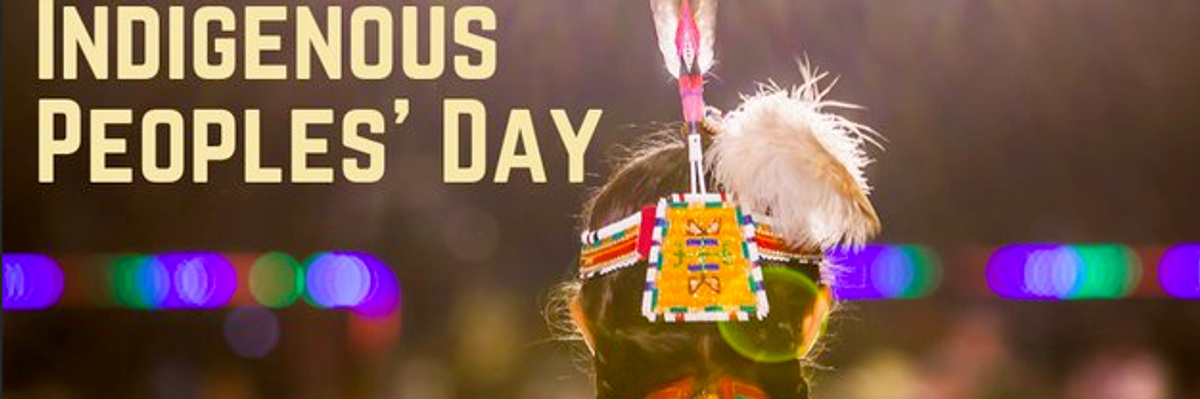
"This Indigenous Peoples' Day Resolution is an opportunity to honor the true nature of our founding and re-focus a federal holiday on the incredible cultural contributions of Native peoples that have been absent from our celebrations until now," said Rep. Norma Torres. (Image: via Rep. Ray Lugjan/ @repbenraylujan)
The national chorus of those calling to make Indigenous Peoples' Day an official federal holiday to replace Columbus Day once and for all continued to grow Monday as Native Americans and their allies called out for a permanent and annual recognition for what has been taken from native people and communities as well as a celebration of their countless contributions to the national fabric.
In a Monday op-ed at Common Dreams, activist and author Edgar Villanueva, founder of the Decolonizing Wealth Project, argues that celebrating Christopher Columbus with a federal holiday each year is as much an affront to history as it is to Native Americans who lived here for thousand of years before the European explorer's arrival in 1492.
The so-called "discovery" of the Americas by Columbus, writes Villanueva, "was no discovery at all. He was not the first person to step foot on this soil, nor was he even the first European. Rather, he was a man who sailed and stumbled upon an island that had been inhabited by millions of Indigenous peoples for centuries. His true legacy is not one of discovery, but rather one of conquest, exploitation, and genocide."
In a tweet shared with the #IndigenousPeoplesDay hashtag, Rep. Deb Haaland (D-N.M.) said that "dedicating this day to the strength and resilience of Indigenous peoples, we condemn those who have tried to erase us, and build strength through understanding."
"Indigenous Peoples' Day is a way to honor the people who lived and thrived on this continent before colonization," said Haaland. "The celebration of this day is a long time coming. Activists, community organizers, and the Indigenous community worked hard lobbying lawmakers, hosting rallies, and showing our culture proudly wherever we go so that we could finally correct the record and recognize the real history of this country."
Last week, Congresswoman Haaland and other members of the Native American Caucus--including Reps. Norma J. Torres (D-Calif.), Tom Cole (R-Okla.), Sharice Davids (D-Kan.), and Betty McCollum (D-Minn.)--introduced a bipartisan Congressional Resolution (pdf) calling to designate the second Monday of October as Indigenous People's Day in place of the current federal holiday of Columbus Day.
"This Indigenous Peoples' Day Resolution is an opportunity to honor the true nature of our founding and re-focus a federal holiday on the incredible cultural contributions of Native peoples that have been absent from our celebrations until now," Rep. Torres said in a statement on Friday. "Indigenous peoples thrived in the Americas for thousands of years before Europeans arrived, and endured incredible hardships as a result of colonization. Federal holidays should celebrate our heritage and culture, but also honor the struggles that led to society as we know it. Native cultures provide an enduring tapestry of traditions and beliefs that enrich our union and our daily lives. I'm excited to join my colleagues in calling for a true celebration of these contributions through an annual Indigenous Peoples' Day."
As Villanueva writes in his op-ed:
This past year, we've witnessed an awakening across the United States to this country's dark, racist history. Calls for justice and reparations are growing louder and louder, but when it comes to reconciling the American myth with Indigenous truth, the U.S. still has a long way to go.
For centuries, the Euro-centric gatekeepers of history have erased our story and our humanity from textbooks and classrooms. Imagery in Hollywood films presenting Indigenous people as "savages," and racist mascots in professional sports have normalized the mocking of our culture and sacred customs. Our communities face continued systemic racism--from disproportionate access to healthcare and quality education, to discrimination in jobs and wages, to violence by the police, and more. We continue to fight every day for our autonomy and for our right to the land that was stolen from us.
On this second Monday of October 2020, we can take an important step toward healing by abolishing Columbus Day, and instead, establishing a nationwide Indigenous Peoples' Day.
Rep. Ilhan Omar (D-Minn.) backed her colleagues' demand in a pair of tweets Monday, writing that Indigenous Peoples' Day should act as "a reminder of the work we must do to begin repairing the harm and trauma our country continues to cause Native and Indigenous people."
According to Villanueva, "To celebrate Columbus Day is to celebrate America's violent, centuries-long history of colonialism and racism. It's to celebrate a man who enslaved and slaughtered millions of Indigenous people and stole our land. The holiday is a monument to white supremacy, and it's time we abolished it."
Dear Common Dreams reader, It’s been nearly 30 years since I co-founded Common Dreams with my late wife, Lina Newhouser. We had the radical notion that journalism should serve the public good, not corporate profits. It was clear to us from the outset what it would take to build such a project. No paid advertisements. No corporate sponsors. No millionaire publisher telling us what to think or do. Many people said we wouldn't last a year, but we proved those doubters wrong. Together with a tremendous team of journalists and dedicated staff, we built an independent media outlet free from the constraints of profits and corporate control. Our mission has always been simple: To inform. To inspire. To ignite change for the common good. Building Common Dreams was not easy. Our survival was never guaranteed. When you take on the most powerful forces—Wall Street greed, fossil fuel industry destruction, Big Tech lobbyists, and uber-rich oligarchs who have spent billions upon billions rigging the economy and democracy in their favor—the only bulwark you have is supporters who believe in your work. But here’s the urgent message from me today. It's never been this bad out there. And it's never been this hard to keep us going. At the very moment Common Dreams is most needed, the threats we face are intensifying. We need your support now more than ever. We don't accept corporate advertising and never will. We don't have a paywall because we don't think people should be blocked from critical news based on their ability to pay. Everything we do is funded by the donations of readers like you. When everyone does the little they can afford, we are strong. But if that support retreats or dries up, so do we. Will you donate now to make sure Common Dreams not only survives but thrives? —Craig Brown, Co-founder |
The national chorus of those calling to make Indigenous Peoples' Day an official federal holiday to replace Columbus Day once and for all continued to grow Monday as Native Americans and their allies called out for a permanent and annual recognition for what has been taken from native people and communities as well as a celebration of their countless contributions to the national fabric.
In a Monday op-ed at Common Dreams, activist and author Edgar Villanueva, founder of the Decolonizing Wealth Project, argues that celebrating Christopher Columbus with a federal holiday each year is as much an affront to history as it is to Native Americans who lived here for thousand of years before the European explorer's arrival in 1492.
The so-called "discovery" of the Americas by Columbus, writes Villanueva, "was no discovery at all. He was not the first person to step foot on this soil, nor was he even the first European. Rather, he was a man who sailed and stumbled upon an island that had been inhabited by millions of Indigenous peoples for centuries. His true legacy is not one of discovery, but rather one of conquest, exploitation, and genocide."
In a tweet shared with the #IndigenousPeoplesDay hashtag, Rep. Deb Haaland (D-N.M.) said that "dedicating this day to the strength and resilience of Indigenous peoples, we condemn those who have tried to erase us, and build strength through understanding."
"Indigenous Peoples' Day is a way to honor the people who lived and thrived on this continent before colonization," said Haaland. "The celebration of this day is a long time coming. Activists, community organizers, and the Indigenous community worked hard lobbying lawmakers, hosting rallies, and showing our culture proudly wherever we go so that we could finally correct the record and recognize the real history of this country."
Last week, Congresswoman Haaland and other members of the Native American Caucus--including Reps. Norma J. Torres (D-Calif.), Tom Cole (R-Okla.), Sharice Davids (D-Kan.), and Betty McCollum (D-Minn.)--introduced a bipartisan Congressional Resolution (pdf) calling to designate the second Monday of October as Indigenous People's Day in place of the current federal holiday of Columbus Day.
"This Indigenous Peoples' Day Resolution is an opportunity to honor the true nature of our founding and re-focus a federal holiday on the incredible cultural contributions of Native peoples that have been absent from our celebrations until now," Rep. Torres said in a statement on Friday. "Indigenous peoples thrived in the Americas for thousands of years before Europeans arrived, and endured incredible hardships as a result of colonization. Federal holidays should celebrate our heritage and culture, but also honor the struggles that led to society as we know it. Native cultures provide an enduring tapestry of traditions and beliefs that enrich our union and our daily lives. I'm excited to join my colleagues in calling for a true celebration of these contributions through an annual Indigenous Peoples' Day."
As Villanueva writes in his op-ed:
This past year, we've witnessed an awakening across the United States to this country's dark, racist history. Calls for justice and reparations are growing louder and louder, but when it comes to reconciling the American myth with Indigenous truth, the U.S. still has a long way to go.
For centuries, the Euro-centric gatekeepers of history have erased our story and our humanity from textbooks and classrooms. Imagery in Hollywood films presenting Indigenous people as "savages," and racist mascots in professional sports have normalized the mocking of our culture and sacred customs. Our communities face continued systemic racism--from disproportionate access to healthcare and quality education, to discrimination in jobs and wages, to violence by the police, and more. We continue to fight every day for our autonomy and for our right to the land that was stolen from us.
On this second Monday of October 2020, we can take an important step toward healing by abolishing Columbus Day, and instead, establishing a nationwide Indigenous Peoples' Day.
Rep. Ilhan Omar (D-Minn.) backed her colleagues' demand in a pair of tweets Monday, writing that Indigenous Peoples' Day should act as "a reminder of the work we must do to begin repairing the harm and trauma our country continues to cause Native and Indigenous people."
According to Villanueva, "To celebrate Columbus Day is to celebrate America's violent, centuries-long history of colonialism and racism. It's to celebrate a man who enslaved and slaughtered millions of Indigenous people and stole our land. The holiday is a monument to white supremacy, and it's time we abolished it."
The national chorus of those calling to make Indigenous Peoples' Day an official federal holiday to replace Columbus Day once and for all continued to grow Monday as Native Americans and their allies called out for a permanent and annual recognition for what has been taken from native people and communities as well as a celebration of their countless contributions to the national fabric.
In a Monday op-ed at Common Dreams, activist and author Edgar Villanueva, founder of the Decolonizing Wealth Project, argues that celebrating Christopher Columbus with a federal holiday each year is as much an affront to history as it is to Native Americans who lived here for thousand of years before the European explorer's arrival in 1492.
The so-called "discovery" of the Americas by Columbus, writes Villanueva, "was no discovery at all. He was not the first person to step foot on this soil, nor was he even the first European. Rather, he was a man who sailed and stumbled upon an island that had been inhabited by millions of Indigenous peoples for centuries. His true legacy is not one of discovery, but rather one of conquest, exploitation, and genocide."
In a tweet shared with the #IndigenousPeoplesDay hashtag, Rep. Deb Haaland (D-N.M.) said that "dedicating this day to the strength and resilience of Indigenous peoples, we condemn those who have tried to erase us, and build strength through understanding."
"Indigenous Peoples' Day is a way to honor the people who lived and thrived on this continent before colonization," said Haaland. "The celebration of this day is a long time coming. Activists, community organizers, and the Indigenous community worked hard lobbying lawmakers, hosting rallies, and showing our culture proudly wherever we go so that we could finally correct the record and recognize the real history of this country."
Last week, Congresswoman Haaland and other members of the Native American Caucus--including Reps. Norma J. Torres (D-Calif.), Tom Cole (R-Okla.), Sharice Davids (D-Kan.), and Betty McCollum (D-Minn.)--introduced a bipartisan Congressional Resolution (pdf) calling to designate the second Monday of October as Indigenous People's Day in place of the current federal holiday of Columbus Day.
"This Indigenous Peoples' Day Resolution is an opportunity to honor the true nature of our founding and re-focus a federal holiday on the incredible cultural contributions of Native peoples that have been absent from our celebrations until now," Rep. Torres said in a statement on Friday. "Indigenous peoples thrived in the Americas for thousands of years before Europeans arrived, and endured incredible hardships as a result of colonization. Federal holidays should celebrate our heritage and culture, but also honor the struggles that led to society as we know it. Native cultures provide an enduring tapestry of traditions and beliefs that enrich our union and our daily lives. I'm excited to join my colleagues in calling for a true celebration of these contributions through an annual Indigenous Peoples' Day."
As Villanueva writes in his op-ed:
This past year, we've witnessed an awakening across the United States to this country's dark, racist history. Calls for justice and reparations are growing louder and louder, but when it comes to reconciling the American myth with Indigenous truth, the U.S. still has a long way to go.
For centuries, the Euro-centric gatekeepers of history have erased our story and our humanity from textbooks and classrooms. Imagery in Hollywood films presenting Indigenous people as "savages," and racist mascots in professional sports have normalized the mocking of our culture and sacred customs. Our communities face continued systemic racism--from disproportionate access to healthcare and quality education, to discrimination in jobs and wages, to violence by the police, and more. We continue to fight every day for our autonomy and for our right to the land that was stolen from us.
On this second Monday of October 2020, we can take an important step toward healing by abolishing Columbus Day, and instead, establishing a nationwide Indigenous Peoples' Day.
Rep. Ilhan Omar (D-Minn.) backed her colleagues' demand in a pair of tweets Monday, writing that Indigenous Peoples' Day should act as "a reminder of the work we must do to begin repairing the harm and trauma our country continues to cause Native and Indigenous people."
According to Villanueva, "To celebrate Columbus Day is to celebrate America's violent, centuries-long history of colonialism and racism. It's to celebrate a man who enslaved and slaughtered millions of Indigenous people and stole our land. The holiday is a monument to white supremacy, and it's time we abolished it."