SUBSCRIBE TO OUR FREE NEWSLETTER
Daily news & progressive opinion—funded by the people, not the corporations—delivered straight to your inbox.
5
#000000
#FFFFFF
To donate by check, phone, or other method, see our More Ways to Give page.
Daily news & progressive opinion—funded by the people, not the corporations—delivered straight to your inbox.
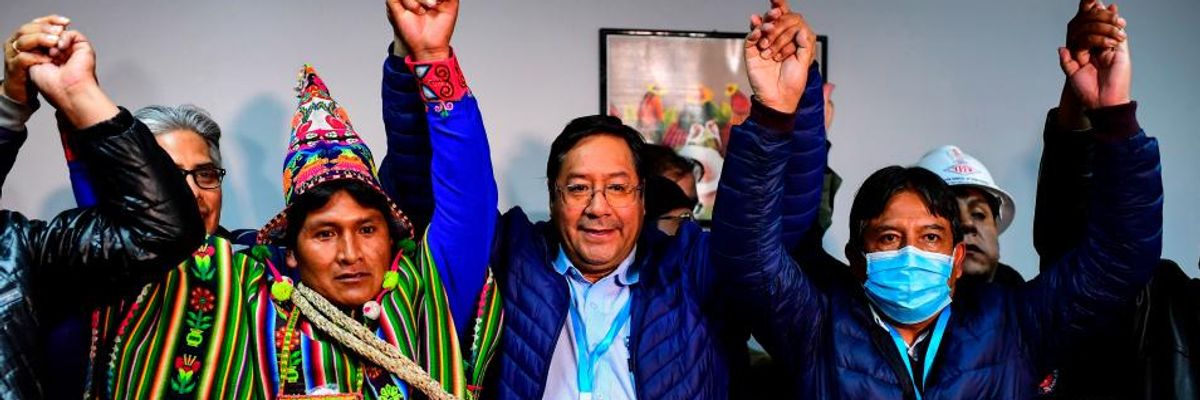
Bolivia's leftist presidential candidate Luis Arce of the Movement for Socialism party celebrates with running mate David Choquehuanca early on October 19, 2020 in La Paz, Bolivia. (Photo: Ronaldo Schemidt/AFP via Getty Images)
A year after former Bolivian president Evo Morales was ousted in a military coup that installed a brutal far-right regime, Morales ally Luis Arce declared victory in the South American nation's high-stakes presidential election early Monday after exit polls showed the socialist candidate with a large advantage over his two main competitors.
" Democracy has won," Arce, who served as Morales' finance minister, said in an address to the nation after one exit poll showed him leading the race with 52.4% of the vote and former president Carlos Mesa in a distant second with 31.5%. Right-wing candidate Luis Camacho--an ally of unelected interim President Jeanine Anez--won just 14.1% of the vote, according to the survey.
The Washington Post reported that "if the exit poll numbers are confirmed by the official count, which was being tabulated slowly late Sunday, it would be more than enough to avoid a November runoff and claim outright victory."
Arce characterized his apparently decisive victory, which even Anez was forced to acknowledge, as a mandate to continue the policies of the Morales government, which lifted millions of Bolivians out of poverty and expanded the nation's economy.
"I think the Bolivian people want to retake the path we were on," Arce said Monday.
Twice postponed due to the coronavirus pandemic, Sunday's election was a do-over of last year's presidential contest, which was thrown into chaos after the U.S.-dominated Organization of American States (OAS) leveled baseless allegations of "fraud" by Morales, who was eventually forced to resign and flee the country under threat by Bolivia's military.
The coup against Morales sparked a wave of Indigenous-led protests that were violently repressed by the Bolivian military and police forces, which were granted sweeping immunity from prosecution by the anti-Indigenous Anez government.
"The OAS allegations were indeed the main political foundation of the coup that followed the October 20 election three weeks later," Mark Weisbrot, co-director of the Center for Economic and Policy Research, wrote last month. "But they provided no evidence to support these allegations--because there wasn't any. This has since been established repeatedly by a slew of expert statistical studies."
From exile in Argentina, Morales on Monday celebrated Arce's apparent victory as a "great triumph of the people."
"Brothers and sisters: the will of the people has been asserted," Morales tweeted. "This is an overwhelming victory... We are going to give dignity and liberty back to the people."
Dear Common Dreams reader, It’s been nearly 30 years since I co-founded Common Dreams with my late wife, Lina Newhouser. We had the radical notion that journalism should serve the public good, not corporate profits. It was clear to us from the outset what it would take to build such a project. No paid advertisements. No corporate sponsors. No millionaire publisher telling us what to think or do. Many people said we wouldn't last a year, but we proved those doubters wrong. Together with a tremendous team of journalists and dedicated staff, we built an independent media outlet free from the constraints of profits and corporate control. Our mission has always been simple: To inform. To inspire. To ignite change for the common good. Building Common Dreams was not easy. Our survival was never guaranteed. When you take on the most powerful forces—Wall Street greed, fossil fuel industry destruction, Big Tech lobbyists, and uber-rich oligarchs who have spent billions upon billions rigging the economy and democracy in their favor—the only bulwark you have is supporters who believe in your work. But here’s the urgent message from me today. It's never been this bad out there. And it's never been this hard to keep us going. At the very moment Common Dreams is most needed, the threats we face are intensifying. We need your support now more than ever. We don't accept corporate advertising and never will. We don't have a paywall because we don't think people should be blocked from critical news based on their ability to pay. Everything we do is funded by the donations of readers like you. When everyone does the little they can afford, we are strong. But if that support retreats or dries up, so do we. Will you donate now to make sure Common Dreams not only survives but thrives? —Craig Brown, Co-founder |
A year after former Bolivian president Evo Morales was ousted in a military coup that installed a brutal far-right regime, Morales ally Luis Arce declared victory in the South American nation's high-stakes presidential election early Monday after exit polls showed the socialist candidate with a large advantage over his two main competitors.
" Democracy has won," Arce, who served as Morales' finance minister, said in an address to the nation after one exit poll showed him leading the race with 52.4% of the vote and former president Carlos Mesa in a distant second with 31.5%. Right-wing candidate Luis Camacho--an ally of unelected interim President Jeanine Anez--won just 14.1% of the vote, according to the survey.
The Washington Post reported that "if the exit poll numbers are confirmed by the official count, which was being tabulated slowly late Sunday, it would be more than enough to avoid a November runoff and claim outright victory."
Arce characterized his apparently decisive victory, which even Anez was forced to acknowledge, as a mandate to continue the policies of the Morales government, which lifted millions of Bolivians out of poverty and expanded the nation's economy.
"I think the Bolivian people want to retake the path we were on," Arce said Monday.
Twice postponed due to the coronavirus pandemic, Sunday's election was a do-over of last year's presidential contest, which was thrown into chaos after the U.S.-dominated Organization of American States (OAS) leveled baseless allegations of "fraud" by Morales, who was eventually forced to resign and flee the country under threat by Bolivia's military.
The coup against Morales sparked a wave of Indigenous-led protests that were violently repressed by the Bolivian military and police forces, which were granted sweeping immunity from prosecution by the anti-Indigenous Anez government.
"The OAS allegations were indeed the main political foundation of the coup that followed the October 20 election three weeks later," Mark Weisbrot, co-director of the Center for Economic and Policy Research, wrote last month. "But they provided no evidence to support these allegations--because there wasn't any. This has since been established repeatedly by a slew of expert statistical studies."
From exile in Argentina, Morales on Monday celebrated Arce's apparent victory as a "great triumph of the people."
"Brothers and sisters: the will of the people has been asserted," Morales tweeted. "This is an overwhelming victory... We are going to give dignity and liberty back to the people."
A year after former Bolivian president Evo Morales was ousted in a military coup that installed a brutal far-right regime, Morales ally Luis Arce declared victory in the South American nation's high-stakes presidential election early Monday after exit polls showed the socialist candidate with a large advantage over his two main competitors.
" Democracy has won," Arce, who served as Morales' finance minister, said in an address to the nation after one exit poll showed him leading the race with 52.4% of the vote and former president Carlos Mesa in a distant second with 31.5%. Right-wing candidate Luis Camacho--an ally of unelected interim President Jeanine Anez--won just 14.1% of the vote, according to the survey.
The Washington Post reported that "if the exit poll numbers are confirmed by the official count, which was being tabulated slowly late Sunday, it would be more than enough to avoid a November runoff and claim outright victory."
Arce characterized his apparently decisive victory, which even Anez was forced to acknowledge, as a mandate to continue the policies of the Morales government, which lifted millions of Bolivians out of poverty and expanded the nation's economy.
"I think the Bolivian people want to retake the path we were on," Arce said Monday.
Twice postponed due to the coronavirus pandemic, Sunday's election was a do-over of last year's presidential contest, which was thrown into chaos after the U.S.-dominated Organization of American States (OAS) leveled baseless allegations of "fraud" by Morales, who was eventually forced to resign and flee the country under threat by Bolivia's military.
The coup against Morales sparked a wave of Indigenous-led protests that were violently repressed by the Bolivian military and police forces, which were granted sweeping immunity from prosecution by the anti-Indigenous Anez government.
"The OAS allegations were indeed the main political foundation of the coup that followed the October 20 election three weeks later," Mark Weisbrot, co-director of the Center for Economic and Policy Research, wrote last month. "But they provided no evidence to support these allegations--because there wasn't any. This has since been established repeatedly by a slew of expert statistical studies."
From exile in Argentina, Morales on Monday celebrated Arce's apparent victory as a "great triumph of the people."
"Brothers and sisters: the will of the people has been asserted," Morales tweeted. "This is an overwhelming victory... We are going to give dignity and liberty back to the people."