SUBSCRIBE TO OUR FREE NEWSLETTER
Daily news & progressive opinion—funded by the people, not the corporations—delivered straight to your inbox.
5
#000000
#FFFFFF
To donate by check, phone, or other method, see our More Ways to Give page.
Daily news & progressive opinion—funded by the people, not the corporations—delivered straight to your inbox.
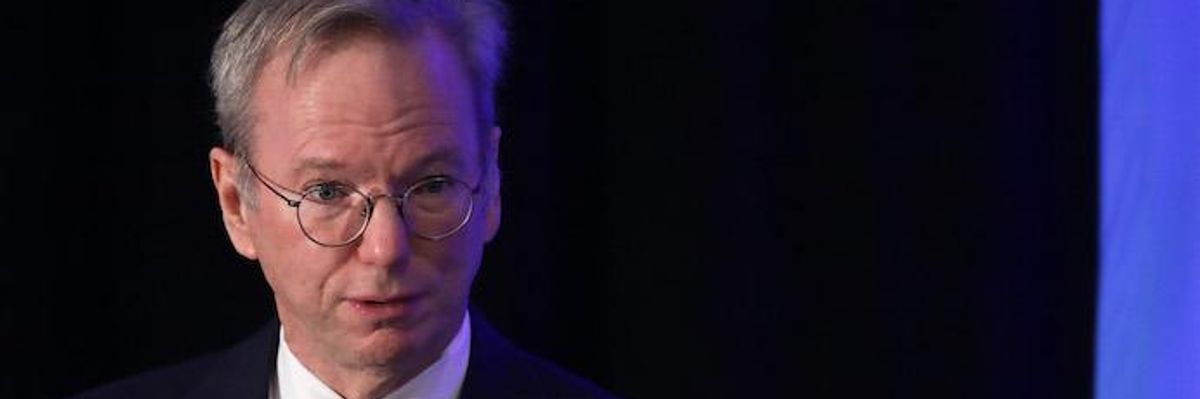
Then-executive chairman of Alphabet Inc., Google's parent company, Eric Schmidt speaks during a National Security Commission on Artificial Intelligence (NSCAI) conference November 5, 2019 in Washington, D.C. (Photo: Alex Wong/Getty Images)
Former Google CEO Eric Schmidt suggested Wednesday that social networks are "amplifiers for idiots" and that the U.S. government's new antitrust lawsuit targeting the search engine giant is baseless.
Schmidt's remarks came during an interview at a technology conference hosted by the Wall Street Journal just a day after the Justice Department announced the landmark case.
No longer with Google--"I can say what I actually think," he said--Schmidt still holds over $5 billion in shares of Google's parent company, Alphabet. He's also chair of the National Security Commission on Artificial Intelligence, and his later tenure at Google saw heated criticism for the company's role in military initiatives. The New York Times described him earlier this year as having "reinvented himself as the prime liaison between Silicon Valley and the national security community."
The antitrust lawsuit, said Schmidt, was "largely driven by Republicans."
"It's bad public policy to use antitrust to regulate," Schmidt said, adding that "Google's market share is not 100%."
He also brushed off "these dominance arguments," though Google controls roughly 90% of global web searches.
Social network platforms, said Schmidt, are deserving of regulatory scrutiny.
"The most obvious candidate for regulation are the excesses in the social-networking space," said Schmidt.
"The concept of social networks, broadly speaking, as amplifiers for idiots and crazy people is not what we intended," he said, adding, "Unless the industry gets its act together in a really clever way, there will be regulation."
The former executive's comments came amid growing questions about efforts social media platforms including Facebook and Twitter have made to promote or censor news stories and hate speech and to control misinformation.
Dear Common Dreams reader, It’s been nearly 30 years since I co-founded Common Dreams with my late wife, Lina Newhouser. We had the radical notion that journalism should serve the public good, not corporate profits. It was clear to us from the outset what it would take to build such a project. No paid advertisements. No corporate sponsors. No millionaire publisher telling us what to think or do. Many people said we wouldn't last a year, but we proved those doubters wrong. Together with a tremendous team of journalists and dedicated staff, we built an independent media outlet free from the constraints of profits and corporate control. Our mission has always been simple: To inform. To inspire. To ignite change for the common good. Building Common Dreams was not easy. Our survival was never guaranteed. When you take on the most powerful forces—Wall Street greed, fossil fuel industry destruction, Big Tech lobbyists, and uber-rich oligarchs who have spent billions upon billions rigging the economy and democracy in their favor—the only bulwark you have is supporters who believe in your work. But here’s the urgent message from me today. It's never been this bad out there. And it's never been this hard to keep us going. At the very moment Common Dreams is most needed, the threats we face are intensifying. We need your support now more than ever. We don't accept corporate advertising and never will. We don't have a paywall because we don't think people should be blocked from critical news based on their ability to pay. Everything we do is funded by the donations of readers like you. When everyone does the little they can afford, we are strong. But if that support retreats or dries up, so do we. Will you donate now to make sure Common Dreams not only survives but thrives? —Craig Brown, Co-founder |
Former Google CEO Eric Schmidt suggested Wednesday that social networks are "amplifiers for idiots" and that the U.S. government's new antitrust lawsuit targeting the search engine giant is baseless.
Schmidt's remarks came during an interview at a technology conference hosted by the Wall Street Journal just a day after the Justice Department announced the landmark case.
No longer with Google--"I can say what I actually think," he said--Schmidt still holds over $5 billion in shares of Google's parent company, Alphabet. He's also chair of the National Security Commission on Artificial Intelligence, and his later tenure at Google saw heated criticism for the company's role in military initiatives. The New York Times described him earlier this year as having "reinvented himself as the prime liaison between Silicon Valley and the national security community."
The antitrust lawsuit, said Schmidt, was "largely driven by Republicans."
"It's bad public policy to use antitrust to regulate," Schmidt said, adding that "Google's market share is not 100%."
He also brushed off "these dominance arguments," though Google controls roughly 90% of global web searches.
Social network platforms, said Schmidt, are deserving of regulatory scrutiny.
"The most obvious candidate for regulation are the excesses in the social-networking space," said Schmidt.
"The concept of social networks, broadly speaking, as amplifiers for idiots and crazy people is not what we intended," he said, adding, "Unless the industry gets its act together in a really clever way, there will be regulation."
The former executive's comments came amid growing questions about efforts social media platforms including Facebook and Twitter have made to promote or censor news stories and hate speech and to control misinformation.
Former Google CEO Eric Schmidt suggested Wednesday that social networks are "amplifiers for idiots" and that the U.S. government's new antitrust lawsuit targeting the search engine giant is baseless.
Schmidt's remarks came during an interview at a technology conference hosted by the Wall Street Journal just a day after the Justice Department announced the landmark case.
No longer with Google--"I can say what I actually think," he said--Schmidt still holds over $5 billion in shares of Google's parent company, Alphabet. He's also chair of the National Security Commission on Artificial Intelligence, and his later tenure at Google saw heated criticism for the company's role in military initiatives. The New York Times described him earlier this year as having "reinvented himself as the prime liaison between Silicon Valley and the national security community."
The antitrust lawsuit, said Schmidt, was "largely driven by Republicans."
"It's bad public policy to use antitrust to regulate," Schmidt said, adding that "Google's market share is not 100%."
He also brushed off "these dominance arguments," though Google controls roughly 90% of global web searches.
Social network platforms, said Schmidt, are deserving of regulatory scrutiny.
"The most obvious candidate for regulation are the excesses in the social-networking space," said Schmidt.
"The concept of social networks, broadly speaking, as amplifiers for idiots and crazy people is not what we intended," he said, adding, "Unless the industry gets its act together in a really clever way, there will be regulation."
The former executive's comments came amid growing questions about efforts social media platforms including Facebook and Twitter have made to promote or censor news stories and hate speech and to control misinformation.