SUBSCRIBE TO OUR FREE NEWSLETTER
Daily news & progressive opinion—funded by the people, not the corporations—delivered straight to your inbox.
5
#000000
#FFFFFF
To donate by check, phone, or other method, see our More Ways to Give page.
Daily news & progressive opinion—funded by the people, not the corporations—delivered straight to your inbox.
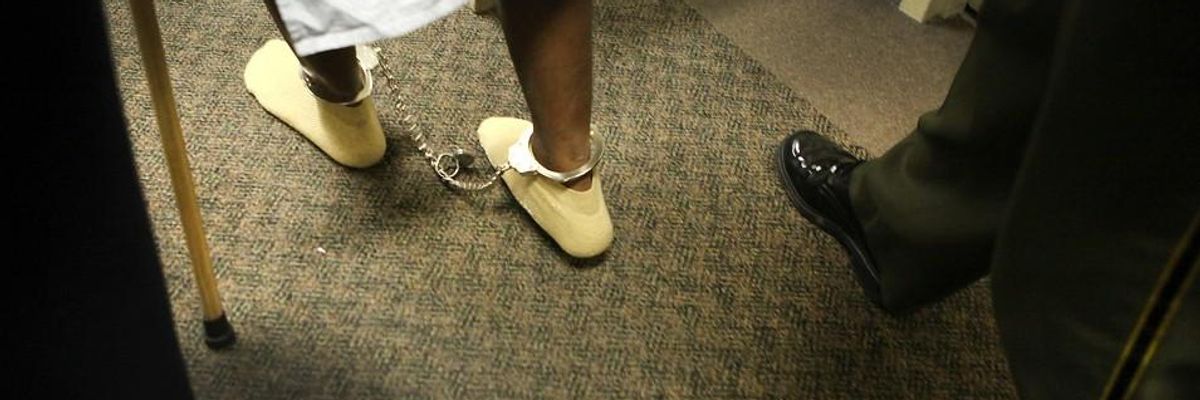
A prisoner is escorted to a medical appointment at an unspecified Bay Area hospital on February 23, 2011. (Photo: Brian van der Brug/Los Angeles Times via Getty Images)
U.S. jails in which healthcare has been contracted out to private providers experienced inmate death rates up to 58% higher than detention facilities with publicly managed medical services, a Reuters investigation published Monday found.
Reuters reviewed inmate deaths in more than 500 U.S. jails from 2016 to 2018 and found that facilities where healthcare was run by one of the country's five top prison medical services companies had significantly higher mortality rates.
"I'm scared to death somebody is going to die over something stupid that Corizon is going to do."
--Melissa Kohne, Chatham County Jail compliance manager
The national average for jails where local public health or law enforcement departments managed healhcare during that period was 12.8 deaths per 100,000 inmates. Detention centers with privatized healthcare experienced between 2.3 to 7.4 additional annual deaths depending on the company providing care, an increase of between 18% and 58%.
Much of this excess mortality is preventable, say some doctors, nurses, and other medical professionals who have worked in the nation's jails. The Reuters report detailed several heartbreaking cases illustrating their point.
Matthew Loflin, who was jailed at the Chatham County Detention Center in Savannah, Georgia in March 2014 while awaiting trial for alleged drug posession, begged for his life. The 32-year-old was coughing up blood, struggling to breathe, and losing consciousness in his cell. Loflin's voice cracked with sheer desperation as he phoned his mother for what turned out to be the last time.
"I need to go to the hospital," Loflin pleaded. "I'm gonna die in here." But management at Corizon Health Inc.--a privately-held company with an exceedingly long list of wrongful death and medical malpractice lawsuits--rejected the request of the jail's medical staff. By the time Corizon approved Loflin's hospitalization, it was too late. He died April 24, 2014 after suffering irreversible brain damage.
Senior medical staff at Chatham County Detention Center--Dr. Charles Pugh and nurses Betty Riner and Lynne Williams--asserted in internal emails and memos that Loflin's was the second preventable death at the jail in as many months. They accused Corizon of caring more about profits than people's lives. The company responded by firing the trio, who are unable to discuss the case under the terms of a wrongful termination lawsuit.
Reuters found Loflin's case was part of a wider pattern at the Savannah jail and across a country in which over 60% of jails hire private contractors to provide what is far too often substandard inmate healthcare. At Chatham County Detention Center during the last two years of Corizon's contract,
prescription drugs went missing, patients deemed gravely ill by medical staff were denied hospitalization, mentally ill inmates went untreated and records were falsified. Weeks passed with no doctor on site, leaving care to nurses and video calls with doctors. The jail's 400 mentally ill inmates, nearly a quarter of its population, were treated by a sole psychiatrist.
After an inmate with mental illness died while strapped into a restraint chair in the Savannah jail, compliance manager Melissa Kohne pleaded with Chatham County to end its contract with Corizon.
"I'm scared to death somebody is going to die over something stupid that Corizon is going to do," Kohne told the Georgia Bureau of Investigation in April 2016.
Corizon's contract with Chatham County Detention Center was eventually terminated, but the company still provides medical care at over 135 correctional facilities across the nation. It recently reported approximately $800 million in annual revenue.
Jails--especially smaller facilities with shoestring budgets--often choose private contractors for the savings they purportedly offer; however, saving money has sometimes meant sacrificing lives.
"You've got counties being greedy, not wanting to spend money on medical care, and companies saying, 'We can do this, we can do it cheaper for you,'" Dr. Robert Greifinger, former chief medical officer for the New York State Department of Correctional Services, told Reuters. "How do companies achieve those economies? Part of it is being stingy with care."
Dear Common Dreams reader, It’s been nearly 30 years since I co-founded Common Dreams with my late wife, Lina Newhouser. We had the radical notion that journalism should serve the public good, not corporate profits. It was clear to us from the outset what it would take to build such a project. No paid advertisements. No corporate sponsors. No millionaire publisher telling us what to think or do. Many people said we wouldn't last a year, but we proved those doubters wrong. Together with a tremendous team of journalists and dedicated staff, we built an independent media outlet free from the constraints of profits and corporate control. Our mission has always been simple: To inform. To inspire. To ignite change for the common good. Building Common Dreams was not easy. Our survival was never guaranteed. When you take on the most powerful forces—Wall Street greed, fossil fuel industry destruction, Big Tech lobbyists, and uber-rich oligarchs who have spent billions upon billions rigging the economy and democracy in their favor—the only bulwark you have is supporters who believe in your work. But here’s the urgent message from me today. It's never been this bad out there. And it's never been this hard to keep us going. At the very moment Common Dreams is most needed, the threats we face are intensifying. We need your support now more than ever. We don't accept corporate advertising and never will. We don't have a paywall because we don't think people should be blocked from critical news based on their ability to pay. Everything we do is funded by the donations of readers like you. When everyone does the little they can afford, we are strong. But if that support retreats or dries up, so do we. Will you donate now to make sure Common Dreams not only survives but thrives? —Craig Brown, Co-founder |
U.S. jails in which healthcare has been contracted out to private providers experienced inmate death rates up to 58% higher than detention facilities with publicly managed medical services, a Reuters investigation published Monday found.
Reuters reviewed inmate deaths in more than 500 U.S. jails from 2016 to 2018 and found that facilities where healthcare was run by one of the country's five top prison medical services companies had significantly higher mortality rates.
"I'm scared to death somebody is going to die over something stupid that Corizon is going to do."
--Melissa Kohne, Chatham County Jail compliance manager
The national average for jails where local public health or law enforcement departments managed healhcare during that period was 12.8 deaths per 100,000 inmates. Detention centers with privatized healthcare experienced between 2.3 to 7.4 additional annual deaths depending on the company providing care, an increase of between 18% and 58%.
Much of this excess mortality is preventable, say some doctors, nurses, and other medical professionals who have worked in the nation's jails. The Reuters report detailed several heartbreaking cases illustrating their point.
Matthew Loflin, who was jailed at the Chatham County Detention Center in Savannah, Georgia in March 2014 while awaiting trial for alleged drug posession, begged for his life. The 32-year-old was coughing up blood, struggling to breathe, and losing consciousness in his cell. Loflin's voice cracked with sheer desperation as he phoned his mother for what turned out to be the last time.
"I need to go to the hospital," Loflin pleaded. "I'm gonna die in here." But management at Corizon Health Inc.--a privately-held company with an exceedingly long list of wrongful death and medical malpractice lawsuits--rejected the request of the jail's medical staff. By the time Corizon approved Loflin's hospitalization, it was too late. He died April 24, 2014 after suffering irreversible brain damage.
Senior medical staff at Chatham County Detention Center--Dr. Charles Pugh and nurses Betty Riner and Lynne Williams--asserted in internal emails and memos that Loflin's was the second preventable death at the jail in as many months. They accused Corizon of caring more about profits than people's lives. The company responded by firing the trio, who are unable to discuss the case under the terms of a wrongful termination lawsuit.
Reuters found Loflin's case was part of a wider pattern at the Savannah jail and across a country in which over 60% of jails hire private contractors to provide what is far too often substandard inmate healthcare. At Chatham County Detention Center during the last two years of Corizon's contract,
prescription drugs went missing, patients deemed gravely ill by medical staff were denied hospitalization, mentally ill inmates went untreated and records were falsified. Weeks passed with no doctor on site, leaving care to nurses and video calls with doctors. The jail's 400 mentally ill inmates, nearly a quarter of its population, were treated by a sole psychiatrist.
After an inmate with mental illness died while strapped into a restraint chair in the Savannah jail, compliance manager Melissa Kohne pleaded with Chatham County to end its contract with Corizon.
"I'm scared to death somebody is going to die over something stupid that Corizon is going to do," Kohne told the Georgia Bureau of Investigation in April 2016.
Corizon's contract with Chatham County Detention Center was eventually terminated, but the company still provides medical care at over 135 correctional facilities across the nation. It recently reported approximately $800 million in annual revenue.
Jails--especially smaller facilities with shoestring budgets--often choose private contractors for the savings they purportedly offer; however, saving money has sometimes meant sacrificing lives.
"You've got counties being greedy, not wanting to spend money on medical care, and companies saying, 'We can do this, we can do it cheaper for you,'" Dr. Robert Greifinger, former chief medical officer for the New York State Department of Correctional Services, told Reuters. "How do companies achieve those economies? Part of it is being stingy with care."
U.S. jails in which healthcare has been contracted out to private providers experienced inmate death rates up to 58% higher than detention facilities with publicly managed medical services, a Reuters investigation published Monday found.
Reuters reviewed inmate deaths in more than 500 U.S. jails from 2016 to 2018 and found that facilities where healthcare was run by one of the country's five top prison medical services companies had significantly higher mortality rates.
"I'm scared to death somebody is going to die over something stupid that Corizon is going to do."
--Melissa Kohne, Chatham County Jail compliance manager
The national average for jails where local public health or law enforcement departments managed healhcare during that period was 12.8 deaths per 100,000 inmates. Detention centers with privatized healthcare experienced between 2.3 to 7.4 additional annual deaths depending on the company providing care, an increase of between 18% and 58%.
Much of this excess mortality is preventable, say some doctors, nurses, and other medical professionals who have worked in the nation's jails. The Reuters report detailed several heartbreaking cases illustrating their point.
Matthew Loflin, who was jailed at the Chatham County Detention Center in Savannah, Georgia in March 2014 while awaiting trial for alleged drug posession, begged for his life. The 32-year-old was coughing up blood, struggling to breathe, and losing consciousness in his cell. Loflin's voice cracked with sheer desperation as he phoned his mother for what turned out to be the last time.
"I need to go to the hospital," Loflin pleaded. "I'm gonna die in here." But management at Corizon Health Inc.--a privately-held company with an exceedingly long list of wrongful death and medical malpractice lawsuits--rejected the request of the jail's medical staff. By the time Corizon approved Loflin's hospitalization, it was too late. He died April 24, 2014 after suffering irreversible brain damage.
Senior medical staff at Chatham County Detention Center--Dr. Charles Pugh and nurses Betty Riner and Lynne Williams--asserted in internal emails and memos that Loflin's was the second preventable death at the jail in as many months. They accused Corizon of caring more about profits than people's lives. The company responded by firing the trio, who are unable to discuss the case under the terms of a wrongful termination lawsuit.
Reuters found Loflin's case was part of a wider pattern at the Savannah jail and across a country in which over 60% of jails hire private contractors to provide what is far too often substandard inmate healthcare. At Chatham County Detention Center during the last two years of Corizon's contract,
prescription drugs went missing, patients deemed gravely ill by medical staff were denied hospitalization, mentally ill inmates went untreated and records were falsified. Weeks passed with no doctor on site, leaving care to nurses and video calls with doctors. The jail's 400 mentally ill inmates, nearly a quarter of its population, were treated by a sole psychiatrist.
After an inmate with mental illness died while strapped into a restraint chair in the Savannah jail, compliance manager Melissa Kohne pleaded with Chatham County to end its contract with Corizon.
"I'm scared to death somebody is going to die over something stupid that Corizon is going to do," Kohne told the Georgia Bureau of Investigation in April 2016.
Corizon's contract with Chatham County Detention Center was eventually terminated, but the company still provides medical care at over 135 correctional facilities across the nation. It recently reported approximately $800 million in annual revenue.
Jails--especially smaller facilities with shoestring budgets--often choose private contractors for the savings they purportedly offer; however, saving money has sometimes meant sacrificing lives.
"You've got counties being greedy, not wanting to spend money on medical care, and companies saying, 'We can do this, we can do it cheaper for you,'" Dr. Robert Greifinger, former chief medical officer for the New York State Department of Correctional Services, told Reuters. "How do companies achieve those economies? Part of it is being stingy with care."