SUBSCRIBE TO OUR FREE NEWSLETTER
Daily news & progressive opinion—funded by the people, not the corporations—delivered straight to your inbox.
5
#000000
#FFFFFF
To donate by check, phone, or other method, see our More Ways to Give page.
Daily news & progressive opinion—funded by the people, not the corporations—delivered straight to your inbox.
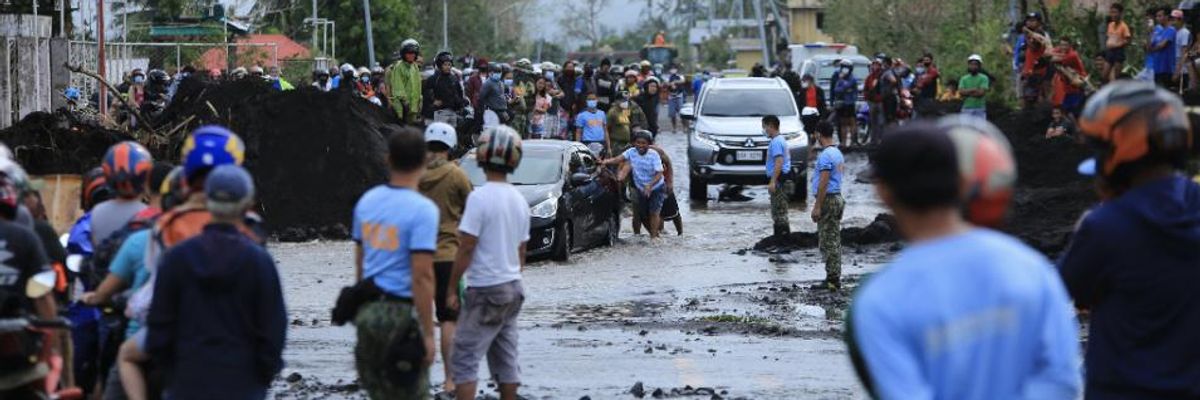
Residents gather along road damaged by heavy rains brought by the super Typhoon Goni after it hit the town of Malinao, Albay province, south of Manila on November 1, 2020. (Photo: Charism Sayat/AFP via Getty Images)
Calls for climate justice emanated from within and beyond the Philippines throughout the weekend as super Typhoon Goni, known locally as Rolly, barreled toward the archipelagic nation as the "strongest landfalling tropical cyclone on record"--ultimately killing 10 people and causing destructive volcanic mudflows.
"Typhoons are getting stronger because of climate change and yet we still don't get enough action and our leaders doesn't treat it like a real emergency that it is."
--Zero Hour Philippines
Goni, now a tropical storm, made its first landfall in the storm-prone Philippines before 5:00 local time Sunday, striking the eastern island province of Catanduanes, according to the Philippine Atmospheric, Geophysical, and Astronomical Services Administration (PAGASA).
The storm made a second landfall near Tiwi, Albay at 7:20 am and a third in San Narcisco, Quezon around noon, PAGASA said.
Meteorologist Jeff Masters wrote for Yale Climate Connections Sunday that based on one-minute average wind speeds from the National Hurricane Center for the Atlantic and northeast Pacific and one-minute average winds from Joint Typhoon Warning Center for the rest of the ocean basins, "Goni was the strongest landfalling tropical cyclone in world recorded history."
While Goni only grazed the capital of Manila, the New York Times reported that in the Bicol region of Luzon, the nation's most populous island, the storm killed at least 10 people, according to the regional Office of Civil Defense. Additionally, nearly 400,000 were displaced, "with almost 350,000 of them sheltering in evacuation centers, and power was out."
According to the Associated Press, "In a Manila gymnasium that was turned into an emergency shelter, Covid-19 outbreaks were an added worry of displaced residents. The Philippines has had more than 383,000 cases of the virus, the second-most in Southeast Asia behind Indonesia."
As the storm garnered global headlines and footage of the aftermath circulated on social media, so did demands for both the Filipino government and the international community to take bolder action to address human-caused climate change, which global scientists warn is strengthening tropical cyclones--called typhoons or hurricanes depending on location.
Greenpeace Philippines shared a petition urging President Rodrigo Duterte, along with mayors and governors across the nation, to:
The group, and other organizations and advocates, also noted that vulnerable communities are bearing the brunt of the climate crisis while fossil fuel giants and developed nations that have disproportionately caused it are "getting away unscathed."
In a series of tweets on Sunday, Ajit Niranjan, environment and globalization reporter at DW, Germany's international broadcaster, pointed out the absence of discussions of climate change in media coverage of Goni.
"It's too early to say by how much climate change made this storm stronger but there's important context that we really should report as soon as such disasters strike," he wrote, "like that by 2050, coastal floods that used to hit once a century will strike many cities *every single year.*"
Niranjan noted that some publications, such as the Times, acknowledged the climate connection, reporting:
The Philippines is situated on the so-called Ring of Fire, a seismically active swath encircling the Pacific Ocean that is vulnerable to earthquakes and volcanoes. Typhoons regularly batter the Philippine archipelago, packed with more than 100 million people.
Deadly floods and landslides are common. And now climate change is exacerbating the Philippines' weakness to natural disasters, making it one of the most vulnerable countries on the planet, scientists say.
As sea-surface temperatures rise, the Philippines' positioning in warm ocean waters means the country is being subjected to both bigger and more frequent tropical storms. Residents of low-lying, densely populated slums, such as those on the outskirts of Manila, the capital, are particularly exposed. So are miners and farmers who excavate and till mountainous earth, creating slippery, muddy conditions in which torrents of soil bury can people alive.
Dakila Kim P. Yee, a sociologist at the University of the Philippines Visayas Tacloban College, told the Times, "Climate change is a big international idea, but we are facing this on the local level and we aren't equipped with enough progressive vision for it."
Dear Common Dreams reader, It’s been nearly 30 years since I co-founded Common Dreams with my late wife, Lina Newhouser. We had the radical notion that journalism should serve the public good, not corporate profits. It was clear to us from the outset what it would take to build such a project. No paid advertisements. No corporate sponsors. No millionaire publisher telling us what to think or do. Many people said we wouldn't last a year, but we proved those doubters wrong. Together with a tremendous team of journalists and dedicated staff, we built an independent media outlet free from the constraints of profits and corporate control. Our mission has always been simple: To inform. To inspire. To ignite change for the common good. Building Common Dreams was not easy. Our survival was never guaranteed. When you take on the most powerful forces—Wall Street greed, fossil fuel industry destruction, Big Tech lobbyists, and uber-rich oligarchs who have spent billions upon billions rigging the economy and democracy in their favor—the only bulwark you have is supporters who believe in your work. But here’s the urgent message from me today. It's never been this bad out there. And it's never been this hard to keep us going. At the very moment Common Dreams is most needed, the threats we face are intensifying. We need your support now more than ever. We don't accept corporate advertising and never will. We don't have a paywall because we don't think people should be blocked from critical news based on their ability to pay. Everything we do is funded by the donations of readers like you. When everyone does the little they can afford, we are strong. But if that support retreats or dries up, so do we. Will you donate now to make sure Common Dreams not only survives but thrives? —Craig Brown, Co-founder |
Calls for climate justice emanated from within and beyond the Philippines throughout the weekend as super Typhoon Goni, known locally as Rolly, barreled toward the archipelagic nation as the "strongest landfalling tropical cyclone on record"--ultimately killing 10 people and causing destructive volcanic mudflows.
"Typhoons are getting stronger because of climate change and yet we still don't get enough action and our leaders doesn't treat it like a real emergency that it is."
--Zero Hour Philippines
Goni, now a tropical storm, made its first landfall in the storm-prone Philippines before 5:00 local time Sunday, striking the eastern island province of Catanduanes, according to the Philippine Atmospheric, Geophysical, and Astronomical Services Administration (PAGASA).
The storm made a second landfall near Tiwi, Albay at 7:20 am and a third in San Narcisco, Quezon around noon, PAGASA said.
Meteorologist Jeff Masters wrote for Yale Climate Connections Sunday that based on one-minute average wind speeds from the National Hurricane Center for the Atlantic and northeast Pacific and one-minute average winds from Joint Typhoon Warning Center for the rest of the ocean basins, "Goni was the strongest landfalling tropical cyclone in world recorded history."
While Goni only grazed the capital of Manila, the New York Times reported that in the Bicol region of Luzon, the nation's most populous island, the storm killed at least 10 people, according to the regional Office of Civil Defense. Additionally, nearly 400,000 were displaced, "with almost 350,000 of them sheltering in evacuation centers, and power was out."
According to the Associated Press, "In a Manila gymnasium that was turned into an emergency shelter, Covid-19 outbreaks were an added worry of displaced residents. The Philippines has had more than 383,000 cases of the virus, the second-most in Southeast Asia behind Indonesia."
As the storm garnered global headlines and footage of the aftermath circulated on social media, so did demands for both the Filipino government and the international community to take bolder action to address human-caused climate change, which global scientists warn is strengthening tropical cyclones--called typhoons or hurricanes depending on location.
Greenpeace Philippines shared a petition urging President Rodrigo Duterte, along with mayors and governors across the nation, to:
The group, and other organizations and advocates, also noted that vulnerable communities are bearing the brunt of the climate crisis while fossil fuel giants and developed nations that have disproportionately caused it are "getting away unscathed."
In a series of tweets on Sunday, Ajit Niranjan, environment and globalization reporter at DW, Germany's international broadcaster, pointed out the absence of discussions of climate change in media coverage of Goni.
"It's too early to say by how much climate change made this storm stronger but there's important context that we really should report as soon as such disasters strike," he wrote, "like that by 2050, coastal floods that used to hit once a century will strike many cities *every single year.*"
Niranjan noted that some publications, such as the Times, acknowledged the climate connection, reporting:
The Philippines is situated on the so-called Ring of Fire, a seismically active swath encircling the Pacific Ocean that is vulnerable to earthquakes and volcanoes. Typhoons regularly batter the Philippine archipelago, packed with more than 100 million people.
Deadly floods and landslides are common. And now climate change is exacerbating the Philippines' weakness to natural disasters, making it one of the most vulnerable countries on the planet, scientists say.
As sea-surface temperatures rise, the Philippines' positioning in warm ocean waters means the country is being subjected to both bigger and more frequent tropical storms. Residents of low-lying, densely populated slums, such as those on the outskirts of Manila, the capital, are particularly exposed. So are miners and farmers who excavate and till mountainous earth, creating slippery, muddy conditions in which torrents of soil bury can people alive.
Dakila Kim P. Yee, a sociologist at the University of the Philippines Visayas Tacloban College, told the Times, "Climate change is a big international idea, but we are facing this on the local level and we aren't equipped with enough progressive vision for it."
Calls for climate justice emanated from within and beyond the Philippines throughout the weekend as super Typhoon Goni, known locally as Rolly, barreled toward the archipelagic nation as the "strongest landfalling tropical cyclone on record"--ultimately killing 10 people and causing destructive volcanic mudflows.
"Typhoons are getting stronger because of climate change and yet we still don't get enough action and our leaders doesn't treat it like a real emergency that it is."
--Zero Hour Philippines
Goni, now a tropical storm, made its first landfall in the storm-prone Philippines before 5:00 local time Sunday, striking the eastern island province of Catanduanes, according to the Philippine Atmospheric, Geophysical, and Astronomical Services Administration (PAGASA).
The storm made a second landfall near Tiwi, Albay at 7:20 am and a third in San Narcisco, Quezon around noon, PAGASA said.
Meteorologist Jeff Masters wrote for Yale Climate Connections Sunday that based on one-minute average wind speeds from the National Hurricane Center for the Atlantic and northeast Pacific and one-minute average winds from Joint Typhoon Warning Center for the rest of the ocean basins, "Goni was the strongest landfalling tropical cyclone in world recorded history."
While Goni only grazed the capital of Manila, the New York Times reported that in the Bicol region of Luzon, the nation's most populous island, the storm killed at least 10 people, according to the regional Office of Civil Defense. Additionally, nearly 400,000 were displaced, "with almost 350,000 of them sheltering in evacuation centers, and power was out."
According to the Associated Press, "In a Manila gymnasium that was turned into an emergency shelter, Covid-19 outbreaks were an added worry of displaced residents. The Philippines has had more than 383,000 cases of the virus, the second-most in Southeast Asia behind Indonesia."
As the storm garnered global headlines and footage of the aftermath circulated on social media, so did demands for both the Filipino government and the international community to take bolder action to address human-caused climate change, which global scientists warn is strengthening tropical cyclones--called typhoons or hurricanes depending on location.
Greenpeace Philippines shared a petition urging President Rodrigo Duterte, along with mayors and governors across the nation, to:
The group, and other organizations and advocates, also noted that vulnerable communities are bearing the brunt of the climate crisis while fossil fuel giants and developed nations that have disproportionately caused it are "getting away unscathed."
In a series of tweets on Sunday, Ajit Niranjan, environment and globalization reporter at DW, Germany's international broadcaster, pointed out the absence of discussions of climate change in media coverage of Goni.
"It's too early to say by how much climate change made this storm stronger but there's important context that we really should report as soon as such disasters strike," he wrote, "like that by 2050, coastal floods that used to hit once a century will strike many cities *every single year.*"
Niranjan noted that some publications, such as the Times, acknowledged the climate connection, reporting:
The Philippines is situated on the so-called Ring of Fire, a seismically active swath encircling the Pacific Ocean that is vulnerable to earthquakes and volcanoes. Typhoons regularly batter the Philippine archipelago, packed with more than 100 million people.
Deadly floods and landslides are common. And now climate change is exacerbating the Philippines' weakness to natural disasters, making it one of the most vulnerable countries on the planet, scientists say.
As sea-surface temperatures rise, the Philippines' positioning in warm ocean waters means the country is being subjected to both bigger and more frequent tropical storms. Residents of low-lying, densely populated slums, such as those on the outskirts of Manila, the capital, are particularly exposed. So are miners and farmers who excavate and till mountainous earth, creating slippery, muddy conditions in which torrents of soil bury can people alive.
Dakila Kim P. Yee, a sociologist at the University of the Philippines Visayas Tacloban College, told the Times, "Climate change is a big international idea, but we are facing this on the local level and we aren't equipped with enough progressive vision for it."