SUBSCRIBE TO OUR FREE NEWSLETTER
Daily news & progressive opinion—funded by the people, not the corporations—delivered straight to your inbox.
5
#000000
#FFFFFF
To donate by check, phone, or other method, see our More Ways to Give page.
Daily news & progressive opinion—funded by the people, not the corporations—delivered straight to your inbox.
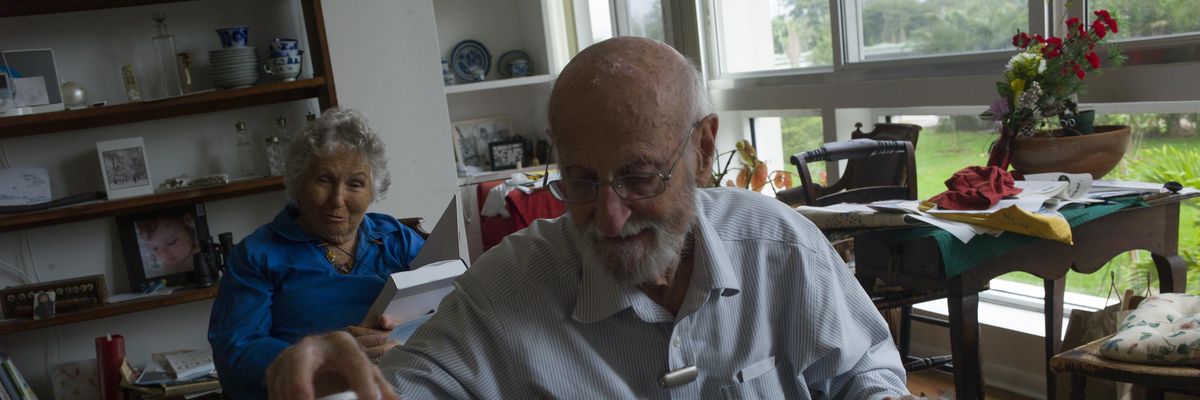
Charles Miller, 90, prepares the daily pills his wife will need for the week on January 4, 2020 in Sarasota, Florida. After suffering a stroke and a heart attack, his wife needs approximately ten different medicines daily which need to be carefully monitored. (Photo: Andrew Lichtenstein/Corbis via Getty Images)
More than 1.1 million seniors in the Medicare program could die prematurely over the next decade because they cannot afford the exorbitant prices of prescription medications.
"High prescription drug prices cost lives. Period."
--David Mitchell, Patients For Affordable Drugs Now
That's according to a study released last week by the West Health Policy Center, a nonprofit and nonpartisan policy research group, and Xcenda, the research arm of AmerisourceBergen, a drug distributor.
Researchers expect "cost-related nonadherence" to drug therapy to increase not only unnecessary suffering but also Medicare spending, as deteriorating health conditions drive up preventable expenses by more than $177 billion by 2030.
Unless drug prices are reduced, the analysis estimated that 112,000 seniors per year could succumb to early death as a result of not being able to afford their medications. In addition, researchers projected that health complications stemming from the unaffordable cost of prescriptions will force Medicare to spend nearly $18 billion annually on avoidable medical expenses.
Prescription drug prices have been soaring, with list prices having increased by 159% from 2007 to 2018.
West Health noted that if these trends continue, cost-related nonadherence to drug therapy will be "a leading cause of death in the U.S., ahead of diabetes, influenza, pneumonia, and kidney disease."
"One of the biggest contributors to poor health, hospital admissions, higher healthcare costs, and preventable death is patients failing to take their medications as prescribed," said Timothy Lash, president of the West Health Policy Center. "Cost-related nonadherence is a significant and growing issue that is a direct result of runaway drug prices and a failure to implement policies and regulations that make drugs more affordable."
The good news is that policy changes can curb the power of Big Pharma, resulting in far fewer avoidable deaths.
Currently, Medicare beneficiaries are required to pay 25% of the list price cost of generic and brand-name medications until they reach their out-of-pocket maximum.
"As drug companies continue to raise list prices," the analysis explained, "patients may experience a significant increase in their coinsurance costs."
If Medicare were able to directly negotiate with pharmaceutical companies--as described in H.R. 3, The Elijah Cummings Lower Drug Costs Now Act, which has languished on the desk of Senate Majority Leader Micth McConnell (R-Ky.) since it was passed by House Democrats in December 2019--it would result in dramatically lower prescription drug prices nationwide.
H.R. 3 is backed by the Patients For Affordable Drugs Now coalition. David Mitchell, a cancer patient and the founder of the group, said last year that the legislative proposal could "help fix our broken system and ensure Americans with private and public insurance get the drugs they need at lower prices."
According to the Council for Informed Drug Spending Analysis (CIDSA), allowing Medicare to negotiate and limit drug price increases could prevent nearly 94,000 deaths per year while also reducing Medicare spending by almost $476 billion by 2030.
Sean Dickson, director of health policy at West Health Policy Center and chair of CIDSA, said that "the costs of doing nothing about high drug prices are too high."
"Especially when policy changes such as allowing Medicare to negotiate drug prices would result in saving millions of lives and billions of dollars," he added.
Dear Common Dreams reader, It’s been nearly 30 years since I co-founded Common Dreams with my late wife, Lina Newhouser. We had the radical notion that journalism should serve the public good, not corporate profits. It was clear to us from the outset what it would take to build such a project. No paid advertisements. No corporate sponsors. No millionaire publisher telling us what to think or do. Many people said we wouldn't last a year, but we proved those doubters wrong. Together with a tremendous team of journalists and dedicated staff, we built an independent media outlet free from the constraints of profits and corporate control. Our mission has always been simple: To inform. To inspire. To ignite change for the common good. Building Common Dreams was not easy. Our survival was never guaranteed. When you take on the most powerful forces—Wall Street greed, fossil fuel industry destruction, Big Tech lobbyists, and uber-rich oligarchs who have spent billions upon billions rigging the economy and democracy in their favor—the only bulwark you have is supporters who believe in your work. But here’s the urgent message from me today. It's never been this bad out there. And it's never been this hard to keep us going. At the very moment Common Dreams is most needed, the threats we face are intensifying. We need your support now more than ever. We don't accept corporate advertising and never will. We don't have a paywall because we don't think people should be blocked from critical news based on their ability to pay. Everything we do is funded by the donations of readers like you. When everyone does the little they can afford, we are strong. But if that support retreats or dries up, so do we. Will you donate now to make sure Common Dreams not only survives but thrives? —Craig Brown, Co-founder |
More than 1.1 million seniors in the Medicare program could die prematurely over the next decade because they cannot afford the exorbitant prices of prescription medications.
"High prescription drug prices cost lives. Period."
--David Mitchell, Patients For Affordable Drugs Now
That's according to a study released last week by the West Health Policy Center, a nonprofit and nonpartisan policy research group, and Xcenda, the research arm of AmerisourceBergen, a drug distributor.
Researchers expect "cost-related nonadherence" to drug therapy to increase not only unnecessary suffering but also Medicare spending, as deteriorating health conditions drive up preventable expenses by more than $177 billion by 2030.
Unless drug prices are reduced, the analysis estimated that 112,000 seniors per year could succumb to early death as a result of not being able to afford their medications. In addition, researchers projected that health complications stemming from the unaffordable cost of prescriptions will force Medicare to spend nearly $18 billion annually on avoidable medical expenses.
Prescription drug prices have been soaring, with list prices having increased by 159% from 2007 to 2018.
West Health noted that if these trends continue, cost-related nonadherence to drug therapy will be "a leading cause of death in the U.S., ahead of diabetes, influenza, pneumonia, and kidney disease."
"One of the biggest contributors to poor health, hospital admissions, higher healthcare costs, and preventable death is patients failing to take their medications as prescribed," said Timothy Lash, president of the West Health Policy Center. "Cost-related nonadherence is a significant and growing issue that is a direct result of runaway drug prices and a failure to implement policies and regulations that make drugs more affordable."
The good news is that policy changes can curb the power of Big Pharma, resulting in far fewer avoidable deaths.
Currently, Medicare beneficiaries are required to pay 25% of the list price cost of generic and brand-name medications until they reach their out-of-pocket maximum.
"As drug companies continue to raise list prices," the analysis explained, "patients may experience a significant increase in their coinsurance costs."
If Medicare were able to directly negotiate with pharmaceutical companies--as described in H.R. 3, The Elijah Cummings Lower Drug Costs Now Act, which has languished on the desk of Senate Majority Leader Micth McConnell (R-Ky.) since it was passed by House Democrats in December 2019--it would result in dramatically lower prescription drug prices nationwide.
H.R. 3 is backed by the Patients For Affordable Drugs Now coalition. David Mitchell, a cancer patient and the founder of the group, said last year that the legislative proposal could "help fix our broken system and ensure Americans with private and public insurance get the drugs they need at lower prices."
According to the Council for Informed Drug Spending Analysis (CIDSA), allowing Medicare to negotiate and limit drug price increases could prevent nearly 94,000 deaths per year while also reducing Medicare spending by almost $476 billion by 2030.
Sean Dickson, director of health policy at West Health Policy Center and chair of CIDSA, said that "the costs of doing nothing about high drug prices are too high."
"Especially when policy changes such as allowing Medicare to negotiate drug prices would result in saving millions of lives and billions of dollars," he added.
More than 1.1 million seniors in the Medicare program could die prematurely over the next decade because they cannot afford the exorbitant prices of prescription medications.
"High prescription drug prices cost lives. Period."
--David Mitchell, Patients For Affordable Drugs Now
That's according to a study released last week by the West Health Policy Center, a nonprofit and nonpartisan policy research group, and Xcenda, the research arm of AmerisourceBergen, a drug distributor.
Researchers expect "cost-related nonadherence" to drug therapy to increase not only unnecessary suffering but also Medicare spending, as deteriorating health conditions drive up preventable expenses by more than $177 billion by 2030.
Unless drug prices are reduced, the analysis estimated that 112,000 seniors per year could succumb to early death as a result of not being able to afford their medications. In addition, researchers projected that health complications stemming from the unaffordable cost of prescriptions will force Medicare to spend nearly $18 billion annually on avoidable medical expenses.
Prescription drug prices have been soaring, with list prices having increased by 159% from 2007 to 2018.
West Health noted that if these trends continue, cost-related nonadherence to drug therapy will be "a leading cause of death in the U.S., ahead of diabetes, influenza, pneumonia, and kidney disease."
"One of the biggest contributors to poor health, hospital admissions, higher healthcare costs, and preventable death is patients failing to take their medications as prescribed," said Timothy Lash, president of the West Health Policy Center. "Cost-related nonadherence is a significant and growing issue that is a direct result of runaway drug prices and a failure to implement policies and regulations that make drugs more affordable."
The good news is that policy changes can curb the power of Big Pharma, resulting in far fewer avoidable deaths.
Currently, Medicare beneficiaries are required to pay 25% of the list price cost of generic and brand-name medications until they reach their out-of-pocket maximum.
"As drug companies continue to raise list prices," the analysis explained, "patients may experience a significant increase in their coinsurance costs."
If Medicare were able to directly negotiate with pharmaceutical companies--as described in H.R. 3, The Elijah Cummings Lower Drug Costs Now Act, which has languished on the desk of Senate Majority Leader Micth McConnell (R-Ky.) since it was passed by House Democrats in December 2019--it would result in dramatically lower prescription drug prices nationwide.
H.R. 3 is backed by the Patients For Affordable Drugs Now coalition. David Mitchell, a cancer patient and the founder of the group, said last year that the legislative proposal could "help fix our broken system and ensure Americans with private and public insurance get the drugs they need at lower prices."
According to the Council for Informed Drug Spending Analysis (CIDSA), allowing Medicare to negotiate and limit drug price increases could prevent nearly 94,000 deaths per year while also reducing Medicare spending by almost $476 billion by 2030.
Sean Dickson, director of health policy at West Health Policy Center and chair of CIDSA, said that "the costs of doing nothing about high drug prices are too high."
"Especially when policy changes such as allowing Medicare to negotiate drug prices would result in saving millions of lives and billions of dollars," he added.