SUBSCRIBE TO OUR FREE NEWSLETTER
Daily news & progressive opinion—funded by the people, not the corporations—delivered straight to your inbox.
5
#000000
#FFFFFF
To donate by check, phone, or other method, see our More Ways to Give page.
Daily news & progressive opinion—funded by the people, not the corporations—delivered straight to your inbox.
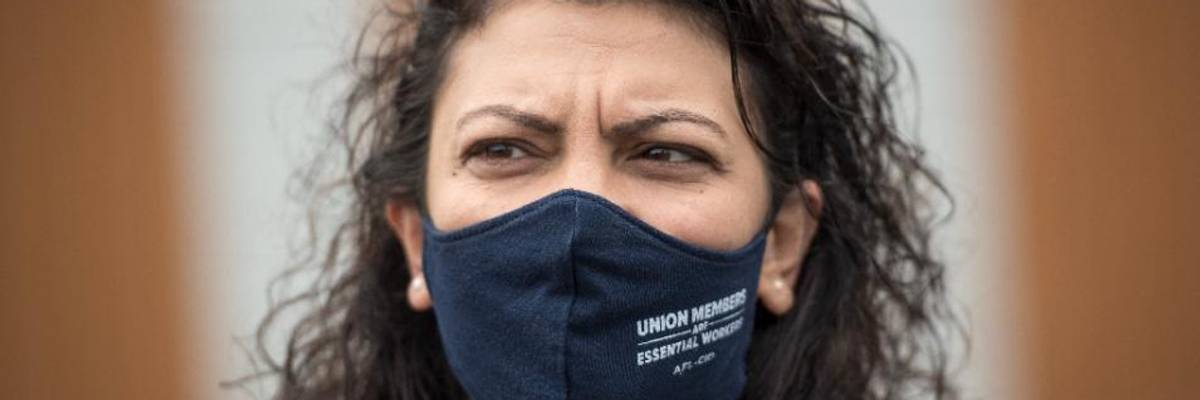
Rep. Rashida Tlaib (D-Mich.) looked on before then-Vice Presidential nominee Kamala Harris spoke at IBEW Local Union 58 on October 25, 2020 in Detroit, Michigan. (Photo: Nic Antaya/Getty Images)
Joining a chorus of progressive critics disappointed by the direct payment provision of President-elect Joe Biden's new coronavirus pandemic relief plan, Congresswoman Rashida Tlaib on Friday evening reiterated the need for two bills she has introduced that would aid Americans affected by the ongoing public health and economic crises.
Biden's $1.9 trillion proposal calls for $1,400 checks, the difference between the $600 that lawmakers agreed to in a recent relief package and the $2,000 sought by some Democrats for months. Though President Donald Trump backed boosting the checks on his way out the door, the increase failed to garner enough congressional support.
Reps. Alexandria Ocasio-Cortez (D-N.Y.) and Cori Bush (D-Mo.) expressed disappointment that Biden's plan doesn't include $2,000 checks. Tlaib (D-Mich.) joined in, tweeting: "That $600 is already in the clutches of landlords and bill collectors. Stop compromising the working class, and our most vulnerable neighbors."
Tlaib also promoted two bills she introduced last session: the Automatic BOOST to Communities (ABC) and the Building Our Opportunities to Survive and Thrive (BOOST) acts. The former would provide $2,000 per month to eligible individuals during the Covid-19 crisis, then $1,000 monthly payments for the next year.
As a Forbes report about the ABC Act, shared on Friday by Tlaib, detailed:
The payments would be made via direct deposit if the [U.S.] Treasury has the individual's banking information on file, unless the individual would prefer to have their payment made on an Interim BOOST Card (BOOST Card).
The BOOST Card would be a prepaid debit card that would not be subject to any fees, penalty charges, or usage restrictions. The full amount would be available for immediate withdrawal at any ATM in the country without any usage or withdrawal fees. Individuals who do not have banking information would receive their payments via a BOOST Card.
The Michigan Democrat officially introduced the ABC Act in April 2020 with Rep. Pramila Jayapal (D-Wash.), after a few weeks of public discussion about it. Jayapal, chair of the Congressional Progressive Caucus, is currently battling Covid-19 after sheltering with maskless GOP lawmakers while pro-Trump rioters stormed the U.S. Capitol last week.
"We have to deliver $2,000 survival checks to the American people. Not anything less," Jayapal tweeted Thursday evening. She has stuck to that call throughout the pandemic:
Tlaib on Friday also highlighted the BOOST Act, which she and Jayapal introduced in June 2019--months before the pandemic--with Reps. Jesus "Chuy" Garcia (D-Ill.), Sheila Jackson-Lee (D-Texas), and Ayanna Pressley (D-Mass.). That bill would provide a Middle-Class Tax Credit of up to $3,000 annually for a single taxpayer and up to $6,000 annually for married couples, families, and joint filers.
According to a page of Tlaib's congressional website dedicated to the BOOST Act:
When the bill was introduced, long before the economic devastation of the pandemic, Adam Reuben, director of the Economic Security Project, said that "while Americans work hard--whether it's a full-time job, or caring for a sick family member--an outdated notion of who deserves help from our society means that too many still struggle to make ends meet."
"The BOOST Act would essentially provide a cost-of-living refund to those who need it most," he added, "so that in the richest country in the world, we can make sure that no one lives in poverty."
With millions of Americans now out of work because of the public health crisis, and struggling to keep food on the table and a roof ever their heads, the need for relief is even greater. As Pressley put it in a tweet Friday afternoon: "The people deserve, demand, and require $2,000 recurring monthly survival checks."
Dear Common Dreams reader, It’s been nearly 30 years since I co-founded Common Dreams with my late wife, Lina Newhouser. We had the radical notion that journalism should serve the public good, not corporate profits. It was clear to us from the outset what it would take to build such a project. No paid advertisements. No corporate sponsors. No millionaire publisher telling us what to think or do. Many people said we wouldn't last a year, but we proved those doubters wrong. Together with a tremendous team of journalists and dedicated staff, we built an independent media outlet free from the constraints of profits and corporate control. Our mission has always been simple: To inform. To inspire. To ignite change for the common good. Building Common Dreams was not easy. Our survival was never guaranteed. When you take on the most powerful forces—Wall Street greed, fossil fuel industry destruction, Big Tech lobbyists, and uber-rich oligarchs who have spent billions upon billions rigging the economy and democracy in their favor—the only bulwark you have is supporters who believe in your work. But here’s the urgent message from me today. It's never been this bad out there. And it's never been this hard to keep us going. At the very moment Common Dreams is most needed, the threats we face are intensifying. We need your support now more than ever. We don't accept corporate advertising and never will. We don't have a paywall because we don't think people should be blocked from critical news based on their ability to pay. Everything we do is funded by the donations of readers like you. When everyone does the little they can afford, we are strong. But if that support retreats or dries up, so do we. Will you donate now to make sure Common Dreams not only survives but thrives? —Craig Brown, Co-founder |
Joining a chorus of progressive critics disappointed by the direct payment provision of President-elect Joe Biden's new coronavirus pandemic relief plan, Congresswoman Rashida Tlaib on Friday evening reiterated the need for two bills she has introduced that would aid Americans affected by the ongoing public health and economic crises.
Biden's $1.9 trillion proposal calls for $1,400 checks, the difference between the $600 that lawmakers agreed to in a recent relief package and the $2,000 sought by some Democrats for months. Though President Donald Trump backed boosting the checks on his way out the door, the increase failed to garner enough congressional support.
Reps. Alexandria Ocasio-Cortez (D-N.Y.) and Cori Bush (D-Mo.) expressed disappointment that Biden's plan doesn't include $2,000 checks. Tlaib (D-Mich.) joined in, tweeting: "That $600 is already in the clutches of landlords and bill collectors. Stop compromising the working class, and our most vulnerable neighbors."
Tlaib also promoted two bills she introduced last session: the Automatic BOOST to Communities (ABC) and the Building Our Opportunities to Survive and Thrive (BOOST) acts. The former would provide $2,000 per month to eligible individuals during the Covid-19 crisis, then $1,000 monthly payments for the next year.
As a Forbes report about the ABC Act, shared on Friday by Tlaib, detailed:
The payments would be made via direct deposit if the [U.S.] Treasury has the individual's banking information on file, unless the individual would prefer to have their payment made on an Interim BOOST Card (BOOST Card).
The BOOST Card would be a prepaid debit card that would not be subject to any fees, penalty charges, or usage restrictions. The full amount would be available for immediate withdrawal at any ATM in the country without any usage or withdrawal fees. Individuals who do not have banking information would receive their payments via a BOOST Card.
The Michigan Democrat officially introduced the ABC Act in April 2020 with Rep. Pramila Jayapal (D-Wash.), after a few weeks of public discussion about it. Jayapal, chair of the Congressional Progressive Caucus, is currently battling Covid-19 after sheltering with maskless GOP lawmakers while pro-Trump rioters stormed the U.S. Capitol last week.
"We have to deliver $2,000 survival checks to the American people. Not anything less," Jayapal tweeted Thursday evening. She has stuck to that call throughout the pandemic:
Tlaib on Friday also highlighted the BOOST Act, which she and Jayapal introduced in June 2019--months before the pandemic--with Reps. Jesus "Chuy" Garcia (D-Ill.), Sheila Jackson-Lee (D-Texas), and Ayanna Pressley (D-Mass.). That bill would provide a Middle-Class Tax Credit of up to $3,000 annually for a single taxpayer and up to $6,000 annually for married couples, families, and joint filers.
According to a page of Tlaib's congressional website dedicated to the BOOST Act:
When the bill was introduced, long before the economic devastation of the pandemic, Adam Reuben, director of the Economic Security Project, said that "while Americans work hard--whether it's a full-time job, or caring for a sick family member--an outdated notion of who deserves help from our society means that too many still struggle to make ends meet."
"The BOOST Act would essentially provide a cost-of-living refund to those who need it most," he added, "so that in the richest country in the world, we can make sure that no one lives in poverty."
With millions of Americans now out of work because of the public health crisis, and struggling to keep food on the table and a roof ever their heads, the need for relief is even greater. As Pressley put it in a tweet Friday afternoon: "The people deserve, demand, and require $2,000 recurring monthly survival checks."
Joining a chorus of progressive critics disappointed by the direct payment provision of President-elect Joe Biden's new coronavirus pandemic relief plan, Congresswoman Rashida Tlaib on Friday evening reiterated the need for two bills she has introduced that would aid Americans affected by the ongoing public health and economic crises.
Biden's $1.9 trillion proposal calls for $1,400 checks, the difference between the $600 that lawmakers agreed to in a recent relief package and the $2,000 sought by some Democrats for months. Though President Donald Trump backed boosting the checks on his way out the door, the increase failed to garner enough congressional support.
Reps. Alexandria Ocasio-Cortez (D-N.Y.) and Cori Bush (D-Mo.) expressed disappointment that Biden's plan doesn't include $2,000 checks. Tlaib (D-Mich.) joined in, tweeting: "That $600 is already in the clutches of landlords and bill collectors. Stop compromising the working class, and our most vulnerable neighbors."
Tlaib also promoted two bills she introduced last session: the Automatic BOOST to Communities (ABC) and the Building Our Opportunities to Survive and Thrive (BOOST) acts. The former would provide $2,000 per month to eligible individuals during the Covid-19 crisis, then $1,000 monthly payments for the next year.
As a Forbes report about the ABC Act, shared on Friday by Tlaib, detailed:
The payments would be made via direct deposit if the [U.S.] Treasury has the individual's banking information on file, unless the individual would prefer to have their payment made on an Interim BOOST Card (BOOST Card).
The BOOST Card would be a prepaid debit card that would not be subject to any fees, penalty charges, or usage restrictions. The full amount would be available for immediate withdrawal at any ATM in the country without any usage or withdrawal fees. Individuals who do not have banking information would receive their payments via a BOOST Card.
The Michigan Democrat officially introduced the ABC Act in April 2020 with Rep. Pramila Jayapal (D-Wash.), after a few weeks of public discussion about it. Jayapal, chair of the Congressional Progressive Caucus, is currently battling Covid-19 after sheltering with maskless GOP lawmakers while pro-Trump rioters stormed the U.S. Capitol last week.
"We have to deliver $2,000 survival checks to the American people. Not anything less," Jayapal tweeted Thursday evening. She has stuck to that call throughout the pandemic:
Tlaib on Friday also highlighted the BOOST Act, which she and Jayapal introduced in June 2019--months before the pandemic--with Reps. Jesus "Chuy" Garcia (D-Ill.), Sheila Jackson-Lee (D-Texas), and Ayanna Pressley (D-Mass.). That bill would provide a Middle-Class Tax Credit of up to $3,000 annually for a single taxpayer and up to $6,000 annually for married couples, families, and joint filers.
According to a page of Tlaib's congressional website dedicated to the BOOST Act:
When the bill was introduced, long before the economic devastation of the pandemic, Adam Reuben, director of the Economic Security Project, said that "while Americans work hard--whether it's a full-time job, or caring for a sick family member--an outdated notion of who deserves help from our society means that too many still struggle to make ends meet."
"The BOOST Act would essentially provide a cost-of-living refund to those who need it most," he added, "so that in the richest country in the world, we can make sure that no one lives in poverty."
With millions of Americans now out of work because of the public health crisis, and struggling to keep food on the table and a roof ever their heads, the need for relief is even greater. As Pressley put it in a tweet Friday afternoon: "The people deserve, demand, and require $2,000 recurring monthly survival checks."