
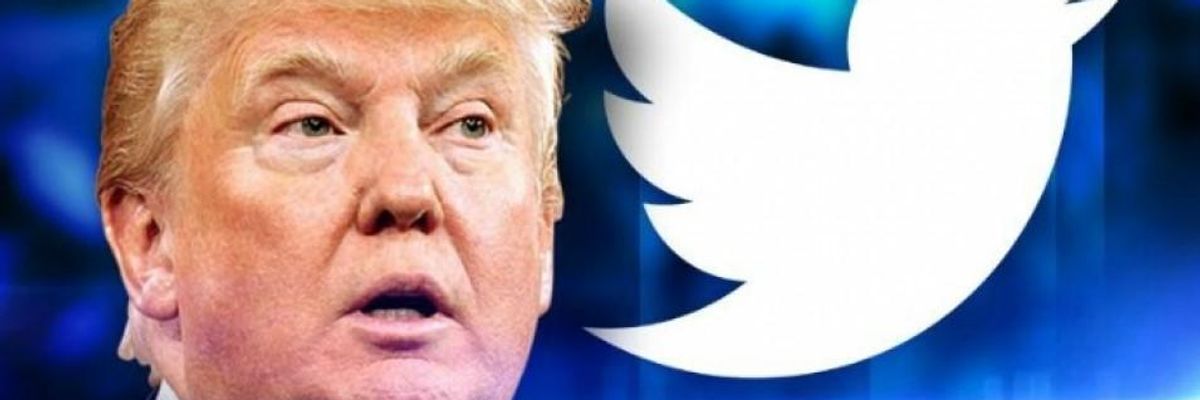
"The findings, from Jan. 9 through Friday," reports the Washington Post, "highlight how falsehoods flow across social media sites--reinforcing and amplifying each other--and offer an early indication of how concerted actions against misinformation can make a difference." (Image: Gage Skidmore/Flickr/cc)
'Talk About a Super Spreader': Analysis Finds Online Election Misinformation Fell by 73% After Trump Barred
After Trump's lies disappeared from Twitter and Facebook, the dissemination of falsehoods and the conversations based on them fell dramatically.
A new analysis of online misinformation released Saturday showed that false and wildly misleading content regarding the outcome of the 2020 presidential election was reduced by nearly three-fourths overall after President Donald Trump was barred from posting on major social media sites in the wake of the January 6 attack on the U.S. Capitol building by his supporters.
The research firm Zignal Labs, as the Washington Post reports, calculated that conversations based on misinformation "plunged 73 percent after several social media sites suspended President Trump and key allies last week."
According to the Post:
The findings, from Jan. 9 through Friday, highlight how falsehoods flow across social media sites--reinforcing and amplifying each other--and offer an early indication of how concerted actions against misinformation can make a difference.
Twitter's ban of Trump on Jan. 8, after years in which @realDonaldTrump was a potent online megaphone, has been particularly significant in curbing his ability to push misleading claims about what state and federal officials have called a free and fair election on Nov. 3.
Trump's banishment was followed by other actions by social media sites, including Twitter's ban of more than 70,000 accounts affiliated with the baseless QAnon ideology, which played a key role in fomenting the Capitol siege on Jan. 6.
"Together, those actions will likely significantly reduce the amount of online misinformation in the near term," Kate Starbird, disinformation researcher at the University of Washington, told the Post. "What happens in the long term is still up in the air."
Writing for the media watchdog outlet Fairness and Accuracy In Reporting (FAIR) on Friday, journalist Alan MacLeod warned that even if Trump's current ban from prominent social media is justified, the fact that these platforms have such outsized power is a danger to free speech rights and democracy in the long run.
"It's difficult to argue that Trump did not repeatedly violate Twitter's rules against 'threaten[ing] violence' and 'glorification of violence,' justifying his ban," wrote MacLeod. "But we urgently need to rethink the power of these social media behemoths, because there are plenty of other examples where their enforcement of their rules has been arbitrary and non-transparent."
An Urgent Message From Our Co-Founder
Dear Common Dreams reader, It’s been nearly 30 years since I co-founded Common Dreams with my late wife, Lina Newhouser. We had the radical notion that journalism should serve the public good, not corporate profits. It was clear to us from the outset what it would take to build such a project. No paid advertisements. No corporate sponsors. No millionaire publisher telling us what to think or do. Many people said we wouldn't last a year, but we proved those doubters wrong. Together with a tremendous team of journalists and dedicated staff, we built an independent media outlet free from the constraints of profits and corporate control. Our mission has always been simple: To inform. To inspire. To ignite change for the common good. Building Common Dreams was not easy. Our survival was never guaranteed. When you take on the most powerful forces—Wall Street greed, fossil fuel industry destruction, Big Tech lobbyists, and uber-rich oligarchs who have spent billions upon billions rigging the economy and democracy in their favor—the only bulwark you have is supporters who believe in your work. But here’s the urgent message from me today. It's never been this bad out there. And it's never been this hard to keep us going. At the very moment Common Dreams is most needed, the threats we face are intensifying. We need your support now more than ever. We don't accept corporate advertising and never will. We don't have a paywall because we don't think people should be blocked from critical news based on their ability to pay. Everything we do is funded by the donations of readers like you. When everyone does the little they can afford, we are strong. But if that support retreats or dries up, so do we. Will you donate now to make sure Common Dreams not only survives but thrives? —Craig Brown, Co-founder |
A new analysis of online misinformation released Saturday showed that false and wildly misleading content regarding the outcome of the 2020 presidential election was reduced by nearly three-fourths overall after President Donald Trump was barred from posting on major social media sites in the wake of the January 6 attack on the U.S. Capitol building by his supporters.
The research firm Zignal Labs, as the Washington Post reports, calculated that conversations based on misinformation "plunged 73 percent after several social media sites suspended President Trump and key allies last week."
According to the Post:
The findings, from Jan. 9 through Friday, highlight how falsehoods flow across social media sites--reinforcing and amplifying each other--and offer an early indication of how concerted actions against misinformation can make a difference.
Twitter's ban of Trump on Jan. 8, after years in which @realDonaldTrump was a potent online megaphone, has been particularly significant in curbing his ability to push misleading claims about what state and federal officials have called a free and fair election on Nov. 3.
Trump's banishment was followed by other actions by social media sites, including Twitter's ban of more than 70,000 accounts affiliated with the baseless QAnon ideology, which played a key role in fomenting the Capitol siege on Jan. 6.
"Together, those actions will likely significantly reduce the amount of online misinformation in the near term," Kate Starbird, disinformation researcher at the University of Washington, told the Post. "What happens in the long term is still up in the air."
Writing for the media watchdog outlet Fairness and Accuracy In Reporting (FAIR) on Friday, journalist Alan MacLeod warned that even if Trump's current ban from prominent social media is justified, the fact that these platforms have such outsized power is a danger to free speech rights and democracy in the long run.
"It's difficult to argue that Trump did not repeatedly violate Twitter's rules against 'threaten[ing] violence' and 'glorification of violence,' justifying his ban," wrote MacLeod. "But we urgently need to rethink the power of these social media behemoths, because there are plenty of other examples where their enforcement of their rules has been arbitrary and non-transparent."
A new analysis of online misinformation released Saturday showed that false and wildly misleading content regarding the outcome of the 2020 presidential election was reduced by nearly three-fourths overall after President Donald Trump was barred from posting on major social media sites in the wake of the January 6 attack on the U.S. Capitol building by his supporters.
The research firm Zignal Labs, as the Washington Post reports, calculated that conversations based on misinformation "plunged 73 percent after several social media sites suspended President Trump and key allies last week."
According to the Post:
The findings, from Jan. 9 through Friday, highlight how falsehoods flow across social media sites--reinforcing and amplifying each other--and offer an early indication of how concerted actions against misinformation can make a difference.
Twitter's ban of Trump on Jan. 8, after years in which @realDonaldTrump was a potent online megaphone, has been particularly significant in curbing his ability to push misleading claims about what state and federal officials have called a free and fair election on Nov. 3.
Trump's banishment was followed by other actions by social media sites, including Twitter's ban of more than 70,000 accounts affiliated with the baseless QAnon ideology, which played a key role in fomenting the Capitol siege on Jan. 6.
"Together, those actions will likely significantly reduce the amount of online misinformation in the near term," Kate Starbird, disinformation researcher at the University of Washington, told the Post. "What happens in the long term is still up in the air."
Writing for the media watchdog outlet Fairness and Accuracy In Reporting (FAIR) on Friday, journalist Alan MacLeod warned that even if Trump's current ban from prominent social media is justified, the fact that these platforms have such outsized power is a danger to free speech rights and democracy in the long run.
"It's difficult to argue that Trump did not repeatedly violate Twitter's rules against 'threaten[ing] violence' and 'glorification of violence,' justifying his ban," wrote MacLeod. "But we urgently need to rethink the power of these social media behemoths, because there are plenty of other examples where their enforcement of their rules has been arbitrary and non-transparent."