SUBSCRIBE TO OUR FREE NEWSLETTER
Daily news & progressive opinion—funded by the people, not the corporations—delivered straight to your inbox.
5
#000000
#FFFFFF
To donate by check, phone, or other method, see our More Ways to Give page.
Daily news & progressive opinion—funded by the people, not the corporations—delivered straight to your inbox.
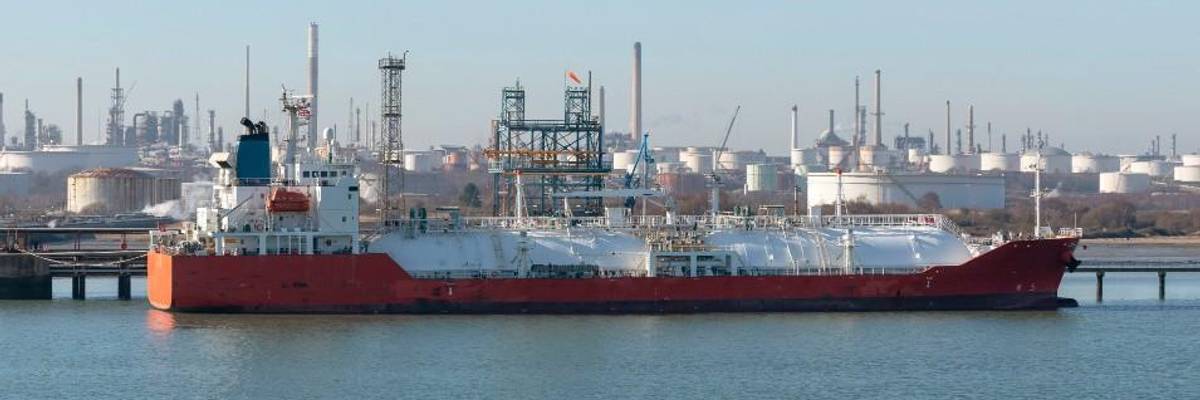
Indigenous and environmental activists hailed the announced cancellation on March 22, 2021 of Annova LNG's planned liquefied natural gas terminal in Brownsville, Texas. (Photo: Peter Titmuss/Education Images/Universal Images Group via Getty Images)
In what Indigenous and environmental activists hailed as a testament to the power of grassroots organizing, a leading U.S. fossil fuel company on Monday announced the cancellation of a planned fracked natural gas terminal in southern Texas.
"If built, Annova LNG would have destroyed wetlands, blocked a wildlife corridor threatening the survival of endangered wildlife, and put communities needlessly at risk."
-- Sierra Club
Reuters reports liquefied natural gas developer Annova LNG said it will immediately discontinue work on the Brownsville export terminal "due to changes in the global LNG market." The company's facility would have been capable of exporting 6.5 million tonnes per annum (MTPA) of liquefied natural gas. The project was one of three proposed fracked natural gas terminals in the Rio Grande Valley.
"If built, Annova LNG would have destroyed wetlands, blocked a wildlife corridor threatening the survival of endangered wildlife, and put communities needlessly at risk," said the Sierra Club in a statement Monday.
"Today's victory is the result of six years of tireless efforts of the Rio Grande Valley communities in South Texas who have written comments, attended hearings, protested banks, and more to protect their health, their precious coastline, and the climate from Annova LNG's proposed fracked gas project," said Sierra Club Gulf Coast Campaign representative Bekah Hinojosa.
"No LNG export terminal has any place in our communities or our energy future, and today's news is a step in the right direction to putting an end to exporting fracked gas across the world," she added.
Juan Mancias, chairman of the Carrizo Comecrudo tribe, welcomed the cancellation in a statement.
"Ayema ahua'p pele maute alpa Esto'k Gna," he said--It is a good day to be a human being.
"Thank you to all who have worked so hard to fight this fracked gas project and protect our sacred lands from pollution," said Mancias. "There's more work to do to ensure other proposed fracked gas export terminals, which would desecrate our burial sites and sacred lands, are never built, but today we celebrate this important victory for our people and our environment. The other two Rio Grande Valley proposed LNG terminals must be stopped."
In addition to the cancelled Annova terminal, the Federal Energy Regulatory Commission during the administration of former President Donald Trump also approved Texas LNG Brownsville's proposal for a four million metric tons per year terminal at the Brownsville Ship Canal and Rio Grande LNG's Rio Bravo pipeline terminal at the Port of Brownsville.
Dear Common Dreams reader, It’s been nearly 30 years since I co-founded Common Dreams with my late wife, Lina Newhouser. We had the radical notion that journalism should serve the public good, not corporate profits. It was clear to us from the outset what it would take to build such a project. No paid advertisements. No corporate sponsors. No millionaire publisher telling us what to think or do. Many people said we wouldn't last a year, but we proved those doubters wrong. Together with a tremendous team of journalists and dedicated staff, we built an independent media outlet free from the constraints of profits and corporate control. Our mission has always been simple: To inform. To inspire. To ignite change for the common good. Building Common Dreams was not easy. Our survival was never guaranteed. When you take on the most powerful forces—Wall Street greed, fossil fuel industry destruction, Big Tech lobbyists, and uber-rich oligarchs who have spent billions upon billions rigging the economy and democracy in their favor—the only bulwark you have is supporters who believe in your work. But here’s the urgent message from me today. It's never been this bad out there. And it's never been this hard to keep us going. At the very moment Common Dreams is most needed, the threats we face are intensifying. We need your support now more than ever. We don't accept corporate advertising and never will. We don't have a paywall because we don't think people should be blocked from critical news based on their ability to pay. Everything we do is funded by the donations of readers like you. When everyone does the little they can afford, we are strong. But if that support retreats or dries up, so do we. Will you donate now to make sure Common Dreams not only survives but thrives? —Craig Brown, Co-founder |
In what Indigenous and environmental activists hailed as a testament to the power of grassroots organizing, a leading U.S. fossil fuel company on Monday announced the cancellation of a planned fracked natural gas terminal in southern Texas.
"If built, Annova LNG would have destroyed wetlands, blocked a wildlife corridor threatening the survival of endangered wildlife, and put communities needlessly at risk."
-- Sierra Club
Reuters reports liquefied natural gas developer Annova LNG said it will immediately discontinue work on the Brownsville export terminal "due to changes in the global LNG market." The company's facility would have been capable of exporting 6.5 million tonnes per annum (MTPA) of liquefied natural gas. The project was one of three proposed fracked natural gas terminals in the Rio Grande Valley.
"If built, Annova LNG would have destroyed wetlands, blocked a wildlife corridor threatening the survival of endangered wildlife, and put communities needlessly at risk," said the Sierra Club in a statement Monday.
"Today's victory is the result of six years of tireless efforts of the Rio Grande Valley communities in South Texas who have written comments, attended hearings, protested banks, and more to protect their health, their precious coastline, and the climate from Annova LNG's proposed fracked gas project," said Sierra Club Gulf Coast Campaign representative Bekah Hinojosa.
"No LNG export terminal has any place in our communities or our energy future, and today's news is a step in the right direction to putting an end to exporting fracked gas across the world," she added.
Juan Mancias, chairman of the Carrizo Comecrudo tribe, welcomed the cancellation in a statement.
"Ayema ahua'p pele maute alpa Esto'k Gna," he said--It is a good day to be a human being.
"Thank you to all who have worked so hard to fight this fracked gas project and protect our sacred lands from pollution," said Mancias. "There's more work to do to ensure other proposed fracked gas export terminals, which would desecrate our burial sites and sacred lands, are never built, but today we celebrate this important victory for our people and our environment. The other two Rio Grande Valley proposed LNG terminals must be stopped."
In addition to the cancelled Annova terminal, the Federal Energy Regulatory Commission during the administration of former President Donald Trump also approved Texas LNG Brownsville's proposal for a four million metric tons per year terminal at the Brownsville Ship Canal and Rio Grande LNG's Rio Bravo pipeline terminal at the Port of Brownsville.
In what Indigenous and environmental activists hailed as a testament to the power of grassroots organizing, a leading U.S. fossil fuel company on Monday announced the cancellation of a planned fracked natural gas terminal in southern Texas.
"If built, Annova LNG would have destroyed wetlands, blocked a wildlife corridor threatening the survival of endangered wildlife, and put communities needlessly at risk."
-- Sierra Club
Reuters reports liquefied natural gas developer Annova LNG said it will immediately discontinue work on the Brownsville export terminal "due to changes in the global LNG market." The company's facility would have been capable of exporting 6.5 million tonnes per annum (MTPA) of liquefied natural gas. The project was one of three proposed fracked natural gas terminals in the Rio Grande Valley.
"If built, Annova LNG would have destroyed wetlands, blocked a wildlife corridor threatening the survival of endangered wildlife, and put communities needlessly at risk," said the Sierra Club in a statement Monday.
"Today's victory is the result of six years of tireless efforts of the Rio Grande Valley communities in South Texas who have written comments, attended hearings, protested banks, and more to protect their health, their precious coastline, and the climate from Annova LNG's proposed fracked gas project," said Sierra Club Gulf Coast Campaign representative Bekah Hinojosa.
"No LNG export terminal has any place in our communities or our energy future, and today's news is a step in the right direction to putting an end to exporting fracked gas across the world," she added.
Juan Mancias, chairman of the Carrizo Comecrudo tribe, welcomed the cancellation in a statement.
"Ayema ahua'p pele maute alpa Esto'k Gna," he said--It is a good day to be a human being.
"Thank you to all who have worked so hard to fight this fracked gas project and protect our sacred lands from pollution," said Mancias. "There's more work to do to ensure other proposed fracked gas export terminals, which would desecrate our burial sites and sacred lands, are never built, but today we celebrate this important victory for our people and our environment. The other two Rio Grande Valley proposed LNG terminals must be stopped."
In addition to the cancelled Annova terminal, the Federal Energy Regulatory Commission during the administration of former President Donald Trump also approved Texas LNG Brownsville's proposal for a four million metric tons per year terminal at the Brownsville Ship Canal and Rio Grande LNG's Rio Bravo pipeline terminal at the Port of Brownsville.