

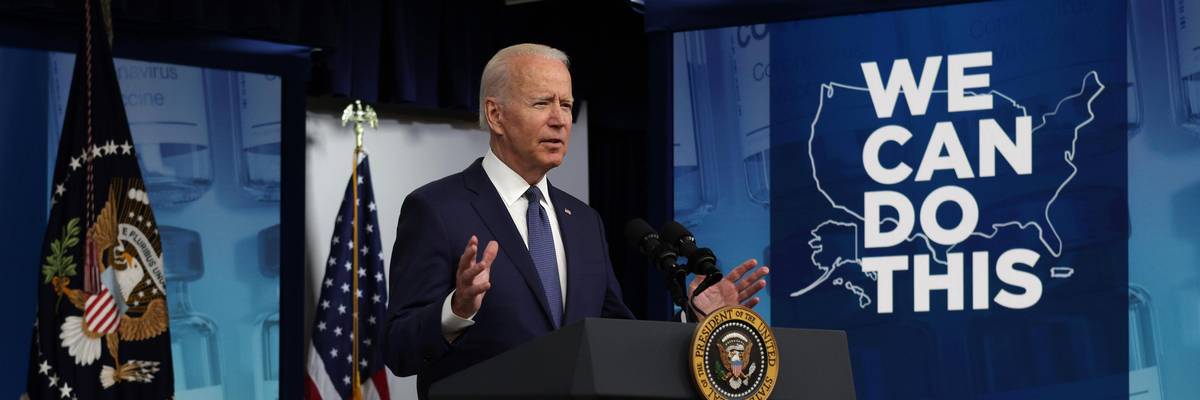
President Joe Biden speaks during an event on the Covid-19 response and vaccination program at the South Court Auditorium of Eisenhower Executive Office Building on July 6, 2021 in Washington, D.C. (Photo: Alex Wong/Getty Images)
As Delta Wreaks Havoc, Biden Faces Growing Pressure to Force Big Pharma to Share Vaccine Recipes
"Millions of people have lost their lives waiting for such desperately needed action."
With a proposed patent waiver for coronavirus vaccines still mired in fruitless talks at the World Trade Organization, U.S. President Biden is facing growing calls to use his legal authority to force pharmaceutical giants to share their vaccine recipes as governments around the world race to combat the fast-spreading Delta variant.
"The U.S. government has power to share vaccine manufacturing knowledge and help other countries scale up production."
--Peter Maybarduk, Public Citizen
The U.S. government currently owns the patent for critical spike-protein technology developed by the National Institutes of Health. That technology, which helps trigger an immune response against the coronavirus, has been utilized by at least five companies in the development of vaccines, including Moderna, Pfizer, and Johnson & Johnson.
Thus far, the Biden administration has declined to leverage the government's ownership of the so-called '070 patent to force Big Pharma to share its vaccine formulas with manufacturers around the world, despite being urged to do so by the NIH scientist who helped develop the spike-protein technology.
But with the ultra-contagious Delta variant ripping through undervaccinated regions of the world, public health campaigners are ramping up pressure on Biden to act as pharmaceutical giants refuse to voluntarily take part in technology-sharing efforts.
"The U.S. government has power to share vaccine manufacturing knowledge and help other countries scale up production and finally end this pandemic. Millions of people have lost their lives waiting for such desperately needed action," Peter Maybarduk, director of Public Citizen's Access to Medicines program, said in a statement Tuesday.
Maybarduk said he is encouraged by recent comments from Gayle Smith, head of the global Covid-19 response at the U.S. State Department. In an interview with the Financial Times earlier this week, Smith urged U.S. vaccine makers to help develop low-cost manufacturing hubs overseas and share their technological expertise.
But Maybarduk made clear that--given the Biden administration's legal authority to compel their participation--the U.S. government can do much more than plead with profit-driven pharmaceutical companies to willingly act in the best interest of the world.
"If the U.S. government acts swiftly, it can help save hundreds of thousands of lives and stem the spread of variants," said Maybarduk. "Moderna and Pfizer's resistance to sharing the knowledge needed for countries to make vaccines is unforgivable. President Joe Biden has authority under existing law to order the sharing of vaccine recipes."
In exchange for allowing Moderna and other pharmaceutical giants to use the NIH technology, progressive advocacy groups argue, the U.S. government should require the companies to help other nations produce vaccines by sharing formulas and manufacturing know-how.
"U.S. taxpayers have invested over $2.5 billion in the development of mRNA-1273," a coalition of public health organizations wrote (pdf) in March, referring to the Moderna vaccine. "Now it is time for our government to ensure that this critical lifesaving technology be made available to all."
Biden has faced criticism for remaining largely on the sidelines following his May endorsement of the proposed vaccine patent waiver, which would lift legal barriers that are stopping manufacturers around the world from producing generic shots for the developing world. Rich members of the WTO, including Germany and the United Kingdom, continue to block the waiver.
"It is unconscionable that high-income nations of the WTO would continue to turn their backs on people of the Global South, desperate for immunity from the highly transmissible Delta variant," Asia Russell, executive director of Health GAP, said Tuesday. "Leaders of the E.U., Germany, the U.K.--and by extension, the Biden administration for abetting their TRIPS waiver obstruction--must stop their cruel and self-defeating indifference to vaccinating the world through suspending the monopolies of profiteering pharmaceutical companies."
But proponents of the patent waiver have emphasized that temporarily suspending intellectual property protections--while a necessary step--would not be sufficient to address global supply shortages and vast inequities in distribution, which have left the people of low-income nations largely without access to live-saving vaccines.
Public Citizen is calling on the U.S. Congress to support a $25 billion global vaccine manufacturing program aimed at helping developing nations produce billions of doses at home, instead of being forced to rely on restrictive bilateral deals with Big Pharma and inadequate donations from rich countries. Progressive U.S. lawmakers are also pushing for a $34 billion investment in global vaccine production and distribution in an emerging reconciliation package.
"No investment in the fight against Covid-19 is more urgent and cost-effective now than an investment in getting the world vaccinated as quickly as possible," Rep. Pramila Jayapal (D-Wash.), Sen. Elizabeth Warren (D-Mass.), and other lawmakers wrote in a letter to congressional leaders last week.
As Politico reported Tuesday, two manufacturers in Africa--which has vaccinated just 1% of its population--are working to establish "an mRNA vaccine technology-transfer hub at the tip of the continent that could let it produce its own vaccines, on its own terms."
But the effort is predictably running into resistance from pharmaceutical giants, which have also refused to join the World Health Organization's technology-transfer campaign.
"To get the [Africa] hub up and running in a year--when it could still help end the pandemic--its partners need Big Pharma's help," Politico noted. "And Big Pharma isn't keen: Neither Moderna nor Pfizer has signaled interest in working with the facility."
Nick Dearden, director of the U.K.-based advocacy group Global Justice Now, said it is "no surprise that Pfizer and Moderna aren't participating" in development of the hub, which he described as "hugely important."
"They will need to be compelled to do so," argued Dearden, "because they ain't giving up this revolutionary technology without a fight."
We are at a crossroads
This country and this world are at a monumental crossroads. In a few short weeks, US voters will have an opportunity to beat back the forces of fascism and confront the billionaires who are rigging the economy, our media system, and our democracy, making it increasingly impossible for ordinary people to get by. We’re not just talking about the election. We’re talking about what must be done once these fascist elements are vanquished from power. We need a bolder set of solutions than what either major party has so far been willing to offer and a working-class movement ready to fight like hell for it. Trump didn't emerge from nowhere. The conditions that fueled MAGA authoritarianism were created by decades of radical neoliberal economic policies and a corrupt political system dominated by corporate interests. They slashed taxes on the super-rich, promising that the benefits would trickle down. They said giveaways to the corporate titans would make life more affordable for the rest of us. It was all bullshit. And when a bitter, betrayed populace searches for someone to blame, right-wing demagogues have little trouble finding scapegoats. People know when they're being lied to, but you won't hear any of this from the corporate media. Only independent journalism—powered and funded by people who believe in building a better world—can deliver truly trustworthy daily news. Our Fall Campaign is underway, and we need your help. To power our newsroom through the rest of the year, we need to raise $125,000 by midnight on October 31. So if you share our vision, please contribute whatever you can to sustain our work. |
With a proposed patent waiver for coronavirus vaccines still mired in fruitless talks at the World Trade Organization, U.S. President Biden is facing growing calls to use his legal authority to force pharmaceutical giants to share their vaccine recipes as governments around the world race to combat the fast-spreading Delta variant.
"The U.S. government has power to share vaccine manufacturing knowledge and help other countries scale up production."
--Peter Maybarduk, Public Citizen
The U.S. government currently owns the patent for critical spike-protein technology developed by the National Institutes of Health. That technology, which helps trigger an immune response against the coronavirus, has been utilized by at least five companies in the development of vaccines, including Moderna, Pfizer, and Johnson & Johnson.
Thus far, the Biden administration has declined to leverage the government's ownership of the so-called '070 patent to force Big Pharma to share its vaccine formulas with manufacturers around the world, despite being urged to do so by the NIH scientist who helped develop the spike-protein technology.
But with the ultra-contagious Delta variant ripping through undervaccinated regions of the world, public health campaigners are ramping up pressure on Biden to act as pharmaceutical giants refuse to voluntarily take part in technology-sharing efforts.
"The U.S. government has power to share vaccine manufacturing knowledge and help other countries scale up production and finally end this pandemic. Millions of people have lost their lives waiting for such desperately needed action," Peter Maybarduk, director of Public Citizen's Access to Medicines program, said in a statement Tuesday.
Maybarduk said he is encouraged by recent comments from Gayle Smith, head of the global Covid-19 response at the U.S. State Department. In an interview with the Financial Times earlier this week, Smith urged U.S. vaccine makers to help develop low-cost manufacturing hubs overseas and share their technological expertise.
But Maybarduk made clear that--given the Biden administration's legal authority to compel their participation--the U.S. government can do much more than plead with profit-driven pharmaceutical companies to willingly act in the best interest of the world.
"If the U.S. government acts swiftly, it can help save hundreds of thousands of lives and stem the spread of variants," said Maybarduk. "Moderna and Pfizer's resistance to sharing the knowledge needed for countries to make vaccines is unforgivable. President Joe Biden has authority under existing law to order the sharing of vaccine recipes."
In exchange for allowing Moderna and other pharmaceutical giants to use the NIH technology, progressive advocacy groups argue, the U.S. government should require the companies to help other nations produce vaccines by sharing formulas and manufacturing know-how.
"U.S. taxpayers have invested over $2.5 billion in the development of mRNA-1273," a coalition of public health organizations wrote (pdf) in March, referring to the Moderna vaccine. "Now it is time for our government to ensure that this critical lifesaving technology be made available to all."
Biden has faced criticism for remaining largely on the sidelines following his May endorsement of the proposed vaccine patent waiver, which would lift legal barriers that are stopping manufacturers around the world from producing generic shots for the developing world. Rich members of the WTO, including Germany and the United Kingdom, continue to block the waiver.
"It is unconscionable that high-income nations of the WTO would continue to turn their backs on people of the Global South, desperate for immunity from the highly transmissible Delta variant," Asia Russell, executive director of Health GAP, said Tuesday. "Leaders of the E.U., Germany, the U.K.--and by extension, the Biden administration for abetting their TRIPS waiver obstruction--must stop their cruel and self-defeating indifference to vaccinating the world through suspending the monopolies of profiteering pharmaceutical companies."
But proponents of the patent waiver have emphasized that temporarily suspending intellectual property protections--while a necessary step--would not be sufficient to address global supply shortages and vast inequities in distribution, which have left the people of low-income nations largely without access to live-saving vaccines.
Public Citizen is calling on the U.S. Congress to support a $25 billion global vaccine manufacturing program aimed at helping developing nations produce billions of doses at home, instead of being forced to rely on restrictive bilateral deals with Big Pharma and inadequate donations from rich countries. Progressive U.S. lawmakers are also pushing for a $34 billion investment in global vaccine production and distribution in an emerging reconciliation package.
"No investment in the fight against Covid-19 is more urgent and cost-effective now than an investment in getting the world vaccinated as quickly as possible," Rep. Pramila Jayapal (D-Wash.), Sen. Elizabeth Warren (D-Mass.), and other lawmakers wrote in a letter to congressional leaders last week.
As Politico reported Tuesday, two manufacturers in Africa--which has vaccinated just 1% of its population--are working to establish "an mRNA vaccine technology-transfer hub at the tip of the continent that could let it produce its own vaccines, on its own terms."
But the effort is predictably running into resistance from pharmaceutical giants, which have also refused to join the World Health Organization's technology-transfer campaign.
"To get the [Africa] hub up and running in a year--when it could still help end the pandemic--its partners need Big Pharma's help," Politico noted. "And Big Pharma isn't keen: Neither Moderna nor Pfizer has signaled interest in working with the facility."
Nick Dearden, director of the U.K.-based advocacy group Global Justice Now, said it is "no surprise that Pfizer and Moderna aren't participating" in development of the hub, which he described as "hugely important."
"They will need to be compelled to do so," argued Dearden, "because they ain't giving up this revolutionary technology without a fight."
With a proposed patent waiver for coronavirus vaccines still mired in fruitless talks at the World Trade Organization, U.S. President Biden is facing growing calls to use his legal authority to force pharmaceutical giants to share their vaccine recipes as governments around the world race to combat the fast-spreading Delta variant.
"The U.S. government has power to share vaccine manufacturing knowledge and help other countries scale up production."
--Peter Maybarduk, Public Citizen
The U.S. government currently owns the patent for critical spike-protein technology developed by the National Institutes of Health. That technology, which helps trigger an immune response against the coronavirus, has been utilized by at least five companies in the development of vaccines, including Moderna, Pfizer, and Johnson & Johnson.
Thus far, the Biden administration has declined to leverage the government's ownership of the so-called '070 patent to force Big Pharma to share its vaccine formulas with manufacturers around the world, despite being urged to do so by the NIH scientist who helped develop the spike-protein technology.
But with the ultra-contagious Delta variant ripping through undervaccinated regions of the world, public health campaigners are ramping up pressure on Biden to act as pharmaceutical giants refuse to voluntarily take part in technology-sharing efforts.
"The U.S. government has power to share vaccine manufacturing knowledge and help other countries scale up production and finally end this pandemic. Millions of people have lost their lives waiting for such desperately needed action," Peter Maybarduk, director of Public Citizen's Access to Medicines program, said in a statement Tuesday.
Maybarduk said he is encouraged by recent comments from Gayle Smith, head of the global Covid-19 response at the U.S. State Department. In an interview with the Financial Times earlier this week, Smith urged U.S. vaccine makers to help develop low-cost manufacturing hubs overseas and share their technological expertise.
But Maybarduk made clear that--given the Biden administration's legal authority to compel their participation--the U.S. government can do much more than plead with profit-driven pharmaceutical companies to willingly act in the best interest of the world.
"If the U.S. government acts swiftly, it can help save hundreds of thousands of lives and stem the spread of variants," said Maybarduk. "Moderna and Pfizer's resistance to sharing the knowledge needed for countries to make vaccines is unforgivable. President Joe Biden has authority under existing law to order the sharing of vaccine recipes."
In exchange for allowing Moderna and other pharmaceutical giants to use the NIH technology, progressive advocacy groups argue, the U.S. government should require the companies to help other nations produce vaccines by sharing formulas and manufacturing know-how.
"U.S. taxpayers have invested over $2.5 billion in the development of mRNA-1273," a coalition of public health organizations wrote (pdf) in March, referring to the Moderna vaccine. "Now it is time for our government to ensure that this critical lifesaving technology be made available to all."
Biden has faced criticism for remaining largely on the sidelines following his May endorsement of the proposed vaccine patent waiver, which would lift legal barriers that are stopping manufacturers around the world from producing generic shots for the developing world. Rich members of the WTO, including Germany and the United Kingdom, continue to block the waiver.
"It is unconscionable that high-income nations of the WTO would continue to turn their backs on people of the Global South, desperate for immunity from the highly transmissible Delta variant," Asia Russell, executive director of Health GAP, said Tuesday. "Leaders of the E.U., Germany, the U.K.--and by extension, the Biden administration for abetting their TRIPS waiver obstruction--must stop their cruel and self-defeating indifference to vaccinating the world through suspending the monopolies of profiteering pharmaceutical companies."
But proponents of the patent waiver have emphasized that temporarily suspending intellectual property protections--while a necessary step--would not be sufficient to address global supply shortages and vast inequities in distribution, which have left the people of low-income nations largely without access to live-saving vaccines.
Public Citizen is calling on the U.S. Congress to support a $25 billion global vaccine manufacturing program aimed at helping developing nations produce billions of doses at home, instead of being forced to rely on restrictive bilateral deals with Big Pharma and inadequate donations from rich countries. Progressive U.S. lawmakers are also pushing for a $34 billion investment in global vaccine production and distribution in an emerging reconciliation package.
"No investment in the fight against Covid-19 is more urgent and cost-effective now than an investment in getting the world vaccinated as quickly as possible," Rep. Pramila Jayapal (D-Wash.), Sen. Elizabeth Warren (D-Mass.), and other lawmakers wrote in a letter to congressional leaders last week.
As Politico reported Tuesday, two manufacturers in Africa--which has vaccinated just 1% of its population--are working to establish "an mRNA vaccine technology-transfer hub at the tip of the continent that could let it produce its own vaccines, on its own terms."
But the effort is predictably running into resistance from pharmaceutical giants, which have also refused to join the World Health Organization's technology-transfer campaign.
"To get the [Africa] hub up and running in a year--when it could still help end the pandemic--its partners need Big Pharma's help," Politico noted. "And Big Pharma isn't keen: Neither Moderna nor Pfizer has signaled interest in working with the facility."
Nick Dearden, director of the U.K.-based advocacy group Global Justice Now, said it is "no surprise that Pfizer and Moderna aren't participating" in development of the hub, which he described as "hugely important."
"They will need to be compelled to do so," argued Dearden, "because they ain't giving up this revolutionary technology without a fight."