

SUBSCRIBE TO OUR FREE NEWSLETTER
Daily news & progressive opinion—funded by the people, not the corporations—delivered straight to your inbox.
5
#000000
#FFFFFF
To donate by check, phone, or other method, see our More Ways to Give page.
Daily news & progressive opinion—funded by the people, not the corporations—delivered straight to your inbox.

Sophia Har, Communications Director: sophia@jubileeusa.org / (o) (202) 783-3566 x101 (m) (651) 815-1818
Budget amendment SA 621, to repeal the Foreign Account Tax Compliance Act (FATCA), failed to reach the the US Senate floor for a vote on Friday. FATCA was originally passed in 2010 to prevent corrupt activities and Americans from evading taxes abroad. The law requires foreign financial institutions to disclose financial information or face penalties.
"It's an unpopular idea to overturn existing tax transparency laws in the Senate," said Eric LeCompte, executive director of the financial reform organization Jubilee USA Network, which generated thousands of phone calls into the Senate in support of FATCA. "The lack of support for repealing FATCA shows how important anti-corruption legislation is to Congress."
Countries and financial institutions that sign FATCA compliance agreements with the US government agree to automatically share certain tax information. To date, over 77,000 banks and 80 countries have signed such agreements. In 2013, G8 leaders pledged to crack down on tax avoidance and improve transparency by working toward a global version of FATCA. The G20 that year agreed to automatically exchange information by the end of 2015 and called such exchange "the new standard." In 2014, 47 countries agreed to a global standard of information exchange developed by the Organization for Economic Cooperation and Development.
"FATCA is part of a global campaign for financial transparency," noted LeCompte.
Read more about FATCA.
Jubilee USA Network is an interfaith, non-profit alliance of religious, development and advocacy organizations. We are 75 U.S. institutions and more than 750 faith groups working across the United States and around the globe. We address the structural causes of poverty and inequality in our communities and countries around the world.
(202) 783-3566
A World Health Organization panel is expected to announce that measles is now endemic in the US, as rising cases among pregnant women and newborns alarm doctors.
An independent commission within the World Health Organization is expected to announce Tuesday that the US has lost its measles elimination status, a hard-won public health achievement the country reached in 2000 after decades of investment in vaccination and community outreach campaigns.
Multiple news outlets reported that after a four-day meeting last week of the Pan American Health Organization (PAHO) commission, officials had determined that measles has spread in the US non-stop for at least a year, ending the highly contagious disease's elimination status.
Though the declining vaccination rates that have been linked to outbreaks predate the Trump administration, public health experts have condemned Health and Human Services (HHS) Secretary Robert F. Kennedy Jr. and President Donald Trump for continuously pushing false claims about the safety and efficacy of the measles-mumps-rubella (MMR) vaccine.
State health departments have reported that 10 people have died of measles this year and 5,400 cases have been recorded. At least four of the deaths were in babies who were too young to receive their first dose of the MMR vaccine, which is typically given at age 1.
The death rate this year has been more than double last year's and the highest since 1991.
The loss of the country's status, with measles now designated as endemic, comes after years of declining vaccination rates and misinformation about the MMR vaccine, which in 1998 was falsely linked to autism in a fraudulent research paper that was published in The Lancet. The paper was retracted in 2010, but vaccination rates among kindergarten students have steadily dropped, and a Gallup poll in 2020 found that 10% of Americans still believed vaccines cause autism.
A vaccination rate of 95% is needed to prevent outbreaks, but in the 2025-26 school year, 92% of kindergarteners overall in the US had been vaccinated against measles. An NBC News investigation found that 75% of US counties had immunization rates below 95%, and since 2019, 92% of counties and jurisdictions have reported declines.
But Kennedy's public comments on the MMR vaccine have made a bad situation worse, experts and Democrats in Congress have said.
Kennedy, a longtime anti-vaccine activist, baselessly said in April that "the vaccine wanes very quickly." Two doses of the MMR shot provide lifelong protection and are about 97% effective at preventing infection. The health secretary also claimed that inhaled steroids and antibiotics were effective at treating measles, for which there are no approved treatments. He later admitted that the vaccine is the most effective way to prevent measles, but has maintained that the government should not mandate the shots. Trump also falsely claimed in August that the vaccine "can be quite lethal."
Kennedy and Trump have sowed doubt about the vaccines as measles outbreaks have surged in states including Pennsylvania, South Carolina, and Texas, but a spokesperson for HHS suggested the department had nothing to do with the United States' lost elimination status, telling NBC News that the Centers for Disease Control and Prevention had "mounted an aggressive response to measles outbreaks" by allocating $100 million in funding and deploying experts to states facing large numbers of cases.
The Washington Post reported Monday that scientists at the CDC had pushed the agency's leadership to notify doctors nationwide of the rising threat measles poses to pregnant women and newborns, but CDC Director Erica Schwartz did not approve the alert.
NEJM Evidence published the data that had concerned federal scientists Monday, showing that 13 newborns from January 2025-September 2026 met the report's definition of congenital measles—babies born to mothers with confirmed measles who then tested positive for the virus or developed symptoms within 10 days of birth.
If the CDC had provided alerts to healthcare providers, Dr. Kevin Ault, an obstetrician-gynecologist at Penn State Health in Hershey, Pennsylvania, told the Post, hospitals could have provided immune globulin, which can help protect pregnant women and their babies, as the MMR shot cannot be given during pregnancy.
"Why would CDC/HHS leadership prevent career scientists from alerting America’s doctors about the risk to pregnant women? The same reason there’s been no federal vaccine campaign," said Dr. Jonathan Reiner, a CNN medical analyst.
Sen. Mark Warner (D-Va.) said that after 26 years of measles' elimination status in the US, "RFK Jr. and this administration’s reckless attacks on vaccines are bringing it back. This is a completely preventable public health failure."

“The senators who voted to advance BAAJA just betrayed the voters who turned out en masse to demand that Congress rein in data center development, stop corruption, and bring down electricity costs."
US senators, including 21 members of the Democratic caucus, voted late Monday to end debate on permitting reform legislation that would weaken critical environmental safeguards to speed up the federal approval process for energy projects, including fossil fuel infrastructure and data centers.
One Democratic senator, Catherine Cortez Masto of Nevada, opposed the cloture motion on Monday after previously voting to advance the Bipartisan American Affordability and Jobs Act (BAAJA), legislation backed by the oil lobby, tech giants, and the climate-wrecking Trump White House, as well as major labor unions. Cortez Masto said after last week's procedural vote that she would vote against advancing the bill to final passage if its changes to the National Historic Preservation Act were not removed.
The Senate Democratic caucus members who supported the cloture motion, which sets the stage for final passage, were: Richard Blumenthal (Conn.), Chris Coons (Del.), John Fetterman (Pa.), Ruben Gallego (Ariz.), Kirsten Gillibrand (D-NY), Martin Heinrich (NM), John Hickenlooper (Colo.), Andy Kim (NJ), Angus King (Maine), Amy Klobuchar (Minn.), Jon Ossoff (Ga.), Gary Peters (Mich.), Jack Reed (RI), Jacky Rosen (Nev.), Brian Schatz (Hawaii), Chuck Schumer (NY), Jeanne Shaheen (NH), Elissa Slotkin (Mich.), Mark Warner (Va.), Raphael Warnock (Ga.), and Sheldon Whitehouse (RI).
“The senators who voted to advance BAAJA just betrayed the voters who turned out en masse to demand that Congress rein in data center development, stop corruption, and bring down electricity costs," said Elizabeth Bast, executive director of the advocacy group Oil Change International. "BAAJA would double down on Trump’s failed energy policies, which enrich Big Oil and his own stock portfolio at the expense of communities and our climate. Even analysis from the American Petroleum Institute, a major BAAJA backer, shows that the bill doesn't stop energy prices from rising."
“BAAJA would act as a kill switch for future climate action without offering any meaningful emissions reductions," Bast warned. "At best, this bill leaves US emissions over 2.1 billion tons short in 2040 of even a modest climate goal. Big Oil and Big Tech have spent millions lobbying for this backroom deal, which has not had a single hearing, and are urging Congress to ram through the bill before the incoming Congress is sworn in."
If, as expected, the Senate votes for final passage of BAAJA, the bill would move to the narrowly GOP-controlled House, where it has drawn significant opposition from Democratic lawmakers, including the Congressional Progressive Caucus (CPC). Environmental groups and other opponents have urged lawmakers in both chambers to press pause on the bill until Democrats take control of Congress in January.
"BAAJA includes important policies for which the CPC has advocated, including stronger federal authority to approve much-needed transmission lines to accelerate the clean energy transition," the caucus said in a statement last week. "However, it also contains provisions that would undermine Tribal sovereignty and roll back key environmental laws, such as the National Environmental Policy Act, the Clean Water Act, the Endangered Species Act, and the National Historic Preservation Act. As a result, the public would lose key tools used to protect the environment and hold the administration accountable against ICE detention centers, Trump vanity projects, and more."
The Senate's cloture vote came days after around 100 environmental and energy law scholars warned in a letter to the chamber's Democratic leadership that BAAJA "would inflict permanent, sweeping damage on the nation's core environmental laws (and on the people and environment they are designed to protect)."
"Whatever modest emissions reductions its transmission reforms may deliver cannot justify the rollback that comes with them," the letter reads. "And the threat posed by this lame-duck initiative provides a template and momentum for rollbacks far beyond environmental protections—potentially undercutting enforcement of public health protections, civil rights, public education, consumer finance, and more."

"The urban 'dirty bomb' threat was one of the great chimeras of peak War on Terror America, and I guess it's back!" said one journalist.
Over two decades after the George W. Bush administration spread lies about weapons of mass destruction to push its invasion of Iraq, and nearly nine months into an illegal US-Israeli war on Iran, CNN's Monday reporting about the Iranian government's alleged plan for a "dirty bomb" is being met with skepticism.
"New US intelligence indicates that Iran is developing plans to target senior Trump administration officials by detonating a so-called dirty bomb or a chemical weapon in Washington, DC, even as officials continue to debate whether Iran can or will attempt to execute such a plot," CNN exclusively reported, citing seven unnamed US officials.
"Sources familiar with the latest intelligence characterized the Iranian planning as, for now, an effort to give itself options rather than an indicator of an imminent attack," the network continued. "But the plotting picked up by the US has been very specific and includes locations and targets, two of the sources said, and has sparked a flurry of US contingency planning."
While the sources are US officials, spokespeople for both governments pushed back in statements to CNN.
Lauren Bis from President Donald Trump's White House said that the US is "monitoring any and all potential threats, but at this time there are no credible threats to the homeland," while a representative from the Iranian Mission at the United Nations in New York said that Iran "considers the use of chemical weapons under any circumstances to be wholly illegitimate and categorically rejects and unequivocally refutes the false and fabricated allegations circulated in this regard."
Sam Biddle, a technology reporter at The Intercept, said on the social media platform X that "the urban 'dirty bomb' threat was one of the great chimeras of peak War on Terror America, and I guess it's back!"
The journalist wasn't alone in recalling US claims that late Iraqi President Saddam Hussein had weapons of mass destruction. Laila Al-Arian, executive producer of Al Jazeera's "Fault Lines," similarly said that "it's giving Iraq WMDs reporting."
Omar Baddar, a progressive political analyst focused on the United States and the Middle East, also said that "this gives 'Saddam WMDs' vibes," and argued that "in this case it cannot be separated from" Axios' recent reporting.
According to Axios, Roman Gofman, the director of the Israeli spy agency Mossad and a key ally of Prime Minister Benjamin Netanyahu, traveled to DC for talks with senior Trump administration officials about the Iran War as the PM urges the US president to resume the assault.
Shortly after Netanyahu lost his majority in Israel's Knesset last month, Trump's Republicans lost control of both houses of Congress. Democrats are set to take over in January, but with next month's government funding deadline looming, key Democratic senators have already unveiled an amendment to defund "Trump's disastrous, illegal, and unjustified war in Iran until this conflict is authorized by Congress, as the Constitution requires."
Sen. Elizabeth Warren (D-Mass.), who's leading the amendment with Sens. Tammy Duckworth (D-Ill.) and Kirsten Gillibrand (D-NY), said that "the American people have spoken loud and clear: End the war with Iran and lower costs."

"It has never been clearer that agrochemical corporations have too much influence in government, and that unchecked pesticide use has created an urgent public health crisis."
The Take Down Pesticides coalition announced on Monday is calling for a global "agricultural shift away from petroleum-derived pesticides and towards proven organic and agroecological alternatives," with a particular focus on paraquat, a weedkiller "already banned in over 70 countries and linked to Parkinson's disease, thyroid cancer, and neurological harm to children."
The coalition—which includes Alianza Nacional de Campesinas, Coming Clean, Pesticide Action & Agroecology Network (PAN), and dozens of other organizations—wants policymakers worldwide to crack down on pesticides, but its first public statement highlights actions under US President Donald Trump, who has repeatedly betrayed his campaign promise to "Make America Healthy Again."
"This year, the Supreme Court sided with multibillion-dollar pesticide companies over people who have been harmed by their products," the groups said. "The Environmental Protection Agency continues to greenlight pesticides linked to cancer, Parkinson's disease, birth defects, and neurological harm to children. The US president has attempted to intervene in markets and boost the production of a pesticide linked to cancer, at the bidding of the company who makes it. And Congress has slashed food assistance for needy families, while incentivizing even more pesticide use."
"It has never been clearer that agrochemical corporations have too much influence in government, and that unchecked pesticide use has created an urgent public health crisis," the coalition continued, highlighting the heightened risks for farmers and farmworkers as well as public demand for outlawing dangerous pesticides. "States are starting to take back power, and protect their own residents from pesticides. More than 13 states have introduced legislation to ban or restrict paraquat, a toxic weedkiller that has shortened too many lives. One of those states, Vermont, became the first to ban it."
While recognizing that "banning one pesticide is not enough to protect the health of the farmworkers, farmers, and rural communities regularly exposed to multiple pesticides," the coalition explained that "ending paraquat use is an opportunity for farmers to get off the pesticide treadmill, and adopt organic and agroecological practices, instead of reaching for a replacement herbicide. Banning paraquat would send a powerful signal that agriculture cannot continue as usual."
PAN organizing lead Cristobal Lagunas said that "through our work, we meet people and hear stories of farmers and farmworkers who have been harmed by pesticides. People who sprayed pesticides for years and later developed cancer, Parkinson's, or other chronic conditions, people who were exposed while pregnant and whose children suffered developmental and neurological harm, and people who live near farms and experienced pesticide drift and are now afraid of what the future holds."
"Unfortunately these are not rare exceptions; these are regular occurrences in a system designed to take advantage of our most vulnerable communities," Lagunas stressed. "Our food system has let science, regulation, and compassion fall behind corporate profit. It’s time to foster a food system built on justice, transparency, and resiliency."
Hormis Bedolla, initiative coordinator for pesticides and environmental justice at Alianza Nacional de Campesinas, declared: "Pesticides are not combating insects and pests... They are poisoning and killing us. The idea of creating perfect fruit is not worth our health nor our lives."
Launched during the latest United Nations Climate Change Conference, the coalition also highlighted that "virtually all synthetic pesticides are derived from fossil fuels, and are manufactured in polluting facilities that harm community health. Fossil fuel-based pesticides contribute to the climate crisis—and should not be falsely marketed as a sustainability tool. Pesticides strip the soil of nutrients, reduce biological diversity, and inhibit soils from sequestering carbon."
The groups argued that "organic and agroecological practices of controlling weeds and other pests can be scaled up and widely adopted, if we have the political will to invest in them. We call on the public to continue to demand affordable food free from pesticides. We call on state lawmakers to prohibit paraquat and other toxic pesticides."
With Democrats set to take control of the US Senate and House of Representatives in January, after decisive wins against Trump's party in the midterms, "we call on members of Congress to resist agrochemical lobbying, reject campaign contributions from pesticide companies, and prioritize people’s health over corporate profits," the coalition continued.
"We call on state and local policymakers to prohibit the use of synthetic pesticides on lands that they manage," it added. "And we call on farmers to stand up to agrochemical companies, and demand federal, state, and local support for adopting organic and agroecological growing practices. Together, we can take down pesticides."
Other coalition members include Friends of the Earth US, Earthjustice, and the Center for Food Safety—whose legislative and policy coordinator, Reagan Ferris, noted that the group has long "championed the rights of farmworkers, consumers, endangered species, and the planet by challenging government policies permitting the overuse of toxic pesticides."
"Pesticides are a poisonous false promise that harm people, contaminate our food, and irreparably pollute the water, soil, and air," Ferris said. "A new agriculture for the 21st century is not only possible, but essential, to ensure a regenerative, healthful food system."

"Donald Trump wants Head Start teachers to get paid less and take away health insurance and paid leave to boot—how many of these teachers will just leave for a better paying job?" said one Democratic senator.
A Biden-era policy that would have raised salaries for Head Start preschool teachers by about $10,000 over the next five years was set to cost $2.1 billion annually—a tiny fraction of the $1.5 trillion Pentagon budget requested by Defense Secretary Pete Hegseth.
But months after President Donald Trump bluntly said the federal government "can’t take care of daycare" because "we're fighting wars," the administration is repealing the rule, claiming the money saved will allow the program, introduced more than six decades ago by President Lyndon Johnson, to enroll more students.
US Sen. Patty Murray (D-Wash.), former chair of the Senate Health, Education, Labor, and Pensions Committee and a former preschool teacher, noted Monday that the elimination of the pay hike is just Trump's latest attack on the program, which serves more than 750,000 children living below the poverty line at 17,000 centers across the country.
"Everyone knows that these educators are overworked and underpaid, creating retention challenges that limit options for families. This is a real problem that Donald Trump and RFK Jr. want to make worse," said Murray, referring to Health and Human Services (HHS) Secretary Robert F. Kennedy Jr., whose agency oversees Head Start.
Under the pay-raise mandate, teachers' health insurance and paid leave benefits also would have been expanded, and advocates said the salary boost would help solve a teacher turnover crisis in the program that has been especially acute in recent years since the pandemic—and could in turn increase enrollment capacity, contrary to the Trump administration's claims.
More than 20% of Head Start teachers left for higher-paying jobs in 2022, according to The Associated Press. President Joe Biden's 2024 policy was meant to achieve parity with public school teachers, who earn $75,000 per year on average. Head Start teachers with master's degrees earn an average of less than $60,000, while educators with bachelor's degrees earn less than $50,000 per year, the program reported this year.
Teacher turnover was still at 17% last year, HHS data shows, and the exodus of teachers has led some Head Start programs to close.
The National Association for the Education of Young Children (NAEYC) said the administration had framed the decision to roll back the pay raise as "a choice between paying educators and serving children, but a funded slot without a qualified teacher serves no one."
"The Department of Health and Human Services’ final rule asks Head Start educators to keep doing more for less," said the organization. "The rule says its estimate of 106,000 saved slots doesn’t predict how many children will actually be served, because that depends on whether programs can staff classrooms... The main barrier to supporting a stable, highly qualified workforce in Head Start is a lack of resources. In our public comment opposing the proposed rule, NAEYC urged HHS to work with Congress to fund these requirements. HHS chose to drop the standard instead."
With Democrats set to take control of the US Senate and House of Representatives in January, the group urged "Congress to make the investment Head Start needs so every eligible child has a qualified and consistent educator in the classroom."
The repeal of the pay-raise mandate was published in the Federal Register Monday, saying the new policy “restores flexibility to local Head Start programs and improves access for children and families by removing the costly requirements added in 2024.”
In actuality, said Murray, the Trump administration has gone out of its way to severely weaken the program that "moms and dads in every corner of the country count on," going as far as pushing for Head Start's elimination entirely in one leaked memo, "in keeping with Project 2025."
The senator pointed to the firing of up to 50% of the staff at the Office of Head Start and Office of Child Care at HHS, as well as the shuttering of half the offices' 10 regional locations. HHS has also proposed doing away with many of Head Start's regulations and standards, including federal student-to-teacher ratios, and deferring to looser state guidelines.
"President Trump also illegally impounded funding provided by Congress for Head Start programs across America, in violation of the Impoundment Control Act (ICA)," said a statement by Murray's office. "In response, Sen. Murray raised alarm bells and she led her colleagues in demanding that the funds get moving."
The senator said that when Democrats take control of Congress, she will "be fighting to stop this policy dead in its tracks every way I can—just like I’ll keep pushing back on Trump’s attempts to gut Head Start’s health and safety standards."
"Donald Trump wants Head Start teachers to get paid less and take away health insurance and paid leave to boot—how many of these teachers will just leave for a better-paying job? I’ve taught preschool and I’ll tell you what: You can’t help more kids with fewer teachers," said Murray. "You can bet I’ll be fighting to invest in Head Start and setting our kids up for success instead of Trump’s illegal wars overseas.”

Khanna took an apparent shot at a potential 2028 rival, Pete Buttigieg, calling his "Medicare for All Who Want It" proposal "pablum."
As he teases a 2028 presidential bid, US Rep. Ro Khanna is reigniting the healthcare debate that was front and center during the last open Democratic presidential primary and making the case for Medicare for All.
The California Democrat responded Monday to a common talking point from opponents of a single-payer healthcare program: that it would force those who want to keep their current insurance plans to give them up for a one-size-fits-all public plan.
"Medicare for All means healthcare for everyone, like public school is free for every kid," Khanna wrote on social media. "Private insurance can still exist on top of it, just like private school still exists."
The Medicare for All bills introduced in the House and Senate by Rep. Pramila Jayapal (D-Wash.) and Sen. Bernie Sanders (I-Vt.) would cover virtually all medically necessary healthcare, including doctor visits, hospital stays, prescription drugs, dental and vision care, and long-term care.
Both bills would prohibit private insurance that duplicates benefits covered by the public program, while allowing Americans to purchase supplemental coverage for benefits not covered by the government plan.
Khanna also took an apparent jab at a healthcare proposal from former Transportation Secretary and South Bend, Indiana Mayor Pete Buttigieg, one of his potential 2028 rivals.
During the 2020 Democratic presidential primary, Buttigieg campaigned on a policy he called “Medicare for All Who Want It,” which would have preserved private insurance while allowing Americans to enroll in a government-subsidized public plan, with marketplace premiums capped at 8.5% of household income.
“‘Medicare for All Who Want It’ is pablum,” wrote Khanna, who has argued that healthcare should be considered a human right. “It’s telling parents they have to pay for public school.”
Though Medicare for All would be funded through taxes, proponents argue that Americans would ultimately save money through the elimination of private insurance premiums, deductibles, and copays.
A recent analysis by researchers at Yale University, conducted at Khanna’s request, estimated that a single-payer system would reduce annual national healthcare expenditures by more than $1 trillion, or nearly 20%, by cutting administrative costs, lowering prescription drug prices, and reducing other inefficiencies. It also projected that approximately 114,000 deaths could be prevented every year through expanded healthcare coverage.

"We are going backwards toward the goal of controlling CO2 emissions," said the author of a new study accounting for the electricity use and emissions of over 400 US data centers.
Just over 400 artificial intelligence data centers emitted as much climate pollution as Denmark does in a year, according to Harvard research published in Nature Sustainability on Monday.
The study found that a total of 403 hyperscale data centers released 28.3 million tons of carbon dioxide between May 2024 and April 2025, up to triple earlier estimates. And that number is likely to increase further as the rapid build-out continues.
"We are going backwards toward the goal of controlling CO2 emissions," Francesca Dominici, the study's senior author and Clarence James Gamble professor of biostatistics, population, and data science and director of the Harvard Data Science Initiative, told The Associated Press.
"What we're seeing is already striking, but it's only a snapshot of a rapidly expanding industry."
The researchers also looked at the overall electricity use of the data centers and found it was between 68 and 99 terawatt-hours, with higher estimates rivaling the annual electricity use of Michigan. All told, the centers accounted for 1.8% of US electricity consumption.
“We’re talking about just 403 facilities consuming approximately 82 terawatt-hours of electricity in a single year—approaching the annual electricity consumption of an entire mid-sized American state, including its homes, businesses, and industries,” lead author Gianluca Guidi, a postdoctoral fellow in the Harvard Department of Biostatistics, told Gizmodo.
The numbers, while high, are "nowhere near" the true greenhouse gas emissions of the industry, as Emily Atkin noted in Heated. The study did not count every data center active during the study period, did not look at the contribution of off-grid power plants like those used by Elon Musk's controversial Colossus data center in Memphis, and did not consider the climate pollution of refrigerants used to cool the centers.
The researchers also acknowledge that the build-out has only increased since the study period ended.
"What we're seeing is already striking, but it's only a snapshot of a rapidly expanding industry," Guidi said in a statement. "The data center boom hasn't slowed down since our study period ended in April 2025. New facilities have been built, existing campuses have expanded, and demand for AI computing continues to grow. That means the electricity use and carbon footprint we're reporting could already be substantially larger now in 2026."
This makes their findings all the more urgent for policymakers to consider.
“We already have over a thousand hyperscale facilities operating and another 2,000 planned,” Guidi told Gizmodo. “So, the data starts to raise a red flag about where we’re going, and whether we’re building these AI data centers in the most responsible way we can.”
The authors are also concerned about the impact of the data centers' fossil fuel use on public health. The researchers found that 54% of the data centers they studied were powered by fossil fuels, with 38% of them powered by gas and 15% by coal, but they were not able to dive into what that means for US residents' health and well-being.
"Quantifying health impacts is an important next step," Dominici said in a statement. "First, carbon dioxide drives climate change, which affects health through heatwaves, wildfire smoke, flooding, and other pathways."
Dominic continued:
Second, the fossil fuel power plants in the regional electricity systems associated with this demand also release other pollutants, such as fine particulate matter, nitrogen oxides, and sulfur dioxide, that are directly linked to heart and lung disease and premature death. So when data centers draw heavily on fossil fuel power, the people living near and downwind of those power plants may bear health costs, even if they're far from the data center itself.
The study authors also noted a lack of transparency and reliable information about data centers.
"Perhaps what surprised me most throughout the research was how little independently verified information is publicly available about infrastructure that’s already consuming electricity on this scale," Guidi told Gizmodo.
Atkin noted that the lack of transparency had made the researchers' task more difficult, and provided an opening for the new democratically controlled Congress to take action in January:
It’s supremely messed up that scientists have to work this hard just to get a partial picture of how much an immensely powerful, fast-growing industry is heating the planet we all have to live on—especially when voters just made it clear they want the industry reined in.
The public deserves to know exactly how many of these facilities exist, and how much they are polluting, so they can decide whether it’s worth trading the planet’s health for toothbrushes that tell us if we’re doing it right.
Come January, Democrats can show voters they were listening by making tech companies publish the data scientists actually need to figure out how many hyperscale data centers are running and how much they pollute. My bet is that once scientists get the full numbers, we’ll need a bigger country than Denmark for the comparison.
The research comes amid a nationwide backlash against the proliferation of AI data centers, with voters approving 43 of 44 anti-data center measures on the ballot in the midterm elections.
It also builds on growing evidence that the data center build-out is a worrying new contribution to the climate crisis. A Sierra Club analysis warned that the use of fossil fuels to power data centers could increase power sector emissions by 42% by 2030. Another study concluded that artificial intelligence is boosting climate emissions in another way: by helping facilitate the extraction and production of fossil fuels.

"The DHS proposal was always a solution in search of a problem that appeared designed to crack down on independent journalism."
A federal judge on Monday struck down a rule from the US Department of Homeland Security that drastically shortened the length of visas for international students, researchers, teachers, and journalists.
In his ruling, US District Judge F. Dennis Saylor IV, an appointee of former President George W. Bush, found that DHS' visa rule change violated the Administrative Procedure Act's restrictions against federal agencies making "arbitrary and capricious" rule changes.
Saylor argued that, in shortening the length of visas, DHS failed to consider alternative methods for achieving its purported goals of cracking down on alleged fraud, such as enhanced utilization of the Student and Exchange Visitor Information System (SEVIS).
The judge also knocked DHS for trying to place restrictions on the types of degrees foreign students can pursue in the US, noting that the agency's rule changes "would prohibit foreign students from engaging in extended periods of study, such as those required for Ph.D. programs," among other restrictions.
"Put bluntly," wrote Saylor, "DHS is seeking to prevent or discourage the very activity—providing educational opportunities for foreign students in the United States—that Congress sought to permit and encourage. The statute simply does not grant DHS such broad and open-ended authority to undermine the F-1 visa program."
The judge concluded by vacating the entire rule "on the ground that it is arbitrary, capricious, an abuse of discretion, and otherwise not in accordance with law."
Saylor's decision earned applause from Reporters Without Borders (RSF), which hailed the ruling as "a victory for press freedom."
RSF pointed out that, in arguing for the visa restrictions, DHS "never articulated a justification for this arbitrary and overly restrictive change to visas for international journalists working in the United States" and "never even identified a single instance of the current visa rules being abused."
"The DHS proposal was always a solution in search of a problem that appeared designed to crack down on independent journalism," said RSF. "International journalists must be free to report from the United States without fear of arbitrary restrictions or political interference."

Members of the activist group, which boasts millions of supporters nationwide, described Van Hollen as “much more in tune with the average American” than Schumer and “not beholden” to donors.
Members of MoveOn, one of the most influential progressive organizations in the United States, are rallying behind Sen. Chris Van Hollen's leadership bid against Sen. Chuck Schumer.
A survey released Monday by the group shows that 75% of the more than 33,000 members surveyed prefer Van Hollen (D-Md.) to become the next majority leader when Democrats retake the chamber in January.
Surveys from earlier this month have shown a strong desire among Democrats more broadly to see Schumer (D-NY) replaced. In a YouGov survey commissioned by the activist group Indivisible earlier this month, 62% of Democratic partisans said they wanted a different Senate leader. Fifty-seven percent of all registered voters said they wanted someone else to lead the party, while just 10% wanted Schumer to remain.
“Americans gave Democrats a massive mandate for economic change, but they risk failing to deliver on affordability and accountability if they stick with the same leadership that’s failed us before,” said MoveOn executive director Joel Payne. “Sen. Van Hollen’s willingness to end the Iran War, part ways with the status quo, and take on the Trump administration shows he’s ready to meet the moment. MoveOn members are proud to support him in this leadership race so Washington can meaningfully deliver for working people.”
BREAKING: 75% of MoveOn members, out of more than 33,000 votes cast, voted to endorse Sen. @ChrisVanHollen for majority leader.
— MoveOn (@MoveOn) November 16, 2026
The overwhelming momentum behind Van Hollen among members of MoveOn—an activist group boasting around 10 million members nationwide—suggests that many of the party's most engaged supporters see this month's resounding midterm victory as a mandate for Democrats to deliver a transformative agenda and confront President Donald Trump more directly.
“Americans voted for bold new leadership from the Democratic Party, not the same old, tired corporate Democrats of recent years,” said one MoveOn member who voted to back Van Hollen—a senator who has built his profile over the past two years by increasingly breaking with Democratic Party leaders on issues including US military aid to Israel and the party's response to Trump.
Contrasting him with Schumer, another respondent said Van Hollen is “not beholden” to interests like the American Israel Public Affairs Committee (AIPAC), Wall Street, and other Democratic Party “donors” and that he “seems genuinely interested in listening to the mandate the voters just provided: Give us economic populism and fight the oligarchy.”
Another respondent said that Van Hollen made them “proud to be a Marylander” when he traveled to El Salvador to advocate for the release of Kilmar Ábrego García—a Maryland resident whom the administration had illegally deported and imprisoned in the notorious CECOT megaprison despite a court order explicitly prohibiting his removal to the country.
Van Hollen's trip was one of the first highly visible acts of resistance to Trump's mass deportation agenda by Democratic officials who'd until then been wary of the political consequences of opposing his immigration policy. One respondent said it showed the senator to be “a man of action, not just words.”
Van Hollen, who has publicly accused Israel of committing genocide in Gaza, endorsed Medicare for All, called to defund US Immigration and Customs Enforcement (ICE), and advocated for Democrats to hold up government funding to halt Trump's war with Iran, was described by another respondent as “much more in tune with the average American” than Schumer.
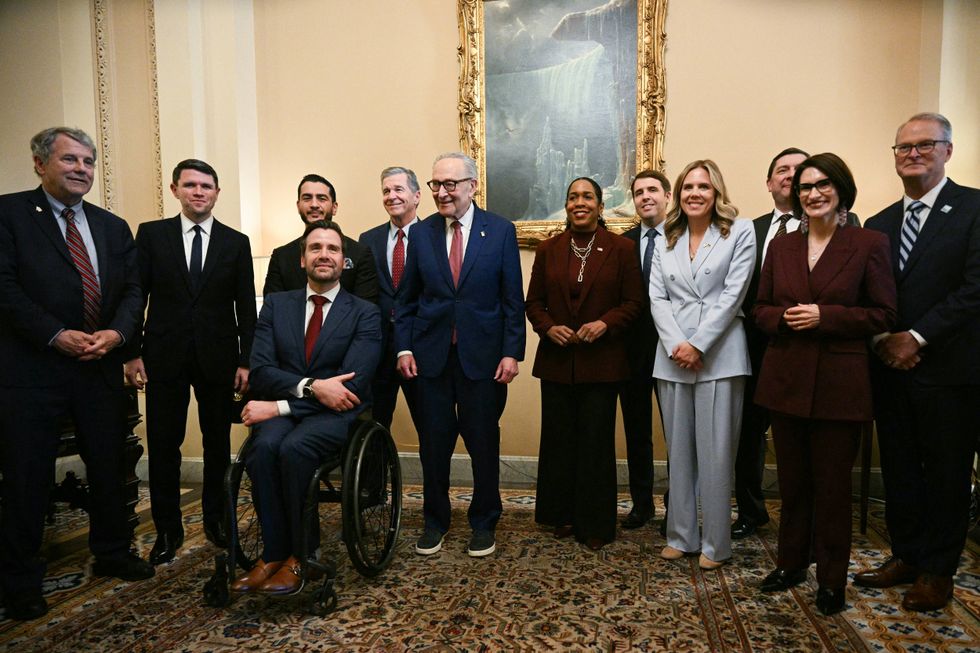 Senate Minority Leader Chuck Schumer (D-NY) and Sens.-elect (from left) Sherrod Brown (D-Ohio), James Talarico (D-Texas), Abdul El-Sayed (D-Mich.), Josh Turek (D-Iowa), Roy Cooper (D-NC), Juliana Stratton (D-Ill.), Chris Pappas (D-NH), Annie Andrews (D-SC), Troy Jackson (D-Maine), Peggy Flanagan (D-Minn.), and Adam Hamilton (D-Kan.) pose for a photo before a coffee discussion at the US Capitol in Washington, DC, on November 9, 2026. (Photo by Jim Watson/AFP via Getty Images)
Schumer has publicly projected confidence, declaring that he already has the votes to be elected party leader. But momentum has continued to build behind Van Hollen, who has gained the support of Sens. Bernie Sanders (I-Vt.), Jeff Merkley (D-Ore.), Tina Smith (D-Minn.), and several incoming senators elected this month.
Senate Democrats are scheduled to hold a closed-door vote to select their leader on December 1. But allies of Schumer are reportedly pushing to move the vote up to this week to capitalize on his lead, a move Van Hollen described Sunday as a “sign of weakness.”
Activist groups, including the Working Families Party, Our Revolution, and the Sunrise Movement, meanwhile, continue to line up behind Van Hollen.
Indivisible, one of the groups behind the "No Kings" movement that has brought millions of people into the streets to protest against Trump, endorsed Van Hollen on Monday, noting support for him among 97% of its chapter heads.
“Voters sent a clear message this November: They want leaders who will stand up to powerful interests, challenge a corrupt status quo, and deliver real results for working people,” said Leah Greenberg, Indivisible's co-executive director. “Chuck Schumer has become a symbol of the failed leadership and political status quo that voters are ready to move beyond.”
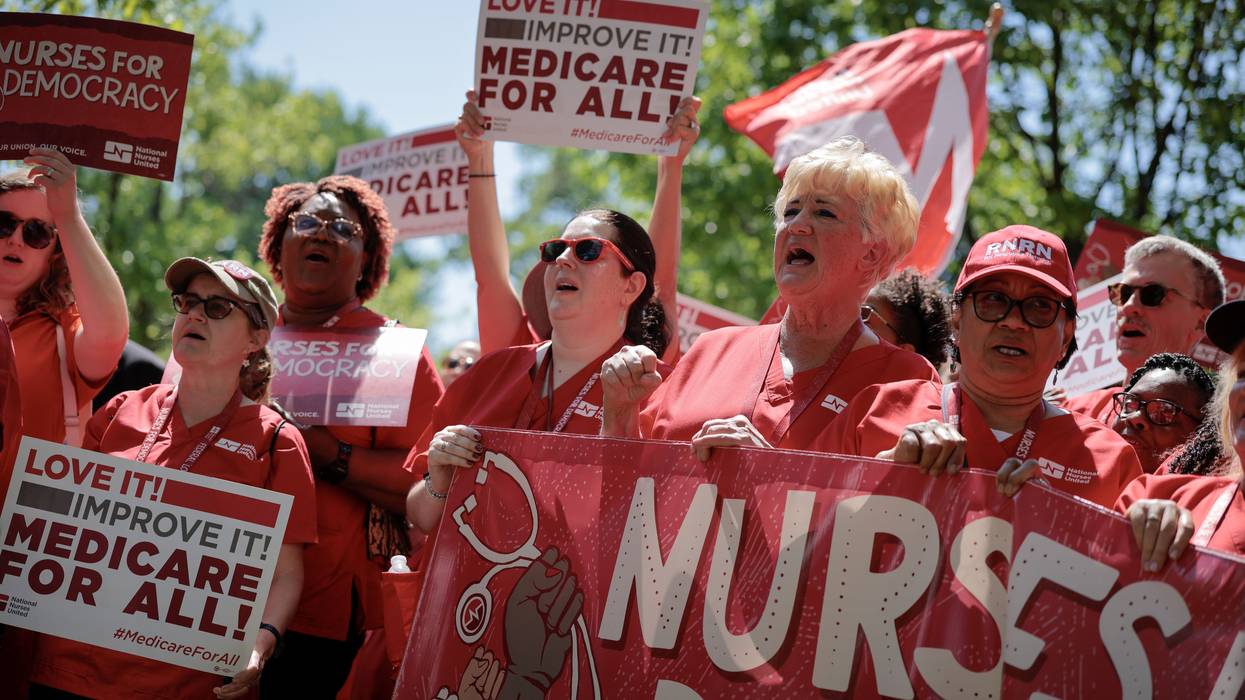
"Nurses and working people demand new Senate leadership that confronts the billionaire class, corporations, and governments to deliver transformative change for us," said National Nurses United.
The largest union of nurses in the United States on Monday endorsed Sen. Chris Van Hollen to lead the Senate Democratic caucus in the new Congress, arguing he is the only candidate "ready to advance real, systemic change" following the party's blowout midterm wins.
"The people have spoken," National Nurses United (NNU), which represents more than 225,000 registered nurses across the US, said in a statement. "Sen. Van Hollen is the clear leadership choice for nurses because he firmly stands on the side of working-class people."
Unlike Sen. Chuck Schumer, the current Democratic leader, Van Hollen cosponsored the Medicare for All Act of 2025—NNU's top legislative priority.
“Nurses witness every day, every shift how business-as-usual politics and policies have failed their patients, their communities and this country. Corporations have been allowed to steal from everyday working people,” Puneet Maharaj, NNU's executive director, said Monday. "The Democratic Party must not squander the chance midterm voters have given it to tackle our nation in crisis. Nurses and working people demand new Senate leadership that confronts the billionaire class, corporations, and governments to deliver transformative change for us."
"Sen. Van Hollen is the best person for the job," Maharaj continued. "We want guaranteed healthcare, not warfare. We want to abolish ICE. We want billionaires to pay their fair share. We want our tax dollars to meet working people’s needs, not fund genocide in Gaza and the war in Iran. And this is just the beginning."
The people have spoken. On Nov. 3, voters overwhelmingly rejected business-as-usual politics and demanded real, systemic change.That’s why nurses proudly endorse @ChrisVanHollen for Senate Majority Leader. He stands on the side of working-class people.https://t.co/qv27b9bjDQ
— National Nurses United (@NationalNurses) November 16, 2026
NNU is the third major labor union to endorse Van Hollen's bid for majority leader against Schumer, who has headed the Senate Democratic caucus for a decade. The 600,000-member International Association of Machinists and Aerospace Workers and the 90,000-member Office and Professional Employees International Union have also backed Van Hollen.
Growing union support for Van Hollen came as leaders and members of several major progressive advocacy organizations—including Indivisible, MoveOn, and the Working Families Party—threw their support behind the Maryland Democrat.
In the Senate Democratic caucus, Van Hollen has "around 15" supporters, the Maryland senator said on Sunday, calling his contest with Schumer "a wide open race."
Speaking to Politico for an interview released on Monday, Van Hollen suggested that some senators are hesitant to publicly break with Schumer because "there's a fear of retribution."
“Nobody should be afraid of a little democracy in the Democratic caucus," said the Maryland senator.
Van Hollen also said he has the votes to block any effort to fast-track the leadership election, which is currently scheduled for December 1.
"The more that time goes on, the more we have an open debate, the more we’ll see people voting for change," said Van Hollen.