SUBSCRIBE TO OUR FREE NEWSLETTER
Daily news & progressive opinion—funded by the people, not the corporations—delivered straight to your inbox.
5
#000000
#FFFFFF
To donate by check, phone, or other method, see our More Ways to Give page.


Daily news & progressive opinion—funded by the people, not the corporations—delivered straight to your inbox.

Kate Fried, Food & Water Watch, (202) 683-4905, kfried@fwwatch.org
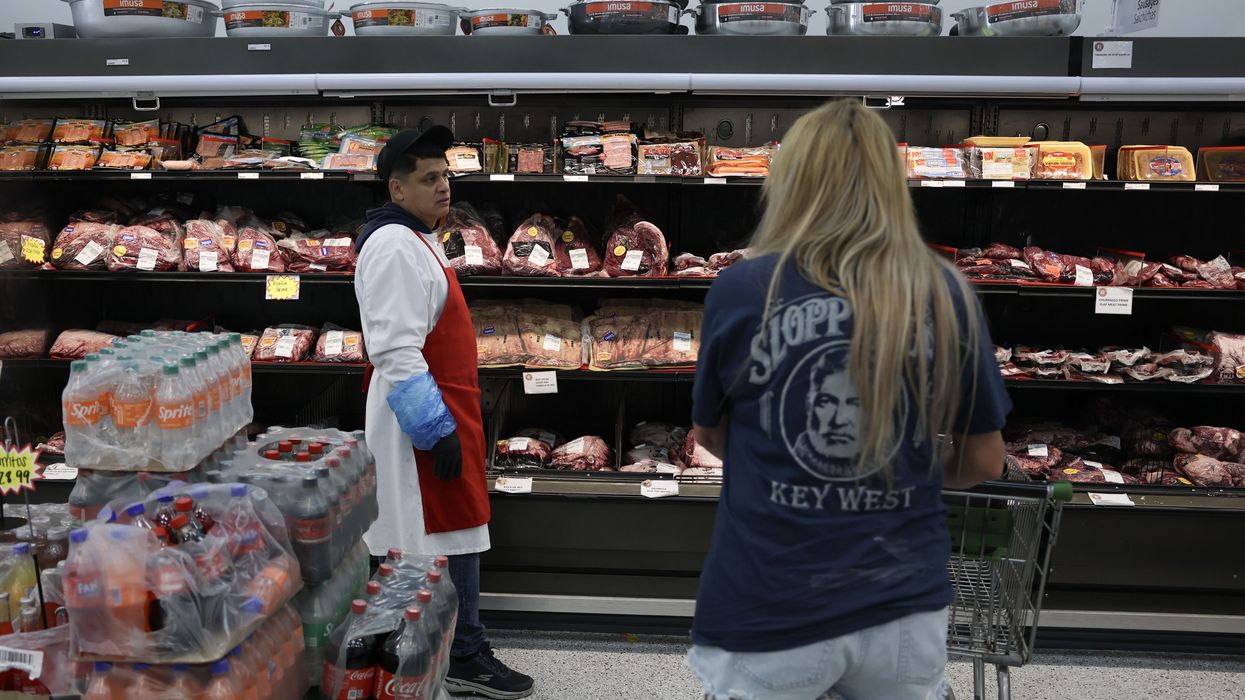
"The Country of Origin Labeling (COOL) legislation introduced today by Senators Debbie Stabenow (D-Michigan) and John Hoeven (R-North Dakota) repeals an overwhelmingly popular food label, surrenders to over exaggerated threats by our trading partners and creates more international trade problems than it solves.
"The legislation is aimed at solving an ongoing World Trade Organization (WTO) dispute, but the WTO process is far from complete. The Senate has never repealed a statute that was challenged under international trade rules before the dispute was completed.
"The legislation introduced today fully repeals mandatory COOL for beef, pork, chicken and ground meat and gives the U.S. Department of Agriculture (USDA) discretion to establish a voluntary domestic label for beef, pork or chicken. It is considerably weaker than the discussion draft circulated last month because it repeals COOL labels for ground meat, which the WTO ruled were trade legal, and COOL labels for chicken, which were not even considered in the dispute.
"The legislation is a full repeal of COOL with the window dressing of a voluntary labeling option. But before mandatory COOL labels were re-enacted in 2008, meatpackers did not use voluntary COOL labels. In practice, a voluntary COOL label is the same as no label at all. Meatpackers won't use it, consumers won't see it and farmers and ranchers won't benefit from it.
"Even if voluntary COOL labels went into widespread use, a voluntary labeling program could still face a challenge under international trade deals. The voluntary "Dolphin-Safe" tuna label has been successfully challenged at the WTO. Today's voluntary COOL label is especially subject to challenge because it only applies to domestic livestock, there are no provisions for a voluntary label on imports, which creates the presumption that unlabeled and potentially imported meat is less desirable or less safe. That distinction runs afoul of every trade agreement's rules prohibiting discrimination against imports.
"Consumers deserve to know where their food comes but today's proposal puts meatpacking giants back in control of what we get to know about the food we buy. The Senate should not let international trade tribunals and big meat companies run roughshod over Congress' authority to enact American laws. We urge the Senate to reject this bill and stand up for mandatory COOL."
Food & Water Watch mobilizes regular people to build political power to move bold and uncompromised solutions to the most pressing food, water, and climate problems of our time. We work to protect people's health, communities, and democracy from the growing destructive power of the most powerful economic interests.
(202) 683-2500"Continuing to help the war machine will only cause you more pain. There has never been a better time to reject those orders, and join a fight that matters."
Dozens of veterans were arrested by US Capitol Police on Monday after they occupied the Cannon House Office Building on Capitol Hill to protest President Donald Trump's illegal war on Iran.
During the protest, which was organized by a coalition of veterans groups, the demonstrators stood in the middle of the rotunda, holding red tulips and chanting anti-war slogans.
A video published by Reuters shows Capitol Police restraining the veterans and taking them into custody one by one.
Military veterans protest Iran war https://t.co/jtiGxiTMjv
— Reuters (@Reuters) April 20, 2026
One of the demonstrators arrested was Mike Prysner, executive director of the Center on Conscience and War (CCW) and a veteran of the 2003 Iraq War, who encouraged members of the US military to become conscientious objectors in a statement released ahead of the demonstration.
"The war I was sent to senselessly claimed the lives of thousands of Americans and a million Iraqis," said Prysner. "Like the other veterans here with me today, I have spent the last two decades wishing I could turn back the hands of time and refuse to go. Service members have that chance right now."
Prysner then informed US service members that "conscientious objection is your legal right, and we have professional counselors who will fight to ensure you are approved and kept from deployment."
Tyler Romero, conscientious objector client for CCW, said that he "decided to get arrested today because as someone who was a participant in a war machine that is responsible for untold suffering around the world, it is my duty to help put an end to it."
Like Prysner, Romero also encouraged service members to declare themselves conscientious objectors.
"My advice to troops still serving is this," he said, "This is the most important historical moment of our lifetime, and what you choose to do matters. I can tell you from experience that continuing to help the war machine will only cause you more pain. There has never been a better time to reject those orders, and join a fight that matters."
Trump over the weekend renewed his threats to commit war crimes by bombing Iranian civilian infrastructure, including bridges and power plants, unless Iran agreed to a deal to give up its uranium enrichment capabilities and reopen the Strait of Hormuz.
"If they don’t sign the deal, then the whole country is going to get blown up,” Trump said.
"Trump’s repeated threats to destroy civilian infrastructure are not negotiation, they’re reckless escalations that endanger millions," said one group.
As Iran reversed course on reopening the Strait of Hormuz amid continued US and Israeli provocations, President Donald Trump renewed threats to destroy Iran and its civilian infrastructure, prompting calls on Monday for the US leader to stop threatening to commit war crimes—and for Americans to not normalize such criminal behavior.
Trump was embarrassed on the world stage after declaring Friday that it was "A GREAT AND BRILLIANT DAY FOR THE WORLD" because "Iran has agreed to never close the Strait of Hormuz again."
While Iran's government did agree to fully reopen the vital Mideast waterway—through which around 20% of the world's oil is shipped—on Friday, Trump's continued blockade of Iran's ports and rampant Israeli ceasefire violations in Lebanon led to Tehran shutting down the strait again and accusing the United States of "acts of piracy and maritime theft."
Iranian naval vessels subsequently opened fire on a pair of Indian-flagged ships attempting to travel through the strait Saturday, allegedly after giving at least one of them permission to transit the waterway.
The following day, US forces attacked and seized an Iranian-flagged cargo ship in the Gulf of Oman.
Two weeks after his genocidal threat to wipe out the "whole civilization" of Iran, Trump took to his Truth Social network on Sunday to renew vows to commit war crimes if the Iranian government does not sign a peace deal by Wednesday.
“If they don’t sign the deal, then the whole country is going to get blown up," the president said. “We’re offering a very fair and reasonable DEAL, and I hope they take it because, if they don’t, the United States is going to knock out every single Power Plant, and every single Bridge, in Iran. NO MORE MR. NICE GUY!”
Responding to Trump's post, the National Iranian American Council (NIAC) said Monday on social media: "Threats of war crimes cannot become normalized. Trump’s repeated threats to destroy civilian infrastructure are not negotiation, they’re reckless escalations that endanger millions."
"The president must abandon this pattern immediately and pursue a serious, lawful, diplomatic strategy grounded in legitimate de-escalation," NIAC added.
Threats to commit war crimes such as blowing up entire countries or destroying civilian infrastructure can, like the acts themselves, be illegal under international law.
"If you follow illegal orders to commit war crimes, you will be prosecuted by a future administration," Congressman Ted Lieu (D-Calif.)—who served in the Air Force Judge Advocate General’s Corps—said in a Sunday message to the US Joint Chiefs of Staff. "Bombing 'every single power plant, and every single bridge' would violate proportionality principle and cause excessive civilian harm, which is a war crime."
However, US Ambassador to the United Nations Mike Waltz on Sunday defended Trump's statements, citing American actions in World War II—which included waging the world's only nuclear war and carpet-bombing of German and Japanese cities that killed more people than the atomic bombs—to justify the president's threats.
Waltz also claimed that "the Iranian regime... and its terrorist proxies have a long history of actually deliberately hiding military infrastructure in hospitals, schools, neighborhoods, and other civilian assets," comments that came as Israeli forces continued their attacks on all of those civilian structures and more in Gaza and Lebanon. Iranians are also reeling from US and Israeli attacks, many of them on civilian infrastructure, that officials in Tehran and human rights groups say have killed as many as 1,700 noncombatantas, including hundreds of women and children.
Trump's continued blockade and renewed threats come as Pakistan on Monday pushed for a resumption of peace talks, with Pakistani officials saying Iran has signaled its willingness to send a delegation to Islamabad for negotiations. If Tehran agrees to new talks, Vice President JD Vance is expected to lead a US delegation to Pakistan whose members would likely include Mideast envoy Steve Witkoff and Trump son-in-law Jared Kushner.
Iranian officials have slammed the unreliability of the Trump administration—which has twice waged war on Iran right when deals were in sight, according to international mediators.
“Iranians do not submit to force,” Iranian President Masoud Pezeshkian said Monday.
Another Iranian official, Foreign Ministry spokesperson Esmail Baghaei, said the US is "claiming diplomacy and readiness for negotiations" while still engaging in acts of aggression.
Iranian President Masoud Pezeshkian on Monday criticized what he called "unconstructive and contradictory signals" by US officials as the two sides weighed another round of peace talks in the Pakistani capital of Islamabad, where an earlier summit failed to produce a deal to end the conflict that the Trump administration and its Israeli counterparts launched in late February.
"Honoring commitments is the basis of meaningful dialogue," Pezeshkian wrote in a social media post, adding that Iranians harbor "deep historical mistrust" toward the US government given its record of aggression against the Middle Eastern country.
"They seek Iran's surrender," Pezeshkian wrote of Trump administration officials. "Iranians do not submit to force."
The Iranian president's comments came as his US counterpart, President Donald Trump, threatened to continue the bombing campaign that has so far killed more than 3,300 Iranians—and displaced millions—if the current two-week ceasefire expires Wednesday evening without an agreement to end the war.
"Lots of bombs start going off," Trump told PBS News when asked what happens if the ceasefire lapses without a deal.
Trump's remarks came after he warned that if Iranian leaders don't accept his administration's terms for an end to the war, "the United States is going to knock out every single Power Plant, and every single Bridge, in Iran." Experts have said Trump's threats are themselves war crimes even if he doesn't follow through with the attacks on civilian infrastructure, which is protected under international law.
Iran is considering attending another round of peace talks with the Trump administration in Islamabad this week, even after Iran's top diplomat accused the US delegation of sabotaging the previous round with maximalist demands and "shifting goal posts."
The spokesperson for Iran's Foreign Ministry, Esmail Baghaei, said in a press briefing on Monday that "no decision has been made" regarding Iranian attendance at another round of talks.
"While claiming diplomacy and readiness for negotiations, the US is carrying out behaviors that do not in any way indicate seriousness in pursuing a diplomatic process," Baghaei told reporters, pointing to the US military's attack on and seizure of an Iranian-flagged cargo ship in the Gulf of Oman over the weekend.