October, 13 2015, 08:45am EDT

SPOKANE, Wash.
Three former Central Intelligence Agency prisoners represented by the American Civil Liberties Union are filing a lawsuit today against the two psychologists who designed and implemented the CIA's torture program.
The CIA-contracted psychologists, James Mitchell and John "Bruce" Jessen, helped convince the agency to adopt torture as official policy, making millions of dollars in the process. The two men, who had previously worked for the U.S. military, designed the torture methods and performed illegal human experimentation on CIA prisoners to test and refine the program. They personally took part in torture sessions and oversaw the program's implementation for the CIA.
The lawsuit is being brought on behalf of three men -- Gul Rahman, Suleiman Abdullah Salim, and Mohamed Ahmed Ben Soud -- who were tortured using methods developed by Mitchell and Jessen, as detailed in the Senate Intelligence Committee's landmark report on CIA torture. The U.S. has never charged or accused the victims of any crime. One of them was tortured to death, and the other two are now free.
"Mitchell and Jessen conspired with the CIA to torture these three men and many others," said Steven Watt, a senior staff attorney with the ACLU Human Rights Program. "They claimed that their program was scientifically based, safe, and proven, when in fact it was none of those things. The program was unlawful and its methods barbaric. Psychology is a healing profession, but Mitchell and Jessen violated the ethical code of 'do no harm' in some of the most abhorrent ways imaginable."

Torture methods devised by Mitchell and Jessen and inflicted on the three men include slamming them into walls, stuffing them inside coffin-like boxes, exposing them to extreme temperatures and ear-splitting levels of music, starving them, inflicting various kinds of water torture, depriving them of sleep for days, and chaining them in stress positions designed for pain and to keep them awake for days on end. The two victims who survived still suffer physically and psychologically from the effects of their torture.
The plaintiffs include the family of Gul Rahman, who died because of torture. He was an Afghan refugee living in Pakistan with his wife and their four daughters, making a living selling wood to fellow residents of their refugee camp. While in Islamabad for a medical checkup in 2002, Rahman was abducted in a joint U.S.-Pakistani operation and rendered to a CIA "black site" in Afghanistan. According to the Senate report, Rahman was tortured by a team of CIA interrogators that included Jessen and died in his cell. An autopsy and internal CIA review found the cause of death to be hypothermia caused "in part by being forced to sit on the bare concrete floor without pants," with the contributing factors of "dehydration, lack of food, and immobility due to 'short chaining.'" The family has never been officially notified of his death, and his body has never been returned to them for burial.
Another plaintiff is Suleiman Abdullah Salim, a fisherman from Tanzania. He had recently married a Somali woman and was doing business in Somalia when he was abducted by the CIA. He was then rendered to two of the agency's black site prisons in Afghanistan, where he was held and tortured for over a year before being transferred to Bagram Air Force Base. The U.S. military released him over five years after his abduction with a letter acknowledging that he poses no threat to the United States. He now lives in Zanzibar with his wife and three-year-old daughter.
"The terrible torture I suffered at the hands of the CIA still haunts me. I still have flashbacks, but I've learned to deal with them with a psychologist who tries to help people, not hurt them." said Salim. "This lawsuit is about achieving justice. No person should ever have to endure the horrors that these two men inflicted."
The third plaintiff is Mohamed Ahmed Ben Soud. He fled his native Libya in 1991, fearing persecution for his opposition to Muammar Qaddafi's dictatorship. In 2003, Ben Soud was captured in a joint U.S.-Pakistani raid on his home and sent to two secret CIA prisons in Afghanistan, where he was held and tortured for over two years. Ben Soud saw Mitchell in the first of these prisons, later identifying him as a man present in a room where CIA interrogators were torturing him by forcibly submerging him in ice water. In 2005, the CIA sent him to Libya, where he was tortured and sentenced to life imprisonment after a sham trial. Ben Soud was freed in 2011 after Gaddafi was deposed, and he now lives with his wife and three children.
In addition to torturing prisoners themselves, Mitchell and Jessen trained and supervised other CIA personnel in their methods. In 2005, they founded a company -- Mitchell, Jessen & Associates -- that the CIA contracted with to run its entire torture program, including supplying interrogators and security for black sites and rendition operations. According to the Senate report, the government paid the company $81 million over several years. The CIA let Mitchell and Jessen themselves evaluate the effectiveness of their torture in "breaking" detainees, and the agency has since admitted that this was a mistake.
Citing experiments conducted on dogs in the 1960s, Mitchell and Jessen proposed to the CIA a program based on the intentional infliction of intense pain and suffering, both physical and mental. In the 1960s' experiments, dogs were subjected to random electric shocks, and they eventually collapsed into a passive state termed "learned helplessness." According to Mitchell and Jessen's theory, if humans were psychologically destroyed through torture and abuse, they would become totally unable to resist demands for information. Mitchell and Jessen invented different "phases" of the torture process with the aim of breaking down prisoners into a state of "learned helplessness" in a systematized fashion.
"These psychologists devised and supervised an experiment to degrade human beings and break their bodies and minds," said Dror Ladin, a staff attorney with the ACLU National Security Project. "It was cruel and unethical, and it violated a prohibition against human experimentation that has been in place since World War II."
The CIA adopted Mitchell and Jessen's proposals, and in August of 2002, the agency secured Justice Department authorization in the so-called "torture memos," which were later rescinded by the Justice Department.
The lawsuit is being filed in federal court in Washington State, where Mitchell, Jessen & Associates was based and where Jessen still lives. The plaintiffs are suing Mitchell and Jessen under the Alien Tort Statute -- which allows federal lawsuits for gross human rights violations -- for their commission of torture; cruel, inhuman, and degrading treatment; non-consensual human experimentation; and war crimes.
The attorneys on the case are Steven Watt, Dror Ladin, Hina Shamsi, and Jameel Jaffer of the ACLU, and Emily Chiang and La Rond Baker of the ACLU of Washington.
A short documentary featuring interviews with a plaintiff and a psychology expert, plus graphics and more information, are at:
https://www.aclu.org/darkness
Today's complaint is at:
https://www.aclu.org/legal-document/salim-v-mitchell-complaint
Photos of the plaintiffs for press use are at:
https://www.dropbox.com/sh/1u48invqaxeji5t/AACtreHhompyNo4uEQTopS2fa
The American Civil Liberties Union was founded in 1920 and is our nation's guardian of liberty. The ACLU works in the courts, legislatures and communities to defend and preserve the individual rights and liberties guaranteed to all people in this country by the Constitution and laws of the United States.
(212) 549-2666LATEST NEWS







'Shameful': Trump DOJ Ditches Civil Rights and School Desegregation Cases
The new analyses of the cases—"Walking Away: DOJ's Abandonment of Civil Rights Cases for People of Color" and "Filling in The Gaps: Tracking The 50+ School Desegregation Cases DOJ Says It Is Ending"—were developed by Democracy Forward's oversight and accountability project Red Line for Civil Rights.
"People and communities rely on DOJ to pursue vital cases to address threats to civil rights under our nation's laws. The Red Line for Civil Rights reports don't just highlight the cases that have been abandoned, but also make clear the harm that DOJ's abandonment of its mission retreat has caused," said Democracy Forward president and CEO Skye Perryman.
The project found at least 36 abandoned cases and probes addressing discrimination against Black, Latino, and Native American people, from Voting Rights Act lawsuits and redlining settlements with banks to firefighter and police hiring issues.
There was United States v. Cobb County, Georgia, in which the DOJ alleged that credit checks and a written exam illegally screened out Black firefighter applicants, and United States v. Patriot Bank, a 2024 consent order over redlining of Black and Hispanic neighborhoods in Memphis, Tennessee.
In United States v. SouthEast Bank, the department argued that a student loan refinancing product discriminated against Alaska Native, American Indian, and Black applicants, and in United States v. City of Minneapolis, the DOJ concluded that police discriminated against Black and Native American in Minnesotans.
"The shameful withdrawal of DOJ resources from these cases and investigations highlights how this administration is abandoning communities across the country," said Megan Marks, a former leader in the department who is now the project's deputy director and managing editor. "Walking away from them doesn't mean the discrimination has been addressed. It just means DOJ is no longer watching."
In its second analysis, the project identified 56 school districts in 12 states where the department has moved to ditch or end a desegregation case, or did not oppose ending one—from Athens City, Alabama and Chesterfield County, South Carolina to South Bend, Indiana and Waterbury, Connecticut.
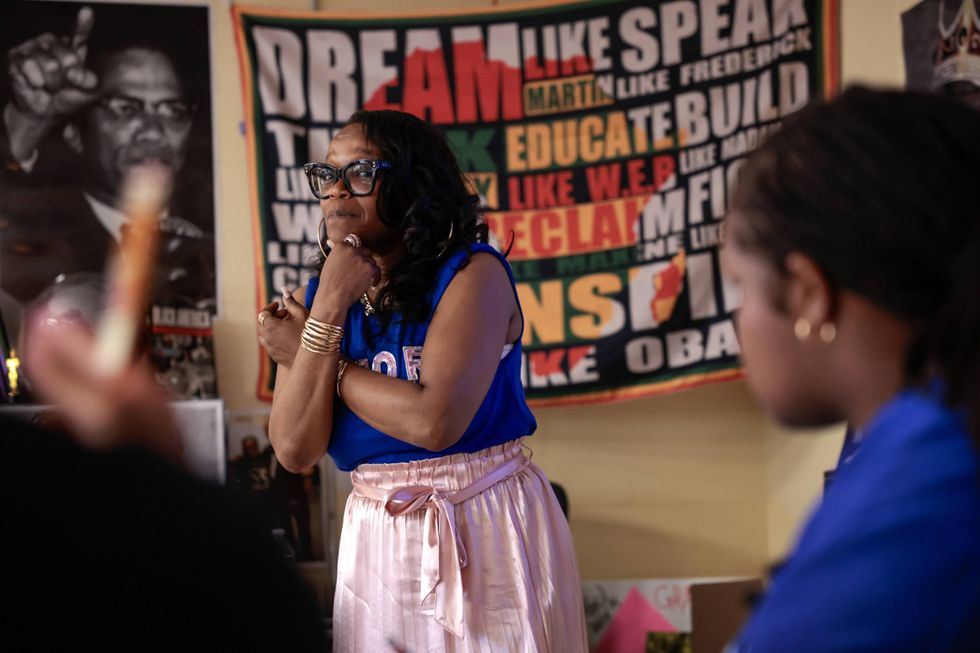 Tanisha Milton teaches a lesson on busing and the desegregation of Boston, Massachusetts public schools during an 8th grade civics class at TechBoston Academy on May 22, 2024. (Photo by Craig F. Walker/The Boston Globe via Getty Images)
"The Supreme Court held in its landmark 1954 case, Brown v. Board of Education, that segregating public school students by race violates the 14th Amendment's guarantee of equal protection," the report notes. "Since Brown, DOJ has monitored and enforced desegregation orders, reviewing evidence and often working collaboratively with school districts and, in some cases, private plaintiffs to support progress."
"This work was central to the Civil Rights Division's history. The Civil Rights Act of 1964 authorized DOJ to file its own school desegregation lawsuits against public schools or institutions of higher education and to join cases that families had already brought," the paper explains. "These school desegregation cases are how the promise of Brown reaches individual classrooms. Behind each of these cases are children, families, and a community that fought, sometimes at great personal risk, for the right to an equal education."
Shaheena Simons previously oversaw the Justice Department's desegregation docket but is now a senior adviser at the Lawyers' Committee for Civil Rights Under Law. In response to the report, she said that the "DOJ's haste to end these cases without deliberation or transparency is a betrayal of Black students who continue to face segregation and inequality in our schools."
"This retreat is part of a much bigger picture," Simons emphasized. "Not only has the Civil Rights Division abandoned its work to protect the rights of our most marginalized students, but it is also weaponizing civil rights statutes against them."
Democratic leaders in the US House of Representatives also spoke out about the project's findings. Education and Workforce Committee Ranking Member Bobby Scott (Va.) accused the "politicized" department of "turning its back on workers and students by abandoning entire categories of discrimination cases and ending the fight against school desegregation altogether."
Democrats on his panel "are committed to the protection of civil rights and to guaranteeing that all Americans are protected from discrimination in accordance with the civil rights laws that so many Americans fought to secure," pledged Scott, as his party prepares for next month's midterm elections, in which Republicans could lose control of one or both chambers of Congress.
 Harmeet Dhillon shakes hands with Republican US President-elect Donald Trump in a photo she posted on social media on October 31, 2024. (Photo: Harmeet Dhillon/X)
Fellow Democratic Congressman Jamie Raskin (Md.), a constitutional scholar and ranking member on the House Judiciary Committee, said that "Democracy Forward's reports expose the Justice Department's shocking betrayal of its central duty to protect Americans against race discrimination."
"While DOJ devotes its resources to persecuting Trump's political enemies, it has dropped protection of voting rights and is allowing discrimination to proliferate by abandoning school desegregation and job discrimination cases," he said, as the Trump administration pursues everyone from former Federal Bureau of Investigation Director James Comey to New York Attorney General Letitia James and Rep. Ilhan Omar (D-Minn.).
"We need a Department of Justice that stands by the rule of law and the rights of all Americans," Raskin asserted. "But this administration carries out presidential vendettas, covers up child sex trafficking, promotes corruption, and pardons and coddles violent felons in the president's private militia."
Most Popular