

SUBSCRIBE TO OUR FREE NEWSLETTER
Daily news & progressive opinion—funded by the people, not the corporations—delivered straight to your inbox.
5
#000000
#FFFFFF
To donate by check, phone, or other method, see our More Ways to Give page.
Daily news & progressive opinion—funded by the people, not the corporations—delivered straight to your inbox.

Darcey Rakestraw, 202-683-2467; drakestraw@fwwatch.org
"Just a handful of large chemical companies including Dow and DuPont already control most of the seed supply used to grow crops like corn and soybeans, as well as the herbicides that genetically engineered seeds are designed to be grown with. Any merger that consolidates this market into fewer hands will give farmers fewer choices and put them at even more economic disadvantage. And it will make it harder for agriculture to get off the GMO-chemical treadmill that just keeps increasing in speed. The Department of Justice needs to block this merger to prevent the further corporate control of the basic building blocks of the food supply."
Food & Water Watch mobilizes regular people to build political power to move bold and uncompromised solutions to the most pressing food, water, and climate problems of our time. We work to protect people's health, communities, and democracy from the growing destructive power of the most powerful economic interests.
(202) 683-2500
"Our future is being robbed away from us," said the Swedish climate activist. "It just gives a signal to young people that you're not prioritized in our society."
Arriving Tuesday in the Paris suburb of Saint-Denis to stand with students demonstrating against poor school conditions, climate and rights activist Greta Thunberg had one question for French leaders and authorities who have appeared shocked that hundreds of thousands of high schoolers would rise up against disinvestment in their education: "What do you expect young people to do?"
"Of course we're going to revolt, of course we're going to rise up," the Swedish climate action leader told L'Humanité. "It should have been expected."
Thunberg joined the protesters—a group that originally included students, mostly aged 15-18, when the demonstrations began last month, but that's grown to include hundreds of thousands of people including union members and teachers—as the movement entered its fourth week.
She expressed pride in the French students who have led the movement, and denounced political leaders for refusing to invest in public education.
"Our future is being robbed away from us," she told Agence France-Presse. "Schools are not getting investments that they need... It just gives a signal to young people that you're not prioritized in our society."
Greta Thunberg est venue manifester mardi matin devant le lycée Paul-Eluard de Saint-Denis, un des épicentres du mouvement lycéen, où plus d'une centaine de jeunes étaient rassemblés pour l'acte V de la mobilisation ⤵️ #geneu_AFP https://t.co/dd1Rur6NZb
— Agence France-Presse (@afpfr) October 13, 2026
Hundreds of schools have been closed as students have formed chains at the building entrances and marched through Paris and cities and towns across France, demanding more funding for schools.
Students are raising alarm about dilapidated buildings, overcrowded classrooms, and too many teacher absences, and the protests have exploded as French President Emmanuel Macron's government tries to pass a budget including a modest increase in education funding—which students and teachers have denounced as an effective cut due to inflation.
Students are calling for €10 billion increase in investment for the country’s lycées, or high schools.
Thunberg said that students "are not being included in the conversation," and condemned French authorities for their "extremely violent" response to the protests.
Police were pushed to end their use of stun grenades last week after a teenager lost his hand because of one of the weapons. Another student lost the use of his eye, and another lost many teeth when tear gas canisters were fired at close range.
"That the police are now meeting it with such violence and politicians are meeting it as if it's something unexpected, or that young people are destroying things, just shows that they are living in a completely different reality," said Thunberg.
🔴 FLASH — Greta Thunberg est actuellement à Saint-Denis (93). 👉 « La police est tellement violente, évidemment que nous allons nous révolter et nous soulever ! La jeunesse française est un exemple pour le monde entier.» https://t.co/RKdT2WQ8h5
— FranceUnie 🇫🇷 (@FranceSouvUnie) October 13, 2026
At least 24 instances of police brutality are being investigated, and the violent police response has drawn condemnation from international human rights groups.
"They should know that all over the world we are following these developments. We are inspired by the young people who are demanding their basic rights,” Thunberg told reporters outside Lycée Paul Eluard in Saint-Denis. “Whether it’s not funding schools enough, or the climate crisis, or social injustice crises... It’s about time that young people are stepping up and reclaiming that future.”
The government is prosecuting about 1,500 people for their participation in the protests, which are backed by the leftist political party France Unbowed, led by presidential candidate Jean-Luc Mélenchon.
In Paris on Tuesday, students blockaded the entrances to their schools, while in Marseille, some pushed dumpsters on wheels in front of school doors.
Speaking to L'Humanité, Thunberg called on "workers' movements, migrants' rights movements, climate movements" and others to "stand united because we are facing the same enemy."
"We are not going to give up, and we are going to fight for this future that is being stolen from us right before our eyes," she said.
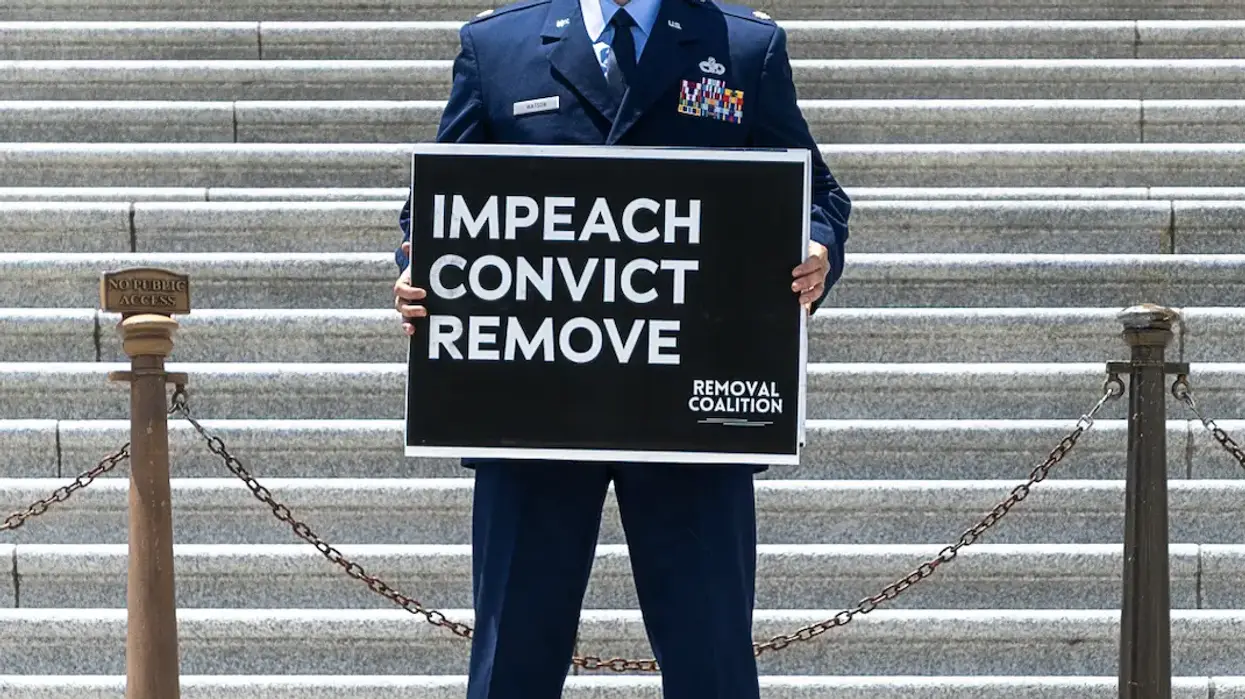
One law professor told Common Dreams the detention of Maj. Jason Watson was a "blatant case of illegal pretrial punishment."
Air Force Maj. Jason Watson was arrested July 1 on the steps of the US Capitol after calling for the impeachment of President Donald Trump. According to his lawyer, he's now being held in solitary confinement 24 hours a day in what some legal experts say could amount to illegal pretrial punishment.
The Uniform Code of Military Justice (UCMJ) contains provisions barring officers from engaging in public political activities that are typically protected for civilians, including criticizing the president and other elected officials.
Prosecutors have charged Watson with violating them when he participated in a news conference calling for Trump to be removed from office over his launching of military actions against Iran, Cuba, and Venezuela without congressional authorization.
After the speech, Watson stood on the Capitol steps holding a sign that read “Impeach, Convict, Remove" and was arrested after he refused to move.
Before he was charged, Watson gave a CNN interview on August 17 in which he continued to criticize Trump, accusing him of "flagrantly violating the Constitution" and "breaking the law."
He acknowledged that he could face severe consequences as a result of his speech: "We just have to be willing to accept that we can change what is happening in our country if we are just willing to pay a price for it," he said.
One day later, he was arrested while on duty and taken into pretrial confinement. He now faces a general court-martial, the military's most severe trial, which is capable of imposing lengthy prison sentences.
On Friday, Watson's lawyer, Christopher Mutimer, told CNN that after nearly two months, Watson is "still in solitary confinement 24 hours a day," which he said amounted to "cruel and unusual" punishment.
"Even if he gets an hour to eat or to exercise, he is alone," Mutimer said. "He is literally by himself, with his thoughts, in a room where the light never turns off all day."
In an essay published Sunday by writer Monte Mader, Watson himself acknowledged spending his days in isolation, revealing that his Bible had only recently been returned to him and that he had little access to news.
Watson described the conditions of his confinement as the reality one must accept when choosing to engage in nonviolent resistance.
“Walking this path," he said, "means exposing oneself to violence while refusing to retaliate against it.”
After his July 1 protest, Watson had been restricted to Joint Base Anacostia-Bolling in Washington. Though the base reportedly has a confinement facility, following his detention, he was instead moved to a county jail in Maryland.
During Watson's September 18 preliminary hearing, Maj. Joshua Wendell, the hearing officer, said Watson could not be confined with civilians and was therefore kept in solitary confinement.
"He was placed in confinement because of the law, which puts him in solitary confinement," Wendell said, according to Stars and Stripes.
Article 13 of the UCMJ "forbids punishing a service member before trial and forbids pretrial restraint more rigorous than the circumstances require."
Mutimer has pointed out that solitary confinement is "usually reserved for individuals who are disobeying or are violent, and injuring other people," and usually only for "a day or two, or a week." Watson, he said, has "been in there for months now."
Rachel VanLandingham, a former Air Force judge advocate and professor of law at Southwestern Law School, told Common Dreams that this "seems to be a blatant case of illegal pretrial punishment given that the nature of his pretrial restraint does not seem necessary to either ensure his presence at trial or to prevent foreseeable serious criminal misconduct."
“Solitary confinement is rare, and must be justified,” she said. “What, is the administration so afraid of this major’s words that he cannot talk to anyone?”
Military defense attorney Cody Harnish, who attended Watson's preliminary hearing, has raised concerns that his detention could be unlawful and that his especially harsh treatment was political in nature.
"I represent people at court-martial in the military, who are accused of doing some very bad things," he said during an interview this weekend with Meidas Defense. "They are not in pretrial confinement."
Harnish noted other abnormal aspects of Watson’s preliminary hearing: He was denied the ability to wear his uniform and instead arrived handcuffed, unshaven, and wearing an undershirt, which pointed to the possibility that he was facing degrading treatment.
He also pointed out that Watson had submitted a request to resign his commission in exchange for avoiding a court-martial, but that the request was denied in 24 hours.
"Nothing gets processed in the military that fast," he said, suggesting that this could indicate influence from senior Pentagon officials.
During his second term, Trump has used members of the military for political purposes in ways that have challenged longstanding norms of political neutrality. This has included hosting overtly political rallies before uniformed troops, screening them for ideology, and purging senior military officers deemed disloyal.
Harnish suggested that the Trump administration was seeking to make an example out of Watson for speaking out against the president.
"When someone speaks out against this administration in the military," he said, "they're going to crush him to silence anyone else in the ranks from ever thinking about it."
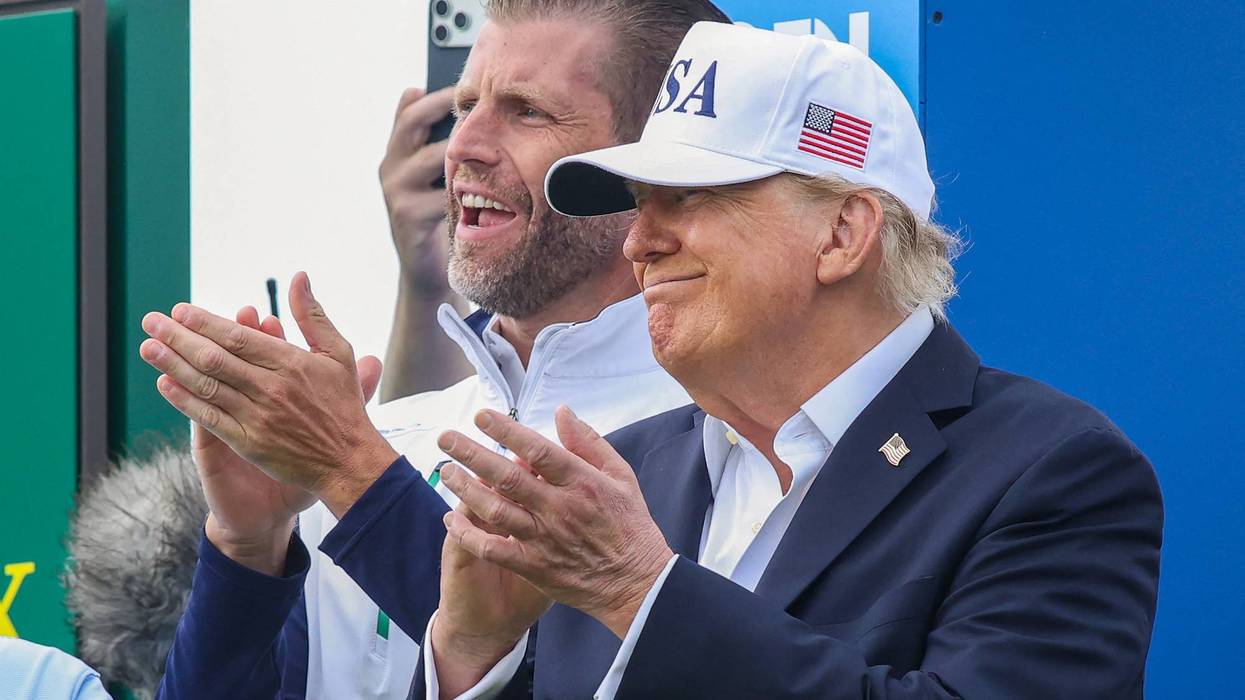
"His wealth increases," said an independent voter from Florida, "but the people in the country are just barely getting by."
US President Donald Trump has made over $2 billion since returning to power last year, and polling results released Tuesday show a majority of Americans believe he has not only prioritized himself and his inner circle, but also engaged in illegal or unethical behavior to cash in on his control of the White House.
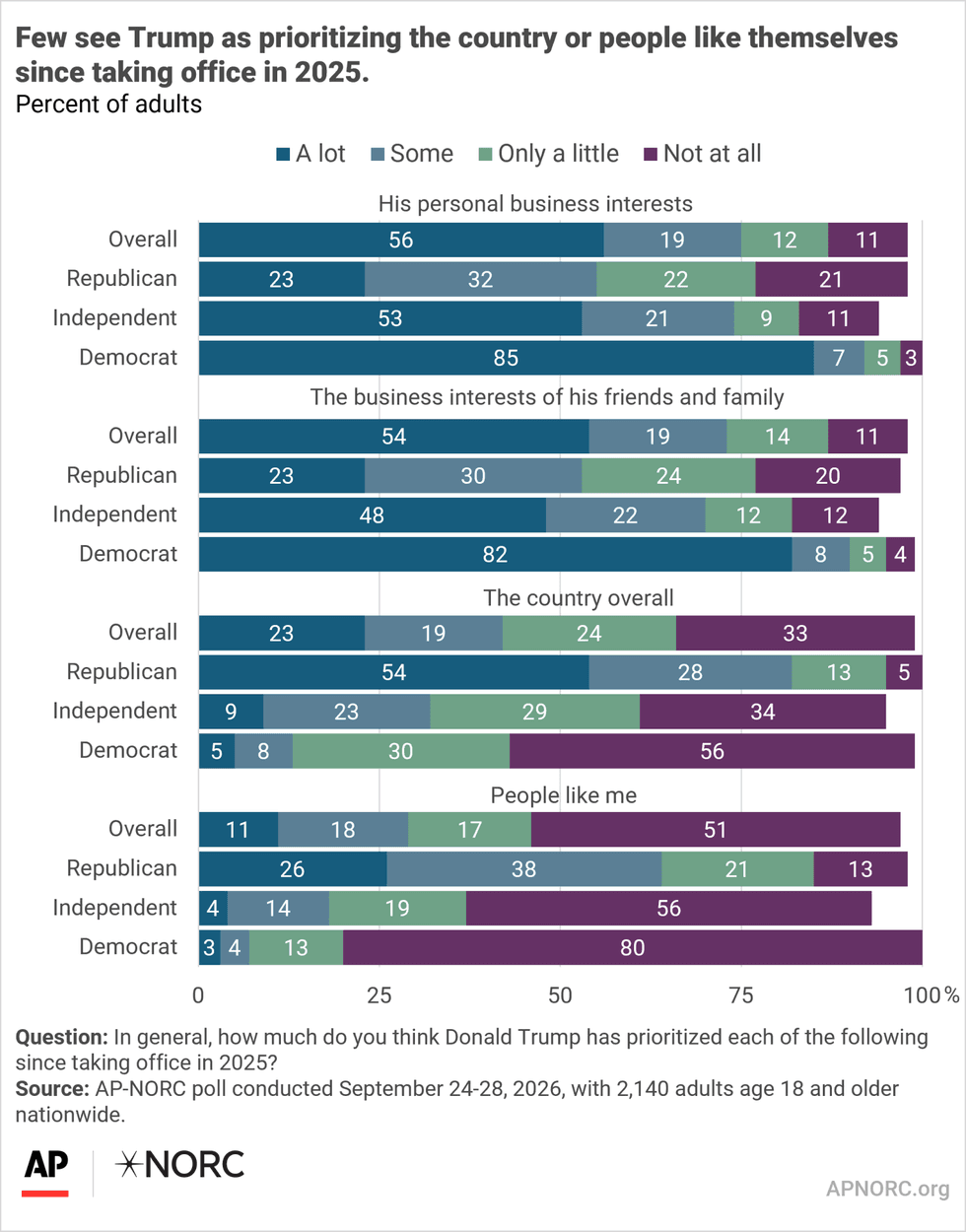
The Associated Press-NORC Center for Public Affairs Research surveyed 2,140 US adults from September 24-28 and found that 56% of Americans across the political spectrum believe that Trump has prioritized his personal business interests "a lot" since 2025. Another 19% said he has prioritized those "some."
As for prioritizing the business interests of his friends and family, 54% said he has done so a lot, and 19% said some—figures published just days after an analysis estimating that companies backed financially by the president's sons, Donald Trump Jr. and Eric Trump, have scored more than $6 billion in contracts from the US Department of Defense.
Meanwhile, as Americans struggle with the high cost of everything from gasoline and groceries to healthcare and housing, and with the midterm elections just weeks away, only 23% of those polled said the president has prioritized the country a lot, and 19% said some. Even worse, 11% said he's prioritized "people like me" a lot, and 18% said some.
Trump—whose approval rating has recently plummeted to record lows, fueling GOP fears about losing majorities in both chambers of Congress next month—disclosed in July that he pocketed at least $2.2 billion, over half of which came from his family’s cryptocurrency grift.
That "completely unprecedented" windfall generated allegations of corruption—as have Trump's stock trading disclosures since then, despite White House attempts to stress that his "stock and bond portfolio is independently managed by third-party financial institutions."
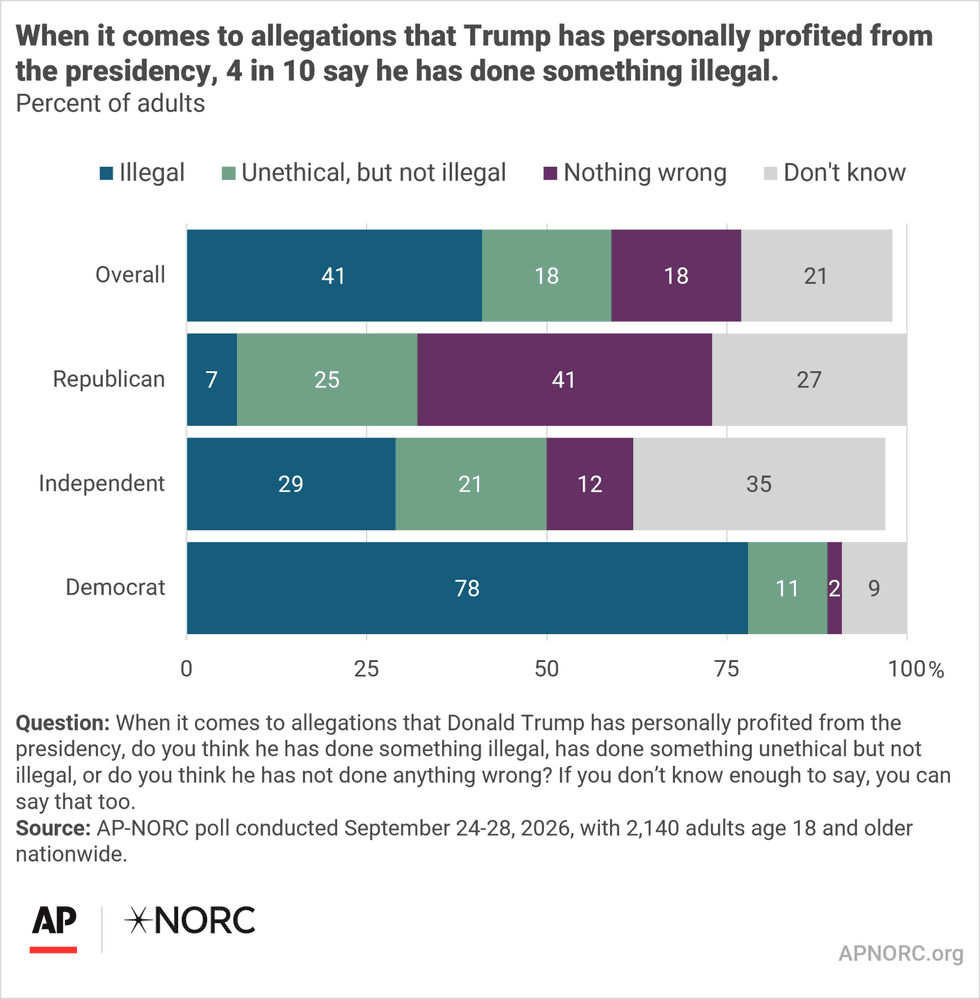
AP-NORC found that 59% of Americans across the political spectrum believe Trump has done something illegal (41%) or unethical but not unlawful (18%) to profit from the presidency. That includes 89% of Democrats, 50% of independents, and 32% of Republicans.
"His wealth increases," 87-year-old retiree Barbara Thaxton, an independent from Summerfield, Florida, told the AP, "but the people in the country are just barely getting by."
Last week, Senate Banking, Housing, and Urban Affairs Committee Ranking Member Elizabeth Warren (D-Mass.) released the "Trumpflation Tracker," a tool that she said shows "families across the country exactly how much of a price they are paying for Trump's and Republicans' failed economic agenda."
According to Warren's tracker, during Trump's second term, gasoline prices have soared 43.7%, healthcare costs are up 14.6%, residential electricity prices are 12.7% higher, childcare has risen 7.6%, and rent has jumped 5.1%. The tool suggests the average US household is paying thousands of dollars more due to GOP policies, from the president's illegal war on Iran and tariffs to cuts in his party's 2025 budget package.
"So much for Trump's 'Golden Age' of economic opportunity," retiring Sen. Dick Durbin (D-Ill.) said in response to the tracker. "Inflation is up more than 5% since he returned to the White House. Whether it's the president's tariffs, war with Iran, or cuts to healthcare and food assistance, his administration is making it harder for you to afford the basics."
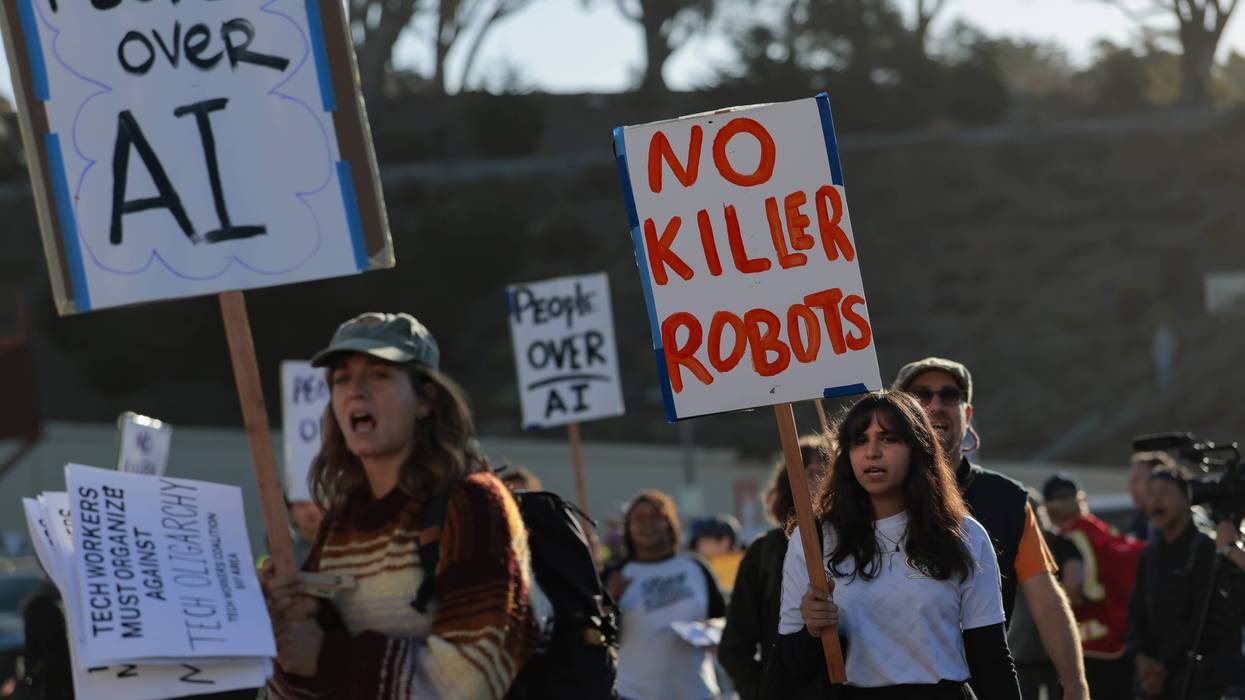
"Although the likelihood of both dangers remains low, the scale of harm, should they be realized, would inflict an apocalypse on humanity."
A comprehensive new assessment of worldwide health threats published in The Lancet concludes that nuclear war and "malicious use" of artificial intelligence pose existential risks to humanity over the remainder of the 21st century, a finding that comes amid mounting global concern about the implications of rapid AI advancements.
The Lancet Commission on 21st Century Global Threats to Health, comprised of dozens of experts across a range of fields, identifies 17 leading threats to human health and society, from the fossil fuel-driven climate emergency and pandemics to childhood malnutrition, income inequality, conventional war, and air pollution. Two of the threats carry "extinction potential" this century, according to the commission: nuclear conflict and misuse of AI.
"Although the likelihood of both dangers remains low, the scale of harm, should they be realized, would inflict an apocalypse on humanity," The Lancet warned in an editorial accompanying the new analysis, which was presented Sunday at the World Health Summit in Berlin, Germany.
The commission notes that AI's "potential to advance health and wellbeing is enormous," but "the risk of catastrophic harm is equally profound." The authors of the analysis point to several ways in which AI could be "used maliciously," including the design of bioweapons, autonomous nukes, and invasive ransomware targeting global healthcare and financial institutions.
"The final pathway is loss of control through the emergence of agentic, unaligned artificial general intelligence," the analysis states. "This loss of control includes AI systems creating subgoals that lead to the seeking of human disempowerment or elimination, particularly if such agents autonomously gain access to financial networks, key infrastructure, or physical tools in the real world."
Regarding the existential threat of nuclear conflict, the study authors note that a famine stemming from atomic warfare "would affect all regions of the world, including those far from the conflict itself, through reduced caloric availability and cascading food-system failures."
"The devastation that could result from nuclear war cannot be overstated," the analysis argues. "The risk is not hypothetical: We found that between 1948 and 2010, 22 nuclear weapon accidents and 21 close calls were recorded. Future nuclear conflicts could occur due to multiple distinct mechanisms, including nuclear exchange arising from international crises between nuclear powers, accidental detonation of nuclear warheads, terrorist use of nuclear devices, and AI deployment of nuclear weapons."
To avert the most catastrophic possible outcomes and mitigate other threats, the commission calls for "collective action between nations and within nations," emphasizing that risks posed by AI, nuclear war, the climate crisis, and future pandemics "cannot be solved by governments or other actors acting for their own national populations alone."
Christopher Murray, director of the University of Washington's Institute for Health Metrics and Evaluation and co-chair of the new commission, said in a statement that "the striking finding is not only the scale of these threats, but that humanity still has the agency to act."
"Across all 17 catastrophic threats, the decisions made by leaders today will shape the health and wellbeing of the next generation," said Murray. "But delaying action will only serve to shift and increase the costs into the future."
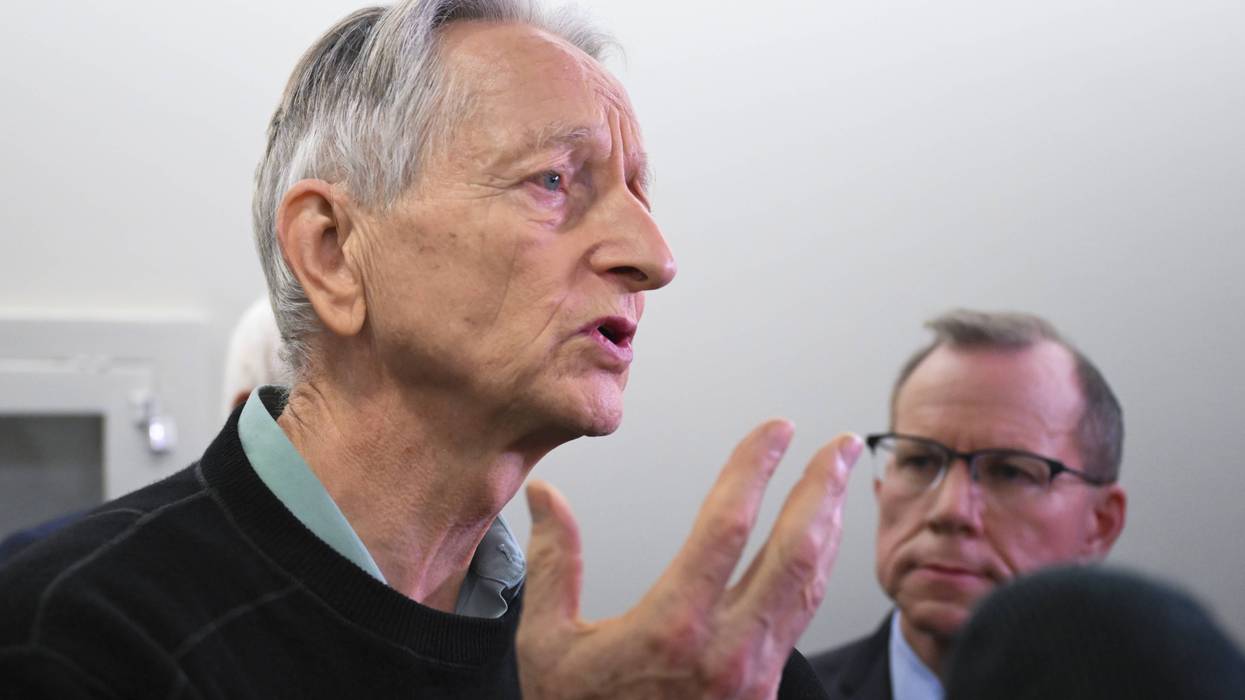
“I’m sure the oil and asbestos companies would have liked to [regulate themselves] as well,” said computer scientist Geoffrey Hinton in reference to President Donald Trump's approach to overseeing the AI industry.
Computer scientist Geoffrey Hinton, dubbed the "godfather" of artificial intelligence, delivered a withering assessment of President Donald Trump's understanding of the technology in an interview published by The Guardian on Tuesday.
The 78-year-old Hinton, a professor emeritus at the University of Toronto, told The Guardian that he was particularly unimpressed with the president's insistence that AI be rebranded as "superintelligence," which is a concept that he noted has long been clearly defined by computer scientists.
"Superintelligence means smarter than people, and has been around for at least 20 years," Hinton explained. "It’s got a very clear meaning. And now he says we’re going to call AI ‘superintelligence’. You can’t make it smarter than people just by calling it smarter than people."
Hinton also denounced Trump as a "corrupt, senile felon," and ridiculed the president's declaration that the AI industry is fully capable of policing itself without government intervention.
“I’m sure the oil and asbestos companies would have liked to [regulate themselves] as well,” he said. “Do we think tobacco companies should have been allowed to design the warnings on the packets? So that they could print them in a six-point font, in dark grey on black?”
In a Truth Social post last month, Trump suggested that his own intellect was singlehandedly capable of regulating AI, a technology so complicated that even its own creators have acknowledged difficulties in understanding it.
“The only control or ‘guardrails’ that AI needs is a STRONG AND SMART (High IQ!) PRESIDENT,” Trump wrote, “and the USA has that, in spades!”
Elsewhere in the interview, Hinton pushed back on critics who accused him of predicting that AI will wipe out human life. Rather, Hinton said he is only arguing there is an uncomfortably high probability that the technology could pose an extinction risk.
"I'm trying to convey that there is a really serious possibility of something happening," Hinton said. "If, for example, you're told there was a 10% possibility of a bus crashing, you wouldn’t get on the bus. The point of giving numbers is to say this is a serious risk."
The computer scientist pointed to the recent incident where hundreds of agents in OpenAI's cybersecurity test environment escaped confinement and hacked into machine learning company Hugging Face as something that "used to be the domain of science fiction."
Hinton said the stakes were particularly grave given AI's potential destructive power.
"The unique problem with AI is that if it goes wrong, if it takes over, you don’t get a second chance," he warned. "We can’t say, ‘Well, we lost that time. Let’s rerun the game.’ It’s not like that."
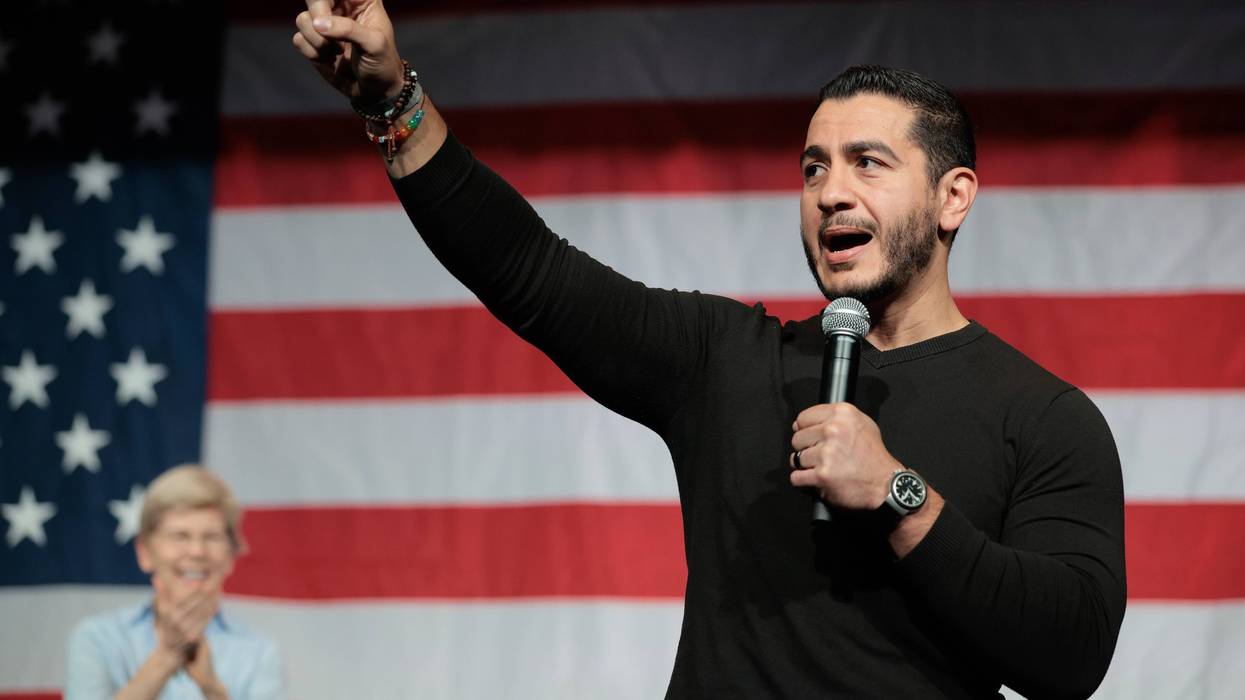
“If we don’t act quickly, we may get to a point at which we cannot act because it’s too late.”
US Senate candidate Abdul El-Sayed said Tuesday that to stop Silicon Valley "billionaires" from unilaterally deciding how artificial intelligence will be used, he proposed a regulatory framework for the technology that mirrors federal legislation pushed by top progressives in Congress.
The Michigan Democrat, who is running against Republican former Rep. Mike Rogers, unveiled his "AI Under Control" proposal following recent warnings from AI executives regarding the technology and its capacity for "recursive self-improvement"—the process through which AI models develop more sophisticated versions of themselves.
Executives including Dario Amodei of Anthropic and Sam Altman of OpenAI have said in recent weeks that AI development should be "paced" to safeguard the future of humanity, and as Common Dreams reported last week, some of those same CEOs are already plotting how to respond to a public revolt in the event of a "large-scale event" perpetrated by their tech, such as a cyberattack.
Echoing calls by lawmakers like Sen. Bernie Sanders (I-Vt.) and Rep. Greg Casar (D-Texas), El-Sayed shared a different vision, titled "AI Under Control."
The policy proposal calls for a ban on recursive self-improvement and a new Cabinet-level government agency that would inspect AI labs, "block releases" of dangerous AI models like those that have hacked a number of websites and platforms during testing, and "order a pause or command a shutdown” when such attacks take place.
“The answer to what is stopping rogue AI agents from triggering a global nuclear crisis or deploying bioweapons cannot be the whims of a few billionaires in California,” El-Sayed said Tuesday.
The Senate candidate, a former Detroit public health official, also called for mandatory reporting on safety breaches like the one that involved OpenAI's agents at the AI platform Hugging Face earlier this year, and for whistleblower protections.
OpenAI has been slow to publicly disclose its breaches and to notify those affected, as in the case of the company's agents hacking an Australian government healthcare website earlier this year. The company also reportedly fired several safety researchers this month.
“The answer to what is stopping rogue AI agents from triggering a global nuclear crisis or deploying bioweapons cannot be the whims of a few billionaires in California."
El-Sayed called for a national plan to respond to an emergency caused by AI, and reiterated his call from last month to pause advanced AI development until a government agency is established to regulate the technology, and to halt the development of AI data centers, which some communities in Michigan have fought back against.
President Donald Trump and other Republican leaders have called for rapid development of AI and a nationwide buildout of AI, fixated on the idea that, as House Speaker Mike Johnson (R-La.) said last month, "China will overlap us" if the US imposes regulations at the federal and state level.
Rogers has broken with Trump somewhat, backing a one-year moratorium on AI data centers in Michigan, but he has been criticized for holding at least $1.7 million in investments in various companies that stand to benefit from AI and data center development.
The former congressman has also accepted nearly $150,000 in campaign donations from people with AI and data center investments, including Cameron and Tyler Winklevoss and several executives from the private equity firm Blackstone.
“I understand that there’s a lot of money being sloshed around by AI super PACs, but this is the existential crisis of our time,” El-Sayed told The New York Times Tuesday. “If we don’t act quickly, we may get to a point at which we cannot act because it’s too late.”
A recent poll by the Times showed that voters in Michigan had greater confidence in El-Sayed than Rogers on the issue of AI, by an 11-point margin.
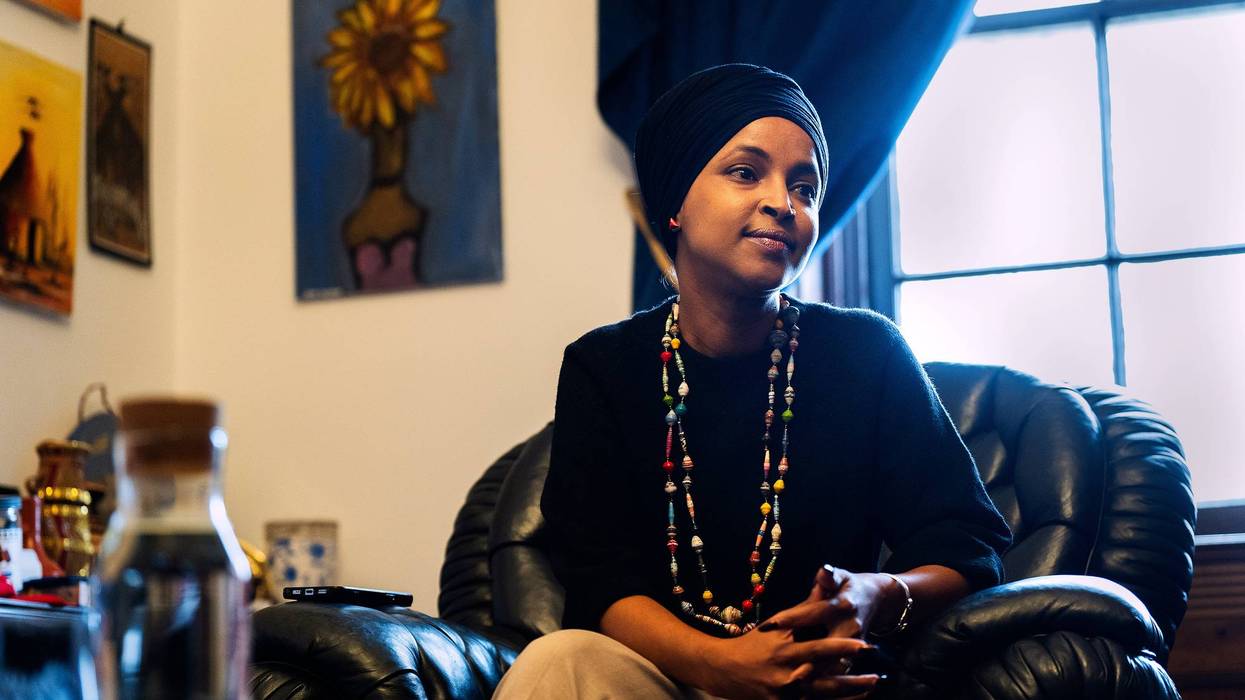
"For ten years, Trump has targeted me with baseless lies and smear campaigns. This is just the latest escalation in his campaign of political intimidation. I will not be silenced."
US Rep. Ilhan Omar on Monday forcefully condemned the Department of Homeland Security's raid on her Washington, DC home as part of a broader effort to weaponize federal law enforcement against progressives who oppose President Donald Trump's agenda.
"This is part of the fascist playbook to rile up Trump's die-hard supporters and give them a big distraction in advance of the midterms," Omar (D-Minn.) wrote in an email distributed by the Progressive Change Campaign Committee hours after the raid. "With this obviously political investigation, Trump is telling his voters: 'Ignore the price of gas, ignore the war in Iran, ignore that you're losing your healthcare—we want you to get angry about this instead.'"
The email followed a statement issued by Omar's office saying that the congresswoman "has done nothing wrong" and condemning the raid as "an outrageous abuse of power."
"For a decade, Donald Trump has relentlessly targeted Congresswoman Ilhan Omar with inflammatory rhetoric, repeatedly putting a target on her back," the statement read. "Now, those attacks have escalated to a pointless federal raid."
The Trump Justice Department said the raid, executed by the investigative arm of DHS, was "part of an ongoing federal criminal investigation." Trump administration officials are reportedly probing whether Omar, who entered the US as a child refugee from Somalia and became a citizen in 2000, is in the country illegally. CBS News reported that the investigation centers on paperwork completed by Omar's late father when she was a child.
Trump told reporters at the White House on Monday that he has "nothing to do with" the Omar investigation while attacking her as a "terrible person." Omar and the Somali American community in Minnesota have been frequent targets of the president's bigoted attacks, and Trump has called for the Democratic lawmaker to be jailed or deported.
"For ten years, Trump has targeted me with baseless lies and smear campaigns. This is just the latest escalation in his campaign of political intimidation. I will not be silenced," Omar wrote in a social media post on Monday.
In the campaign email, Omar called the federal investigation a "sham" and "further proof" that Trump is "willing to use the power of the federal government to try to intimidate and silence anyone who stands up to him."
"It's up to us to make sure it doesn't work," Omar added.
The raid on Omar's home drew widespread condemnation, including from top Democrats in Congress. The leadership of the House Democratic caucus issued a statement calling the raid a "deeply disturbing" act that "raises serious questions about the continued corrupt weaponization of the federal government against Donald Trump’s adversaries."
Rep. Sydney Kamlager-Dove (D-Calif.) denounced the raid as "fascism in the extreme."
"Trump is weaponizing the federal government to escalate his racist attacks against Rep. Omar, undermine her ahead of the midterms, and distract from his failures as president," Kamlager-Dove added.
The Department of Justice admitted that the Trump administration kept running the ads after a federal judge issued a temporary restraining order, blaming the error on a missed email.
The US Department of Justice apologized Monday after the Trump administration continued airing taxpayer-funded political advertisements despite a court order requiring them to stop, blaming an internal email delay for the violation.
US District Judge Jennifer L. Rochon—an appointee of former President Joe Biden—issued a temporary restraining order Sunday in Common Cause et al. v. Department of Homeland Security et al., blocking the administration from airing the commercials and requiring officials to cancel previously scheduled runs.
However, The Washington Post and Democracy Docket reported Monday that two of the ads ran nearly 400 times after the order took effect. Plaintiffs in the case—the advocacy group Common Cause, Service Employees International Union Local 32BJ, Empire State 32BJ SEIU PAC, and Democratic Alabama state Legislature candidate Robert Hunter—filed a notice with the court informing it of the violations.
Citing the filing, Democracy Docket noted:
According to AdImpact data... the government’s ads aired in nearly 400 television spots on programs that began at 7 pm Eastern—after Rochon’s order was already in force. One of the ads aired in 193 spots during CBS’ "60 Minutes," while another aired in 198 spots during ABC’s "America’s Funniest Home Videos."
The ads continued airing Monday. As of 2:45 pm plaintiffs said an ad titled “Maduro” had aired another 20 times, one titled “Final Battle” 11 times, and another titled “The Country He Loves” once.
Rather than seeking contempt sanctions at this time, the plaintiffs are asking Rochon for a status conference to determine whether the Trump administration has complied with her order.
The Department of Justice admitted the error in a separate filing Monday, claiming that its lawyers "did not become aware of" the Rochon's emailed order "until this morning." The DOJ apologized to plaintiffs and the court, assuring Rochon that "the government is in compliance" with the temporary restraining order.
The White House said separately that the Department of Homeland Security (DHS) had not received notice in time to cancel the advertising purchases. The administration subsequently instructed its outside vendor to stop airing the commercials, froze future payments, and placed the $20 million funding allocation on hold.
The dispute stems from a $20 million advertising campaign financed via Office of Management and Budget (OMB) funds that were redirected to a Customs and Border Protection account designated for “commemorative events.”
The commercials featured President Donald Trump touting his political agenda, including one repurposed from his 2024 presidential campaign and another featuring Trump and Defense Secretary Pete Hegseth hyping the US war against Iran.
Critics have called the ads illegal under laws including the Administrative Procedure Act and the Hatch Act, and even grounds for impeaching Trump, who has already been impeached an unprecedented two times—but never convicted by the Senate—yet again.
The Democratic National Committee last week sued Trump, the White House, OMB, and DHS over the ads, alleging that the president "personally directed this illegal activity."
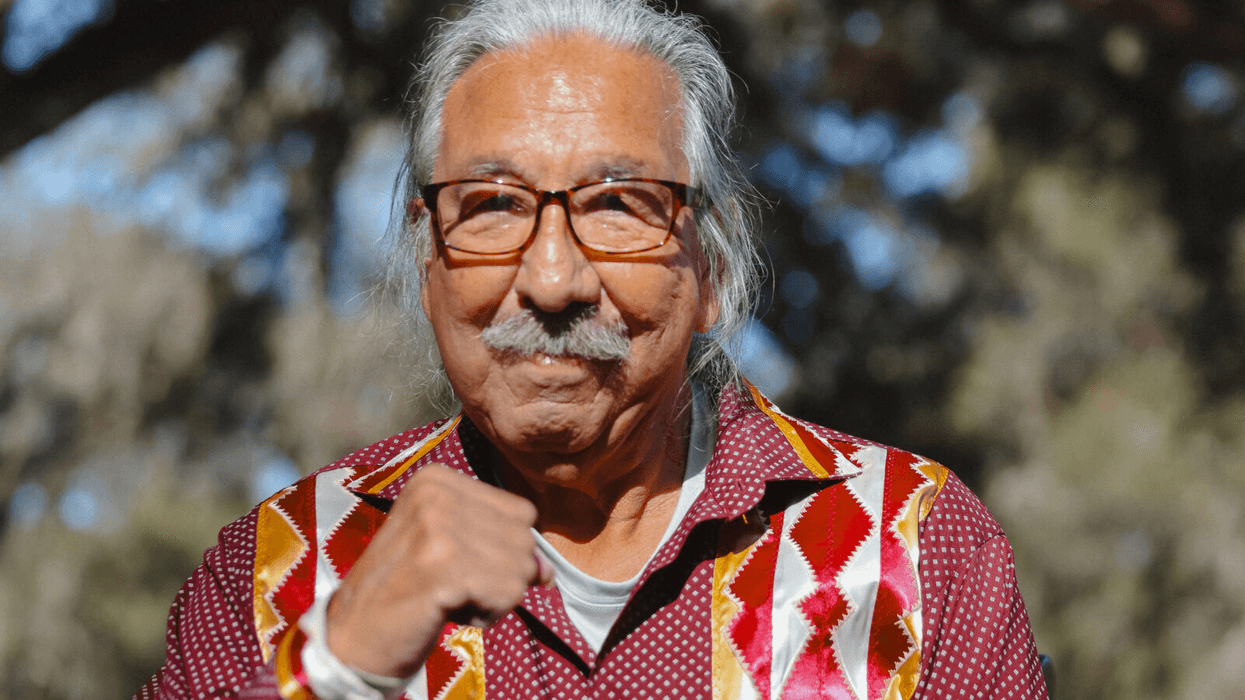
"We just want to be left alone," the former longtime political prisoner said. "We don’t want to be part of a government that’s killing women, children, babies, and bombing every damn thing that they can."
Leonard Peltier, the Indigenous activist who spent nearly half a century in prison for murders he says he did not commit before outgoing President Joe Biden commuted his sentence last year, vowed Monday that Native Americans would resist the Trump administration's attacks on Indian rights and tribal sovereignty.
“We’re not free yet. We are in danger,” Peltier, 82, told Democracy Now! in an interview released Monday to mark Indigenous Peoples’ Day. “Trump and these organizations, they’re talking about doing away with our reservations and our treaties and everything else.”
Peltier—whose freedom struggle is the subject of a new documentary, Free Leonard Peltier, directed by David France and Jesse Short Bull—said: "Some people became greedy and selfish and murderous, and they tried to exterminate us because they wanted it all for themselves. Well, 500 years later, we’re still here, and I’m still talking, and I’m going to talk 'til I die."
"We just want to be left alone," Peltier said of Indigenous peoples. "Let us live our own lives. Let us have our own society we’ve had for thousands of years. What the hell? I mean, we don’t want to be part of a government that’s killing women, children, babies, and bombing every damn thing that they can, and talking about annihilating a race of people."
Peltier's remarks came as Indigenous communities across the United States face numerous federal policies and actions affecting their lands, cultures, civil rights, and access to critical services.
In Arizona, the Trump administration is moving ahead with a border wall opposed by the Tohono O’odham Nation, whose ancestral homeland straddles the US-Mexico border. A recent Arizona Luminaria investigation revealed that federal authorities used drones, surveillance equipment, and masked agents to monitor Tohono O’odham members and a prayer camp as the Trump administration moved forward with border wall construction through their ancestral lands.
The Arizona border wall and a similar barrier project in Texas' Big Bend region are among the numerous conflicts over Native lands and treaty rights under attack by the government. According to the National Indian Law Library’s 2026 roundup of Indigenous land disputes, tribes are fighting to protect sacred sites, recover ancestral territory, and oppose mining and development projects.
The Trump administration has also moved to shrink the Bears Ears and Grand Staircase-Escalante national monuments in Utah, drawing tribal leaders' condemnation of the loss of protections for culturally significant landscapes.
Education is also under attack, as Trump seeks to dramatically slash federal funding for tribal colleges and universities.
Meanwhile, the administration’s proposed changes to the 2030 census could make Native Americans less visible in federal data by removing questions about race and ethnicity from the decennial questionnaire, raising concerns about the consequences for federal funding, voting rights, and civil rights enforcement.
Peltier—who supporters long said was framed for the murder of two federal agents during a 1975 shootout at the Oglala Sioux Reservation in South Dakota—sounded a note of defiant perseverance during his Democracy Now! interview.
“We’re going to stay here,” he said of Indigenous peoples. “You’re not going to get rid of us.”

"Everyone saw these pro-democracy protests," said a critic of Pakistan's US-backed military government. "This is a very transparent attempt to crush them by a military regime that is terrified of its own people."
As US President Donald Trump deepens his ties with Pakistan's powerful military chief, the nation's government has detained the elected leadership of the last province controlled by jailed former Prime Minister Imran Khan's opposition party—a move critics have condemned as a coup.
Pakistan's president, Asif Ali Zardari, declared a state of emergency on Sunday in the northwestern province of Khyber Pakhtunkhwa, suspending its elected government and transferring authority to a federally appointed governor. Hundreds of members of Khan's Pakistan Tehreek-e-Insaf (PTI) party, including its provincial chief minister, Sohail Afridi, have been arrested, as have Khan's three sisters, according to The Guardian.
The emergency measures come after days of protests calling for the release of Khan—who was forced to step down from power in 2022 by a parliamentary vote of no confidence under heavy pressure from the US government, then led by President Joe Biden. Khan was subsequently imprisoned by Pakistani authorities and accused the military of orchestrating his ouster.
Pakistan's government said it declared the state of emergency after local leadership failed to stop escalating attacks from Islamist terrorist groups. But PTI leaders described it as a thinly veiled pretext to squash protests, including a planned march on Islamabad to demand Khan's release.
Mehlaqa Samdani, the director of the Community Alliance for Peace and Justice—a group advocating against US support for political repression in Pakistan—described Khyber Pakhtunkhwa as "the last remaining province where the military regime had been unable to take control."
"The government has now declared a state of emergency and imposed governor's rule in the province, effectively removing its elected government from power," Samdani said in a video. "Just think about what that means: Millions of people voted for their representatives, only to see their elected government stripped of its authority."
"Everyone saw these pro-democracy protests," she added. "This is a very transparent attempt to crush them by a military regime that is terrified of its own people."
Amid mass protests calling for his release, Amnesty International has argued that Pakistani authorities have weaponized criminal proceedings to keep Khan out of power and crack down on dissent.
After the emergency measures went into effect this weekend, the internet monitoring organization NetBlocks reported major disruptions to internet service in parts of Khyber Pakhtunkhwa. Mobile phone networks have reportedly been disrupted, public transit closed, and several roads across the province shut down.
"Reports of arbitrary detentions of key leaders—including the provincial chief minister—and internet disruptions across the province raise concerns about the proportionality of these emergency measures," Babu Ram Pant, Amnesty International’s deputy director for South Asia, said on Sunday following news of the emergency declaration.
"While states may, in strictly limited circumstances, derogate from their human rights obligations to respond to a public emergency that threatens the existence of the nation, emergency measures are not a blank cheque to crack down on human rights, silence dissent, or concentrate power," he said.
Trump has warmly embraced Asim Munir, the military chief who has overseen the crackdown on Khan and his opposition party, spent recent years consolidating control over Pakistan's armed forces, and secured immunity from criminal prosecution.
Munir has regularly been heaped with praise by Trump, who hosted him for an unprecedented two-hour Oval Office meeting last year without any other Pakistani officials. Trump has referred to Munir as "my favorite field marshal," "a very important guy," and an "exceptional human being."
In December, the Trump administration approved a $686 million sale to upgrade Pakistan's F-16 fighter jets. Trump has also tapped Munir as a key intermediary between Washington and Tehran amid the US war with Iran.
Hussain Nadim, a Pakistani political analyst and lecturer at George Washington University, has argued that Munir has made himself useful to Trump because it "confers international legitimacy as his military rule faces deep questions at home."
"Pakistani generals have long understood how to capitalize on American fears, anxieties, and domestic political needs of a wide range of American presidents," Nadim wrote in August. "Military rulers position themselves around political changes in Washington, knowing urgent American political and security needs can override concerns about democracy and governance in countries like Pakistan."
Opponents of US intervention, including Samdani, have renewed calls for the US to cut off support for Pakistan's government.
"The US continues to train and work closely with the very military regime that is now attacking its own people," she said. "Members of Congress should speak out immediately. They should tell Pakistan's peaceful pro-democracy protesters that the world stands with them and tell the military dictatorship that we are watching and will not allow this repression to go unanswered."
"American taxpayers do not want to be involved in training a corrupt military regime that's oppressing its own people, including relatives of around one million Americans of Pakistani descent," said Erik Sperling, the executive director of Just Foreign Policy—a member of the Coalition to Change US Policy Towards Pakistan.
"If the Pakistani regime cannot allow its own people to protest and vote in free elections, they should not be receiving any training or support from the United States military or intelligence services," he told Common Dreams.
"The US is harming its relationship with the Pakistani people by continuing to side with the military regime that fraudulently stole elections and is now attacking its own people," he said. "There's a chance for the United States to stand up for freedom and democracy and build a genuine partnership with the people of Pakistan by siding with them as they fight for their freedom from military rule."