

SUBSCRIBE TO OUR FREE NEWSLETTER
Daily news & progressive opinion—funded by the people, not the corporations—delivered straight to your inbox.
5
#000000
#FFFFFF
To donate by check, phone, or other method, see our More Ways to Give page.
Daily news & progressive opinion—funded by the people, not the corporations—delivered straight to your inbox.

Expert contacts:
Jason Pfeifle, CALPIRG Education Fund, (626) 221-4925, jpfeifle@calpirg.org
Kari Hamerschlag, Friends of the Earth, (510) 207-7257, khamerschlag@foe.org
Communications contact: Kate Colwell, Friends of the Earth, (703) 622-9093, kcolwell@foe.org
Public interest, environmental, food safety and consumer groups representing millions of consumers today announced a campaign calling on In-N-Out Burger, California's iconic hamburger restaurant chain, to stop selling beef produced with the routine use of antibiotics. These groups, including CALPIRG Education Fund, Friends of the Earth, Center for Food Safety, Consumers Union, along with author and activist Vani Hari, delivered a letter to the company's corporate headquarters signed by more than 50 groups urging that the company commit to a strong antibiotics policy. CALPIRG Education Fund staff and volunteers also held public outreach efforts at In-N-Out restaurants and other locations to motivate the company to do its part to help protect the public from antibiotic resistance.
Most meat served by America's chain restaurants comes from animals raised in industrial-scale facilities where they are routinely fed antibiotics to prevent disease that is easily spread in crowded, unsanitary and stressful conditions. This overuse of antibiotics in livestock production contributes to the rise in antibiotic-resistant infections that claim at least 23,000 lives each year. Major restaurant chains can influence their meat suppliers to adopt better practices by committing to purchase meat only from farms that don't abuse life-saving medicines.
"As a hamburger restaurant known for its high-quality, fresh ingredients, In-N-Out should be a leader on this issue," said Jason Pfeifle, Public Health Advocate with CALPIRG Education Fund. "It's time for the company to set a strong antibiotics policy that will help push the meat industry to do the right thing for public health."
Consumer advocates and volunteers passed out literature at In-N-Out locations around the state about the dangers of antibiotic-resistant bacteria, and asked passersby to take a photo posing with signs that read: "I'm an In-N-Out lover, but I'm hungry for beef raised without routine antibiotics," and other slogans. The photos were posted on Twitter and Instagram with #InNOutSaveABX #InNOutBurgers.
"It's time for In-N-Out Burger to respond to consumers and fill the void left by the FDA's failed policies by working with its meat suppliers to improve practices and end the misuse of antibiotics," said Kari Hamerschlag, senior program manager at Friends of the Earth.
Last year McDonald's announced it would stop selling chicken raised with medically important antibiotics after consumers across the country demanded it. Shortly after the McDonald's announcement, Tyson Foods, the largest U.S. poultry producer, committed to eliminate the use of human antibiotics in raising their birds. Subway also committed to transition away from all meats raised on antibiotics, starting with chicken. These commitments were major wins for public health and came on the heels of several public mobilization campaigns.
"In-N-Out is a highly regarded chain that many people believe serve better food than other fast food competitors. It's time to live up to their reputation and stop lagging behind companies like Elevation Burger and Shake Shack who have responsibly decided not to serve meet raised with routine antibiotics or growth hormones," said author and activist Vani Hari.
Other groups calling on In-N-Out to make this commitment made the following statements:
"Until strong federal regulations prohibit the routine use of antibiotics and other drugs in animals raised for food, commitments from In-N-Out and other popular restaurants to source more responsibly raised meat can help protect human health, animal welfare, and the environment," said Rebecca Spector, West Coast Director with Center for Food Safety.
"The public health crisis of antibiotic resistance warrants immediate action from all sectors," said Laura Rogers, deputy director of the Antibiotic Resistance Action Center at the George Washington University's Milken School of Public Health. "While the U.S. government has taken some action, it is not enough. We need companies, like In-N-Out Burger, to harness their purchasing power and demand that the meat they serve is raised with responsible antibiotic use."
Background on antibiotics overuse on industrial farms:
Antibiotic-resistant infections kill 23,000 Americans, and sicken 2 million every year, according to the Centers for Disease Control and Prevention. Most large industrial farms administer antibiotics on a routine basis to animals that often aren't sick in an effort to promote growth and prevent disease brought on by unsanitary production practices. In the United States, 70 percent of medically important antibiotics are sold for use on food animals.. That overuse breeds antibiotic resistant bacteria that rapidly multiply and spread off of farms via contaminated meat, direct human to animal contact, and through the air, water and soil.
California recently passed landmark legislation that prohibits the routine use of antibiotics on animals for growth promotion or disease prevention. This first-in-the-nation law must be implemented by January 2018. Strong antibiotics commitments from California-based restaurant chains will help move livestock producers to comply with the new law more quickly.
For more information consult the CALPIRG Education Fund website.
Friends of the Earth fights for a more healthy and just world. Together we speak truth to power and expose those who endanger the health of people and the planet for corporate profit. We organize to build long-term political power and campaign to change the rules of our economic and political systems that create injustice and destroy nature.
(202) 783-7400
“We are currently concentrated on ending the war in the region, including in Lebanon,” said Foreign Ministry spokesperson Esmaeil Baghaei, who added that "no nuclear negotiations” are happening at this stage.
A spokesperson for Iran's Foreign Ministry on Sunday said the Iranian leadership is reviewing the response issued by the US government over the weekend following a 14-point plan offered by Tehran to bring the unpopular war started by President Donald Trump—now in its third month—to an end.
“The Americans have given their answer to Iran’s 14-point plan to the Pakistani side, and we are currently reviewing it,” Foreign Ministry spokesman Esmaeil Baghaei said in an interview with Iranian television.
Baghaei said that the offered framework is strictly focused on ending the immediate hostilities and that the plan contains "absolutely no details regarding the country’s nuclear issues," which he suggested could be discussed at a later time.
“We are not currently engaged in any negotiations over the nuclear issue, and decisions about the future will be made in due course,” he said, even though Trump and US Secretary of Defense Pete Hegseth have continued to claim the preventing the Iranians from having a nuclear weapons program—which Tehran denies having and US intelligence assessments have shown does not exist in the manner that US officials describe it—is central to their war aims.
“I will soon be reviewing the plan that Iran has just sent to us," Trump said in a social media post on Saturday, "but can’t imagine that it would be acceptable in that they have not yet paid a big enough price for what they have done to Humanity and the World, over the last 47 years."
Despite some reporting examining what's purportedly in the Iranian proposal, the exact details of the 14-point plan remain murky or contentious, depending on who you ask. Trita Parsi, executive vice president of the Quincy Institute for Responsible Statecraft, gave his assessment of the current situation on Sunday by saying:
Overall, the Iranians appear to be pursuing a grand bargain—without labeling it as such. This is not merely a proposal aimed at securing a ceasefire, or even a formal end to the current conflict, but rather an attempt to resolve the broader US-Iran antagonism that has persisted for the past 47 years. Implicit in this approach is an expectation that both sides would also restrain their respective regional partners and proxies (Israel, Hezbollah, etc.). In many respects, framing the proposal in this way may align more effectively with Trump’s instincts and psychology.
Meanwhile, a poll out Friday showed that 61% of Americans believe Trump's launching of the war was a mistake, and an even higher number (66%) disapprove of how he's handling the conflict. The same ABC News/Washington Post/Ipsos poll also showed that Trump is now facing the lowest approval ratings of his presidency.
Speaking with Al-Jazeera over the weekend, Parsi explained that Trump's maximalist demands, including the blockade that it has tried to impose on Iran near the Strait of Hormuz, have made negotiations much more difficult:
Trump had time on his side during the ceasefire - until he imposed the blockade per the recommendation of FDD, Israel, and Lindsey Graham. Though the blockade is hurting Iran, it has ended up hurting Trump more, with oil prices now exceeding where they were even during the war… pic.twitter.com/wNSbvjtwSz
— Trita Parsi (@tparsi) May 3, 2026
Over the weekend, archival footage from the 1990s shared online by journalist Séamus Malekafzali showed former Iranian Revolutionary Guard Corps commander Hossein Salami, who was killed by US-Israeli forces last year, talking to the IRGC's staff college about the country's strategy of "asymmetric warfare" if and when it ever faced an opponent that was perceived to have military superiority over it.
Fascinating footage released by the IRGC of a class at the org's staff college in the 90s, where future IRGC leader Hossein Salami teaches a course on asymmetric warfare, teaching officers how to drag out a war with the US by driving up economic costs and political turmoil. pic.twitter.com/et5ZVFIEMi
— Séamus Malekafzali (@Seamus_Malek) May 2, 2026
"The chance of conflict with American forces is very possible," Salami says in the video, according to the English subtitles provided, but the "possibility of victory really exists" if Iranians are able to move the conflict toward "the area of our capabilities into the area of America's weaknesses."
That strategy, as Malekafzali paraphrases it, is "to drag out a war with the US by driving up economic costs and political turmoil," thereby draining the US and sapping its power by inflicting economic pain and political pressure.
As many foreign policy observers have pointed out since Trump launched the war, the strategy of Iran to inflict pain on US allies in the region and economic pain at a global level—such as has been achieved by the closing of the Strait of Hormuz—is very much what Salami describes.
As geopolitical analyst Misbah Qasemi explained, Salami's point was basically this: "Don't match their strength (air power, technology). Attack their weaknesses (economic endurance, political will, domestic opinion). Drag them into your terrain—maritime, cyber, proxy networks—where their advantages neutralize themselves."
This point was made explicitly by Harrison Mann, a fellow with the advocacy group Win Without War, during a Sunday appearance on CNN, where he explained how this plays out in practical terms.
Told @brikeilarcnn: The "good news" is Iran won't become another quagmire because, unlike other countries the US has picked on in the region, Iran can actually inflict pain back on the US. In this case via economic warfare, which is not sustainable for Trump in the long run. pic.twitter.com/lwySB2BLca
— Harrison Mann (@Harrison_J_Mann) May 3, 2026
"Iran can actually inflict pain back on the US," said Mann. "In this case, via economic warfare, which is not sustainable for Trump in the long run."
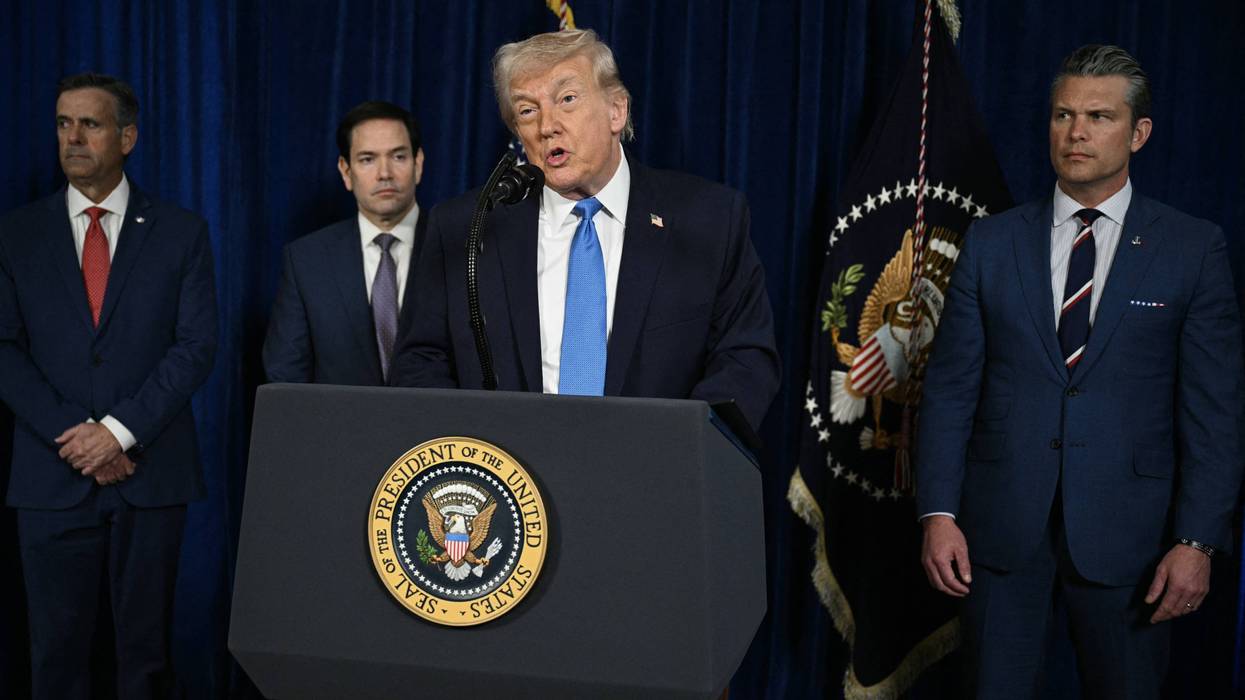
"The vaults are open and the arms trade is thriving before the war and after it," said one Nobel Peace Prize laureate.
As the US voting public continues to express its discontent over the disastrous war of choice against Iran that US President Donald Trump launched just over two months ago, fresh criticism followed after weekend reporting revealed the administration skirted congressional review to approve an $8.6 billion weapons deal with the United Arab Emirates and other allies in the Middle East.
Announced Friday night quietly by the US State Department, as the New York Times reports, the "sales would entail the transfer of rockets to Israel, Qatar, and the United Arab Emirates and air-defense equipment to Qatar and Kuwait."
According to the Times:
Under the terms of the deal with Qatar, the Gulf country would pay more than $4 billion for American-made Patriot missile interceptors — global stockpiles of which have dwindled during the war with Iran.
Israel, the Emirates and Qatar would receive an Advanced Precision Kill Weapon System, which fires laser-guided rockets. Kuwait also purchased an advanced aerial defense system for about $2.5 billion.
Secretary of State Marco Rubio expedited the deals under an emergency provision allowing the “immediate sale” of the weapons, the State Department said, bypassing standard congressional review and prompting criticism from Democratic lawmakers. This is the third time the second Trump administration has invoked an emergency authorization during the Iran war to bypass Congress on arms sales.
"No comment," said Mohamed ElBaradei, a Nobel Peace Prize winner and the former head of the International Atomic Energy Agency (IAEA), in an eye-rolling response to the news on social media.
After a commenter suggested that "America opened the door to war for [the countries taking part in the sale] so they would open their treasuries and the Israeli-American arms trade would boom after a slump," ElBaradei seemed to agree.
"The vaults are open, and the arms trade is thriving before the war and after it," he said.
Kenneth Roth, former executive director of Human Rights Watch and now a visiting professor at Princeton University, said: "Trump is bypassing Congress to fast-track arms sales to the United Arab Emirates, apparently without receiving any promise that the UAE would stop arming the genocidal Rapid Support Forces (RSF) in Sudan."
The RSF has been accused of atrocities in the ongoing Sudanese civil war, and the backing it has received from the US, with the UAE as its closely allied proxy, has been the source of outrage and criticism.

"Over and over again, the Trump administration is exposing private Social Security data," said one watchdog group who called the leak of personal information "a goldmine for identity thieves" and other fraudsters.
A newly reported failure of the Trump administration's ability to handle sensitive private information in the social programs it is tasked with operating triggered a fresh wave of anger over the weekend after it was revealed that healthcare providers' Social Security numbers were made public as part of a faulty Medicare portal rollout.
The Washington Post discovered the compromised database and alerted the administration last week, before publishing a story about it on Friday, after efforts had been made to protect the sensitive information from further compromise.
According to the Post:
The Centers for Medicare and Medicaid Services (CMS) last year created a directory to help seniors look up which doctors and medical providers accept which insurance plans, framing it as an overdue improvement and part of the Trump administration’s initiative to modernize health care technology.
But a publicly accessible database used to populate the directory contains some of the providers’ Social Security numbers, linked to their names and other identifying information. For at least several weeks, CMS made the database available for public use as part of its data transparency efforts.
While the reporting noted that the files were "not immediately visible to users who [visited] the provider directory," lawmakers and experts said the compromised information would be a treasure trove for fraudsters.
“The more we learn about how the Trump Administration handles the people’s most sensitive data, the clearer their incompetence becomes."
Critics pounced on the new reporting, calling it "yet another mess-up by the Team Trump" and only the latest evidence that the administration cannot and should not be trusted to protect the nation's most successful anti-poverty programs or the sensitive personal data of the American people who entrust the government with that information.
"Over and over again, the Trump administration is exposing private Social Security data," said Social Security Works, an advocacy group that serves as a public watchdog for the nation's social programs.
The compromised database, said the group, "is a goldmine for identity thieves, scammers, and foreign governments. And it is undermining the very foundation of our Social Security system."
"This is a failure by this administration," said Sen. Ruben Gallego (D-Ariz.) in response to the reporting. "Exposing Social Security numbers, whether patients or providers, is unacceptable."
Rep. Richard Neal (D-Mass.), the ranking member of the House committee that oversees the Medicare program, put the onus on his Republican colleagues in Congress.
“The more we learn about how the Trump Administration handles the people’s most sensitive data, the clearer their incompetence becomes,” Neal told the Post in a statement. “Do House Republicans need to see their own data exposed before they do right by their constituents and act?”
In March, as Common Dreams reported at the time, a whistleblower filed a complaint with the Social Security Administration accusing a former staffer with Trump's Department of Government Efficiency (DOGE), run for a time by right-wing billionaire Elon Musk, of trying to share information from SSA databases with his private employer.
Since the outset of Trump's second term, DOGE's meddling with Social Security and Trump's undermining of the program have been the source of deep anger and concerns among the program's defenders.
In a social media post on Saturday citing the whistleblower allegations from March, Rep. John Larson (D-Conn.) said, "For more than a year, 'DOGE' has been combing through the American people's records. They want to use your data to overturn elections and profit in the private sector. Enough! This administration must be held accountable for this massive data breach!
On Friday, responding to the Post's new reporting about the compromised database of physicians' private information, Larsen condemned Republicans for their ongoing and pervasive failures in the face of Trump's malfeasance and incompetence.
DOGE, said Larsen, "has been in your data for more than a year. We just learned that physicians' Social Security numbers were publicly exposed in an online portal launched by ‘DOGE’ officials."
"If this isn't enough for Republicans to act," he asked, "where will they draw the line?"