

SUBSCRIBE TO OUR FREE NEWSLETTER
Daily news & progressive opinion—funded by the people, not the corporations—delivered straight to your inbox.
5
#000000
#FFFFFF
To donate by check, phone, or other method, see our More Ways to Give page.

Earthjustice is a non-profit public interest law firm dedicated to protecting the magnificent places, natural resources, and wildlife of this earth, and to defending the right of all people to a healthy environment. We bring about far-reaching change by enforcing and strengthening environmental laws on behalf of hundreds of organizations, coalitions and communities.
800-584-6460



The school blockades and other protests began in blue-collar Parisian suburbs and rapidly spread across the country as students and their supporters demanded more teachers and staff, smaller classes, improved school buildings, an end to socially discriminatory university admissions, and an education system that does not force working-class youth to bear the cost of government austerity.
The Confédération Générale du Travail (CGT), one of France's largest unions, urged its members to join Tuesday's mobilization alongside students and educators. The union said it would stand with high school and university students "including through strikes," while demanding major investment in public education.
"Beyond the issue of resources, students are demanding greater equality and social justice, aware that the policies of [President] Emmanuel Macron and his successive governments have deliberately damaged the principles of the French public education system," a coalition of unions including CGT said in a statement of solidarity.
Such solidarity was visible on the streets Tuesday as students from Épinay-sur-Seine marched alongside SUD-Rail railway employees, while education workers formed human chains to protect young protesters from police. Workers also joined students blockading a high school in Montpellier.
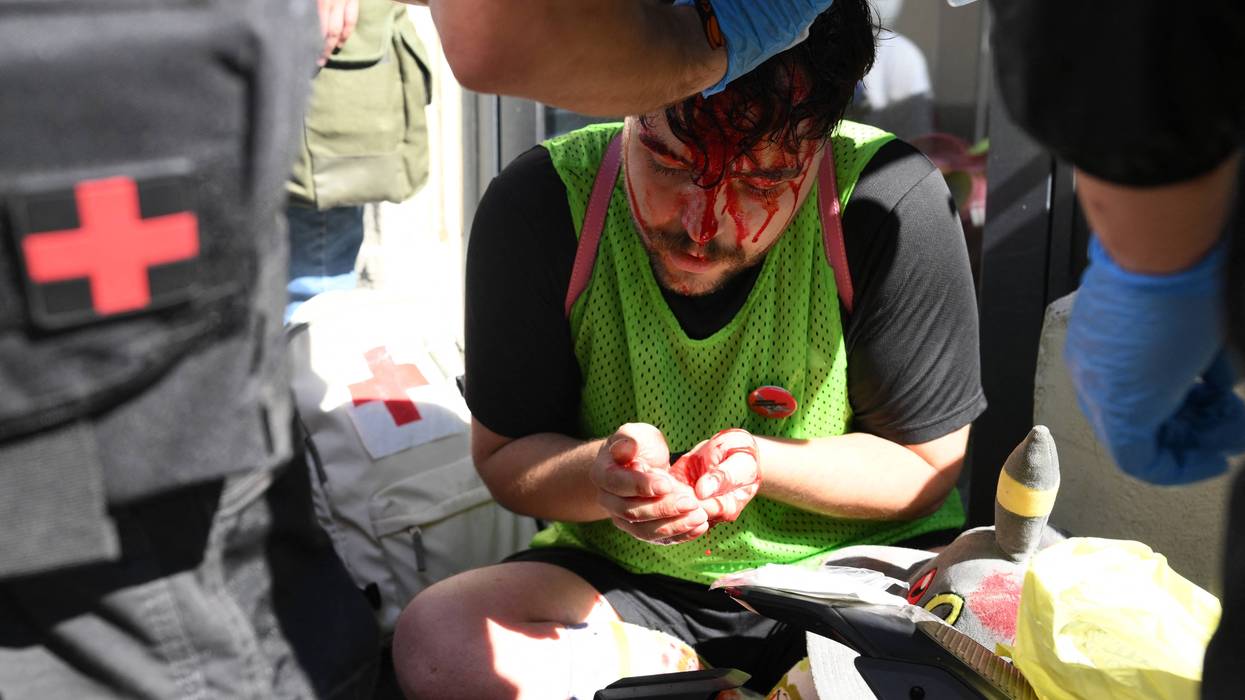
Protesters in some cities were met with police violence.
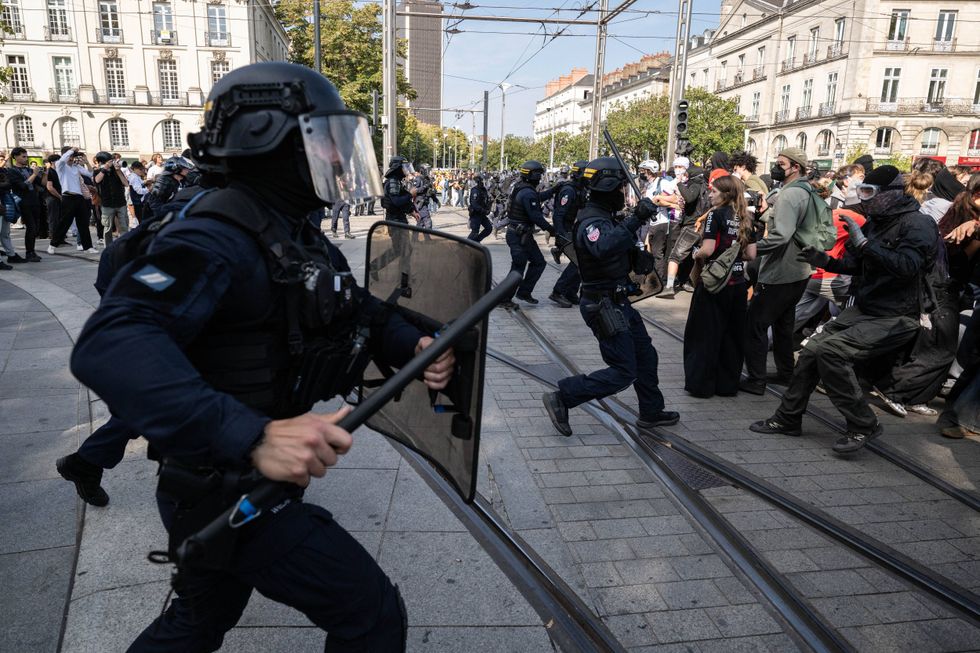 Police in riot gear charge student protesters in Nantes, France on October 6, 2026. (Photo by Sebastien Salom-Gomis/AFP via Getty Images)
"The repression is the same as that employed against the Yellow Vests except that now it's our kids who are in the streets," said Julien, a CGT Total refinery worker and union activist, referring to the 2018 economic protests that swept the nation. "The high school and university students have opened the way, and we have to follow them."
Coline, a high school student in Le Havre, said that workers physically placed themselves between young protesters and police.
"Union members formed a human chain between us and the CRS," she said. "All workers should do it because our demands are theirs. They portray us as rioters when we just want a future."
Alarming scenes of police terror shocked many observers.
In Lens, a 15-year-old student suffered a devastating hand injury during clashes near his high school Monday. According to La Voix du Nord, the teenager lost his hand after a police grenade exploded. The precise circumstances remain under investigation, chiefly by the Inspection Générale de la Police Nationale (IGPN).
A fellow student, Chloé, rejected the authorities' claims that the teenager was injured when he picked up the grenade.
"The police started coming toward us," she told La Voix du Nord. "So we all started running in the opposite direction. They threw smoke grenades at us... We were running. We couldn't see. And my high schoolmate got it in his hand."
She said the injured student began shouting, "My hand! My hand!"
"I turn around and see that he doesn't have a hand anymore," she recounted. "We all gathered around him."
"We're students, we're young," Chloé added. "There's no need to do that. It was useless; we were already leaving."
A 14-year-old in Saint-Ouen-l'Aumône reportedly suffered a double jaw fracture after being struck by a tear gas grenade fired at close range. Le Monde said the incident is among several cases being investigated by the IGPN.
Another 14-year-old reportedly lost most of his teeth after a police officer apparently fired a grenade at his face at close range during a protest northwest of Paris.
“His jaw is sealed shut, he can no longer speak, and he eats through a straw,” his mother told reporters.
In Tours, a 16-year-old reportedly suffered a severe eye injury when police fired "less-lethal" projectiles, including rubber-coated steel bullets, into a crowd of protesters during a high school blockade.
Another student, 16-year-old Isabella, connected the police crackdown to the class inequalities underlying the movement.
"Everybody told us that school was the great leveler, but today that is not the case at all," she told The Guardian. "A teenager in the suburbs of Paris is never going to have the same opportunities as a student from the city center."
The protests have also become a political flashpoint, with Jean-Luc Mélenchon and his left-wing La France Insoumise party openly backing the students while rejecting government accusations that they are responsible for the unrest. LFI lawmakers have appeared alongside protesters, while Mélenchon has condemned the police response and called on his supporters to nonviolently resist what he called police “savagery.”
On Tuesday, French Interior Minister Laurent Nuñez refused to apologize for the police violence, drawing calls from the left for his resignation.
Amnesty International accused French authorities of answering protests with "disproportionate" force.
“Footage and testimonies widely reported over the last week raise alarming concerns about the dangerous use of tear gas, batons, and restraint techniques by police," Amnesty International France president Anne Savinel-Barras said Monday. "Tear gas grenades have been discharged recklessly, and rubber bullets have been fired, causing serious injuries."
“Authorities must ensure that any response to demonstrations is necessary and proportionate, and that children and young people peacefully demanding their right to education are protected rather than being beaten, tear-gassed, or arbitrarily detained," she added. "The priority should be the de-escalation of tensions, and authorities must take all available precautionary measures to avoid the need to use force.”
At least dozens of protesting educators, parents, and labor unionists have also been injured by police during the demonstrations.
Some police also reportedly refused to attack protesters.
Workers interviewed during the protests appeared undaunted and focused on their own demands, as well as those of the students.
“We’re sick of wage freezes; 60% of low-wage public sector workers are paid less than the minimum wage for a full workweek,” CGT Poitiers official Vincent Bohan told World Socialist Web Site during a march in Paris last week. “More and more people rely on us, but there are not enough of us to meet the population’s needs.”
“When you hear Macron’s speeches, each one more provocative than the last, with billions of euros spent on killing, while people in France are starving, one feels like telling him: Stop... help people struggling here rather than killing people elsewhere," Bohan said, referring to rising tensions with Russia and France's testing of a new generation of nuclear missiles. "Frankly, we are very worried.”


“Rampant corporate control of our water systems and federal disinvestment in aging infrastructure are driving up bills, forcing households to pick up the tab," said Mary Grant, FWW's water policy director. "Policymakers must rein in corporate abuses, hold polluters accountable, and provide dedicated funding for water systems. Everyone should have access to safe and affordable water."
The report shows that, overall, household drinking water bills surged by an average of 62% for typical American households over the past decade—increasing twice as much as grocery prices and 19% faster than median household incomes on average.
"A water affordability crisis is rapidly expanding throughout America," said Grant. "While struggling to pay for other essentials like food and energy, many households are grappling with water costs that are rising even faster."
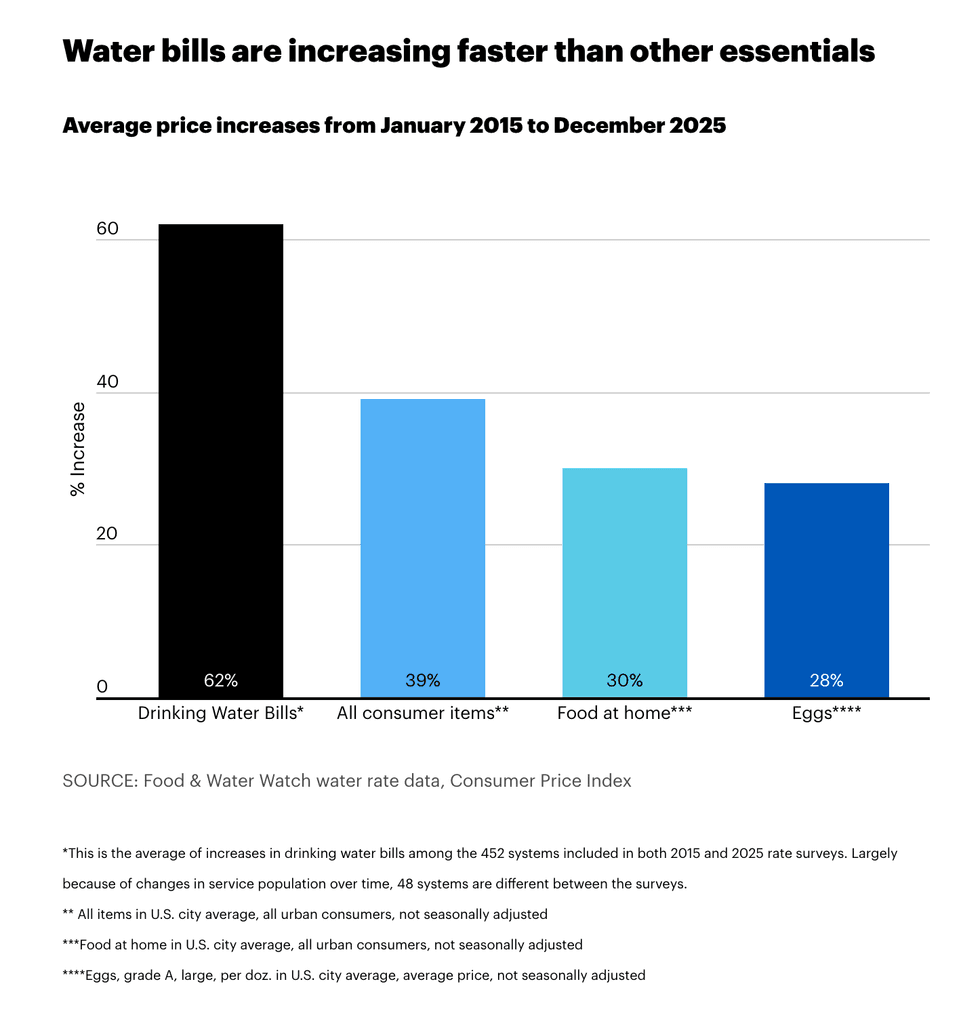
More than half of the 25 most expensive water systems in the US were located in California. The most expensive water bills in the country between 2015 and 2025 were issued by San Jose Water Company, a private utility.
"In the list of the top 10 most expensive water systems in the study, California and Pennsylvania stood out with numerous appearances," FWW said. "However, in Louisiana, Maryland, New Hampshire, and West Virginia, water bills grew about twice as fast as their corresponding statewide median household incomes. West Virginia, a state with one of the lowest average household incomes in the country, had the highest average water cost, at $1,383/year."
"Overall," the group added, "water bills were unaffordable for low-income households in nearly all (93%) of the surveyed water systems."
In addition to calling on state and local governments to ban water privatization and support local control of water systems, FWW urged the US Congress and federal government to:
"Water bills will continue to increase faster than households can keep up with," FWW warned, "unless all levels of government take action to stop corporate abuses and support water affordability."