

SUBSCRIBE TO OUR FREE NEWSLETTER
Daily news & progressive opinion—funded by the people, not the corporations—delivered straight to your inbox.
5
#000000
#FFFFFF
To donate by check, phone, or other method, see our More Ways to Give page.
Daily news & progressive opinion—funded by the people, not the corporations—delivered straight to your inbox.
A study published Monday in the Annals of Internal Medicine finds that health care bureaucracy cost Americans $812 billion in 2017. This represented more than one-third (34.2%) of total expenditures for doctor visits, hospitals, long-term care and health insurance. The study estimated that cutting U.S. administrative costs to Canadian levels would have saved more than $600 billion in 2017.
Health administration costs were more than fourfold higher per capita in the U.S. than in Canada ($2,479 vs. $551 per person) which implemented a single-payer Medicare for All system in 1962. Americans spent $844 per person on insurers' overhead while Canadians spent $146. Additionally, doctors, hospitals, and other health providers in the U.S. spent far more on administration due to the complexity entailed in billing multiple payers and dealing with the bureaucratic hurdles insurers impose. As a result, hospital administration cost Americans $933 per capita vs. $196 in Canada. The authors note that in Canada hospitals are financed through lump-sum "global budgets" rather than fee-for-service, much as fire departments are funded in the U.S. Physicians' billing costs were also much higher in the U.S., $465 per capita vs. $87 per capita in Canada.
The analysis, the first comprehensive study of health administration costs since 1999, was carried out by researchers at Harvard Medical School, the City University of New York at Hunter College, and the University of Ottawa. The authors, who also performed the 1999 study, analyzed thousands of accounting reports that hospitals and other health care providers filed with regulators, as well as census data on employment and wages in the health sector. They obtained additional data from surveys of physicians and government reports.
The researcher found that administration's share of overall U.S. health spending rose by 3.2 percentage points between 1999 and 2017, from 31.0 % to 34.2%. Of the 3.2 percentage point increase, most (2.4 percentage points) was due to the expanding role that private insurers have assumed in tax-funded programs such as Medicaid and Medicare. Private managed care plans now enroll more than one-third of Medicare recipients and a majority of those on Medicaid; Medicare and Medicaid now account for 52% of private insurers' revenues. Private insurers' increasing involvement has pushed up overhead in those public programs; private Medicare Advantage plans take 12% or more of premiums for their overhead, while traditional Medicare's overhead is just 2%, a difference of at least $1,155 per enrollee (per year).
The authors cautioned that their estimates probably understate administrative costs, and particularly the growth since 1999. Their 1999 study included administrative spending for some items such as dental care for which no 2017 data were available. Additionally, private insurance overhead has increased since the study's completion, rising by 13.2% between 2017 and 2018 according to official health spending figures released in December.
"Medicare for All could save more than $600 billion each year on bureaucracy, and repurpose that money to cover America's 30 million uninsured and eliminate copayments and deductibles for everyone," said study senior author Dr. Steffie Woolhandler, a distinguished professor at the City University of New York (CUNY) at Hunter College and lecturer in Medicine at Harvard Medical School, where she previously served as a professor. "Reforms like a public option that leave private insurers in place can't deliver big administrative savings," Dr. Woolhandler added. "As a result, public option reform would cost much more and cover much less than Medicare for All."
According to Dr. David Himmelstein, the study's lead author who is an internist in the South Bronx, a distinguished professor at CUNY's Hunter College and lecturer in Medicine at Harvard, "Americans spend twice as much per person as Canadians on health care. But instead of buying better care, that extra spending buys us sky-high profits and useless paperwork. Before their single-payer reform, Canadians died younger than Americans, and their infant mortality rate was higher than ours. Now Canadians live three years longer and their infant mortality rate is 22% lower than ours. Under Medicare for All, Americans could cut out the red tape and afford a Rolls Royce version of Canada's system."
***
"Health Care Administrative Costs in the United States and Canada, 2017." David U. Himmelstein, M.D.; Terry Campbell, M.H.A.; and Steffie Woolhandler, M.D., M.P.H. Annals of Internal Medicine, published online ahead of print January 6, 2020
doi:10.7326/M19-2818
The Annals of Internal Medicine is the official journal of the American College of Physicians, the largest U.S. medical specialty society with 159,000 members.
In addition to their academic positions, Drs. Woolhandler and Himmelstein founded Physicians for a National Health Program, a 23,000 member organization that advocates for Canadian- style national health insurance in the U.S. Co-author Terry Campbell is Executive Director, Research Operations and Strategies at the University of Ottawa in Canada.
Physicians for a National Health Program is a single issue organization advocating a universal, comprehensive single-payer national health program. PNHP has more than 21,000 members and chapters across the United States.

Data released by the University of Michigan and Gallup this week showed US consumer sentiment cratering even as stock markets hit record highs.
Multiple polls and surveys released in recent days have shown US consumer sentiment cratering—and all the while, the US stock market keeps hitting record highs.
The Kobeissi Letter, a financial newsletter, posted a graphic Saturday that matched consumer sentiment as measured by the University of Michigan's Surveys of Consumers with the performance of the S&P 500 stock index over a 30-year span.
The graphic shows that, up until around 2020, consumer sentiment matched stock market performance closely, although there was a large divergence between the two leading up to the 2008 financial crisis, where stocks briefly outperformed consumer sentiment before crashing downward as the housing bubble burst.
But throughout the last six years, the graphic shows, the S&P 500 has produced an almost continuous upward surge even as consumer sentiment spirals downward.
Absolutely incredible:
Over the last 6 years, the S&P 500 has risen +130% while US Consumer Sentiment has collapsed by -55%, to its lowest since data began in 1952.
We are witnessing the formation of the biggest wealth divide in modern history. https://t.co/XGMR6DfuNc pic.twitter.com/2w7cRvn7ok
— The Kobeissi Letter (@KobeissiLetter) May 23, 2026
"Absolutely incredible," commented Kobeissi Letter. "Over the last six years, the S&P 500 has risen +130% while US Consumer Sentiment has collapsed by -55%, to its lowest since data began in 1952. We are witnessing the formation of the biggest wealth divide in modern history."
Kobeissi Letter produced the graphic one day after the University of Michigan's latest survey found consumer sentiment hitting the lowest level on record.
Joanne Hsu, director of the survey, observed that "the cost of living continues to be a first-order concern, with 57% of consumers spontaneously mentioning that high prices were eroding their personal finances, up from 50% last month."
On the same day, Gallup published new data showing that Americans' economic confidence has fallen to its lowest level since October 2022, with just 16% of Americans rating the economy as excellent or good, and nearly half describing it as poor.
Axios reported on Saturday that even Republicans have been growing sour on the US economy, citing a recent poll from The Associated Press showing GOP approval of President Donald Trump on the economy to be at around 60%, down from 80% just three months ago.
"The growing GOP gloom could hardly come at a worse time for Trump and the party," Axios noted, "less than six months out from a midterm election that's likely to turn on the economy."
The gap between overall consumer sentiment and stock market performance also lines up with recent consumer spending trends. Data published by The Financial Times earlier this year showed that the top 10% of earners in the US now account for nearly half of all consumer spending, while the bottom 80% of earners now account for less than 40% of all consumer spending.
A February report from TD Economics economist Ksenia Bushmeneva noted that “the economic divide between America’s households at the top of the income spectrum and everyone else continued to widen last year,” as “upper-income households benefited from the still-robust wage growth, strong gains in equity markets, and better access to consumer credit.”
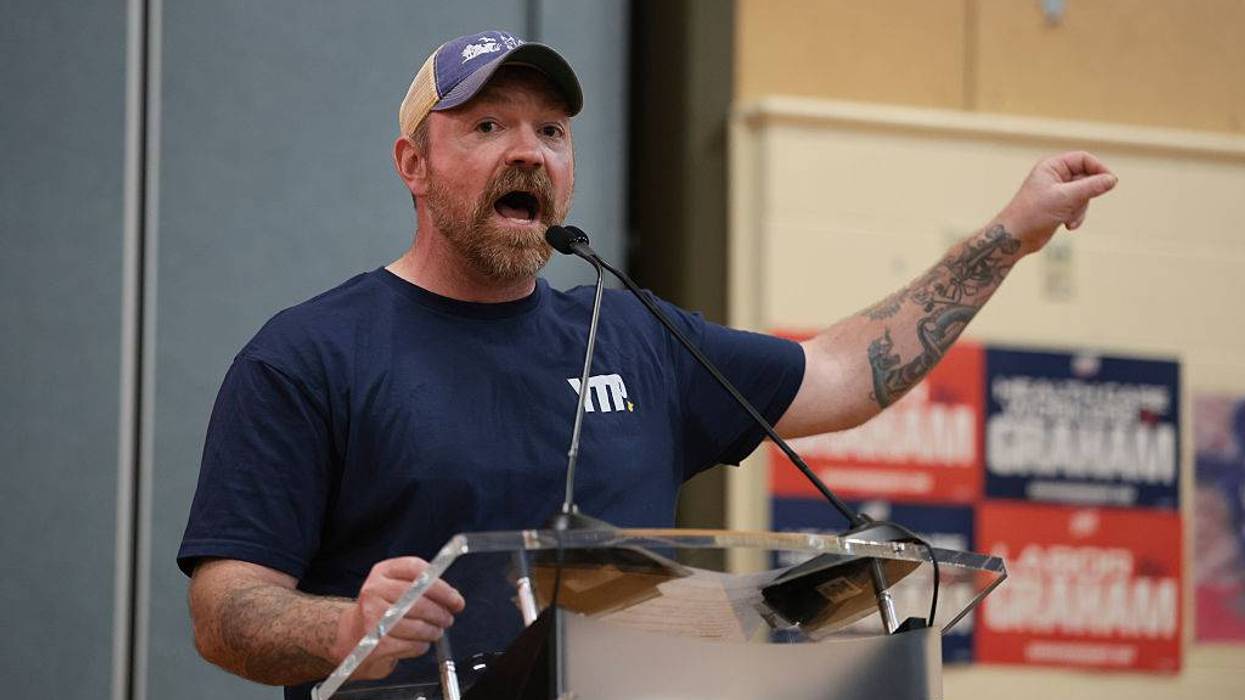
"Private equity is destroying our favorite baseball team, stripping them for parts," Democratic US Senate candidate Platner said in an ad that aired on the New England Sports Network.
Maine Democratic US Senate candidate Graham Platner on Saturday said that a campaign ad that aired during a Boston Red Sox game was "taken down" after it took aim at the team's ownership.
The ad in question features Platner discussing the role that private equity firms play in the US economy, including sports teams.
"Private equity is destroying our favorite baseball team, stripping them for parts," Platner says at the start of the ad. "Private equity is buying up our homes, our sports, and our lives. I will reverse the private equity curse."
Private equity is taking our homes. It's taking our hospitals. It's taking beloved local businesses and stripping them for parts.
And now private equity is running the Red Sox into the ground.
Our new ad ⬇️ pic.twitter.com/w7LapElpdA
— Graham Platner for Senate (@grahamformaine) May 22, 2026
Platner concludes the ad by saying that he approves this message "because I miss Mookie Betts," the star player whom the Red Sox traded to the Los Angeles Dodgers in 2020 in a deal that was widely decried by local fans as a salary dump.
According to Platner, his campaign began airing the ad Friday on the New England Sports Network (NESN), the cable TV station owned partially by Fenway Sports Group, the conglomerate that owns the Red Sox.
However, he said that "midway through the game the ad was taken down" by NESN, after which the Red Sox proceeded to blow a 4-0 lead, losing to the Minnesota Twins by a final score of 8-6.
Platner, an oyster farmer and upstart candidate who has never before held political office, became the Democratic Party's presumptive nominee for the 2026 US Senate race in Maine last month after his top rival, Democratic Maine Gov. Janet Mills, dropped out of the race.
In recent weeks, Platner has pivoted to challenging incumbent Sen. Susan Collins (R-Maine), who has held the seat since 1996 and is now running for her sixth term in office.

The policy change means "we could have families separated for months or years," said one expert.
Critics are slamming the Trump administration for implementing a new rule that foreigners who apply for green cards must do so from abroad.
US Citizenship and Immigration Services (USCIS) on Friday announced that foreigners currently in the US who want to establish permanent legal residency must first return to their countries of origin to apply for a green card.
This announcement broke with decades of US immigration policy, which made it possible for immigrants in the US to obtain green cards without having to leave the country.
Doug Rand, a former senior advisor at USCIS under President Joe Biden, said in an interview with The Associated Press that "the goal of this policy is very explicit," which is to block a path to citizenship "for as many people as possible."
Sarah Pierce, a former USCIS policy analyst, told The New York Times that the rule change could have particularly dire consequences to foreigners who are married to US citizens and will now have to apply for permanent residency from overseas.
"Our consular processing system through which they would have to apply is already overburdened," Pierce explained. "So that means we could have families separated for months or years."
Aaron Reichlin-Melnick, senior fellow at the American Immigration Council, similarly noted that the new policy "could force people to leave their jobs, homes, and families for weeks or months, all at their own expense" just to stay in a country where they have already established roots.
Reichlin-Melnick said that the full scope of the policy isn't yet clear because there are several unknown details about how broadly it will be applied, but added that "in the meantime, hundreds of thousands of immigrants now have to worry about upending their lives to get a legal status that they are entitled to under our laws."
Drop Site News reporter Ryan Grim argued that the new policy rips the mask off Trump administration claims that they aren't opposed to all immigration, they simply want to reduce undocumented immigration.
"The talking point that we do want legal immigration, we just want people to get in line and follow the rules, is BS," Grim commented. "This is an attempt to blow up the line, blow up the rules, and make it insanely difficult to immigrate legally."
Rep. Chuy García (D-Ill.) echoed Grim's comments by pointing out that the new policy shows the Trump administration's disdain for immigration overall.
"This new policy will force thousands of LEGAL immigrants, including spouses of US citizens, to leave their homes, families, and jobs for weeks or even months to get their green card outside the US," said García. "This is an absurd and cruel policy."
Rep. Adriano Espaillat (D-NY), chairman of the Congressional Hispanic Caucus, condemned the new policy for targeting "students, scientists, entrepreneurs, spouses of US citizens, and other individuals following legal immigration processes."
"Aspiring lawful permanent residents are valued members of our communities, workforce, and economy," Espaillat emphasized. "I will continue fighting to protect the rights of aspiring green card holders and immigrant families."