

SUBSCRIBE TO OUR FREE NEWSLETTER
Daily news & progressive opinion—funded by the people, not the corporations—delivered straight to your inbox.
5
#000000
#FFFFFF
To donate by check, phone, or other method, see our More Ways to Give page.
Daily news & progressive opinion—funded by the people, not the corporations—delivered straight to your inbox.

Israel must revoke the export license of NSO Group whose spyware products have been used in malicious attacks on human rights activists around the world, Amnesty International said ahead of the latest court case to embroil the tech firm.
On Thursday, a judge at Tel Aviv's District Court will begin hearing arguments as to why Israel's Ministry of Defense (MoD) should restrict the activities of NSO Group. The firm's Pegasus software has been used to target journalists and activists across the globe - including in Morocco, Saudi Arabia, Mexico and the United Arab Emirates.
Israel must revoke the export license of NSO Group whose spyware products have been used in malicious attacks on human rights activists around the world, Amnesty International said ahead of the latest court case to embroil the tech firm.
On Thursday, a judge at Tel Aviv's District Court will begin hearing arguments as to why Israel's Ministry of Defense (MoD) should restrict the activities of NSO Group. The firm's Pegasus software has been used to target journalists and activists across the globe - including in Morocco, Saudi Arabia, Mexico and the United Arab Emirates.
"NSO continues to profit from its spyware being used to commit abuses against activists across the world and the Israeli government has stood by and watched it happen," said Danna Ingleton, Deputy Director of Amnesty Tech.
"The best way to stop NSO's powerful spyware products reaching repressive governments is to revoke the company's export license, and that is exactly what this legal case seeks to do."
The legal action is being brought by approximately 30 members and supporters of Amnesty International Israel and others from the human rights community. The action is supported by Amnesty International as part of a joint project with New York University (NYU) School of Law's Bernstein Institute for Human Rights and Global Justice Clinic.
"In authorizing exports by NSO -a company that has sold its invasive software products to governments known to abuse human rights--the Ministry of Defense has failed in its human rights law obligations to protect the rights to privacy, freedom of expression and freedom of opinion," said Sukti Dhital, Executive Director of the Bernstein Institute for Human Rights.
Last week, the Ministry of Defense asked the judge to dismiss the case, or if it proceeds to grant a gag order to restrict reporting on national security grounds.
"It is overwhelmingly in the public interest and for press freedom that this case is heard in open court. The Ministry of Defense must not be allowed to hide behind a veil of secrecy when it comes to human rights abuses," said Danna Ingleton.
Digital attacks
The hearing is the latest legal action involving NSO Group. Last October, Facebook announced it is suing NSO Group after the firm exploited a vulnerability in WhatsApp to target at least 100 human rights defenders.
Amnesty International and others have documented the repeated use of NSO Group's Pegasus spyware to target civil society and stifle freedom of expression. In October 2019, Amnesty uncovered targeted digital attacks using Pegasus against two prominent Moroccan human rights defenders - academic and activist Maati Monjib and human rights lawyer Abdessadak El Bouchattaoui.
In August 2018, an Amnesty International staff member received a message which contained a link purporting to be about a protest outside the Saudi Arabian embassy in Washington. It was sent at a time when Amnesty International was campaigning for the release of Saudi women human rights activists. If clicked, the link would have secretly installed NSO malware, allowing the sender to obtain near-total control of the phone.
Previous research also exposed the use of Pegasus to target at least 24 human rights defenders, journalists and parliamentarians in Mexico; Saudi activists Omar Abdulaziz, Yahya Assiri, Ghanem Al-Masarir; award-winning Emirati human rights campaigner Ahmed Mansoor; and allegedly, murdered Saudi dissident Jamal Khashoggi.
Surveillance abuse
NSO Group claims it helps governments fight terrorism and crime, but it has failed to rebut mounting evidence linking its products to attacks on human rights defenders.
Although the company says it undertakes a rigorous review before sales of its products, these claims lack detail and, considering the number of attacks on civil society, appear to have been ineffective in numerous cases.
Despite announcing a new 'Human Rights Policy' in September, NSO has not accepted responsibility for the multiple reported instances of misuse of its surveillance technologies.
States have an obligation to protect human rights in the context of corporate activities, including through regulation and oversight. All companies have a responsibility to respect human rights throughout their operations and supply chains. This means they must avoid causing or contributing to human rights abuses and take steps to identify and address human rights risks in their operations.
Amnesty International is a global movement of millions of people demanding human rights for all people - no matter who they are or where they are. We are the world's largest grassroots human rights organization.
(212) 807-8400
"When leaders traffic in anti-Muslim rhetoric, violence follows," said one Democratic senator. "We must confront Islamophobia with the urgency it demands."
A pair of teenagers allegedly fatally shot three men at a San Diego mosque on Monday before killing themselves in an attack condemned by many—but welcomed or denied by a handful of far-right figures.
The alleged shooters, who the FBI said were 19 and 17 years old, attacked the Islamic Center of San Diego (ICSD) in the Clairemont neighborhood of California's second-largest city, with officers dispatched to the site at 11:43 a.m., according to San Diego Police Chief Scott Wahl. The center contains a mosque and a school where children were studying at the time of the attack.
The chief said one of the victims was a security guard who played a "pivotal" role in preventing more people from being shot at the county's largest mosque just before hundreds of worshippers were expected for afternoon prayers. The guard has been identified as Amin Abdullah.
Wahl said that two shooters—who have yet to be publicly identified—appear to have died from self-inflicted gunshot wounds. Investigators are treating the shooting as a hate crime.
ICSD director Imam Taha Hassane said that all students and staff members were safely evacuated from the facility.
“It is extremely outrageous to target a place of worship,” Hassane added.
The New York Times reported that investigators recovered anti-Islamic material in the vehicle used by the shooting suspects, and that the words "hate speech" were written on one of the guns used in the attack.
President Donald Trump called the shooting a "terrible situation," while some of his supporters denied or seemed to welcome the attack.
Taheen Nizam, director of the San Diego branch of the Council on American-Islamic Relations, said in a statement after the shooting that “we strongly condemn this horrifying act of violence at the Islamic Center of San Diego."
"Our thoughts are with everyone impacted by this attack," Nizam added. "No one should ever fear for their safety while attending prayers or studying at an elementary school. We are working to learn more about this incident and we encourage everyone to keep this community in your prayers.”
The Jewish Democratic Council of America also condemned the attacks. JDCA said that "we're deeply saddened by the shooting at a mosque in San Diego, and our thoughts are with the San Diego Muslim community and all impacted by this tragedy."
"Attacks on our fellow Americans at places of worship are unacceptable," the group added.
New York City Mayor Zohran Mamdani was among the Democratic leaders who denounced the shooting, posting on X that he is "horrified by the deadly attack," which he called "an apparent act of anti-Muslim violence."
Several Democratic US lawmakers also condemned the attack.
"What happened at the Islamic Center of San Diego today is devastating," Sen. Chris Coons (D-Del.) said on X. "I’m praying for the victims, their families, and their loved ones."
"This is horrifying, and it did not happen in a vacuum," Coons added. "Muslim communities in this country have been demonized and treated as inherently suspect by those willing to fuel fear for power. When leaders traffic in anti-Muslim rhetoric, violence follows. We must confront Islamophobia with the urgency it demands."
Sen. Dick Durbin (D-Ill.) also took to X, writing, "I condemn the deadly shooting at a mosque in San Diego, California."
"Every American should be able to practice their religion without fear of violence," he added. "We must do more to combat anti-Muslim bigotry."
Rep. Pramila Jayapal (D-Wash.) said she is "devastated to see the news of this deadly attack on a mosque in San Diego."
"Our places of worship should be safe spaces for all people," she added. "We must all stand up and condemn this attack and all forms of Islamophobia, racism, and hatred that are on the rise in our communities."
Rep. Rashida Tlaib (D-Mich.), who is Muslim and the only Palestinian American in Congress, posted on social media: "I am praying for all the families at the Islamic Center of San Diego. My heart breaks every time senseless violence shatters the safety all of our communities deserve."
Gun control advocates also weighed in on the shooting, with March for Our Lives executive director Jaclyn Corin saying, "We reject the idea that this kind of tragedy is inevitable."
"We have the power to build a society where hatred is confronted before it turns deadly, where communities are protected instead of targeted, and where every person can worship freely and safely without fear," Corin added. "This moment demands more than grief. It demands courage, solidarity, and a collective commitment to rejecting the violence, dehumanization, and extremism that continue to endanger our communities."
Senate Minority Leader Chuck Schumer urged the GOP to "realize that this war didn't end at the 60-day mark and will not end until Republicans show some backbone and support Democrats' war powers resolution."
As President Donald Trump announced Monday that he hit pause on a planned attack against Iran at the request of three Gulf monarchs, Senate Minority Leader Chuck Schumer renewed Democrats' push for a war powers resolution to end the illegal conflict.
Trump wrote on his Truth Social platform Monday afternoon that "I have been asked by the Emir of Qatar, Tamim bin Hamad Al Thani, the Crown Prince of Saudi Arabia, Mohammed bin Salman Al Saud, and the President of the United Arab Emirates, Mohamed bin Zayed Al Nahyan, to hold off on our planned Military attack of the Islamic Republic of Iran, which was scheduled for tomorrow, in that serious negotiations are now taking place, and that, in their opinion, as Great Leaders and Allies, a Deal will be made, which will be very acceptable to the United States of America, as well as all Countries in the Middle East, and beyond."
"This Deal will include, importantly, NO NUCLEAR WEAPONS FOR IRAN!" the president continued. "Based on my respect for the above mentioned Leaders, I have instructed Secretary of War, Pete Hegseth, The Chairman of The Joint Chiefs of Staff, General Daniel Caine, and The United States Military, that we will NOT be doing the scheduled attack of Iran tomorrow, but have further instructed them to be prepared to go forward with a full, large scale assault of Iran, on a moment’s notice, in the event that an acceptable Deal is not reached."
Responding to the post on X, Trita Parsi, co-founder and executive vice president of the Quincy Institute for Responsible Statecraft, concluded that "once again, Trump has realized that escalation will end up badly for the US. That does not necessarily mean, though, that the necessary realism, discipline, and creativity will be mustered for the talks."
Prior to the president's Monday announcement, Parsi had warned that "the Middle East is once again teetering on the brink as Trump appears poised to reignite war with Iran," pointing out reporting that he would convene military advisers on Tuesday and that he had "flooded Truth Social with a barrage of incendiary threats."
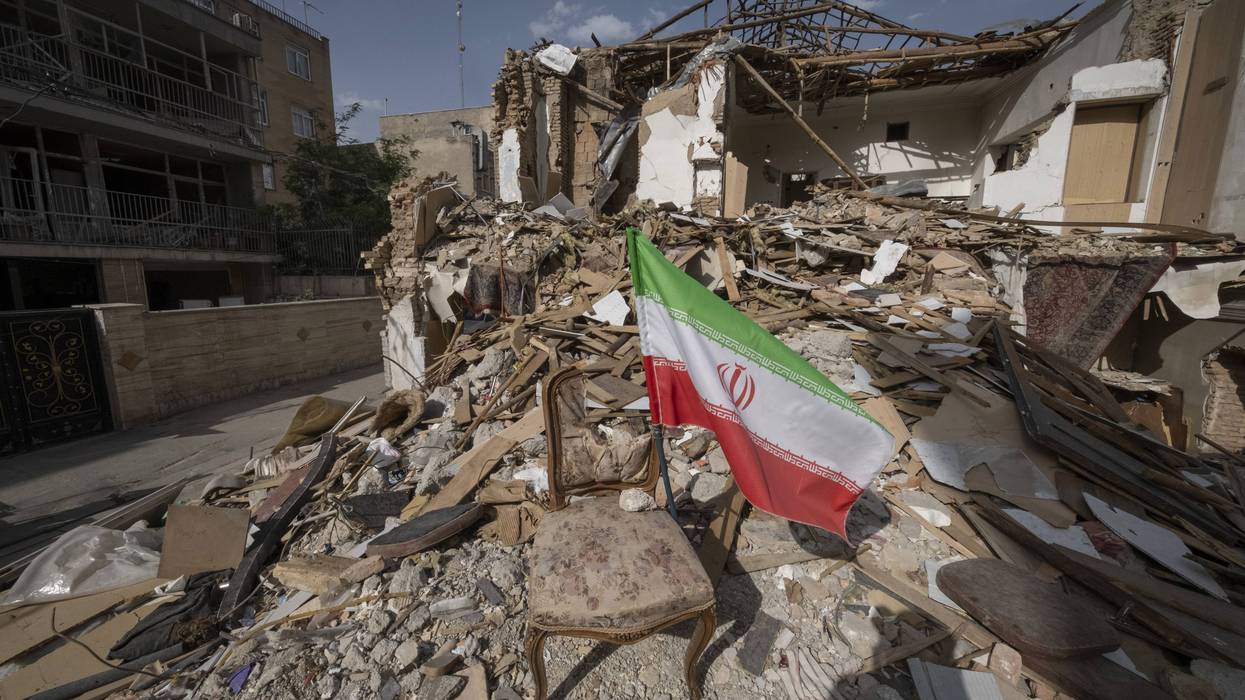
The Trump administration partnered with Israeli forces to launch an assault on Iran—without authorization from Congress and in violation of the United Nations Charter—on February 28. Just hours after Trump's genocidal threat against Iran on April 7, a ceasefire agreement was reached; it has since been extended, though the US has maintained its naval blockade while Iran has continued to restrict ship traffic through the Strait of Hormuz.
The beginning of this month marked a key deadline under the War Powers Act, which the administration tried to dodge by claiming that the current ceasefire means the conflict has been "terminated." While key Republicans, including House Speaker Mike Johnson (La.), have tried to stick to that talking point, Democratic leaders and legal experts aren't buying it.
Nope.Not how this works.A naval blockade is an act of war and U.S. armed forces remain engaged in hostilities for the purposes of the War Powers Resolution.
[image or embed]
— Brian Finucane (@bcfinucane.bsky.social) May 17, 2026 at 10:15 AM
Congressional Democrats have repeatedly tried to pass war powers resolutions in the Republican-controlled chambers.
Last Thursday, Congressman Jared Golden (D-Maine) cast the deciding vote on the latest war powers resolution considered in the House of Representatives. The retiring former Marine sided with all Republicans except Reps. Tom Barrett (Mich.), Brian Fitzpatrick (Pa.), and Thomas Massie (Ky.) to block the measure.
As The Hill reported Monday:
Golden, a former Marine who served in both Iraq and Afghanistan, has indicated he'll support the next war powers resolution. He said he only opposed the last measure because it had a withdrawal deadline that had already passed.
"I look forward to voting for a clean, relevant resolution as soon as possible," Golden said in a statement Wednesday.
And Rep. Frederica Wilson (D-Fla.) could return to Congress after being absent for four weeks and not voting on any issue since April 17. Wilson released a statement Thursday that she recently underwent eye surgery and was unable to fly but plans to be back in Washington, DC, soon.
With Rep. Tom Kean Jr. (R-NJ) also absent since March 5 because of a "personal medical issue," Republicans can't have more than two defections on an otherwise party-line vote.
In other words, "it may [come] down to absences," as Punchbowl News reporter Anthony Adragna said on social media Monday.
Like in the House, the latest Senate vote also came down to a Democrat: Sen. John Fetterman (Pa.) has repeatedly voted with nearly all Republicans against war powers resolutions on Iran, and did so again last Wednesday. Unlike Golden, Fetterman told Semafor on Monday that Senate Democrats know he's "pretty much locked and loaded" regarding his support for Trump's war.
"Something like this is much more important than just voting what your base might demand. Because I think things are much bigger and more important than that. And Iran with a nuclear bomb is one of those things," Fetterman said, taking aim at anti-war campaigners. "I'm very much aware how damaging it is as a Democrat to hold these views. I had 20 CodePink dopes in my office."
CodePink held a "brown bag teach-in" lunch last week. The group said that "many of Fetterman's constituents feel betrayed by the person they campaigned to elect in 2022. Since becoming a senator in 2023, he has repeatedly broken with fellow Democrats to support Trump's wars and militaristic policies. Constituents hope this lunchtime educational session will help him better understand the human consequences of these positions and the growing opposition among Pennsylvanians to endless war and continued support for Israel."
While Fetterman opposed the latest resolution, Sens. Susan Collins (R-Maine), Lisa Murkowski (R-Alaska), and Rand Paul (R-Ky.) all voted in favor of it, and Schumer (D-NY) made clear on the chamber's floor Monday that he's pushing for an eighth vote.
"Over the weekend, Donald Trump told Iran, 'The clock is ticking, and they better get moving, fast, or there won't be anything left of them,'" Schumer noted. "How can Donald Trump say the clock is ticking when he told the Senate that the clock had paused when his war recently passed the War Powers Act's 60-day threshold to either end hostilities or get congressional authorization?"
"Senate Republicans need to stop playing dumb and realize that this war didn't end at the 60-day mark and will not end until Republicans show some backbone and support Democrats' war powers resolution to end the fighting," he declared. "This week, Democrats will force an eighth vote on our war powers resolution to withdraw our troops from hostilities with Iran."
Schumer added that "I urge Republicans to support our war powers resolution, end the war, get the troops out of harm's way, or else Republicans will learn that the clock is ticking not only on this war but on their own political futures."

President Donald Trump is yet again facing accusations of breaking his campaign promise to "Make America Healthy Again" after the US Environmental Protection Agency on Monday proposed repealing and delaying some landmark limits on "forever chemicals" in drinking water.
Per- and polyfluoroalkyl substances (PFAS) are commonly called forever chemicals because they persist in the environment, humans, and wildlife for long periods. Despite their links to various health issues, including cancer, they have been used in products such as firefighting foam, food packaging, nonstick pans, and water-resistant fabrics for clothing and furniture.
The Biden administration was praised for its historic steps to reduce PFAS contamination of tap water and urged to go even further. However, the Trump EPA is now pushing to delay those limits for two common contaminants, PFOA and PFOS, and abandon the restrictions for four others: PFBS, PFHxS, and PFNA, and HFPO-DA—also known as GenX.
Announcing the proposed rules on Monday, EPA Administrator Lee Zeldin and US Department of Health and Human Services Secretary Robert F. Kennedy Jr. claimed not only that the Biden administration failed to follow federal law in implementing its restrictions, but also that the new proposals are part of the president's Make America Healthy Again pledge. They highlighted "innovative" technologies plus funding for states to address PFAS in tap water.
However, campaigners who have long called for stricter PFAS policies excoriated the Trump administration over its two proposed rules—which are set to be published in the Federal Register with a 60-day public comment period, and the subject of an EPA hearing scheduled for July 7.
"Zeldin and Kennedy are trying to sell potions out of the back of a covered wagon. The millions of Americans demanding safe drinking water are not going to fall for their hocus pocus," said Anna Reade, director of PFAS advocacy at the Natural Resources Defense Council, in a statement. "By repealing and delaying PFAS standards, EPA is abandoning communities in desperate need of drinking water protections, especially those who live near polluting industries."
Food and Water Watch's water program director, Mary Grant, declared that "with today's proposals, the Trump administration is telling the public to drink poison. It has once again shown that it represents the interests of billionaire corporate polluters—not the health of people in this country."
"One thing is absolutely clear, we cannot roll back or delay protections against PFAS," she said. "For decades, communities have been sounding the alarm and demanding action on these toxic forever chemicals. Instead of implementing commonsense regulations, Trump's EPA has doubled down on weakening our drinking water protections. Every person deserves and needs clean, safe water, and today's proposed rules are threats to millions of people."
Grant argued that "EPA must not delay or roll back these hard-won limits on toxic PFAS contaminants in drinking water. It must immediately cease these deregulatory actions, stop approving new PFAS chemicals, ban all nonessential uses, hold polluters accountable for clean up, expand protections to regulate the entire class, and ramp up support to ensure that every community has access to safe, affordable water."
Ken Cook, president and co-founder of the Environmental Working Group (EWG), which has tracked PFAS contamination across the United States and publicly released its findings, was similarly outraged by the EPA proposals.
"You cannot make America healthy again while allowing toxic PFAS to flow freely from our taps," Cook said. "The Trump EPA is caving to chemical industry lobbyists and water utility pressure—and in doing so, it is condemning millions of Americans to drink contaminated water for years to come."
"The price of this decision will be paid by ordinary people, in the form of more PFAS-related diseases," he warned.
While Trump's agency leaders claimed Monday that the Biden administration ran afoul of the Safe Drinking Water Act, EWG accused them of violating that same law, given its requirement that any revision to a tap water standard "maintain, or provide for greater, protection of the health of persons."
Melanie Benesh, vice president of government affairs at EWG, said that "this is a deliberate decision to expose American families to chemicals linked to cancer and other serious health harms. Rolling back limits on four PFAS and then allowing water systems to push compliance deadlines to 2031, when contamination is ongoing, is unconscionable."
"The communities least able to protect themselves will pay the highest price," she added. "That is not regulatory reform. It is an environmental injustice."