

SUBSCRIBE TO OUR FREE NEWSLETTER
Daily news & progressive opinion—funded by the people, not the corporations—delivered straight to your inbox.
5
#000000
#FFFFFF
To donate by check, phone, or other method, see our More Ways to Give page.
Daily news & progressive opinion—funded by the people, not the corporations—delivered straight to your inbox.
Physicians for a National Health Program (PNHP) today welcomed the American College of Physicians' (ACP) endorsement of single-payer Medicare for All. The ACP, a national organization of 159,000 internists, is the largest medical specialty society and second-largest physician group in the U.S. after the American Medical Association (AMA).
The ACP announced its endorsement of Medicare for All in a special supplement to its official journal, the Annals of Internal Medicine, where the group also endorsed a "universal public choice" reform model.
The ACP endorsement coincides with the publication of an open letter signed by more than 2,000 physicians "prescribing" Medicare for All, an effort organized by advocates separately from the ACP. Among the "prescribers" are towering figures in American medicine, including Dr. Marcia Angell, former editor-in-chief of the New England Journal of Medicine; Dr. Bernard Lown, developer of the defibrillator; Dr. Paul Farmer, infectious disease expert and founder of Partners in Health; and Dr. Mary Bassett, former New York City Health Commissioner. The letter will appear as an advertisement in the New York Times the week of January 20.
Along with the ACP's position paper, the Annals of Internal Medicine published an editorial by PNHP co-founders Drs. Steffie Woolhandler and David Himmelstein. Drs. Woolhandler and Himmelstein, noting that organized medicine had opposed national health insurance for a century, called the ACP's new position "a sea change for the medical profession."
The ACP's endorsement of Medicare for All and the publication of the open letter reflects growing support for single-payer reform among physicians. Recent surveys have found that half of all doctors now favor national health insurance. Last June, the AMA's House of Delegates only narrowly defeated a resolution that would have rescinded its long-standing opposition to Medicare for All. Under pressure from Medicare for All supporters, the AMA then resigned from the dark money group Partnership for America's Health Care Future, which opposes single-payer reform.
"As physicians, we see daily the harm that our fragmented, private-insurance based system does to our patients," noted Dr. Adam Gaffney, President of PNHP and a pulmonary and critical care physician at Harvard Medical School and the Cambridge Health Alliance. "Patients go without the care they need, and physicians squander time and resources on wasteful billing and clerical tasks. Medicare for All would be a much better way -- for patients and doctors both."
According to Dr. Woolhandler, a Distinguished Professor at the City University of New York at Hunter College and Lecturer in Medicine at Harvard Medical School, "When we started PNHP, doctors who supported single-payer reform were considered radicals, and reporters likened us to 'furriers for animal rights'. Now we're squarely in the mainstream of the medical profession. More and more doctors have realized - often from talking to our Canadian colleagues - that single payer is the only way to cut insurers' paperwork and profits that siphon hundreds of billions annually from care in the U.S." Dr. Woolhandler is a Fellow of the ACP, but not an official spokesperson for that organization.
Physicians for a National Health Program is a single issue organization advocating a universal, comprehensive single-payer national health program. PNHP has more than 21,000 members and chapters across the United States.
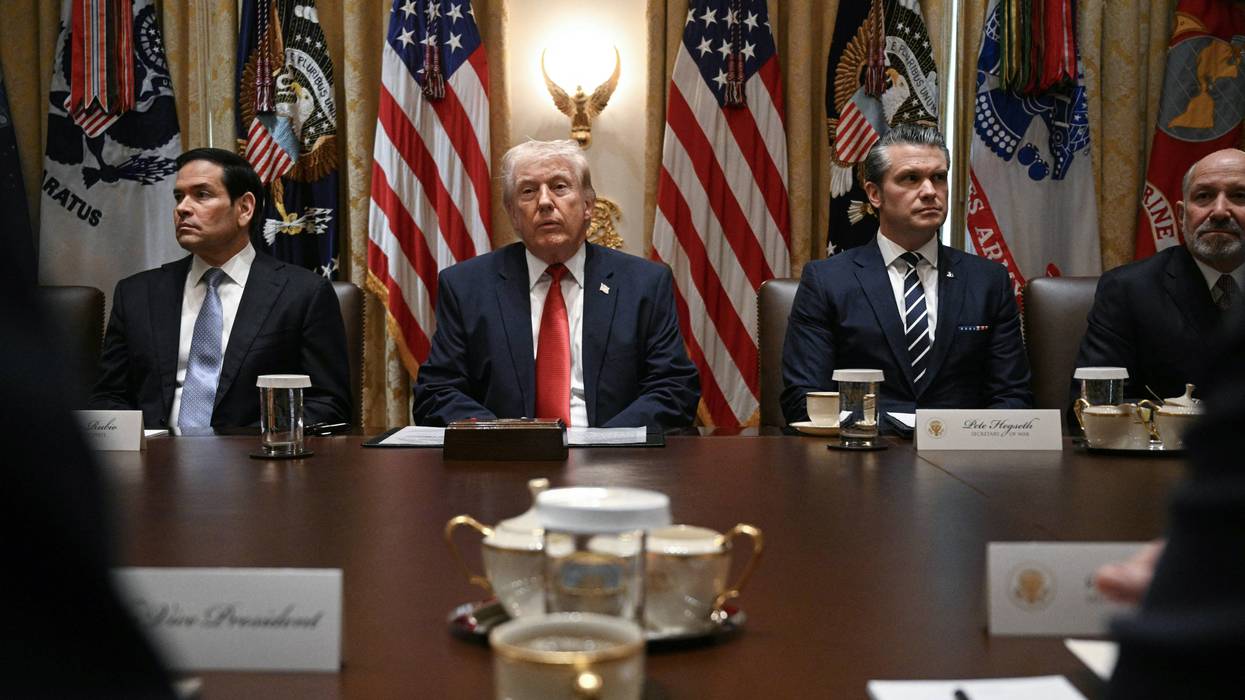
"Apparently you're not allowed to kill people in international waters now?" said one progressive organizer.
Over the last eight months, at the direction of President Donald Trump and Secretary of Defense Pete Hegseth, the US military has bombed at least 57 boats and killed close to 200 people—among them fishermen, a young man known in his town for his indoor soccer playing, and working people who had recently struggled to make ends meet—in what human rights experts have called "murders" and extrajudicial killings.
But the indictment filed this week regarding unlawful killings by government forces in the Caribbean region had nothing to do with Trump's boat bombing spree, which the White House has claimed it aimed at stopping drug trafficking. Instead, the target of the indictment filed by the US Justice Department was 94-year-old former Cuban President Raúl Castro, who was charged with one count of conspiracy for his alleged role in shooting down planes that flew into Cuba's airspace in 1996.
The planes were operated by an anti-Fidel Castro group, Brothers to the Rescue, and four Cuban-Americans were killed in the operation.
In expressing support for the indictment, US Rep. Carlos Giménez (R-Fla.), a Cuban-American immigrant, said that "there will be consequences to pay if you harm American citizens in international waters, in international airspace for no reason at all, and believe me, this was no reason at all."
Michael Galant, a member of the secretariat of the Progressive International, commented with feigned surprise: "Apparently you're not allowed to kill people in international waters now? Someone tell Hegseth."
The organization's co-general coordinator, David Adler, added, "I simply do not understand how we, as a country, tolerate the hypocrisy of indicting Raúl Castro for defending Cuban airspace—while our own government celebrates the extrajudicial assassinations of innocent fishermen sailing across the sea below," while Ryan Grim of Drop Site News noted the indictment also followed the bombing of a school in Iran—an attack that investigators said was likely carried out by the US.
The indictment of Castro, noted the Progressive International, was set to coincide with Cuba's Independence Day and came as Secretary of State Marco Rubio, the son of Cuban immigrants who has long desired regime change in the communist country, mused that the Cuban government has "plundered billions of dollars, but nothing has been used to help the people"—echoing his criticism of Iran, another target of the US military under Trump.
The timing of and ramp-up to the indictment was "a piece of political theater calibrated to one audience only: the Miami exile lobby that has spent decades pursuing its commercial and ideological vendetta against the Cuban Revolution," said the group's Cabinet.
"US officials themselves acknowledge they do not believe Cuba is an imminent threat, nor actively planning to attack American interests—and yet in the same breath, the administration has laundered a set of alarming claims about Cuban drone acquisitions, presented with all the breathless urgency of a casus belli," the Progressive International added, referring to Axios' reporting last weekend on claims from an administration official that Cuba is preparing to attack the US with drones—a report that ultimately acknowledged the Cubans are not planning any preemptive strikes on the US but are rather thought to be strategizing on self-defense as the US intensifies its anti-Cuba rhetoric and continues the oil blockade it imposed in February.
The Cuban embassy in the United Kingdom on Thursday said it rejected US claims about the downing of the Brothers to the Rescue plane, which it called "an irrefutable act of sovereign self-defense" that took place after "25 deliberate, calculated violations of our national airspace" by the exile group.
"To criminalize our nation, the US manipulated the official [International Civil Aviation Organization] investigation, deliberately erasing the first six minutes of radar and radio recordings to conceal the territorial incursion," the embassy asserted. "The narrative of an attack in international waters is an absolute juridical fraud."
In a column at Common Dreams Thursday, Codepink co-counder Medea Benjamin added that she was in Cuba in 1996 when the planes were shot down. The leader of Brothers to the Rescue, José Baulto, she said, openly stated that he was "trained as a terrorist by the United States," and said after one mission in which the group dropped leaflets over Havana that the group was seeking "confrontation.”
"The Cuban government repeatedly warned Washington, the Federal Aviation Administration (FAA), and international aviation authorities that these flights were illegal and dangerous. US officials knew the risks," wrote Benjamin. "The hypocrisy of indicting Raúl Castro nearly 30 years later is staggering, given the long history of anti-Cuban extremists operating from US soil to wreak havoc against the island with bombings, sabotage, and airline terrorism."
Those US-based extremists include the perpetrators of the 1976 midair bombing of Cubana Flight 455, a commercial airliner carrying 73 crew and passengers, many of them teenage members of Cuba’s junior Olympic fencing team.
The Trump administration's boat bombings, meanwhile, have been called likely "war crimes" by some legal experts and "murders" by others. The White House has insisted the US is in an "armed conflict" with drug cartels in Latin America, but no conflict has been officially declared. In at least one instance, US military members were ordered to bomb the survivors of an initial strike—a clear violation of international law.
The US in the past has treated suspected drug trafficking as a criminal issue—not one to be dealt with militarily. Before the boat bombings began, one top military legal adviser warned Pentagon officials, “There is no world where this is legal," and said carrying out the attacks could expose everyone involved, from top White House officials to rank-and-file service members ordered to carry out the strikes, to legal liability.
"The same US government now pursuing charges against Raúl Castro has itself been carrying out deadly strikes on alleged drug-smuggling boats in the Caribbean and Pacific, strikes that have killed at least 193 people since September 2025, with no transparency or due process," wrote Benjamin.
Following the Castro indictment, the Progressive International called on "governments, movements, and peoples of conscience everywhere to call out this escalation for what it is—a naked effort to recolonize Cuba and the hemisphere at large—and to stand firmly against it."
"We have seen this playbook before—in Iraq, in Libya, in Venezuela, and in other sites of manufactured consent for illegal war across the world. The Progressive International will not stand silent as it is deployed against Cuba," said the group. "Hands off Cuba."

"At a time when Republicans are polling at historic lows, Democrats need to capitalize and offer a better vision for the country," said one critic. "This isn’t it."
Critics on Thursday slammed the controversial—and until now secret—Democratic National Committee autopsy of the 2024 election, which completely omitted some of the biggest issues affecting the contest, including President Joe Biden's decision to seek reelection, the manner in which Vice President Kamala Harris replaced him atop the ticket, and the Gaza genocide.
The 2024 postmortem—which was written by strategist Paul Rivera and ostensibly examines why and how Democrats lost the White House to President Donald Trump and control of Congress to Republicans—was published online Thursday after it was obtained CNN. DNC Chair Ken Martin told CNN that he was "releasing the report as we received it, in its entirety, unedited and unabridged,” for the sake of "full transparency."
“It does not meet my standards, and it won’t meet your standards, but I am doing this because people need to be able to trust the Democratic Party and trust our word," Martin said. “After last November’s massive Democratic wins, I didn’t want to create a distraction, but by not putting the report out, I ended up creating an even bigger distraction. For that, I sincerely apologize."
RootsAction, the progressive advocacy group that led the push to release the autopsy, said Thursday that "to call the report a disgrace would be an understatement."
"The report focuses extensively on ad spending and fundraising, without discussing the Democratic platform, policy positions, or political context of the 2024 election," the group noted. "The word 'affordability,' arguably the most important issue in the 2024 election, appears twice in the 129-page report."
"Martin and the DNC are trying to wash their hands of the report and its contents," RootsAction continued. "In a hasty, almost amateurish markup, the DNC has gone out of its way to poke holes in the legitimacy of the very report it commissioned... While Martin may feel that this absolves him of the responsibility to answer for this pitiful document, it should only intensify scrutiny of his leadership of the DNC."
Speculation abounded that the report contained damning findings about the electoral harm caused by the Biden-Harris administration's support for Israel as it waged both a genocidal war in Gaza and expanded its illegal occupation, colonization, apartheid, and ethnic cleansing in the West Bank.
Opposition to the administration's complicity in the slaughter, as well as Biden and Harris' refusal to acknowledge the genocide or seek a ceasefire, was embodied by the Uncommitted movement and its 30 Democratic National Convention delegates.
There isn't a single mention of Gaza, Palestine, Israel, genocide, or Uncommitted in the autopsy.
"We needed a serious DNC autopsy. This alleged autopsy is almost worthless," Jeff Cohen, co-founder of RootsAction—which led the battle for the DNC to release the report—told Common Dreams on Thursday.
"There's no mention of the Biden/Harris administration's Israel policy that abetted the Gaza massacre," Cohen continued. "That cost votes, and helped Trump win. Earlier leaks suggested that the DNC autopsy would discuss Gaza's impact on voters."
Establishment Democrats don't get it.There is no amount of consulting, brand management, influencer outreach, or narrative shaping that can save a campaign with no message at its core. www.commondreams.org/opinion/why-...
[image or embed]
— RootsAction (@rootsaction.org) May 20, 2026 at 9:26 AM
The Institute for Middle East Understanding (IMEU) noted that "polls and reporting leading up to and after the 2024 election showed Biden and Harris’s support for providing weapons to Israel was deeply unpopular with their own voters and an electoral liability."
“Ken Martin should release the information that the author of the autopsy told us clearly and unambiguously, which is that DNC officials’ review of their own data found Biden’s support for Israel to be a net-negative for Democrats in 2024," IMEU policy project executive director Margaret DeReus said Thursday.
While the autopsy mentions inflation 18 times, it does so within the context of adjusting fundraising figures for inflation and not the affordability crisis—arguably the number one issue Trump campaigned on, before exacerbating the crisis via trade wars and actual wars once back in office.
The DNC postmortem argues that Democrats have steadily lost the trust of working-class and non-college voters since the high-water mark of former President Barack Obama's historic 2008 victory.
"The Democratic Party has always tried to be seen as the party of the people, the party of workers, fair play, and civil discourse," the report states. "The party’s connections with working Americans and their families were forged through decades of organizing and engagement, the development of a vibrant and inclusive party infrastructure, and a relatable agenda which helped us connect in homes, workplaces, and neighborhoods across the country."
However, the report argues that the party defined itself as anti-Trump while failing to define what Harris and Democrats stood for, while underinvesting in state and local organizing and failing to build and maintain relationships with voters outside its coastal and urban strongholds.
"Harris wrote off rural America, assuming urban/suburban margins would compensate," the publication notes. "The Harris campaign appears to have relied on Trump being unacceptable rather than building an affirmative case for Harris.”
The autopsy concluded that so-called "identity politics" don't resonate with white male voters. The report noted the success of Trump's attack ads, particularly the anti-trans spots with the kicker, "Kamala is for they/them, President Trump is for you."
"If the vice president would not change her position—and she did not—then there was nothing which would have worked as a response," the report asserts.
Some observers worried that the DNC was suggesting throwing trans people under the bus in pursuit of electoral gains. Worryingly, the only time the publication mentions transgender people, it uses an antiquated term that is offensive to many trans folk.
They used the term "transgendered." This is exactly why the Republicans attack Dems on this issue because for many their support for trans people is hollow and thus they can't defend it. Contrast that with Mamdani or AOC whose support is genuine and can wrap it in a message of economic populism.
[image or embed]
— Alejandra Caraballo (@esqueer.net) May 21, 2026 at 9:17 AM
Amid relentless Republican attacks on transgender people and the wider LGBTQ+ community, reproductive freedom, voting rights—especially for Black Americans—immigrants, and others, the DNC postmortem encourages future Democratic candidates to "focus less on abstract issues and identity politics, and connect with voters on the issues they say matter most, including the economy, disaster relief, and addressing housing affordability."
The autopsy's assertion that "the problem wasn't Democratic policy or party brand" drew incredulous derision from observers including gun control activist and former DNC co-vice chair David Hogg:
Taking aim at the autopsy's many failures, RootsAction asserted that the DNC had "a responsibility to turn in a report that truly grapples with the mistakes of the past so that the Democratic Party can learn from those mistakes and emerge stronger in its fight against Trumpism," but ultimately, "the DNC has utterly failed in that respect."
"The only serious autopsy so far remains the one that RootsAction published," the group said.
The RootsAction 2024 postmortem, authored by San Francisco journalist Christopher Cook, covers some of the same issues as the DNC autopsy. However, it argues that Democrats lost in 2024 because of voter disenchantment, Biden's decision to run for reelection, Democrats' abandonment of their working-class base, loss of younger voters, and "the Gaza effect."
While the DNC autopsy makes no mention of Biden's fateful decision, RootsAction's report states that "a key factor hobbling Harris’s chances in 2024 was the short timeline she had to execute her campaign—just 107 days."
"That her nomination was secured not via the traditional Democratic Party primary, but through some process of intra-administration succession, exacerbated this challenging chronology," the publication adds. "This was, of course, due to President Biden’s betrayal of his 2020 promise to be a 'bridge' president, and his tragic decision to continue running for reelection despite cognitive decline and plunging approval ratings."
Cohen lamented these omissions from the DNC report.
"There's no criticism of Biden for his insistence on seeking reelection, or the lack of any kind of open process to choose Biden's replacement," he told Common Dreams. "No analysis of Harris for her lack of principles—leading to her avoiding media platforms reaching millions of potential voters."
Criticism of the DNC report mounted throughout the day Thursday as more and more people read it.
“What’s important is what’s missing, what they’re not releasing,” former Harris communications director Ashley Etienne told Politico. "It feels like what the DNC is doing is cherry-picking the parts of it that it wants to actually release, that [are] less problematic for the party going forward."
Zenith Research founding partner Adam Carlson called the paper "an absolute mess in every sense of the word" and added that "anyone that is using its findings as justification to follow their ideological preferences for the future of the party should be laughed out of every room they go into."
Hafiz Rashid, a writer at The New Republic, said that "Martin seems to be right about the report’s flaws."
"But hiding it and not commissioning a new one—or at least not editing this one to a passable standard—is a scandal in itself," he added. "At a time when Republicans are polling at historic lows, Democrats need to capitalize and offer a better vision for the country. This isn’t it."
Here is the DNC document, as posted by CNN:

"Having to hire human workers who might have pesky demands for more pay, better hours, or better working conditions is but a nuisance to them," one software engineer wrote about tech industry bosses.
A leading billionaire right-wing donor and tech evangelist raised eyebrows during a podcast appearance this week with a blunt explanation for why he believes artificial intelligence is superior to human workers.
The past few months have seen a wave of tech industry layoffs that companies have acknowledged were driven wholly or in part by AI: From Meta, which slashed 8,000 jobs on Wednesday and reassigned thousands of other workers to AI roles; to Intuit, which announced a cut of about 17% of its workforce the same day to put more focus on the emerging technology.
The venture capitalist Marc Andreessen, who leads one of Silicon Valley's most powerful venture capital firms, Andreessen Horowitz, declared as recently as last month that despite report after report of mass layoffs, "‘AI job loss’ narratives are all fake,” and the industry would facilitate a "massive jobs boom" because it allows individual workers to be "endlessly more productive."
But during an appearance on The Joe Rogan Experience on Tuesday, he seemed to suggest that he viewed the human workforce as not only inferior to AI but also an expendable nuisance that employers would be better off without.
He imagined the programmer of the future "overseeing an org chart of bots" numbering in the thousands, which would go on to exponentially increase productivity.
This, he said, is preferable to the current, inefficient model of hiring human laborers. He used the example of the graphic design work on Rogan's set to illustrate the point.
"You hire somebody... and you tell them you want a screen display and you want it to be an animated version of the thing you got back here," he said. "They spend, you know, two weeks doing it. It's like, 'Okay, that's pretty good, but I actually want the whole thing to be whatever, purple and green.' And they spend a week doing that. And they come back, and you're like, 'I actually prefer the old version.'"
“The guy gets, like, pissed at you because he’s like, ‘I just wasted my time.’ The bot’s like, 'No problem,' you know, no sweat, like whatever you want, and we can try it 12 more times if you want. Or you tell it, you know, this is terrible. Like, I can’t believe you came back to me with this. It has all these bugs. It’s like, ‘Oh, I’m so sorry. I’ll go fix these.’"
"By the way, [it] never gets drunk, never gets sick, never gets high," he continued.
"Never gets depressed because his girlfriend broke up with him," Rogan interjected.
"Never files HR complaints," Andreessen added.
Andreessen said this mass adoption of "armies" of AI workers would begin in tech fields like coding, but would quickly expand out to other fields like writing, medicine, and law.
He described artificial intelligence as technology that would grant workers a "universal basic superpower." But while some proponents of AI expansion imagine it as a tool to liberate workers from long hours by automating menial tasks, Andreessen said it was actually doing the opposite for workers in the coding world.
He said one would assume that “if AI coding makes them four times more productive... then maybe they’re working only a fourth the time and now they’ve got a great life,” but “what’s actually happened is virtually to a person, they’re all working more hours than ever to the point where there is a new term of art that’s used in the valley called the ‘AI vampire.’”
“You’re up all night doing AI coding because you are so productive," Andreessen said approvingly. "You’re getting so much done that you can’t turn off. The opportunity cost of going to sleep is too high because if you go to sleep, you won’t be with your 20 AI coding agents, keeping them working on all the projects that you have them working on. And so people stop sleeping.”
"They're clearly, clearly, clearly not taking care of themselves, and they're absolutely ecstatic," Andreessen said, "because they are able to produce five times, 20 times more code per hour than they could in the past."
The comments drew widespread backlash from critics across the political spectrum, who noted Andreessen's cavalier disregard for the fate of human workers in his imagined future scenario.
His mention of "HR complaints" in particular raised red flags for those who noted that the male-dominated worlds of Silicon Valley and venture capitalism have had many high-profile sexual harassment scandals.
But more broadly, it was interpreted as an expression of contempt for workers who demand a modicum of dignity from their jobs.
One software developer, who writes the Substack blog Dialectics of Decline on Substack under the name Scarlet, described Andreessen's comments as an encapsulation of an attitude that she recently said was "destroying the career I once loved."
I noticed that my bosses were getting infected with the mind virus sold to them by the AI hype men. They started to believe we weren’t needed anymore, or, if we were, we were now capable of producing 10x the amount of code in the same amount of time...
Having to hire human workers who might have pesky demands for more pay, better hours, or better working conditions is but a nuisance to them. They want to streamline their businesses by—ideally—not needing to hire humans at all. They are being sold a dream of a 100% agent-operated business where they purchase tokens instead of labor hours, and at a fraction of the cost. After all, agents won’t ever try to unionize. They don’t need weekends off. They don’t get sick or fall pregnant. They can’t strike. They won’t fight back.
It’s a mindset that Andreessen—one of the most prominent fixtures of the so-called “tech right” that spent big to elect Trump in 2024—is apparently seeking to export to the entire country.
Andreessen Horowitz and its billionaire founders have dumped an unprecedented $115 million to influence elections in the 2026 midterm cycle, more than other more prominent donors like Elon Musk and George Soros.
According to a report last week from the New York Times:
Already Andreessen Horowitz has put $47.5 million into the crypto super PAC network, Fairshake, since Election Day 2024. And the firm’s interests have expanded beyond crypto. It helped found Leading the Future, a super PAC network focused on electing pro-artificial intelligence legislators, which is modeled on Fairshake, and donated $50 million to it. Fairshake and Leading the Future both back Republicans and Democrats.
Andreessen Horowitz and its co-founders have also together donated $12 million to MAGA Inc., President Trump’s super PAC, including $6 million in March. A trust linked to Mr. Andreessen donated nearly $900,000 to the Republican National Committee that same month.
Andreessen's comments on Rogan's show inspired calls from progressive legislators, including Silicon Valley's Rep. Ro Khanna (D-Calif.), who said it was an example of why Washington should "tax agentic AI more than workers" rather than providing tax breaks to companies that invest in AI infrastructure.
But the influence of tech oligarchs like Andreessen is also starting to unnerve some on the right, like the influential conservative pundit James Lindsay, who said he was getting "really sick of anti-human tech weirdos leading anything."