

SUBSCRIBE TO OUR FREE NEWSLETTER
Daily news & progressive opinion—funded by the people, not the corporations—delivered straight to your inbox.
5
#000000
#FFFFFF
To donate by check, phone, or other method, see our More Ways to Give page.
Daily news & progressive opinion—funded by the people, not the corporations—delivered straight to your inbox.

Kim Bryan
Tel: +44 7770881503
Email: kim.bryan@350.org
Across the world, protests have erupted against the murder of George Floyd at the hands of the Minneapolis police in the US. In the UK, Brazil, France, The Netherlands, Australia, Germany, Chile, Spain Italy and Canada, hundreds of thousands of people are coming together, in solidarity to demand justice.
350.org is a global organization working to stop the climate crisis, we know that systemic racism is deeply connected to climate change and 350.org is in solidarity with all of those demanding justice. Floyd's murder is yet another reminder of the white supremacist structures that devalue Black life over and over again.
Last week, U.S. staff at 350.org released a statement making clear that there is no just recovery from the climate crisis without addressing systemic extraction, harm, and violence towards Black communities. This week, in further solidarity with the Movement for Black Lives (MB4L) that has called for a week of action in defense of black life from June 1-5, 350.org's North America director Tamara Toles O'Laughlin and 350.org's executive director May Boeve gave the following statements:
Tamara Toles O'Laughlin, 350.org North America Director.
"There is no climate justice without a racial analysis. At 350.org, we know that the work of dismantling white supremacy is essential to building a climate movement that matters and stands any chance of winning. As we stand up against injustice, our demands include taking action to end systemic violence against Black communities. Decades of environmental justice activism has shown that communities facing racist violence and over-policing are also overrun by fossil fuel extraction, pollution, and every manner of related health disparities. The truth is that the status quo is killing us and so we have no reason to support 'business as usual'. Our fight for climate justice must necessarily include challenging the systems of racism that protect profits for the wealthy few and destroys Black Lives. In our demands to invest in climate action and a Green New Deal, we are also calling for divestment from systems of white supremacy in solidarity with the Movement for Black Lives."
May Boeve 350.org Executive Director
"It's not lost on me that last year's Climate Strikes received overwhelmingly positive coverage, while this weekend we've seen more concern over how people protest than the movement's goals," said. "350.org engages people to take action for how they want the world to change, and that must include dismantling white supremacy. There is no way to tackle the climate crisis fairly without addressing the systemic racism that fuels it. And our demands for just recovery from COVID-19 and the climate crisis must include that very commitment to racial justice. In 2016, 350.org endorsed the platform put out by the Movement for Black Lives; we stand by our commitment to their vision. We stand in solidarity with those protesting the brutal murder of George Floyd by the Minneapolis police department and state-sanctioned violence against Black communities writ large."
350 is building a future that's just, prosperous, equitable and safe from the effects of the climate crisis. We're an international movement of ordinary people working to end the age of fossil fuels and build a world of community-led renewable energy for all.

Immigration agents "murdered two people on video since the beginning of the year, and the Trump administration still lied about what happened and tried to justify it," said one critic. "I don't think cameras are the solution."
As the Hennepin County medical examiner on Monday classified Alex Pretti's death as a homicide, US Homeland Security Secretary Kristi Noem said members of her department who are on the ground in Minnesota will be issued body-worn cameras—a development that came amid a congressional funding fight and was met with mixed reactions.
President Donald Trump and Noem this year have sent thousands of Department of Homeland Security (DHS) agents to the Twin Cities, where they have fatally shot Pretti and Renee Good, both US citizens acting as legal observers. Noem announced on social media Monday that she met with the heads of Customs and Border Protection (CBP) and Immigration and Customs Enforcement (ICE).
"Effective immediately we are deploying body cameras to every officer in the field in Minneapolis. As funding is available, the body camera program will be expanded nationwide. We will rapidly acquire and deploy body cameras to DHS law enforcement across the country. The most transparent administration in American history," the department chief wrote, also thanking the president.
Noem's revealed the move as Congress was in the process of reopening the government after a weekend shutdown. The package would give federal lawmakers until mid-February to sort out a battle over DHS funding. Democrats have fought for policies to rein in the department since ICE officer Jonathan Ross killed Good last month, and demands have mounted since Border Patrol agent Jesus Ochoa and Customs and Border Protection officer Raymundo Gutierrez killed Pretti.
Responding to the secretary on social media, House Appropriations Committee Ranking Member Rosa DeLauro (D-Conn.) said, "The funding is there, and every officer operating in our communities should be wearing a body camera."
"However, this alone won't be enough for Homeland Security to regain public trust or to ensure full transparency and accountability. Secretary Noem must be removed from office," DeLauro added. There have been growing calls to impeach her.
Pointing to extra money that ICE got in the budget package that congressional Republicans and Trump forced through last summer, Rep. Pramila Jayapal (D-Wash.) said: "You got $75 billion in the Big Bad Betrayal bill. You've got funding 'available' right now. And... release the Pretti bodycam footage NOW."
Congressman Don Beyer (D-Va.) also took to social media to call for releasing the bodycam footage from the Pretti shooting and stressed that funding is already available:
As the Associated Press reported:
Homeland Security has said that at least four Customs and Border Protection officers on the scene when Pretti was shot were wearing body cameras. The body camera footage from Pretti's shooting has not been made public.
The department has not responded to repeated questions about whether any of the ICE officers on the scene of the killing of Renee Good earlier in January were wearing the cameras.
Bystander footage of the Minneapolis shootings has circulated widely and fueled global demands for ending Trump's "Operation Metro Surge" in Minnesota as well as arresting and prosecuting the agents who shot and killed both legal observers.
Some Americans and a growing number of Democratic lawmakers are also calling to abolish ICE. Author Chantal James declared Monday: "We didn't say bodycams on ICE. Their murders are already on video. We said no more ICE."
Critics of the administration cast doubt on whether adding more bodycams to the mix will reduce violence by DHS. Campaign for New York Health executive director Melanie D'Arrigo said that immigration agents "murdered two people on video since the beginning of the year, and the Trump administration still lied about what happened and tried to justify it. I don't think cameras are the solution."
Todd Schulte, president of FWD.us, a a policy organization focused on harmful criminal justice and immigration systems, shared an image emphasizing that "surveillance is not accounability" and a fact sheet about body cameras his group put out last month.
"In the wake of the killing of Michael Brown in 2013, policymakers and police departments held up body-worn cameras as the path forward. Editorial boards joined the chorus," the fact sheet states. "Over a decade later, with 80% of large police departments in the US now having acquired body-worn cameras, it's safe to say body-worn cameras have not delivered on their lofty promise."
"The evidence that body-worn cameras reduce use of force is mixed, at best," and "footage ≠ transparency or accountability," the document details. Additionally, "contrary to their stated purpose, body-worn cameras are actually thriving as tools to surveil and prosecute civilians."
Body cameras are surveillance camerasBody cameras are surveillance camerasBody cameras are surveillance camerasBody cameras are surveillance camerasBody cameras are surveillance camerasBody cameras are surveillance cameras
— Evan Greer (@evangreer.bsky.social) February 2, 2026 at 7:03 PM
After a masked federal immigration agent told a legal observer in Maine that she was being put in a database for purported "domestic terrorists," independent journalist Ken Klippenstein reported last week that federal agencies are using multiple watchlists to track and categorize US citizens—especially activists, protesters, and other critics of law enforcement.

Trump administration immigration enforcers shot the 37-year-old nurse multiple times and then allegedly denied him medical care.
A county medical examiner's office in Minnesota on Monday ruled the death of Alex Pretti, the 37-year-old nurse fatally shot last month by Trump administration immigration enforcers in Minneapolis, a homicide.
The Hennepin County medical examiner said that Pretti's cause of death was homicide by multiple gunshot wounds. Homicide is a medical description that does not imply criminal wrongdoing; the Trump administration said last week that it has launched a civil rights probe into the January 24 incident in which agents shot Pretti seconds after disarming him of a legally carried handgun.
On Sunday, ProPublica revealed that US Border Patrol agent Jesus Ochoa and Customs and Border Protection (CBP) officer Raymundo Gutierrez shot Pretti, who was reportedly known to federal officials after a previous encounter in which immigration enforcers allegedly broke his rib.
A physician who rushed to the scene of the shooting and tried to save Pretti's life said in a sworn statement that agents denied the victim medical care and instead "appeared to be counting his bullet wounds."
As they did with Renee Good, the 37-year-old mother and poet who was also shot dead by a US Immigration and Customs Enforcement (ICE) agent in Minneapolis last month, President Donald rTrump and some of his senior officials attempted to smear Pretti as a “domestic terrorist”—a move consistent with the administration’s designation of left-wing activism as terrorism.
Last week, US District Court Judge Katherine Menendez—an appointee of former President Joe Biden—rejected a bid by state and local officials in Minnesota to halt Operation Metro Surge, the Trump administration's name for the ongoing anti-immigrant blitz in the Twin Cities.
This, even as Menendez acknowledged that the operation "has had, and will likely continue to have, profound and even heartbreaking, consequences," and that “there is evidence that ICE and CBP agents have engaged in racial profiling, excessive use of force, and other harmful actions."
Immigrant advocates renewed calls to end ICE and the Trump administration's broader anti-immigrant crackdown in the wake of the Minnesota medical examiner's homicide determination.
Author Chantal James took aim at Homeland Security Secretary Kristi Noem's Monday announcement that every officer with her department deployed to Minneapolis will be equipped with a body-worn camera.
"We didn't say bodycams on ICE," she wrote on Bluesky. "Their murders are already on video. We said no more ICE."
Congresswoman Ilhan Omar (D-Minn.), whose district includes Minneapolis, said on Bluesky: "Abolish ICE. There’s no reforming it. There’s no compromise. There’s only one way to rein in ICE’s terror campaign. Abolish it."
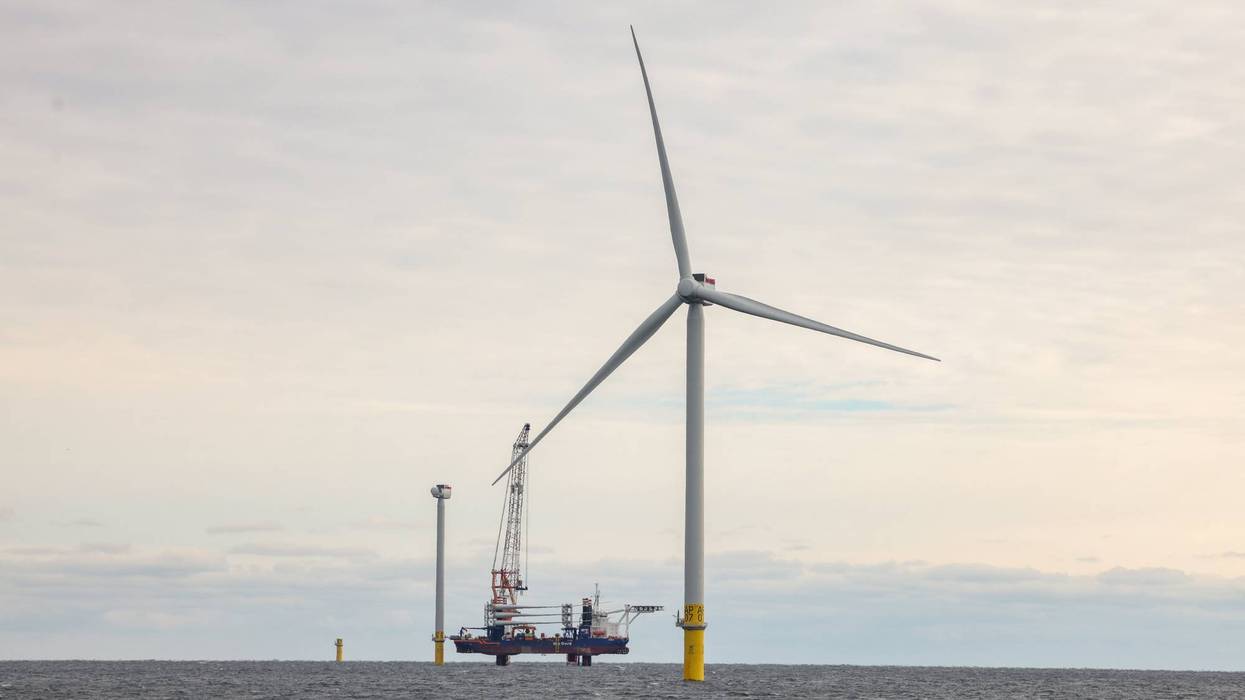
"The unilateral court victories are evidence of what we've known all along—Donald Trump has it out for offshore wind, but we aren’t giving up without a fight," said a Sierra Club senior adviser.
While President Donald Trump's administration on Monday again made its commitment to planet-wrecking fossil fuels clear, a Republican-appointed judge in Washington, DC dealt yet another blow to the Department of the Interior's attacks on offshore wind power.
US District Judge Royce Lamberth, an appointee of former President Ronald Reagan, issued a preliminary injunction allowing the developer of the Sunrise Wind project off New York to resume construction during the court battle over the department's legally dubious move to block this and four other wind farms along the East Coast under the guise of national security concerns.
Lamberth previously issued a similar ruling for Revolution Wind off Rhode Island—which, like Sunrise, is a project of the Danish company Ørsted. Other judges did so for Empire Wind off New York, Coastal Virginia Offshore Wind off Virginia, and Vineyard Wind off Massachusetts, meaning Monday's decision was the fifth defeat for the administration.
Ørsted said in a Monday statement that the Sunrise "will resume construction work as soon as possible, with safety as the top priority, to deliver affordable, reliable power to the State of New York." The company also pledged to "determine how it may be possible to work with the US administration to achieve an expeditious and durable resolution."
Welcoming Lamberth's decision as "a big win for New York workers, families, and our future," Democratic Gov. Kathy Hochul stressed that "it puts union workers back on the job, keeps billions in private investment in New York, and delivers the clean, reliable power our grid needs, especially as extreme weather becomes more frequent."
Despite the series of defeats, the Big Oil-backed Trump administration intends to keep fighting the projects. As E&E News reported:
White House spokesperson Taylor Rogers reiterated in a response Monday that Trump has been clear that "wind energy is the scam of the century."
"The Trump administration has paused the construction of all large-scale offshore wind projects because our number one priority is to put America First and protect the national security of the American people," Rogers said. "The administration looks forward to ultimate victory on the issue."
The Interior Department said it had no comment at this time due to pending litigation.
Still, advocates for wind energy and other efforts to address the fossil fuel-driven climate emergency are celebrating the courts' consistent rejections of the Trump administration's "abrupt attempt to halt construction on these fully permitted projects," as Hillary Bright, executive director of the pro-wind group Turn Forward, put it Monday.
"Taken together, these five offshore wind projects represent nearly 6 gigawatts of new electricity now under construction along the East Coast, enough power to serve 2.5 million American homes and businesses," she noted. "At a time when electricity demand is rising rapidly and grid reliability is under increasing strain, these projects represent critically needed utility-scale power sources that are making progress toward completion."
"We hope the consistent outcomes in court bode well for the completion of these projects," Bright said. "Energy experts and grid operators alike recognize that offshore wind is a critical reliability resource for densely populated coastal regions, particularly during periods of high demand. Delaying or obstructing these projects only increases the risk of higher costs and greater instability for ratepayers."
"After five rulings and five clear outcomes, it is time to move past litigation-driven uncertainty and allow these projects to finish the job they were approved to do," she argued. "Offshore wind strengthens American energy security, supports domestic manufacturing and construction jobs, and delivers reliable power where it is needed most. We need to leverage this resource, not hold it back."
Sierra Club senior adviser Nancy Pyne similarly said that "the unilateral court victories are evidence of what we've known all along—Donald Trump has it out for offshore wind, but we aren't giving up without a fight. Communities deserve a cleaner, cheaper, healthier future, and offshore wind will help us get there."
"Despite the roadblocks Donald Trump has tried to throw up in an effort to bolster dirty fossil fuels, offshore wind will prevail," she predicted. "We will continue to call for responsible and equitable offshore wind from coast to coast, as we fight for an affordable and reliable clean energy future for all."
Allyson Samuell, a Sierra Club senior campaign representative in the state, highlighted that beyond the climate benefits of the project, "we are glad to see Sunrise Wind's 800 workers, made up largely of local New Yorkers, get back to work."
"Once constructed, Sunrise Wind will supply 600,000 local homes with affordable, reliable, renewable energy—this power is super needed and especially important during extreme cold snaps and winter storms like Storm Fern," Samuell said in the wake of the dangerous weather. "Here in New York, South Fork has proven offshore wind works, now is the time to see Sunrise, and Empire Wind, come online too."