SUBSCRIBE TO OUR FREE NEWSLETTER
Daily news & progressive opinion—funded by the people, not the corporations—delivered straight to your inbox.
5
#000000
#FFFFFF
To donate by check, phone, or other method, see our More Ways to Give page.

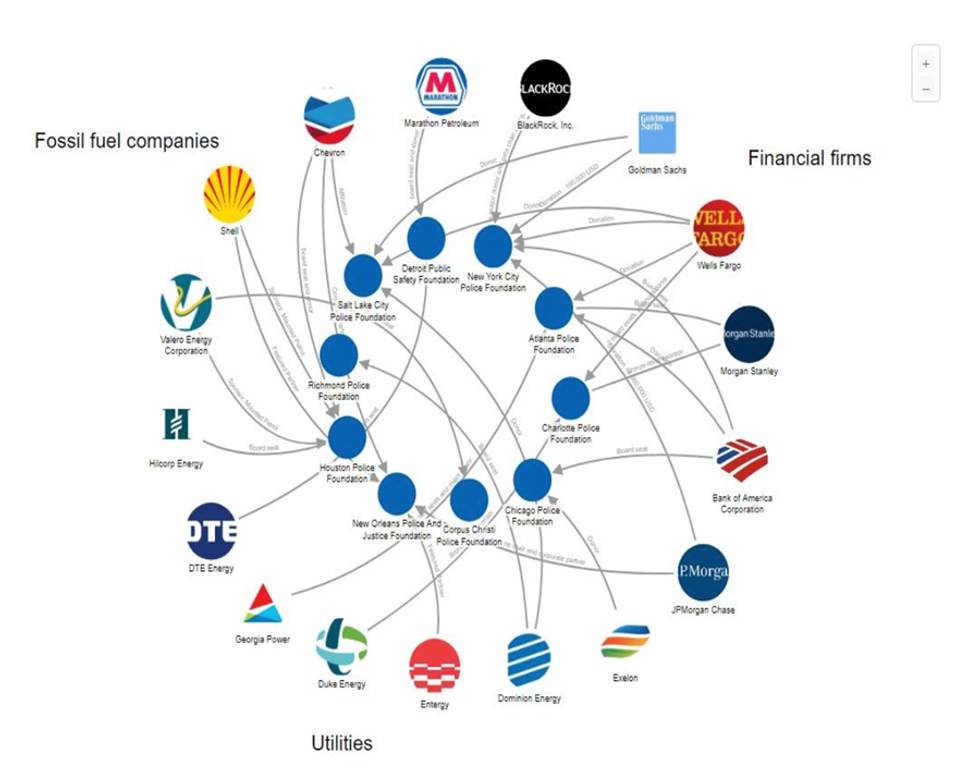
Today, the Public Accountability Institute released a report that maps out how fossil fuel companies, utilities, and fossil-financiers help direct, sponsor, partner with, and fund police foundations.
Through this mapping, it shows how efforts to defund the police and reinvest in Black and Brown communities, and efforts to divest from fossil fuels and reinvest in environmental justice and a just transition, have a common foe in the fossil fuel industry.
Many companies that are polluting Black and Brown communities - or funding polluting operations - are the same companies helping to prop up and bankroll police foundations in those same communities.
As Little Sis writes,
Oil and gas companies, private utilities, and financial institutions that bankroll fossil fuels are all big backers of police foundations, which privately raise money to buy weapons, equipment, and surveillance technology for police departments, bypassing public police budgets. These corporate actors - from Chevron and Shell to Wells Fargo and JPMorgan Chase - can be found serving as directors and funders of police foundations nationwide. Furthermore, these companies sponsor events and galas that celebrate the police and remind the public that police power is backed up by corporate power.
On this report, Tamara Toles O'Laughlin, 350.org North America Director, issued the following statement:
"This report confirms what so many of us have known for decades: the police state exists to protect white supremacy with extraction as a primary tactic. Our work as a part of the movement for climate justice is to dismantle racist structures perpetuating continued harm to communities. From policing to financial violence, the road to tackling the climate crisis includes addressing connected predatory systems. As workers risk their lives to keep the economy afloat, the grift and greed of fossil fuel financiers continues. We support the demand to defund and divest from the police and fossil fuels, and to reinvest in the resilience of people and planet for a Just Recovery.
"This report revealing the ways that Wall Street and the fossil fuel industry support police foundations highlights how firms such as Blackrock and JP Morgan Chase routinely act to extract wealth, health and safety from Black, Brown and Indigenous communities. It's past time to defund the police and demand that Wall Street compensate Black, Brown, and Indigenous communities for the irreparable harm they have inflicted," said Maurice BP-Weeks, Co-Executive Director, Action Center on Race and the Economy
"The fossil fuel industry is a sinking ship hellbent on drowning the planet and taking humanity down with it. It will stop at nothing to keep black and brown afraid of mobilizing and it's no surprise they would partner with the same institution terrorizing our communities and Black Lives Matter protesters in the streets," said Lucas Sanchez, Deputy Director, New York Communities for Change.
"It's no surprise that the companies driving a climate crisis that disproportionately kills black and brown people are also major funders of racist police forces that disproportionately kill black and brown people," said Alec Connon, coalition coordinator with Stop the Money Pipeline. "If companies really value Black Lives they need to stop investing in institutions that destroy and terrorize black communities."
"As we have seen too many times, the fossil fuel industry relies on a militarized top-down police to keep the public from protesting their expansion plans; it's past time to move to a new future," said Bill McKibben, the co-founder of 350.org and Stop the Money Pipeline.
"This report sheds a harsh and needed light on the ways police violence and systemic racism intersect with the climate crisis. Rather than address growing public concerns with the dangers of pipelines and petrochemical plants, the fossil fuel industry has responded instead by seeking to criminalize protest, suppress dissent, and mislabel acts of free speech as acts of terrorism. The result is a rising tide of human rights abuses by militarized police forces against environmental and rights defenders. That oil and gas companies are actually funding the forces inflicting those harms is sadly unsurprising and absolutely unacceptable," said Carroll Muffett, President, Center for International Environmental Law.
"There is little public scrutiny when private donors pay to give police controversial technology and weapons. And it is with no surprises that the Public Accountability Initiative & LittleSis report shows how the same financial institutions like BlackRock that are financing the climate crisis and environmental racism in Black and Brown communities, are the same institutions that are backing the growing militarization of police forces that have beaten down black and brown communities with impunity for so long," said Mary Cerulli, co-founder Climate Finance Action.
"Big Surprise: Most of the same banks that fund fossil fuels, redline loans against people of color also fund private prisons for profit, like JPMorgan Chase, BOA and BlackRock," said Mary Kay Benson, 350 Butte County.
"The fossil fuel industry's ties to police foundations show a willingness to ignore the calls of racial justice advocates to dismantle the systemic racism of policing -- despite some oil and gas companies' hypocritical claims otherwise. Fossil fuel companies harm the racial justice movement in their operations, their public relations and their political funding. In reality, they are part of the system that upholds structural racism in the US," said Zorka Milin, senior advisor, Global Witness.
"The Earth and all people are sacred. Violence against black and brown communities is morally abhorrent. Violence against the earth is an offense against life. Extractive industries and the banks that finance them need to stop supporting racist authoritarianism and quit financing the planet's destruction," said Rev. Fletcher Harper, executive director of GreenFaith.
"Chevron has long treated Richmond like a community that can be bought and sold out, be it through our police or elected officials. This new report further outlines what we already know: fossil fuel companies bankroll the police as a bribe, to keep our communities polluted, over-policed and bound to the charity of companies like Chevron. To reinvest in Black and Brown communities and move toward a just transition from the Ecuadorian Amazon to Richmond, CA, we must hold these companies accountable for their ties to the destruction of our climate and the funding of the police," said Ada Recinos, Amazon Watch communications manager and Richmond, CA resident.
"It is no surprise that big banks and fossil fuel companies see it as in their interest to fund the police. They need to ensure that when they want to impose dangerous and polluting projects on Black, Indigenous and brown communities that the police will be there for them and willing and ready to repress community members who seek to protect their families, and their air, land and water," said Paddy McCully, Energy and Climate Program Director, Rainforest Action Network.
350 is building a future that's just, prosperous, equitable and safe from the effects of the climate crisis. We're an international movement of ordinary people working to end the age of fossil fuels and build a world of community-led renewable energy for all.
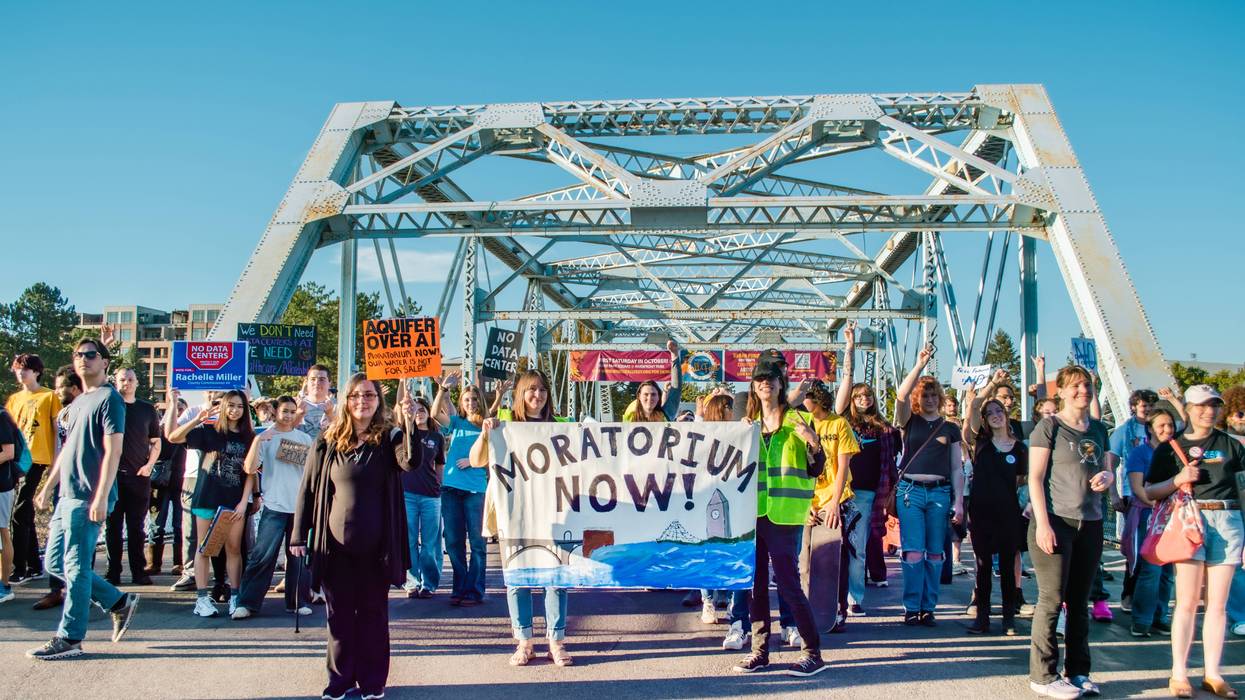
Several of the communities that organized events on Sunday are also trying to stop projects already planned in their backyards. But concerned residents across the state—mobilized under the banner of Washington AI Resistance (WAAIR) in partnership with several other environmental and public interest organizations—want state-level protections to ensure that no community falls through the regulatory cracks. To do that, they aimed to raise their voices louder than the powerful Big Tech lobby in a state where both Microsoft and Amazon have headquarters.
"Communities have a right to determine which industries get to move into their backyards."
“We need to demonstrate to candidates and sitting legislators that there is real public demand for a data center moratorium in every corner of the state,” Evan Sutton, a Seattle-based activist with WAAIR, told Common Dreams.
Lauren Redfield, WAAIR president and co-chair of the Seattle Democratic Socialists of America (DSA) Ecosocialism working group, said the day of action was significant “because it demonstrates wide-ranging support from diverse communities across Washington that people are angry about data centers.”
“Communities have a right to clean air, clean water, affordable energy. Communities have a right to determine which industries get to move into their backyards. Representatives who are more responsive to the tech industry than their community constituents, who are allowing data centers to drive up electricity prices and pollute air, water, and land systems—these representatives are going to be held accountable,” Redfield told Common Dreams.
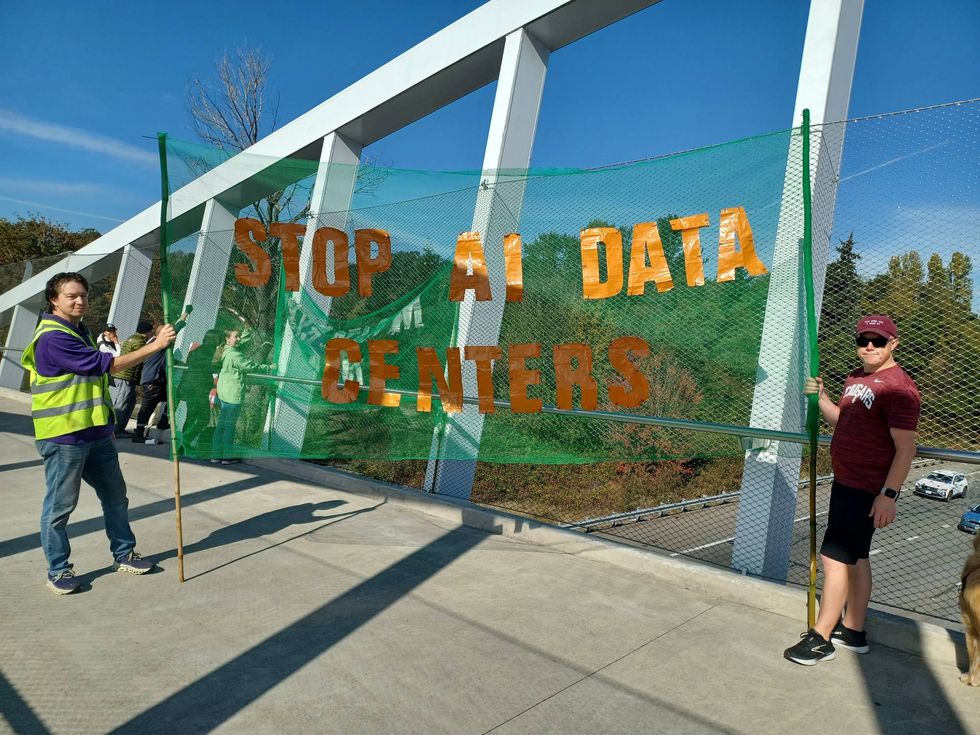 Evan Sutton (left) helps hold a sign reading, "Stop AI Data Centers." (Photo by Olivia Rosane)
In Seattle, activists held four separate events over the course of the day: one at a freeway bridge in the north of the city, another in West Seattle, a third outside the light rail station in the south Seattle neighborhood of Beacon Hill, and a fourth at a central square of the University of Washington.
Sutton, who organized the north Seattle action, said it was important to look beyond local regulations and stand in solidarity with communities across the state.
“In the end our natural resources are shared by everyone,” he told Common Dreams, explaining that Seattle's moratorium might push developers to look to unincorporated parts of the county, and if Seattle’s King County passed a moratorium, they would then turn to other parts of the state.
“We shouldn't have to play whack-a-mole with billionaire developers and AI tech bros,” Sutton said as passing cars honked in support of the protest. “Our legislature should step up and pass rules that everybody has to follow everywhere in the state.”
Thomas Meyer, the deputy political director of Food & Water Watch, who led a group of 10 volunteers in distributing flyers and gathering signatures for a moratorium in Beacon Hill, said that “data centers in Seattle are most likely to be proposed in the south end or in nearby cities like Tukwila, Burien, and Renton. Just like in other parts of the state and the country, data centers are more often proposed in areas with larger populations of people of color.”
Indeed, a study by Washington environmental justice group Front and Centered found that 57% of the data centers it surveyed were placed in census tracts with the highest proportion of people of color.
“It's important to pass a data center moratorium to protect Washington residents from the pollution and extraction from these facilities, and to prevent big tech companies from further concentrating their wealth and power at our expense,” Meyer told Common Dreams.
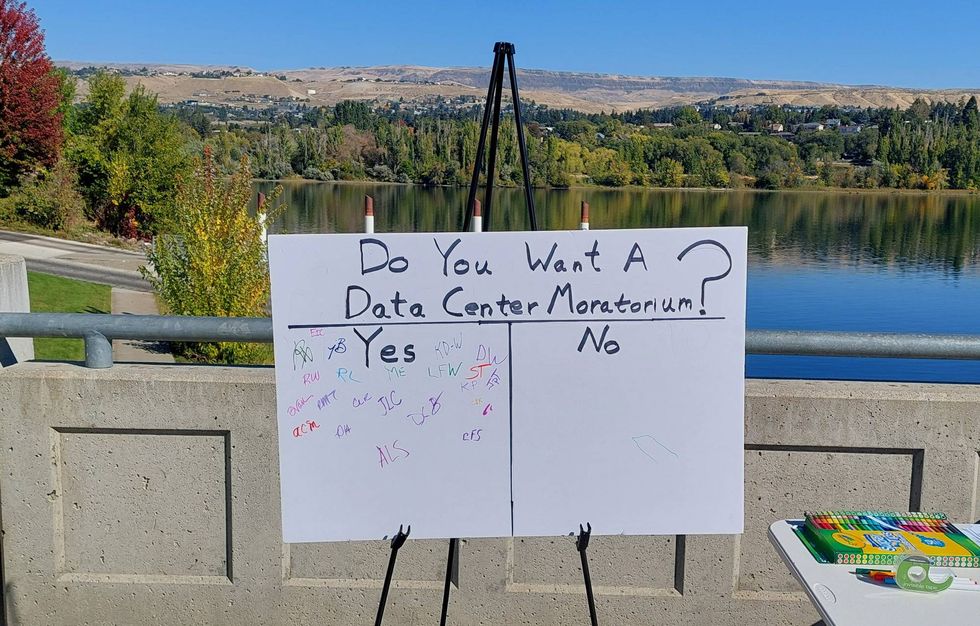 Passersby mark down if they do or do not want a data center moratorium in Wenatchee, Washington. (Image via WAAIR)
In Wenatchee in central Washington, concerned residents gathered by the Loop Trail along the Columbia River and asked passersby if they would like to see a data center moratorium.
“We had them sign their initials on a poster board under ‘YES’ or ‘NO,’ one of the organizers explained. “During the time that we were there, we collected 24 ‘YESes’ and zero ‘NOs.’"
The activists plan to bring the board to a meeting with Chelan County Commissioner Kevin Overbay on Wednesday to oppose data centers in Malaga, an unincorporated community in the county.
“Malaga is ground zero for hyperscale data centers in Chelan County, and currently hosts a 288 megawatt Microsoft data center,” the organizer said. “We want to show Overbay that the Wenatchee community as a whole does not want to see any more data centers. The Columbia is the lifeblood of our community. It provides us with power as well as water. These resources do not belong to private corporations like Microsoft to use as they please.”
While Wenatchee is focused on the county fight, a statewide moratorium would ease their efforts.
“A statewide moratorium would save us from having to spend our time fighting for a moratorium on a county-wide level,” the organizer said. “We could spend our time fighting instead for long-term protections to ensure that our region is permanently protected from exploitation.”
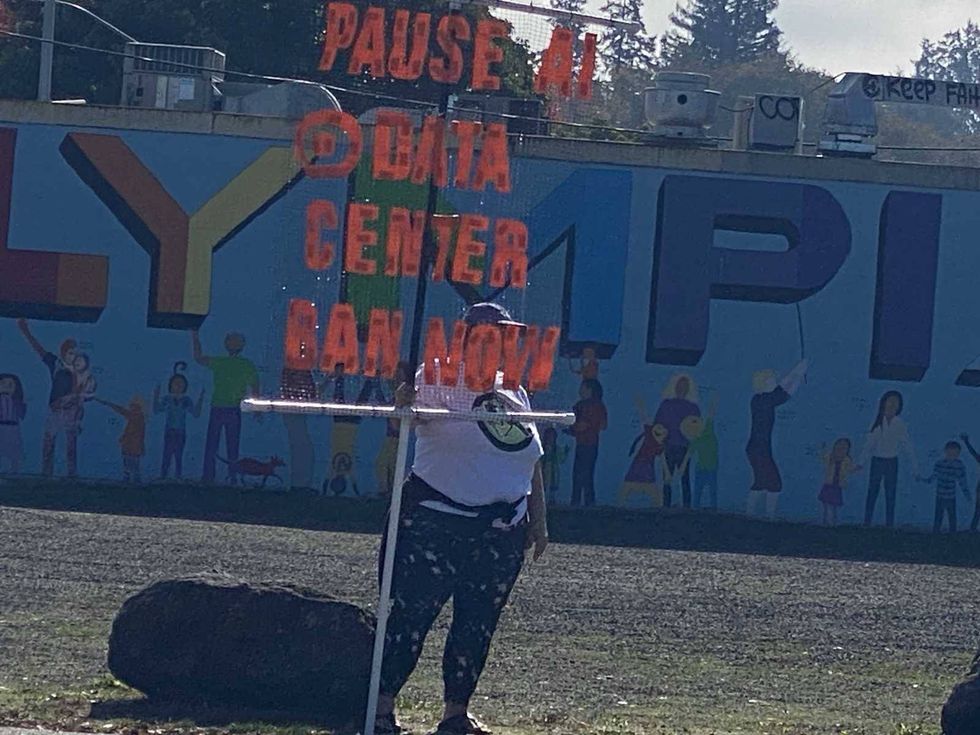 A protester holds a sign reading, "Pause AI Data Center Ban Now" in Olympia, Washington. (Photo by Tina Simcich)
In Olympia, the state capital, activists gathered to put pressure on state Rep. Beth Doglio (D-22). Doglio introduced a bill in the 2026 legislative session with some basic data center regulations that was watered down due to pressure from the tech lobby before dying in committee. Protesters wanted Doglio to know she would have public support to back a moratorium and push for stronger regulations.
“Washington needs to halt the out-of-control tech oligarchs with a moratorium on data center construction,” said Tina Simcich of Olympia DSA. “Working-class jobs and our land, water, energy, and air resources must be protected from this greed-driven grab.”
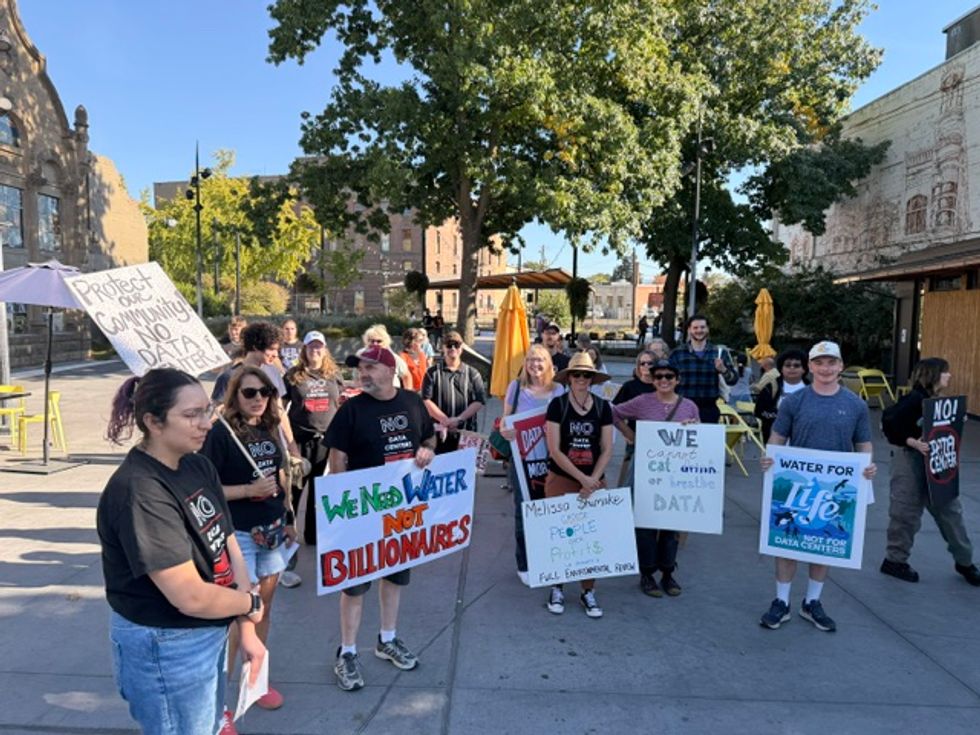 Walla Walla residents participate in a day of action for a data center moratorium on October 4, 2026. (Photo by Allison Carney)
In Walla Walla, residents are mobilizing to stop a planned Amazon data center after the Port of Walla Walla sold land to the company in the nearby Wallula Gap.
“Everyone has their own concerns” about the proposed data center—which is projected to use as much power as Seattle–Allison Carney, a member of the Walla Walla Anti Data Center League, told Common Dreams, “whether it be not knowing if their power bills are going to go up, not knowing if their land is going to be seized through eminent domain,” water pollution and availability, noise, light, and the fact that it will be located near the McNary National Wildlife Refuge and could potentially harm endangered wildlife.
However, she said, “The biggest thing that unites everyone's concerns is the fact that we don't trust Amazon. We don't trust this company coming into our community. We don't trust that they're going to be doing what's best for us. We trust that they're going to do what's best for their profits."
Beginning at 2:00 pm PT on Sunday, around 60 people attended a rally and march in downtown Walla Walla to the County Office of Community Development, where Community Development Department Director Melissa Shumake will determine whether to require a full environmental impact statement for the project, something community members are demanding.
A statewide pause would assist in their efforts by increasing the chance that any data center would be governed by stronger rules to protect the community and environment.
“A statewide moratorium would give time for regulators to catch up with this industry,” Carney said.
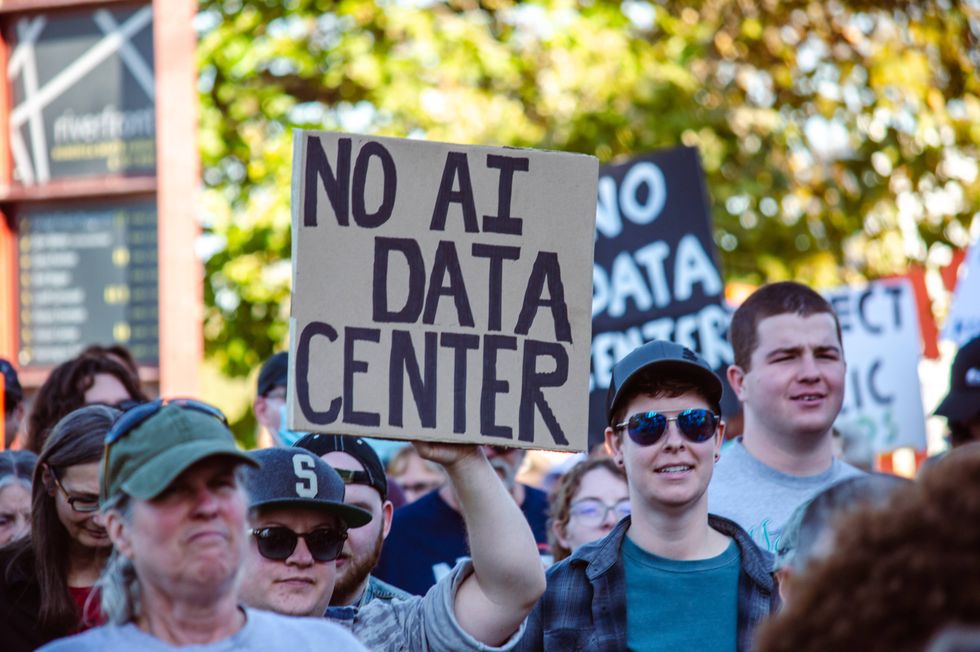 People march against data centers in Spokane, Washington. (Photo by Sandra Rivera)
The largest action of the day took place starting at 3:30 pm PT in Spokane, where 150 people marched from Riverfront Park, past the City Hall and the Public Works Building where the County Commission meets, and back to the park to say, "This is what we're fighting for: our river,” Zenthia Peterson, the lead organizer for the event, told Common Dreams.
Demonstrators, including members of WAAIR, 350 Spokane, the Visibility Brigade, West Plains Water Coalition, and long-time local environmental campaigner Terry Horne, demanded statewide action but also expressed concern about how local data centers would impact a region already under pressure from the climate crisis. The march came about two months after a devastating wildfire scorched Spokane in August, destroying homes and forcing 600,000 to evacuate. Locals are concerned that a large data center could deplete the water resources needed to fight the next blaze.
“We're doing a march tomorrow to save the literal world."
In particular, activists are watching a 1,000-megawatt project slated for the nearby community of Airway Heights, outside the bounds of the city moratorium. While Spokane County has also announced a pause, it ends in December. It is unclear whether it will be extended, and the ordinance that was supposed to follow it has been delayed.
These concerns make a statewide moratorium all the more important, Peterson said, as that “would protect us even if the county sits on their asses."
Organizers had intended to have participants call Washington Gov. Bob Ferguson to demand state action, only to discover the night before that he had turned off his voicemail. Peterson encouraged participants to call him during the week instead.
"My speech was quite literally, ‘May you get bit back tenfold,” Peterson said, referring to Ferguson.
Jeremiah Harding, who organizes with WAAIR and the Spokane Community Organized Response Network, also decried the use of AI technology for layoffs, mass surveillance, and military targeting.
“We're doing a march tomorrow to save the literal world,” Harding told Common Dreams the night before the protest.
He continued: “It's bad enough that it pollutes the environment and fills the air with noise, while draining our water and destroying local homes. It's bad enough that Spokane just had the single largest fire in our history, and we need all the water we can get. But the technology itself is also used to disempower, leech, destroy, and kill people.”
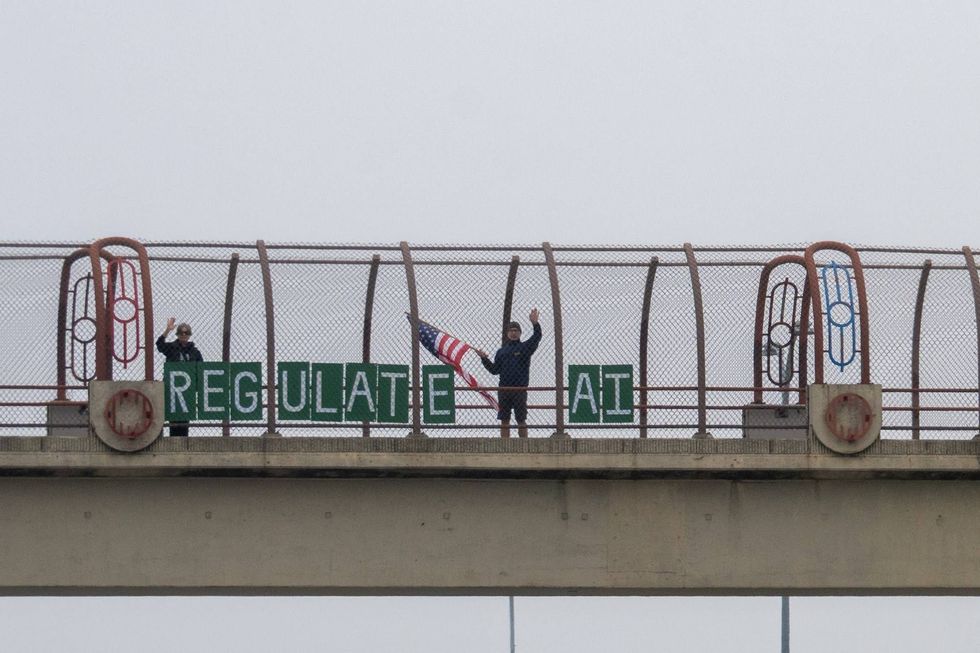 Demonstrators call for AI regulations in Tacoma, Washington. (Photo by Visibility Brigade)
Now that the day of action has passed, WAAIR will continue to put pressure on state lawmakers and Gov. Ferguson, Sutton told Common Dreams. After the November election, activists will also seek out lawmakers to sponsor moratorium legislation and other AI regulations while “pushing forward with future actions that people can take to make sure that legislators understand this isn’t an issue they can ignore.”
At the same time, organizers realize that the actions in Washington are part of a national struggle.
Meyer of Food & Water Watch said Washington was "one of dozens of states with active grassroots campaigns against data centers. Wherever there is resistance to this industry, more people learn that they are not powerless and that they can play a role in determining what happens in their community and with the future of AI and data centers.”
Within that broader movement, Washington may have a unique role to play, Sutton said.
“As the home of Microsoft and Amazon and a state that is deeply tied to Big Tech, if we can achieve this here, then I think it creates momentum for states everywhere else to believe that they can do the same,” he told Common Dreams.
Editor’s note: Olivia Rosane is a member of WAAIR and Seattle DSA.