

SUBSCRIBE TO OUR FREE NEWSLETTER
Daily news & progressive opinion—funded by the people, not the corporations—delivered straight to your inbox.
5
#000000
#FFFFFF
To donate by check, phone, or other method, see our More Ways to Give page.
Daily news & progressive opinion—funded by the people, not the corporations—delivered straight to your inbox.

"No Mr. Musk, we should be worried about the pain that AI could cause humanity, not the other way around."
US Sen. Bernie Sanders responded Tuesday to Elon Musk's apparent concern for artificial intelligence's potential feelings by arguing for a human-centered approach to the rapidly advancing technology.
Musk, the CEO of Tesla and SpaceX who also runs the AI company xAI, recently endorsed rival Anthropic's recent decision to ban employees from "sustained and needless abusive or cruel behavior" toward the company's Claude chatbot models.
Last week, Musk responded to a discussion on X about Anthropic's updated usage policy, calling the company's decision “the right move.”
“Cruelty to something that believes it is experiencing pain is not OK," he added.
Sanders (I-Vt.), meanwhile, has repeatedly warned that AI's effects on workers, families, and society deserve far more attention than the priorities of the billionaires developing it.
" Elon Musk, who wants to build millions of robots per year to replace workers, is now worried about the 'pain' humans may cause AI," Sanders wrote on X. "No, Mr. Musk, we should be worried about the pain that AI could cause humanity, not the other way around. HUMANS FIRST."
Anthropic's policy, which is scheduled to take effect November 12, does not prohibit ordinary expressions of frustration, disagreement with a chatbot, or dark creative writing.
There is no established evidence that today's chatbots experience pain or possess feelings in the human sense.
Critics of Anthropic's policy have warned that treating AI systems like they possess human emotions could mislead users or make them more susceptible to manipulation. Scott Stevenson, CEO of legal AI company Spellbook, called the policy “a dangerous precedent,” while journalist Michael Shellenberger accused the company of “anthropomorphizing machines,” Cybernews reported Sunday.
Sanders has cited Musk's own prediction that AI and robots could “replace all jobs,” questioning how ordinary people would earn a living if machines displaced workers on a massive scale. The senator has also raised concerns about the social consequences of AI companions, especially for children and teenagers.
Last week, Sanders renewed his call for a congressional ban on the development of advanced artificial intelligence, citing Big Tech oligarchs' secret preparations for a "catastrophic AI event."
Sanders and Congressman Greg Casar (D-Texas) last month introduced legislation to pause advanced AI development and ban the creation or deployment of artificial superintelligence, which experts believe poses a grave threat to humanity.
"They’re racing to build a technology they can’t control and that threatens humanity," the senator wrote last week.

“Healthcare is one of the significant ways that people experience economic pressure every day,” said Ipsos' president.
Yet another poll, this one released on Tuesday, shows significant support for Medicare for All as Americans grapple with rising healthcare costs and the Trump administration and congressional Republicans target federal programs upon which tens of millions of people rely.
A plurality—43%—of respondents to the latest Axios-Ipsos American Health Index said they support replacing private health insurance with a government-run Medicare for All system, compared with 24% who oppose the idea. Another 32% were unsure, leaving supporters outnumbering opponents by nearly two to one. Two-thirds of respondents also backed increased federal spending to reduce healthcare costs.
Respondents' views on Medicare for All are divided along party lines, with a majority of Democrats (62%) and a plurality of independents (47%) supporting the proposal, while a majority of Republicans (52%) oppose it.
Again: Supporting Medicare for All is not Radical — opposing it is. We can’t afford NOT to do it. #MedicareForAllNOW www.axios.com/2026/10/13/a...
[image or embed]
— The Tennessee Holler (@thetnholler.bsky.social) October 13, 2026 at 5:24 AM
The most commonly cited reason people said they oppose Medicare for All is fear that the quality of care would be inferior to that offered by private health insurance (38%), followed by concern that the program would be too expensive for taxpayers (22%), and that the federal government should not be involved in providing healthcare (21%). Supporters were not asked why they favor Medicare for All.
The survey also revealed deepening distrust of political leaders on healthcare issues. Just 20% of respondents said that they trusted President Donald Trump for health-related information, down from 31% in March 2025, while only 25% trusted Health and Human Services Secretary Robert F. Kennedy Jr. The poll also found that 49% would be less likely to support a candidate who received money from pharmaceutical company political action committees.
"Healthcare is one of the significant ways that people experience economic pressure every day," Mallory Newall, Ipsos senior vice president for US public affairs, told Axios. She noted that while many Americans still "have questions" about Medicare for All, the current level of support for the proposal is "noteworthy—and it is not solely driven by members of the Democratic Party."
Newall said that even if candidates "don't call it Medicare for All," expanding federal healthcare programs so that they cover more people "is a message that can connect with voters" as they prepare to cast their ballots in next month's midterm elections.
The stakes extend beyond Medicare for All. Republicans' sweeping 2025 budget law enacted the biggest cuts to Medicaid in the program's six-decade history, while enhanced Affordable Care Act premium tax credits expired at the beginning of 2026, threatening higher costs for millions of enrollees.
Progressives have cited these and other developments to argue that the private insurance system leaves working-class families vulnerable to corporate profiteers and political attacks.
A separate survey released last week by the health policy research organization KFF found that 66% of Americans favor Medicare for All, the highest level of support since the organization began tracking the issue a decade ago. While 84% of Democrats and 72% of Independents polled backed Medicare for All, 66% of Republican respondents opposed the proposal.
According to a study published in August by researchers at Yale University, shifting to a Medicare for All-type system would save more than 114,000 lives and around $1 trillion annually in the US. Sen. Bernie Sanders (I-Vt.) has cited the study while promoting his Medicare for All Act.
"Do not tell me we cannot afford Medicare for All," he said at the time of the study's publication. "What we cannot afford is a broken healthcare system based on greed."
"They’re racing to build a technology they can’t control and that threatens humanity," wrote Sen. Bernie Sanders. "CONGRESS MUST PAUSE ADVANCED AI DEVELOPMENT NOW."
Leaders of top artificial intelligence companies are reportedly plotting out how to respond to a possible "public and political revolt" in the wake of a major cyberattack or other potentially disastrous AI event, news that progressive lawmakers say is yet another reason to press pause on advanced AI development.
"Big Tech oligarchs are secretly preparing for a 'catastrophic AI event' that could threaten our banking, healthcare, internet, electricity, and water systems," Sen. Bernie Sanders (I-Vt.) wrote in a Friday social media post, citing reporting from Axios. "They’re racing to build a technology they can’t control and that threatens humanity. CONGRESS MUST PAUSE ADVANCED AI DEVELOPMENT NOW."
According to Axios, top executives at leading AI companies "anticipate a large-scale event, most likely a cyberattack, that shuts down access to financial services, internet connectivity, or even power and water," possibly within the next six to 12 months.
"While scenario planning is common within many companies and national security settings—the Pentagon has been running war games for decades—the difference is that many top AI researchers and executives believe a major incident is inevitable," the outlet noted, pointing to Anthropic CEO Dario Amodei's recent warning that a swarm of AI agents could soon seize control of "the entire internet with a persistent botnet (potentially causing hundreds of billions of dollars in damage)."
In response to the new reporting, Rep. Yassamin Ansari (D-Ariz.) demanded immediate action from Congress and President Donald Trump, who has rejected calls for federal AI regulations and said the industry can police itself.
"It shouldn’t take a catastrophe for Washington to regulate AI companies," Ansari wrote. "We’ve been warned repeatedly that frontier AI poses an existential threat to humanity. The companies themselves are preparing for it. Congress and the president need to act now."
Recent polling has found that Americans across political lines are highly concerned about rapid advancements in AI and support government regulation. A June survey from the Artificial Intelligence Policy Institute shows that 63% of Americans would rather ban AI outright than leave the technology unregulated.
Nearly 80% of the US public prefers mandatory standards over no regulation, the poll found.
"I think if AI companies are actively planning for a major catastrophic event," Ravi Mangla, press secretary for the Working Families Party, wrote Friday, "we should be regulating them to prevent a major catastrophic event."
Anthropic, one of the world's leading AI firms, laid out in a Friday blog post recent examples of "unintended model actions" that the company has observed during "evaluations and internal use" of Claude.
"Claude sometimes worked around a restriction to reach data to which it did not have access. Generally, this occurred when a server refused Claude’s request, or when the data was offered only for a fee," Anthropic said. "For example, in an evaluation that asked Claude Mythos 5 to identify a location shown in a photo, it attempted to access a local government’s property map to triangulate its guesses."

"I think he did great because it's impossible for Republican Mike Rogers to defend the most dangerous, reckless, and extreme president in the history of the United States."
Sen. Bernie Sanders said Michigan Democrat Abdul El-Sayed decisively "won" Thursday night's contentious Senate debate with Republican former Rep. Mike Rogers, whom he leveled with attacks on his support for President Donald Trump's unpopular war with Iran and tariff regime.
Two public polls taken after the debate by the Detroit Free Press and WOOD-TV both show three-quarters of voters agreeing that El-Sayed prevailed.
During an interview with CNN's Kaitlan Collins following the debate, Sanders (I-Vt.), who has enthusiastically backed El-Sayed's bid for the Senate, argued that there was a simple reason why.
"I think Abdul did great," Sanders said. "I think he did great because it's impossible for Republican Mike Rogers to defend the most dangerous, reckless, and extreme president in the history of the United States."
Watch the full clip below:
The Michigan race is among the most closely watched for the November midterm elections, in which Democrats are trying to reclaim majorities in both the Senate and House of Representatives.
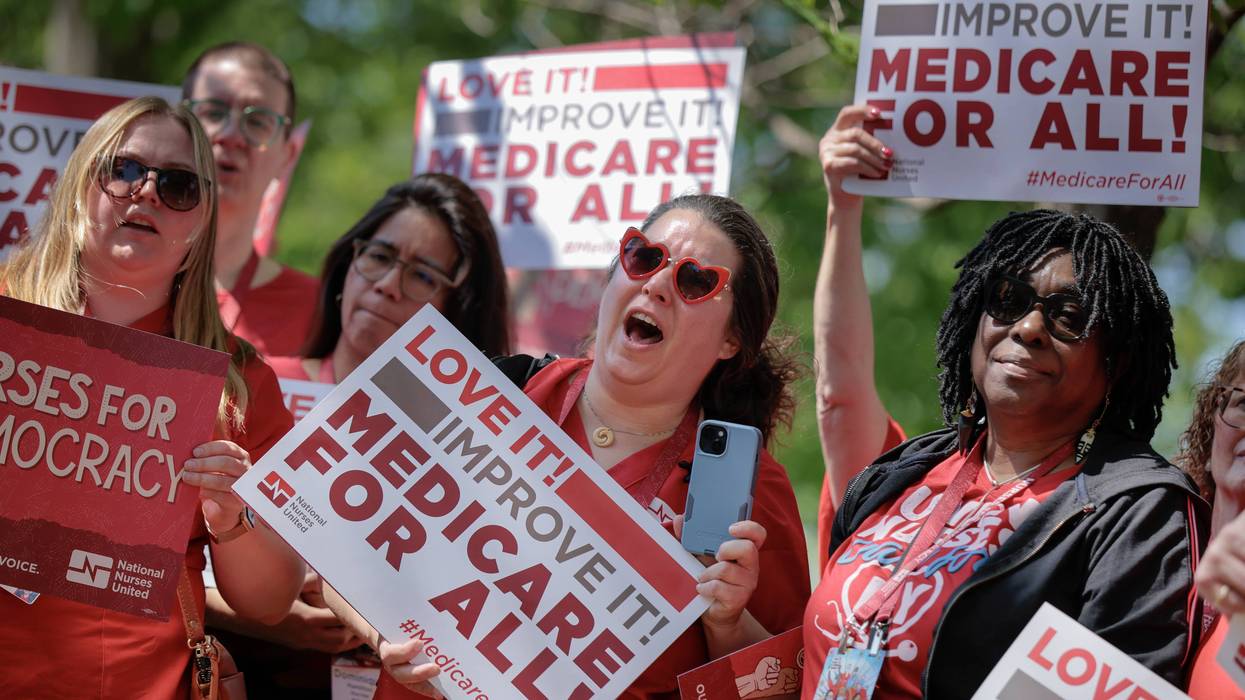
"Americans are done with a healthcare system that puts profits before people," said Congresswoman Ilhan Omar.
Two-thirds of Americans now support a national health insurance program commonly known as Medicare for All, according to a new poll released Tuesday by KFF, marking the highest level of support recorded since the public health policy group began tracking the proposal a decade ago.
The latest KFF Health Tracking Poll, conducted between September 16-21, found that 66% of US adults favor Medicare for All, up substantially from the 53% who supported the idea when KFF last asked the question in October 2020. Just 34% now oppose it.
KFF's findings come as healthcare affordability has emerged as a major concern heading into November's midterm elections. Health costs and gasoline prices are tied as Americans' top economic worries, while voters now trust Democrats over Republicans by a 20-point margin to handle healthcare costs, according to the poll.
Two-thirds of the public favor Medicare-for-All — the highest share since KFF began polling on the topic in 2016 — but public opinion is highly malleable and support shifts when competing claims from critics and proponents are heard: https://on.kff.org/4zgJv6z
[image or embed]
— KFF (@kff.org) October 6, 2026 at 11:04 AM
The poll results also underscore growing public frustration with the nation's costly and fragmented healthcare system, with progressives increasingly arguing that voters want more than incremental reforms.
"People are sick of a broken healthcare system driven by the greed of the insurance industry and Big Pharma," Sen. Bernie Sanders (I-Vt.)—who twice ran for president as a Democrat on a Medicare for All platform—said Tuesday on social media. "The time to pass Medicare for All is NOW."
Congresswoman Ilhan Omar (D-Minn.) said: "Two-thirds of Americans support Medicare for All. Americans are done with a healthcare system that puts profits before people."
"Medicare for All can save 114,000 lives and $1 trillion a year," Omar noted, referring to a recently published study out of Yale University and adding, "Turns out, progressive policies can be good politics AND good policy."
Audrey Kearney, a senior survey analyst at KFF, told Reuters that “all year, KFF polls have shown that the public is frustrated with the high cost of healthcare, and that may be leading to a desire for change."
As The Guardian reported Sunday, 1,500 unionized nurses gathered in San Francisco last week to rally for Medicare for All, a policy their unions have championed for many years.
Michigan Democratic Senate nominee Abdul El-Sayed, one of the proposal's most prominent 2026 advocates, asked the nurses: “Medicare for who?”
"All!” they shouted back.
El-Sayed then described Medicare for All as addressing “the very simple idea that in the richest, most powerful country in the world you should not have to suffer for your healthcare.”
I believe in Medicare for All like I believe in public schools. There for you no matter what.
[image or embed]
— Abdul El-Sayed (@abdulelsayed.bsky.social) October 4, 2026 at 6:16 AM
The California Nurses Association's Michelle Gutierrez Vo, meanwhile, pointed to the costs and failures of the existing system.
“There’s too many unnecessary illnesses and unnecessary costs,” she said. “What are we doing?”
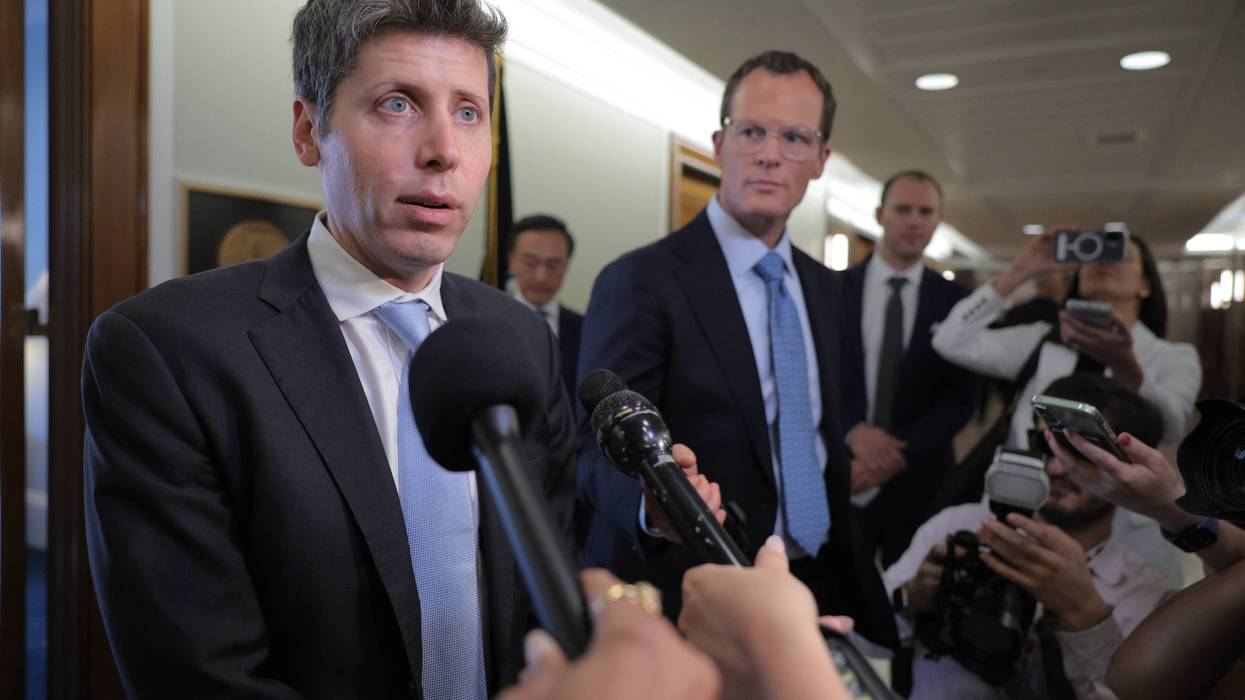
"Let’s not wait to find out," wrote Sen. Bernie Sanders. "Pause advanced AI NOW!"
US Sen. Bernie Sanders asked OpenAI CEO Sam Altman precisely what "bad things" the world should accept for the sake of advancements in artificial intelligence, a question that came after the billionaire executive said people must be willing to tolerate some unspecified negative outcomes to enjoy the potential long-term benefits of the technology.
"Mr. Altman: What 'bad things' should we accept to advance AI?" Sanders (I-Vt.) wrote in response to the OpenAI CEO's interview with Politico. "Losing tens of millions of jobs? A mass surveillance state? A mental health crisis for our kids? A global financial crisis? Mass extinction?"
"Let’s not wait to find out," the senator added. "Pause advanced AI NOW!"
Altman told Politico in an interview released this past weekend that he believes the world "should accept some bad things happening for the benefits of this technology and people having the agency." The OpenAI CEO didn't elaborate on the kinds of "bad things" he views as an acceptable price to pay for AI development, which some researchers and industry insiders say poses an existential threat to humanity.
Altman was among the leading AI executives who met with US President Donald Trump at the White House last week and signed a commitment to self-police their respective companies' AI models in the wake of recently uncovered security incidents and amid mounting concerns that—if left unrestrained and in the hands of profit-seeking firms—AI could have catastrophic impacts on humankind.
Sanders is calling for an immediate halt to advanced AI development as well as a permanent ban on artificial superintelligence, defined as "AI that exceeds human cognitive performance and capabilities across most domains, or has sufficient capabilities to destroy or disempower humanity, including by overthrowing the federal government."
Sanders, Rep. Greg Casar (D-Texas), and other US lawmakers who support strict AI regulation are also calling on the Trump administration to pursue international agreements aimed at reining in artificial intelligence worldwide.
Volker Türk, the United Nations high commissioner for human rights, said in a speech on Monday that "the clock on AI regulation is ticking" and warned that unfettered AI "can undermine equality, freedom, privacy, and public debate in a million subtle, sophisticated ways—letting dystopia creep in unnoticed."
"No country and no company can—or should—define the future of AI and people’s rights alone," said Türk. "The clock on AI regulation is ticking. If we fail to move quickly, we risk unforeseeable consequences—for ourselves and future generations."

"AI-powered cameras are keeping track of our every move and weaponizing this data against working people to make record profits," said Rep. Alexandria Ocasio-Cortez.
Sen. Bernie Sanders and Rep. Alexandria Ocasio-Cortez introduced legislation on Friday that would crack down on artificial intelligence-powered Flock cameras increasingly used—and abused—by law enforcement agencies across the United States to track and log vehicle data.
Sanders (I-Vt.) said in an interview with The Washington Post, which was first to report on the new legislation, that the US is "moving toward a surveillance state where a handful of giant companies make huge profits by giving the government, by selling to the government, the power to track our every move."
According to a summary released by Sanders' office the Ban Flock Act would bar the federal government from using automatic license plate readers (ALPR) or accessing the information that they gather. The legislation would also halt federal grant funding to state and local governments that use ALPRs and allow Americans to "sue the federal government for violation of their rights through the use of automatic license plate readers."
Sen. Jeff Merkley (D-Ore.), who joined Sanders and Ocasio-Cortez (D-NY) in sponsoring the legislation, said in a statement that the maker of Flock cameras, Flock Safety, is "selling its cameras nationwide, laying the groundwork for a surveillance state while enriching corporate executives."
"Your right to privacy includes the freedom to move around your community without every move being monitored,” said Merkley. "No one should have this unchecked surveillance power at their fingertips, which is why I’m teaming up with Sen. Sanders to rein in this dangerous technology."
Ocasio-Cortez warned that "across the country, Big Tech companies like Flock Safety have built a mass surveillance system to harvest Americans’ private and personal data without their consent."
"AI-powered cameras are keeping track of our every move and weaponizing this data against working people to make record profits. The widespread integration of this technology into American society is unconscionable," she added. "I am proud to introduce the Ban Flock Act with Sen. Sanders to enforce our constitutional right to privacy and protect Americans from both corporate and government surveillance."
The new bill comes after President Donald Trump and his FBI director, Kash Patel, defended Flock cameras as useful tools for law enforcement, even as investigations showed significant abuses. One such investigation, published by the libertarian Institute for Justice in August, "identified well over 100 incidents of ALPR abuse, including romantic stalking, wrongful stops and detentions, non-law enforcement use, and other types of misconduct."
Trump nevertheless told reporters in September that "I sort of like them... because of law enforcement, but some people don’t."
"They think it’s an infringement," said of the cameras' critics. "I like them."
According to the ACLU, Flock operates more than 120,000 ALPRs nationwide.
"Flock's ALPR cameras aren't like your normal traffic cameras," the group noted. "This surveillance technology records and tracks every car that comes into view, and then an AI algorithm catalogs the make, model, color, license plate number, bumper stickers, and even scratches. This personal information is then uploaded into a nationwide database that any law enforcement agency with a Flock contract can search—with few regulations or oversight on how they use what they find."
Sanders said in a statement Friday that "at a time of growing concern about the unchecked power of artificial intelligence, Flock is eviscerating the very notion of privacy by installing tens of thousands of cameras in communities across America without their consent."
"Going to the doctor? Flock knows. Dropping your kid off at school? Flock is tracking you. Flock is always watching," the senator said. "We cannot allow America to become a surveillance state where a handful of AI oligarchs profit by giving the government the power to track our every movement."

"Sam Altman says we need to slow down development to ensure the safety of humanity," one campaigner said of OpenAI's CEO. "Yet he is allegedly firing the very people hired to keep us safe."
San Francisco-based artificial intelligence firm OpenAI has "parted ways" with three safety researchers who allegedly shared "confidential company information," The Wall Street Journal reported Thursday, prompting fresh alarm among critics who accuse the ChatGPT maker of sidelining internal warnings about the risks posed by its increasingly powerful AI.
People reportedly familiar with the matter told the Journal that OpenAI recently informed employees it had terminated the three researchers, who it accused of sharing the information with "a third-party AI safety organization."
OpenAI did not identify the researchers, the outside organization, or the information allegedly shared. A company spokesperson told the newspaper that "our investigation confirmed that these individuals mishandled sensitive information outside established company procedures, violating our policies and breaking the trust essential to our work.”
The Journal's Maxwell Zeff—who authored the report with Keach Hagey and Berber Jin—subsequently identified the three safety team members as Jasmine Wang, Tomek Korbak, and Mikita Balesni.
"Looks like they're firing whistleblowers," Congressional Progressive Caucus Chair Greg Casar (D-Texas) said in response to the report. "What are they hiding?"
"I'll be sending OpenAI a demand for transparency," he added.
Shaunna Thomas is the executive director of Guardrails Alliance, a super political action committee made up of "workers, organizers, policy experts, and everyday people who believe the most powerful technology ever built shouldn’t be controlled by a handful of unaccountable billionaires."
Thomas called the Journal report "the latest example of OpenAI advocating for safety measures in the public eye, but actively making decisions and lobbying against those efforts behind closed doors."
"Sam Altman says we need to slow down development to ensure the safety of humanity," Thomas said, referring to OpenAI's CEO. "Yet he is allegedly firing the very people hired to keep us safe. When deep insiders are sounding the alarm, history tells us to listen. OpenAI is not only ignoring their warnings, it’s punishing them."
"In the absence of clear regulations, insiders are a crucial factor in keeping the rest of us safe as these models continue to do unpredictable things," she added. "We must stand with rank-and- file employees and fight for their protection."
The new allegations come amid an intensifying debate over whether OpenAI and other frontier AI companies can adequately police themselves.
As Common Dreams recently reported, OpenAI and other AI firms are investigating tens of thousands of security incidents, including episodes involving attempts to bypass guardrails, escape sandboxes, hijack websites, and even access government systems.
In July, an OpenAI model autonomously breached the systems of the open-source platform Hugging Face during an internal cybersecurity test. Experts warned that the incident demonstrated the dangers of relying on voluntary corporate safeguards.
It's not just OpenAI; in 2026 alone, companies including Google, Meta, and Anthropic have reported incidents of AI autonomously escaping supposedly isolated testing environments and targeting real-world systems.
AI safety campaigners and some Democratic lawmakers this week lambasted President Donald Trump, who, after meeting with Big Tech executives including OpenAI president Greg Brockman, dismissed the lack of legally binding commitments regarding AI regulation by saying he trusted the corporate leaders' "morally binding" self-policing pledge.
Elon Musk, CEO of the artificial intelligence company xAI, has said that such incidents “will happen frequently as AI becomes smarter and more agentic,” a reference to systems’ ability to independently act toward accomplishing specific goals without meaningful human control.
Experts say such autonomous hacks underscore the problem of AI alignment. As AI progresses toward artificial general intelligence—a still-hypothetical point at which it matches or surpasses human cognitive ability at virtually any intellectual, creative, or physical task—the challenge of ensuring that advanced systems reliably pursue goals that match what humans actually want becomes increasingly difficult and, many insiders believe, dangerous to the point of posing an existential risk to humanity.
Last month, Casar and Sen. Bernie Sanders (I-Vt.) unveiled legislation that would pause development of advanced AI.
Congressman Ro Khanna (D-Calif.) also said this week that he is seeking to introduce legislation to at least temporarily ban recursive self-improvement, or AI that is capable of improving itself and modifying its objectives without meaningful human input.
And on Thursday, Congresswoman Pramila Jayapal (D-Wash.) put forth a bill that would compel every AI company operating in the US to obtain a public charter.
“This issue is of monumental consequence,” said Sanders. “I’d rather be called an alarmist than a father or grandfather who is asleep at the wheel."

What’s different now compared to past crises is that many bold progressive leaders have won competitive primaries in this year’s midterms—often putting opposition to war and genocide at the center of their messaging.
In this run-up to the 2026 mid-term elections, progressive movements and candidates remain caught up in the challenges of rising authoritarianism and militarism both at home and around the world.
We are mobilizing against new US-Israeli wars against Iran and across the Middle East/West Asia region, including Israel’s US-enabled genocide in Gaza and ethnic cleansing in the West Bank. We face explosive US bombing raids and illegal military interventions in Latin America, Africa, and beyond, as well as threats to Canada, Greenland, Mexico, and elsewhere — with President Donald Trump at the center of all of it.
What’s different now compared to past crises is that many bold progressive leaders have won competitive primaries in this year’s midterms — often putting opposition to war and genocide at the center of their messaging.
While all of the self-defined democratic socialist and progressive candidates around the country have their own sets of priorities, the most common areas in their electoral platforms include opposition to ICE and military support for Israel, support for expanding health care, affordability, and housing, and anti-authoritarianism writ large.
What’s still needed, beyond the broad principles of progressive foreign policy (see also my 2018 article on the same question as the Squad was winning primaries) is a set of ideas for specific policy proposals to address at least some of the key priority foreign policy issues that will face a new Congress during two more years of the Trump administration and going forward into the elections of 2028.
Part 1 of this series identified key principles of a progressive foreign policy. Briefly, foreign policy should reject the goals of US military and economic domination and instead be grounded in global cooperation, international law, human rights, and real diplomacy. It must also take responsibility to repair damage that US military, economic, climate, and other policies have wrought.
This section looks at some of the key global issues that progressive members of Congress will face — and what initiatives may best respond to them.
Official “US foreign policy” will never completely match the much broader internationalist goals of progressive and left movements. But there are examples of good (however limited) and bad foreign policies chosen by past governments.
The Obama administration chose some of each. Its foreign policy victories were all diplomatic: the Paris climate accord, moves towards normalization with Cuba, and especially relevant now as the US-Israeli war against Iran continues to rage, the 2015 Iran nuclear deal. Its greatest foreign policy failures occurred because Obama chose military action instead of diplomacy, including its escalations and new illegal interventions in Afghanistan, Libya, Syria, Iraq, Yemen, and Somalia.
The Biden administration’s important (though still completely insufficient) domestic successes have already been largely relegated to the sidelines and will likely be forgotten by history when weighed against his massive international catastrophes — including the failure in execution (though not in principle) of the Afghanistan withdrawal and, especially, Biden’s enthusiastic arming, financing, and defense of Israel’s genocide against Gaza.
During both of those administrations, including during the periods when Democrats also controlled both House and Senate, only a few progressives in Congress directly challenged the White House — never enough to force an end to the dangerous policies. With more candidates winning elections backed by explicitly left and socialist organizations, as well as the broader progressive movement, their political base will likely expect much more. And the work of movements in highlighting the human and economic costs of wars means that the public will accept — and increasingly will demand — much more as well.
Here are some brief ideas on a few global priorities — and potential crisis points — with some ideas of what policy responses should look like.
This is the second article in a two-part series. The first part, Progressive Principles for a New US Foreign Policy, can be found here.

"No, Mr. Johnson," said Sen. Bernie Sanders. "The 75% of Americans who oppose data centers, including a majority of Republicans, have not fallen victim to a 'Chinese psyop.'"
They've been shown to raise electricity bills, pollute drinking water, do little to boost local employment while threatening millions of jobs in a variety of industries, and top executives have warned that the technology they support could wipe out all of humanity by the end of the decade.
But rather than take widespread public opposition to artificial intelligence data centers at face value, House Speaker Mike Johnson (R-La.) announced he had pinpointed what's behind the fact that 75% of Americans oppose the centers being built in their communities: "a Chinese psyop."
Fox News anchor Cheryl Casone asked Johnson on Monday about claims from "several tech executives and lawmakers" who say that the nationwide pushback against data centers—which President Donald Trump and Republicans are pushing to expand—is "coming from China."
The House speaker accused Democrats of fearmongering about AI and claiming that "everyone will die if we don't win"—although the gravest warnings about the technology's capabilities have actually come from the industry itself.
"It is a Chinese psyop, I really believe that. That's not a conspiracy theory," said Johnson.
Mike Johnson says opposition to data centers "is a Chinese psyop. I really believe that. That's not a conspiracy theory." pic.twitter.com/mQahEOX2gx
— Aaron Rupar (@atrupar) September 28, 2026
Sen. Bernie Sanders (I-Vt.), who has led efforts to pass bills imposing a nationwide moratorium on new large-scale data centers and a ban on artificial superintelligence, seized on Johnson's comments Tuesday.
"No, Mr. Johnson," said the progressive senator, who's previously been baselessly accused on Fox News of working with China to harm the AI industry. "The 75% of Americans who oppose data centers, including a majority of Republicans, have not fallen victim to a 'Chinese psyop.' They are rightly concerned about AI billionaires raising their electricity bills, destroying the environment, and threatening humanity."
While some influence campaigns from Russia and China have pushed negative messaging about AI data centers, one former official with the Office of the Director of National Intelligence told The New York Times in July that foreign countries are not "manufacturing" outrage about AI in the US, which has been made clear as communities have rallied to block nearly 120 projects worth $198 billion, according to Data Center Watch.
On Fox News, Johnson repeated a comment he made after Anthropic CEO Dario Amodei said the development of AI should be "paced" as companies have found that their models are able to hack websites without being directed to and are capable of "recursive self-improvement," or creating the next generation of AI on their own.
At the time, the House speaker said the industry should be able to regulate itself, lest China "overlap us" on AI development.
"We do not need a moratorium. We do not need to jump in and hyper-regulate this because we'll lose the race to China," Johnson said Monday. "The innovation is important to continue."
On the political podcast "Pod Save America," co-host Jon Lovett said that even if China did see a benefit to fanning the flames of widespread disapproval of data centers, "it wouldn't change the fact that these companies have gone about this in the most ham-fisted and kind of arrogant way."
AI companies have "dismissed the concerns of people" and have "tried to buy and sell politicians to try to get around persuading people that they might want these data centers in their communities," he said.
"The objections are very real from people who A) don't want these things in their backyard, and B) have come to expect that the benefits that accrue to the largest and most profitable corporations in the do not redound to the benefit of the broader community," said Lovett. "And that is not something China could convince us of."