

SUBSCRIBE TO OUR FREE NEWSLETTER
Daily news & progressive opinion—funded by the people, not the corporations—delivered straight to your inbox.
5
#000000
#FFFFFF
To donate by check, phone, or other method, see our More Ways to Give page.
Daily news & progressive opinion—funded by the people, not the corporations—delivered straight to your inbox.
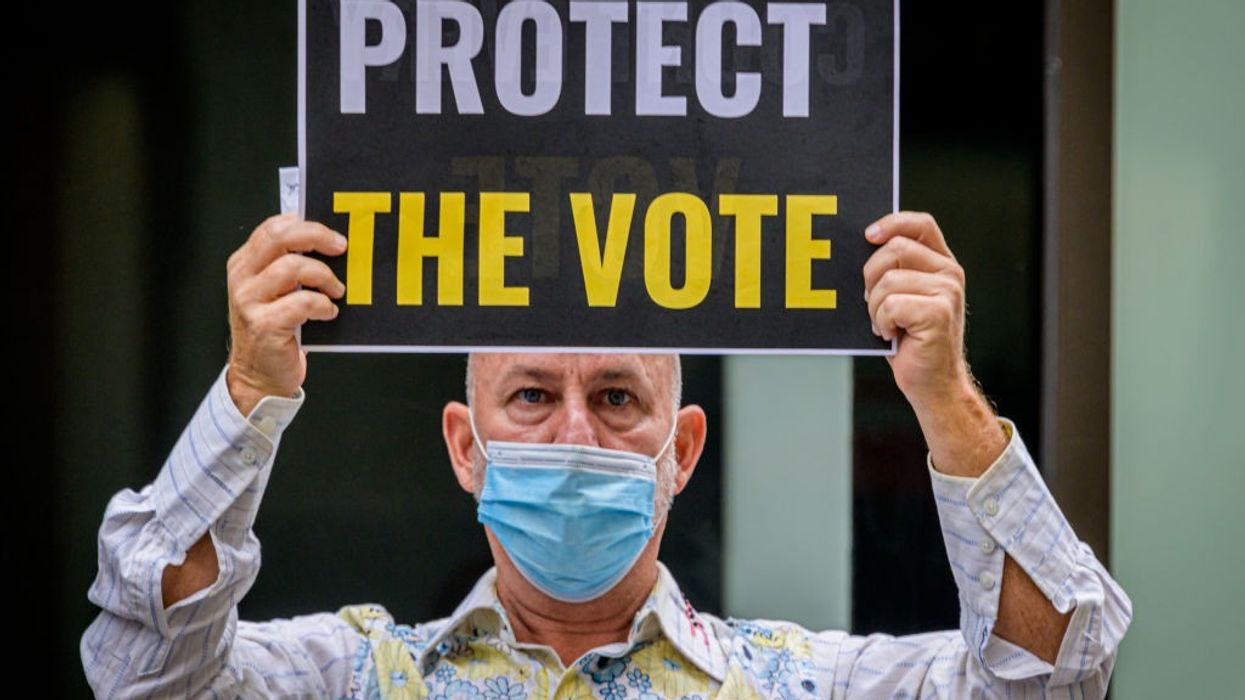
As President Donald Trump continues to insist he won the 2020 election, reporters must keep their readers informed about the 2026 voting process and press all candidates on whether or not they will accept the voters' decision.
A few weeks before the 2020 presidential election, I wrote “An Open Letter to My Old Tribe,” urging “every reporter who is covering this election at any level” to focus on a crucial question—whether the public would trust the election procedure and the losing candidate would accept the result as legitimate. “It does not seem an exaggeration,” I wrote then, “to say that the future of American democracy, perhaps its very survival, depends on the answer.”
More than five years later, with less than seven months to go before the midterm elections, that question is before us again, but in far starker terms than I could have imagined in 2020. So, here’s an updated letter to the media tribe I once belonged to, with suggestions broadly similar to those I made five years ago, but with a far sharper sense of urgency, even fear.
Here’s my first suggestion: Reporters in 2026 need to pay more attention to and offer more forceful coverage of President Donald Trump’s continuing insistence that Joe Biden’s victory in 2020 was fraudulent and that year’s election illegitimate. (As recently as March 15, he tweeted this completely false allegation: “With time, it [the 2020 election] has been conclusively proven to be stolen.”)
While Trump keeps repeating that long-discredited claim, journalists should not treat his falsehoods as “old news” that no longer requires detailed coverage anymore. They should instead consider it an important and newsworthy story right now. Instead of briefly repeating a shorthand conclusion (“false” or “without evidence”) after a quote from the president, they should take a few more lines of type or minutes of air time to remind readers or listeners of the facts that show irrefutably why they should never believe his words. After all, Trump’s “rigged election” claims haven’t been validated in a single one of 64 court cases—that’s right, 64!—challenging the election results, or in any official investigation or recount.
Ask every Republican candidate on your state’s ballot to answer this question: Do you really believe that Donald Trump won the 2020 election, and lost only because of massive vote fraud?
On that point, reporters can cite an authoritative 2022 report, “Lost, Not Stolen: The Conservative Case That Trump Lost and Biden Won the 2020 Election,” written by a panel of authors including two former Republican senators, a lawyer who served as solicitor-general under President George W. Bush, and five other prominent conservatives. After exhaustively reviewing every judicial proceeding and post-election probe in six states where election fraud was alleged, the authors concluded that “Donald Trump and his supporters had their day in court and failed to produce substantive evidence to make their case.” Their definitive verdict on the overall issue was: “There is absolutely no evidence of fraud in the 2020 Presidential Election on the magnitude necessary to shift the result in any state, let alone the nation as a whole. In fact, there was no fraud that changed the outcome in even a single precinct.”
(Journalists might also pass on this thought from David Becker, executive director of the Center for Election Innovation & Research, who, in a recent podcast, suggested that all 2020 election conspiracy theories rest on this dubious premise: “Democrats, being out of power, somehow managed a conspiracy against a sitting president, who controlled the entire government, to steal an election from him… and that four years later when those same Democrats held every lever of federal power, they forgot to do it again.”)
Reporters should also remind their audience of another important fact: Trump’s claims of fraud in the 2020 election were emphatically refuted by Mike Pence, his vice president, and Bill Barr, his attorney general, both of whom publicly broke with the president, strongly denied his allegations, and unequivocally recognized that Joe Biden had been legitimately elected.k
In that connection, here’s a related suggestion for reporters: Ask every Republican candidate on your state’s ballot to answer this question: Do you really believe that Donald Trump won the 2020 election, and lost only because of massive vote fraud? Press as hard as you can for an on-the-record, yes-or-no answer, and if you don’t get one, keep pushing. If a candidate says yes or evades the question, follow up with questions like: “What evidence do you have? How do you explain that those charges were not verified in a vote recount or in a single one of more than 60 judicial proceedings? Were judges in 64 courtrooms across six states all part of a nefarious conspiracy against Donald Trump, or do you have any other explanation?”
Journalists in 2026 also have a much broader task: to keep their audiences informed on the details of the election process and the ongoing efforts to undermine its legitimacy. Covering those themes systematically and proactively will not be easy at a time when the headlines are bound to be filled with other explosive issues: a major war in the Middle East (and possibly beyond); the ongoing bitter controversy about the Trump administration’s chaotic immigration enforcement campaign that led to the violent deaths of two US citizens; the continuing effects of drastic staff reductions in federal agencies that have eliminated or significantly reduced government services and benefits for millions of Americans; and a long list of other divisive subjects. But the threat to public trust in the election process poses a clear and present danger to the principles, traditions, and values of the American political system, and news organizations need to adapt their campaign coverage accordingly.
So, here’s a suggestion (one I made in that earlier letter years ago) to reporters, editors, and news directors across the country:
Starting now, treat the election process in your state as a significant running news story. Make it a separate beat, alongside the traditional coverage of the reactions of candidates and voters. Touch base regularly with local and state election administrators. Learn (and then tell your readers or listeners) the details: how voters are registered, how and where the voting will be conducted, and exactly how their votes will be counted. Cultivate sources and regularly report what local officials are doing (or not doing) to ensure a credible election. Meanwhile, before any votes are cast or counted, press candidates and their minions to state exactly what they would define as evidence of miscounting or fraud, what they would consider grounds for contesting the outcomes of local or other races, and how they envisage conducting those contests—standards for which they can then be held accountable if they do end up disputing the official results.
Don’t cover such subjects only when they arise in a partisan debate where the traditional role of journalists is to report both sides (candidate A says the ballot count will be falsified or ineligible voters will be allowed to vote, candidate B or election administrator C says the voting will be legally conducted and the count will be accurate). Instead, monitor and regularly update your audience on what’s actually happening. Track problems as they appear and solutions as they are proposed, discussed, and adopted.
For example, on the controversy about voting by mail—an issue now before the Supreme Court—don’t just report the opposing arguments and leave it to readers and listeners to choose which side to believe. Give them the knowledge to decide for themselves. Don’t wait for partisans on one side or the other to bring up the subject. Take the initiative with a story detailing the rules in your state that define who can vote by mail and how to do so. When the time comes, report how many mail-in ballots have been distributed and track how many have been returned. Explain in detail how those ballots are stored and protected and when and how they will be opened and counted—facts that will let news consumers reach their own conclusion about the practice and whether it’s risky or not.
A useful resource for journalists covering such issues is the nonprofit news organization Votebeat, which focuses exclusively on covering how elections are conducted and distributes its articles at no cost to readers or local and national news outlets. Founded in 2020, Votebeat has reporters based in five states (Arizona, Michigan, Pennsylvania, Texas, and Wisconsin) that were centers of controversy in that year’s election. On the national level, in 2024 it operated an “Expert Desk” where journalists could ask voting-related questions and get knowledgeable answers from a panel of nearly 100 election administrators, cybersecurity experts, attorneys specializing in election law, and other professionals. It plans a similar program to assist journalists covering this year’s election. Reporters or anyone else concerned about election issues can sign up here to regularly receive its reports.
A variety of other organizations across the political spectrum can answer media queries on election procedures and management. Here are a few more groups whose work reporters should follow and contact if needed:
And one last suggestion for journalists covering this year’s election: Go down the ballot in your state and ask every candidate running for the Senate or House of Representatives or any significant state or local office for an unequivocal on-the-record commitment to respect the voters’ decision, whatever it might be. If any candidates waffle or decline to answer, don’t just leave it at that and go on to the next story. Instead, keep asking them (and their political allies, campaign organizers, and spokespeople) the same question and press them to explain exactly why they are dodging the issue.
I ended my 2020 letter with this closing paragraph:
Journalists alone will not win the fight to protect the legitimacy of this election, but they can make an important contribution—perhaps the most important since reporters covering the civil rights movement in the 1950s and 1960s helped make the country confront the realities and the profound injustice of the segregation era. In the coming weeks, it will be absolutely vital for journalists everywhere, in every medium, to recognize the challenge and greatly intensify their efforts in rising to it. The stakes could not be higher.
Sadly enough, in 2026, those words ring even more pertinently than when I wrote them.
It’s no coincidence the fossil fuel industry has lined up behind racist, belligerent, and authoritarian leaders like Trump.
The second Trump administration has been an unrelenting assault on democracy.
Basic democratic rights are disappearing. Unarmed people have been executed in the streets and smeared as “terrorists” by the government. Entire families are being kidnapped and denied basic rights in inhumane detention centers. And journalists are being arrested for doing their jobs.
Against this backdrop, working for climate justice might seem like a distraction.
But a clear-headed look at how we ended up in this grim situation in the first place shows that the movement for climate justice, far from being a distraction, is an essential part of the fight to defend and deepen democracy.
We cannot defeat authoritarianism without breaking the stranglehold of the fossil fuel industry on our economy and our political system.
The Trump administration has received major political backing from fossil fuel oligarchs—in response, in fact, to Trump’s open solicitation to trade favors for their support. The government has subsequently followed an energy and environmental policy agenda that benefits the industry.
The administration has expanded the industry’s access to resources at home through leases and permits for drilling in public lands and waters. It has attacked Venezuela, kidnapped its president, and is attempting to open up the country’s oil reserves to US corporations.
And of course it launched an unprovoked war on Iran, sending the price of oil skyrocketing—and leading to genocidal threats from the president against Iran unless the country reopens the Strait of Hormuz, through which Gulf oil passes.
Meanwhile at home, the Trump administration has weakened environmental standards, including mercury pollution standards for power plants. By attacking motor vehicle fuel economy standards, it has effectively grown the captive market for the industry’s products. And it has abused the federal permitting process to try to kill the fossil fuel industry’s main competitors, wind and solar energy.
This is not merely a case of an administration that supports the fossil fuel industry and also happens to be authoritarian. The industry directly supports and benefits from an authoritarian government that curtails democratic rights and silences dissent. It also benefits from a government that upholds white supremacy and enforces racial hierarchy.
Several years ago, a report I worked on for the Institute for Policy Studies documented how the fossil fuel industry has used its money and influence to push for state-level legislation to criminalize protest against fossil fuel infrastructure projects. These so-called “critical infrastructure laws” are now on the books in 19 states. The industry has also used strategic lawsuits against public participation (SLAPPs) to intimidate and silence critics.
This is a predictable response of a powerful, politically connected industry that is under assault on two fronts.
First, competition from cheap, widely available wind and solar energy poses a serious economic threat to the industry. Renewable energy is cheaper than fossil fuels in most of the world, and new generation capacity is dominated by renewables.
Simultaneously, the industry faces serious political and reputational threats. Growing numbers of people worldwide are experiencing extreme heat, wildfires, storms, floods, and toxic air and water pollution attributable to the industry’s activities. Many of them are connecting the dots, and refusing to be passive victims of a powerful industry and its political backers.
Social movements against particular fossil fuel projects, or against the industry more broadly, have multiplied on every continent. What’s more, they are already winning. The industry faces restrictions in several political jurisdictions, and likely recognizes that it could even be expropriated in the not so distant future.
Faced with these twin crises, the fossil fuel industry is increasingly resorting to relying on the repressive apparatus of state violence to crush dissenting voices and maintain its dominance.
The industry has also historically benefited from a racially and economically unequal society. The lack of political power of Indigenous, Black, and other racially marginalized communities, and of poor communities of every race, has enabled the industry to locate polluting infrastructure in these communities, treating them as sacrifice zones. This has let the industry avoid the protracted zoning and legal battles they would have to contend with if they tried to locate their infrastructure in more privileged communities, greatly reducing the cost and lead time for their projects.
In recent years, the growing strength of the environmental justice movement has threatened the ability of the industry to continue to reap the benefits of racial and economic stratification. It is therefore no surprise that the industry is supporting an openly white supremacist political agenda that seeks to bring old racial hierarchies back and eliminate the very concept of environmental justice.
In sum, the far-right agenda in the US is deeply intertwined with the political and economic objectives of the fossil fuel industry that is at the root of climate change. We cannot defeat authoritarianism without breaking the stranglehold of the fossil fuel industry on our economy and our political system.
Finally, it is worth pointing out that these observations are mainly based on US politics, but are applicable to many parts of the world. Fossil fueled fascism has become a global phenomenon, and our resistance to the fossil fuel industry must be similarly global in scale.
Moments like this don’t come around often. The candidates are there. The coalition is forming. Don’t let this one pass.
The 2026 and 2028 elections can and should be the beginning of something transformational.
We’ve got tailwinds like you wouldn’t believe. A president whose approval rating has dropped below 35%, rivaling Nixon during Watergate. The man said, on camera, at an Easter lunch at the White House, that we can’t afford daycare because “we’re fighting wars.” That same week he asked Congress for a $1.5 trillion military budget. A 44% increase. The largest in American history.
The same guy who wants $152 million to reopen Alcatraz as a prison while we’re spending roughly $2 billion a day bombing Iran in a war nobody asked for, a war that’s woefully unpopular even with the MAGA base.
But daycare? Too expensive, folks. Can’t swing it. Trump really doesn’t give a f…
Pete Hegseth, Trump’s Fox host turned Secretary of War, is out there at the podium in the Pentagon asking Americans to pray, in the name of Jesus Christ, for “overwhelming violence” against Iran. The Pope rightly sees it differently, calling the war immoral.
Oh, and let’s not forget that these people aren’t just inept, they’re largely insane, like the dude running FEMA who’s been on podcasts claiming he was teleported to a Waffle House.
So, we’ve got a historic opportunity staring us in the face. But here’s the sad part. The really upsetting part.
The question is whether we’re going to back these people or keep doing what we’ve always done. Listening to party leaders and pundits and establishment political hacks tell us who to pick.
Even in the face of all this, our party is still less popular. Even amongst ourselves. 55% of us say the party has the wrong priorities. 71% of Democratic-aligned voters say the party’s been ineffective at opposing Republican policies. Why? Because it has been. This isn’t a messaging problem. This isn’t voters failing to appreciate how good the Democratic Party is. This is us finally starting to understand how bad it is. How far our party has drifted from the people it claims to represent. How captured it’s become by Wall Street, big pharma, big tech, big oil, the military industrial complex, and every other industry that’s learned to write checks to both sides and win no matter who’s in power. Our leadership has failed us. We see it. We know it.
Last Saturday, 8 million of us were in the streets. All 50 states. More than 3,300 events. The largest single-day demonstration in American history. Nearly half of those events were in red states and rural communities. People who never march for anything marched.
But we marched against stuff, not for stuff. Against Trump. Against kings. Against war. There’s this energy out there and it’s real and it’s righteous, but right now it’s anger without a goal, and anger without a goal can’t build power. A goal, a vision, hope, that’s what you build a supermajority around. Our party is really good at channeling anger into “Trump bad” but that won’t do it. These millions of us, not just the 8 million in the streets but the tens of millions more who weren’t, could be a burning light hot enough to set this country’s rot ablaze if a party would just hold the magnifying glass.
But you’ve got to understand how we got here.
Trump’s first election was a warning sign so loud that half the country covered its ears. Then Covid hit and nearly buckled a healthcare system already on life support. We lost jobs, lost coverage, lost family members, and discovered that basically every system we’d been told to trust, healthcare, housing, childcare, the supply chain, was one crisis away from collapse. Then we elected Biden, who passed trillions in spending bills. For a moment it felt like something was changing.
It wasn’t. The systems that caused this mess stayed intact.
We need to accept that America doesn’t just have a spending problem. We have a system problem. Every time Democrats get into power they pump money into broken systems without rebuilding them. Obama did it. Biden did it. The money goes in and disappears, absorbed by corporate middlemen, diluted by bureaucracy, leaving barely a trace in the lives of the people who needed it most.
And then we get Trump again. Twice elected.
If that doesn’t convince you that Americans are screaming for transformation I don’t know what will. People aren’t electing Donald Trump because they love Donald Trump. They’re electing him because they’re done with the status quo. They’re done being told our system is functional when they can see with their own eyes that it isn’t. They want it burned down. That’s a rational response to decades of betrayal. It’s also a catastrophic one. But it’s what happens when nobody offers an alternative vision. In the absence of hope and vision anger will do.
That is what so many elected Democrats lack, a vision. A mission. The folks running this party have failed and they have names. Hakeem Jeffries, Chuck Schumer, Gregory Meeks, Pete Aguilar, Amy Klobuchar, Ted Lieu. Those are the names of the leaders that 55% of Democrats think are failing.
We’ve been so afraid of words like socialism that we’ve allowed these folks to contort our values into shapes that are almost unrecognizable.
Here’s the dark irony. MAGA isn’t calling out corruption. They are the corruption. But they’re willing to tear down institutions that too many treat as sacred. The DOJ, the SEC, the FDA, the courts, it doesn’t matter. They’ll dismantle anything. They’re doing it for greed and power and not a damn thing for the American people, but the lesson is still there. No institution should be untouchable. The revolving door between corporate boardrooms and government shouldn’t just be stopped, the people who came in through it need to be removed. We should’ve been saying that for years. Some of us were. Nobody in leadership heeded the call.
But some of us are done waiting for leadership to listen.
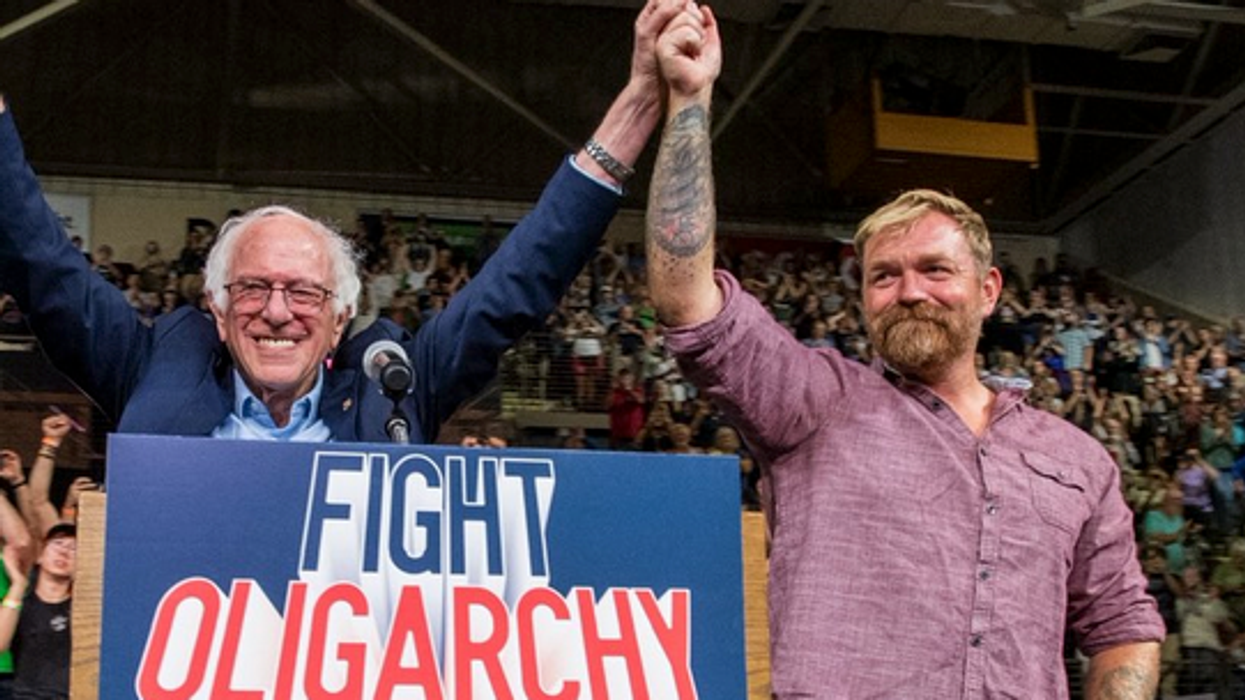
Saikat Chakrabarti built Justice Democrats, the organization that recruited and elected AOC by unseating a ten-term incumbent the Democratic establishment said was untouchable. He was her chief of staff. He wrote the Green New Deal. He took on the most powerful people in the party and won. He’s running for Congress again. Graham Platner is publicly calling for Chuck Schumer to step aside. He’s not just running his own race. He’s campaigning alongside Chakrabarti, alongside Abdul El-Sayed, alongside a growing list of candidates who are building a coalition before they even get to Washington. They’re rallying together, organizing together, building something real together. This isn’t hypothetical. It’s already underway.
These candidates are calling out corporate PAC money, calling out AIPAC, calling out the Iran war, calling out our own party’s leadership on the things that actually matter. They’re proving you can run without selling out before you even start.
But they’re not just running against the establishment. They’re running to stop the next great extraction. AI is going to do to the top 20% what offshoring and NAFTA did to factory workers. The project manager. The paralegal. The coder. The analyst. Same story, faster timeline. It doesn’t have to go that way. But the only path that doesn’t end there runs straight through public ownership. A share of the economy for every American. Because the more automated production becomes, whether it’s software or automobiles or medicine, the more important it is that it gets built here and that we own a piece of what it produces. The alternative is the Rust Belt, but for everyone.
We’re roughly 30% of the electorate. Independents who support healthcare, housing, a government that actually builds things, those people are with us in enormous numbers. What they don’t agree with is our leadership. What they don’t trust is our track record. What they’re waiting for is someone to actually mean what they say.
So the question is whether we’re going to back these people or keep doing what we’ve always done. Listening to party leaders and pundits and establishment political hacks tell us who to pick. Letting them convince us with their metrics and their models that we’re better off than we think we are. Letting them talk us out of believing our own eyes. They’ve been doing it for decades and we’ve been letting them and the results are sitting right in front of us.
This party belongs to us. Not to its donors. Not to its consultants. Not to its leadership. It’s time to squeeze it back toward our values and away from the people who’ve been writing the checks. We’ve got to be brave enough to back the people willing to break the cycle. With money. With hours. With our voices and our votes in primaries that most people ignore.
Moments like this don’t come around often. The candidates are there. The coalition is forming. Don’t let this one pass.
Let’s back the fighters.