
SUBSCRIBE TO OUR FREE NEWSLETTER
Daily news & progressive opinion—funded by the people, not the corporations—delivered straight to your inbox.
5
#000000
#FFFFFF
To donate by check, phone, or other method, see our More Ways to Give page.


Daily news & progressive opinion—funded by the people, not the corporations—delivered straight to your inbox.
Let me be blunt. This wasn't the world I imagined for my denouement. Not faintly. Of course, I can't claim I ever really imagined such a place. Who, in their youth, considers their death and the world that might accompany it, the one you might leave behind for younger generations? I'm 76 now. True, if I were lucky (or perhaps unlucky), I could live another 20 years and see yet a newer world born. But for the moment at least, it seems logical enough to consider this pandemic nightmare of a place as the country of my old age, the one that I and my generation (including a guy named Donald J. Trump) will pass on to our children and grandchildren.
Back in 2001, after the 9/11 attacks, I knew it was going to be bad. I felt it deep in my gut almost immediately and, because of that, stumbled into creating TomDispatch.com, the website I still run. But did I ever think it would be this bad? Not a chance.
I focused back then on what already looked to me like a nightmarish American imperial adventure to come, the response to the 9/11 attacks that the administration of President George W. Bush quickly launched under the rubric of "the Global War on Terror." And that name (though the word "global" would soon be dropped for the more anodyne "war on terror") would prove anything but inaccurate. After all, in those first post-9/11 moments, the top officials of that administration were thinking as globally as possible when it came to war. At the damaged Pentagon, Secretary of Defense Donald Rumsfeld almost immediately turned to an aide and told him, "Go massive -- sweep it all up, things related and not." From then on, the emphasis would always be on the more the merrier.
Bush's top officials were eager to take out not just Osama bin Laden's al-Qaeda, whose 19 mostly Saudi hijackers had indeed attacked this country in the most provocative manner possible (at a cost of only $400,000-$500,000), but the Taliban, too, which then controlled much of Afghanistan. And an invasion of that country was seen as but the initial step in a larger, deeply desired project reportedly meant to target more than 60 countries! Above all, George W. Bush and his top officials dreamed of taking down Iraqi autocrat Saddam Hussein, occupying his oil-rich land, and making the United States, already the unipolar power of the twenty-first century, the overseer of the Greater Middle East and, in the end, perhaps even of a global Pax Americana. Such was the oil-fueled imperial dreamscape of George W. Bush, Dick Cheney, Donald Rumsfeld, and crew (including that charmer and now bestselling anti-Trump author John Bolton).
Who Woulda Guessed?
In the years that followed, I would post endless TomDispatch pieces, often by ex-military men, focused on the ongoing nightmare of our country's soon-to-become forever wars (without a "pax" in sight) and the dangers such spreading conflicts posed to our world and even to us. Still, did I imagine those wars coming home in quite this way? Police forces in American cities and towns thoroughly militarized right down to bayonets, MRAPs, night-vision goggles, and helicopters, thanks to a Pentagon program delivering equipment to police departments nationwide more or less directly off the battlefields of Washington's never-ending wars? Not for a moment.
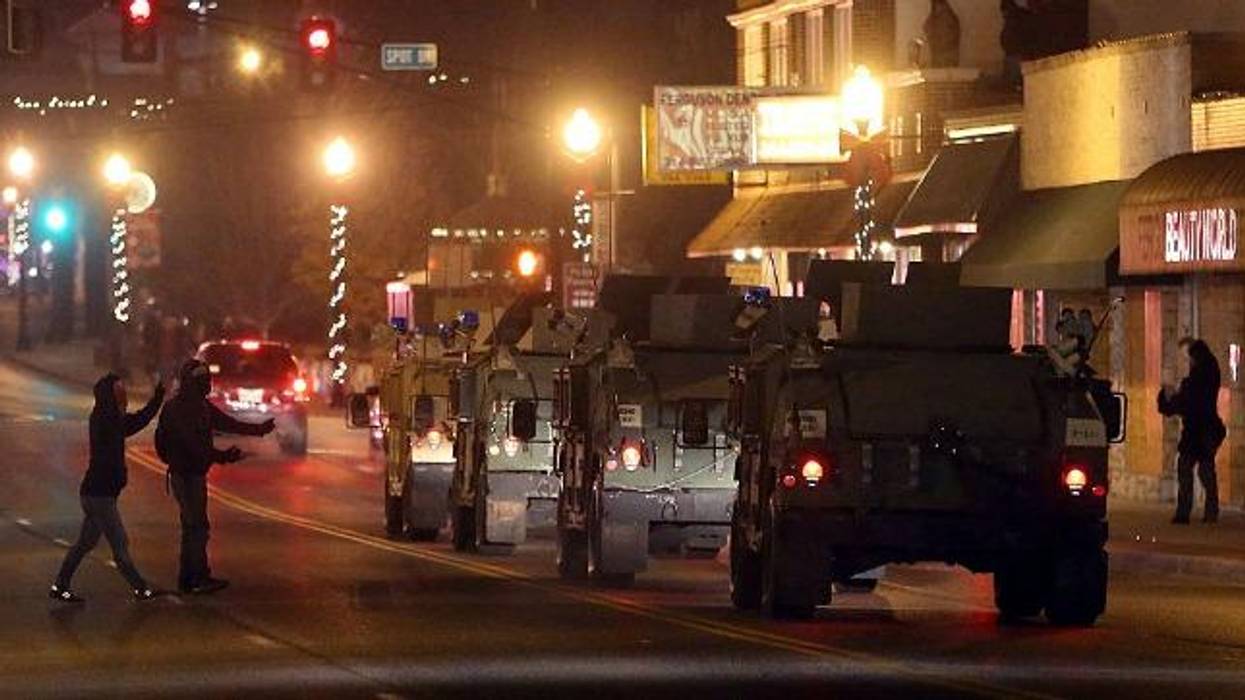
Who doesn't remember those 2014 photos of what looked like an occupying army on the streets of Ferguson, Missouri, after the police killing of a Black teenager and the protests that followed? And keep in mind that, to this day, the Republican Senate and the Trump administration have shown not the slightest desire to rein in that Pentagon program to militarize police departments nationwide. Such equipment (and the mentality that goes with it) showed up strikingly on the streets of American cities and towns during the recent Black Lives Matter protests.
Even in 2014, however, I couldn't have imagined federal agents by the hundreds, dressed as if for a forever-war battlefield, flooding onto those same streets (at least in cities run by Democratic mayors), ready to treat protesters as if they were indeed al-Qaeda ("VIOLENT ANTIFA ANARCHISTS"), or that it would all be part of an election ploy by a needy president. Not a chance.
Or put another way, a president with his own "goon squad" or "stormtroopers" outfitted to look as if they were shipping out for Afghanistan or Iraq but heading for Portland, Albuquerque, Chicago, Seattle, and other American cities? Give me a break! How un-American could you get? A military surveillance drone overhead in at least one of those cities as if this were someone else's war zone? Give me a break again. Never in my wildest dreams did I think I'd live to witness anything quite like it or a president -- and we've had a few doozies -- even faintly like the man a minority of deeply disgruntled Americans but a majority of electors put in the White House in 2016 to preside over a failing empire.
How about an American president in the year 2020 as a straightforward, no-punches-pulled racist, the sort of guy a newspaper could compare to former segregationist Alabama governor and presidential candidate George Wallace without even blinking? Admittedly, in itself, presidential racism has hardly been unique to this moment in America, despite Joe Biden's initial claim to the contrary. That couldn't be the case in the country in which Woodrow Wilson made D.W. Griffith's Birth of a Nation, the infamous silent movie in which the Ku Klux Klan rides to the rescue, the first film ever to be shown in the White House; nor the one in which Richard Nixon used his "Southern strategy" -- Republican presidential candidate Barry Goldwater had earlier labeled it even more redolently "Operation Dixie" -- to appeal to the racist fears of Southern whites and so begin to turn that region from a Democratic stronghold into a Republican bastion; nor in the land where Ronald Reagan launched his election campaign of 1980 with a "states' rights" speech (then still a code phrase for segregation) near Philadelphia, Mississippi, just miles from the earthen dam where three murdered civil rights workers had been found buried in 1964.
Still, an openly racist president (don't take that knee!) as an autocrat-in-the-making (or at least in-the-dreaming), one who first descended that Trump Tower escalator in 2015 denouncing Mexican "rapists," ran for president rabidly on a Muslim ban, and for whom Black lives, including John Lewis's, have always been immaterial, a president now defending every Confederate monument and military base named after a slave-owning general in sight, while trying to launch a Nixon-style "law and (dis)order" campaign? I mean, who woulda thunk it?
And add to that the once unimaginable: a man without an ounce of empathy in the White House, a figure focused only on himself and his electoral and pecuniary fate (and perhaps those of his billionaire confederates); a man filling his hated "deep state" with congressionally unapproved lackies, flacks, and ass-kissers, many of them previously flacks (aka lobbyists) for major corporations. (Note, by the way, that while The Donald has a distinctly autocratic urge, I don't describe him as an incipient fascist because, as far as I can see, his sole desire -- as in those now-disappeared rallies of his -- is to have fans, not lead an actual social movement of any sort. Think of him as Mussolini right down to the look and style with a "base" of cheering MAGA chumps but no urge for an actual fascist movement to lead.)
And who ever imagined that an American president might actually bring up the possibility of delaying an election he fears losing, while denouncing mail-in ballots ("the scandal of our time") as electoral fraud and doing his damnedest to undermine the Post Office which would deliver them amid an economic downturn that rivals the Great Depression? Who, before this moment, ever imagined that a president might consider refusing to leave the White House even if he did lose his reelection bid? Tell me this doesn't qualify as something new under the American sun. True, it wasn't Donald Trump who turned this country's elections into 1% affairs or made contributions by the staggeringly wealthy and corporations a matter of free speech (thank you, Supreme Court!), but it is Donald Trump who is threatening, in his own unique way, to make elections themselves a thing of the past. And that, believe me, I didn't count on.
Nor did I conceive of an all-American world of inequality almost beyond imagining. A country in which only the truly wealthy (think tax cuts) and the national security state (think budgets eternally in the stratosphere) are assured of generous funding in the worst of times.
The World to Come?
Oh, and I haven't even mentioned the pandemic yet, have I? The one that should bring to mind the Black Death of the fourteenth century and the devastating Spanish Flu of a century ago, the one that's killing Americans in remarkable numbers daily and going wild in this country, aided and abetted in every imaginable way (and some previously unimaginable ones) by the federal government and the president. Who could have dreamed of such a disease running riot, month after month, in the wealthiest, most powerful country on the planet without a national plan for dealing with it? Who could have dreamed of the planet's most exceptional, indispensable country (as its leaders once loved to call it) being unable to take even the most modest steps to rein in Covid-19, thanks to a president, Republican governors, and Republican congressional representatives who consider science the equivalent of alien DNA? Honestly, who ever imagined such an American world? Think of it not as The Decameron, that fourteenth century tale of 10 people in flight from a pandemic, but the Trumpcameron or perhaps simply Trumpmageddon.
And keep in mind, when assessing this world I'm going to leave behind to those I hold near and dear, that Covid-19 is hardly the worst of it. Behind that pandemic, possibly even linked to it in complex ways, is something so much worse. Yes, the coronavirus and the president's response to it may seem like the worst of all news as American deaths crest 160,000 with no end in sight, but it isn't. Not faintly on a planet that's being heated to the boiling point and whose most powerful country is now run by a crew of pyromaniacs.
It's hard even to fully conceptualize climate change since it operates on a time scale that's anything but human. Still, one way to think of it is as a slow-burn planetary version of the atomic bombings of Hiroshima and Nagasaki. And by the way, if you'll excuse a brief digression, in these years, our president and his men have been intent on ripping up every Cold War nuclear pact in sight, while the tensions between two nuclear-armed powers, the U.S. and China, only intensify and Washington invests staggering sums in "modernizing" its nuclear arsenal. (I mean, how exactly do you "modernize" the already-achieved ability to put an almost instant end to the world as we've known it?)
But to return to climate change, remember that 2020 is already threatening to be the warmest year in recorded history, while the five hottest years so far occurred from 2015 to 2019. That should tell you something, no?
The never-ending release of greenhouse gases into the atmosphere has been transforming this planet in ways that have now become obvious. My own hometown, New York City, for instance, has officially become part of the humid subtropical climate zone and that's only a beginning. Everywhere temperatures are rising. They hit 100 degrees this June in, of all places, Siberia. (The Arctic is warming at twice the rate of much of the rest of the planet.) Sea ice is melting fast, while floods and mega-droughts intensify and forests burn in a previously unknown fashion.
And as a recent heat wave across the Middle East -- Baghdad hit a record 125 degrees -- showed, it's only going to get hotter. Much hotter and, given how humanity has handled the latest pandemic, how will it handle the chaos that goes with rising sea levels drowning coastlines but also affecting inland populations, ever fiercer storms, and flooding (in recent weeks, the summer monsoon has, for instance, put one third of Bangladesh underwater), not to speak of the migration of refugees from the hardest-hit areas? The answer is likely to be: not well.
And I could go on, but you get the point. This is not the world I either imagined or would ever have dreamed of leaving to those far younger than me. That the men (and they are largely men) who are essentially promoting the pandemicizing and over-heating of this planet will be the greatest criminals in history matters little.
Let's just hope that, when it comes to creating a better world out of such a god-awful mess, the generations that follow us prove better at it than mine did. If I were a religious man, those would be my prayers.
And here's my odd hope. As should be obvious from this piece, the recent past, when still the future, was surprisingly unimaginable. There's no reason to believe that the future -- the coming decades -- will prove any easier to imagine. No matter the bad news of this moment, who knows what our world might really look like 20 years from now? I only hope, for the sake of my children and grandchildren, that it surprises us all.
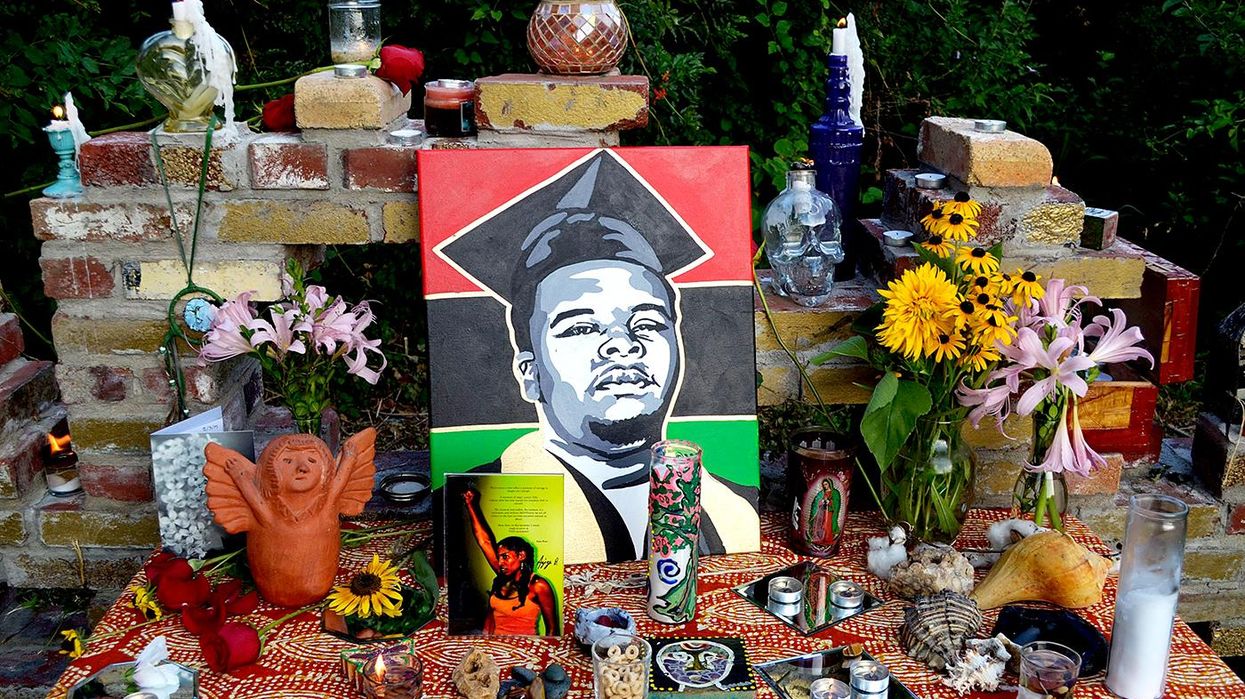
Michael Brown Sr. lies stock-still on his back on the floor of an art studio in St. Louis as an artist layers papier-mache on his arms, chest, and torso.
Brown Sr. is a stand-in, the model for a life-size replica that St. Louis artist Dail Chambers is creating to represent Michael Brown Jr.--his deceased son.
In the days and weeks that followed, other artists added their own interpretations to the cast, and community leaders, family, friends, and activists affixed messages of remembrance, of hope, as well as photos and tributes to Brown Jr.
"Although everybody else has left since your death, we are still here fighting," one 16-year-old girl wrote.
The final exhibit, called "As I See You," will be part of a memorial Aug. 9-11 for Brown Jr., five years after a police officer took the 18-year-old's life in Ferguson, Missouri.
The memorial weekend's events will include a private unveiling of the exhibit for the family members of 25 victims of police killings across the country, and will coincide with the first national reparations convening in Ferguson, beginning Aug. 8.
Brown Jr. was not the first unarmed Black man killed by a White police officer. But his death on Aug. 9, 2014, grabbed the world's attention, exposing long-festering issues of race and inequality in the United States and bringing new energy to a simmering Movement for Black Lives.
In death, Brown Jr. became a household name, and the small, mostly Black city where he died became the movement's ground zero. Both will be forever linked to the tragedy and trauma around police shootings and the will of a frustrated people to rise up against injustice.
For more than four hours, Brown Jr.'s lifeless body lay uncovered on the street where he fell, blood flowing from his head as bystanders watched in horror and outrage. For weeks following the shooting, and months after a St. Louis grand jury failed to indict officer Darren Wilson, protests and demonstrations engulfed the region.
Images on television and on social media caught the sporadic violent clashes between demonstrators and police, who used tear gas and armored vehicles intended for war zones to try to control the crowds.
"The media spent so much time dehumanizing Mike, people forgot he was somebody's brother, somebody's son, somebody's cousin."
"People, protestors were coming in from all over ... coming to ground zero to stand up for what they believed in," Brown Sr. says. "We are so grateful to them for making this happen, for having the courage to know it was wrong and to stand up for their beliefs. Before Mike, this kind of thing was mostly swept under the rug; now it's happening almost all the time."
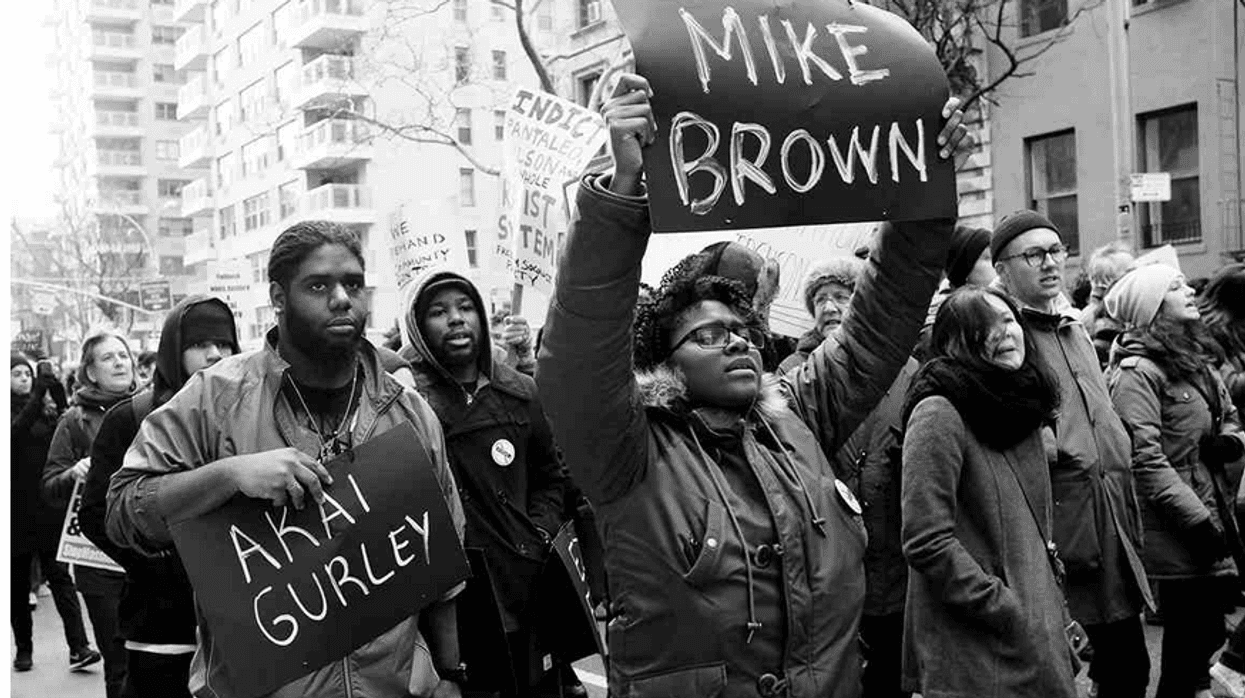
The Ferguson Uprising raised awareness around the level of racial disparity on issues from policing and mass incarceration to economics--not just in that region, but across the country.
And in the months and years afterward, protests and demonstrations elsewhere would follow police shootings of other Black people whose names many have now come to know: Philando Castile, Tamir Rice, Freddie Gray, Eric Harris, Terence Crutcher, Walter Scott, Sandra Bland, Antwon Rose, and on.
David Ragland, cofounder of the Truth Telling Project of Ferguson, which got its start in the early days of the Uprising, described the spontaneity of protests that grew out of the shootings as moments that built into movements.
"Each generation has its own way, and Ferguson questioned the entire American project," Ragland says. "These were people from marginalized communities demanding human rights, human dignity ... They were average people--nurses, postal workers, people who came out because they were tired--saying we are good people, we deserve dignity."
For years, Cal Brown thought about how she might honor and keep alive the memory of her stepson, who was a recent high school graduate and had been preparing to begin vocational training classes just two days before he was killed. At the same time, she wanted to acknowledge and give voice to those who saw his death as a catalyst for change.
As the fifth anniversary neared, she searched for ways to do both.
"The media had spent so much time dehumanizing Mike, people forgot he was somebody's brother, somebody's son, somebody's cousin," Brown says. "So many people say, 'I love Mike Brown; he belongs to me.' I wanted to take the time and show people why they love this young man."
Collaborating with Elizabeth Vega, a St. Louis "artivist" (artist and activist) who uses art to empower and inspire change, she settled on the idea of using Brown Jr.'s father as the model for a body cast of his son. Chambers, a local artist, would create the cast.
The new exhibit would also help to counter a controversial one in a Chicago museum in 2015 that graphically depicted Michael Brown Jr.'s death scene. Already, Brown says, other venues across the country have started requesting "As I See You."
Brown Sr. recalls his reaction when his wife first suggested the idea of using his body as a model for the cast. "It took me a minute," he said. "I went outside and smoked a cigarette to get my mind together, get myself together to prepare for it."
Police have been shooting unarmed people long before cases like Brown Jr.'s called attention to the injustice of it. A Washington Post database has recorded about 1,000 fatal police shootings each year since 2015, when the paper first began tracking them--4,453 fatal shootings in total. Just under one-quarter of the victims have been Black.
In that time, 58 officers were charged and 13 convicted of murder or manslaughter, says Philip Stinson, a criminologist at Bowling Green State University who tracks and studies arrests of police nationwide.
"Between 900 and 1,000 times each year, on-duty police officers across the U.S. shoot and kill someone," Stinson says. "And yet, only a few times each year is an officer charged with murder or manslaughter resulting from one of those shootings."
Based on his research, Stinson says the number of officers charged since 2005 in any given year has varied from zero to 18; any increase in recent years is not statistically significant. Basically, he says, "it's business as usual in the police subculture."
Just last month, after a five-year civil rights investigation, federal prosecutors announced they would not bring charges against Staten Island police officer Daniel Pantaleo, who applied a department-banned chokehold, killing Eric Garner a month before Brown Jr. was shot in 2014.
With a grand jury also declining to bring charges, the most severe punishment Pantaleo faces is termination from his job. He was suspended after an administrative judge recommended he be fired.
The dying gasps of "I can't breathe" by the father of six became a rallying cry in nationwide protests.
In the five years since Garner's and Brown Jr.'s deaths, heightened activism by the Movement for Black Lives and more extensive national discourse have raised awareness around issues of police accountability and use of force--particularly when it comes to people of color.
President Barack Obama, who appealed for calm following Brown Jr.'s death and the nonindictment of Wilson, created the President's Task Force on 21st Century Policing in December 2014. The following spring, it issued a report that called for the removal of policies that reward police for producing more arrests and convictions, and for independent prosecutors to investigate civilian deaths in police custody or in officer-involved shootings.
In 2015, the U.S. Department of Justice issued a scathing report on Ferguson, highlighting how disproportionate enforcement by courts and the police, intended to generate city revenue, targeted African Americans. In a city where Black people make up two-thirds of the population, the 54-person police force had only four African Americans.
That report led to a consent decree between the Justice Department and the city requiring body camera use for police officers, use-of-force policies, and a municipal court overhaul.
The police chief in place during the Uprising and the city manager and municipal judge were all forced out of their jobs. In 2015, residents elected two Black city council members, and last year replaced the prosecutor who declined to charge Wilson in Brown Jr.'s death.
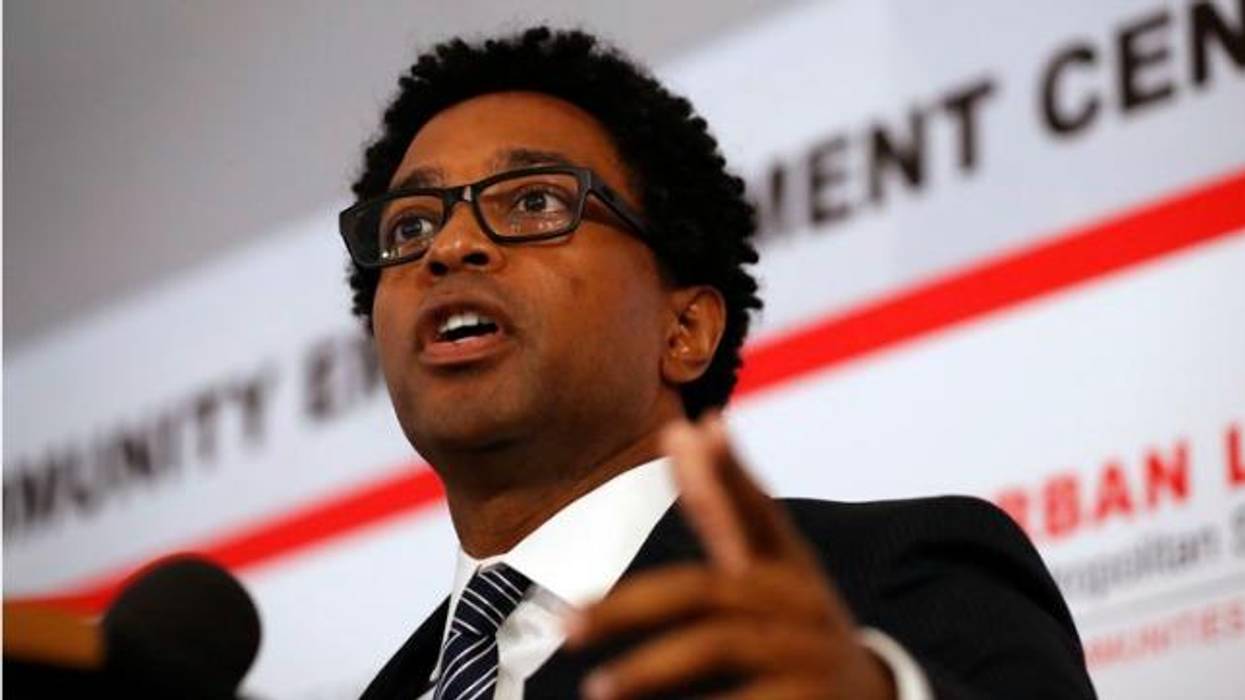
In his place, they elected Wesley Belle, a progressive African American lawyer who understood the system needed to "change from the inside."
The dying gasps of "I can't breathe" by the father of six became a rallying cry in nationwide protests.
Last June, the city appointed a Black police chief--a police captain from the Atlanta suburb of Forest Park.
Residents appear to have mixed feelings about how far the city has come in five years.
Cathy "Mama Cat" Daniels of the activist group Potbangerz, whose organizing around housing and feeding the unhoused began with the Uprising, says she'd hoped the community would be further ahead given "all that we did on the streets and are still fighting for."
She feels hopeful, though. "We have a lot of young Black folks who went from protest to politics and doing some dope, amazing stuff," she says. "They are fighting hard, but we need some people power behind them."
And while applauding the political progress, Ragland says that real substantial change has yet to be seen. Black people in the region are still more likely to be targeted for enforcement, he says.
Pointing to the recent decision in the Garner case, Ragland adds: "We now have a federal government that is less willing to hold law enforcement accountable."
"I think there's a deep power imbalance between law enforcement and everyday citizens," he says. "And I don't think it's helpful for a democracy."
Brown Sr. is also working to help empower and uplift young people through the Michael Brown Chosen for Change Foundation, which he and his wife, Cal, formed the year after his son's death.
It is one of many ways the elder Brown is working to preserve his son's memory.
Through the group Conscious Campus, Ragland and Brown Sr. have been working together to take the story about what happened in Ferguson five years ago to college campuses across the country. The idea is to fill the gaps and correct the misinformation that exists, Brown Sr. says.
He and Brown Jr.'s mother, Leslie McSpadden, were featured in the 2017 documentary about the shooting, Stranger Fruit. And in 2014, the two traveled to Geneva to testify before the United Nations Committee Against Torture.
Brown Sr. is hopeful that the sculpture will be a lasting reminder of the promise of youth and the potential for change.
"Everything is a process," he says. "Just us making noise and standing together and getting in the right rooms and having these discussions, I can see it moving forward. But there's still a lot of work to be done."
This is hardly a surprise: A recent study by the Missouri attorney general's office shows that black drivers are at least twice as likely -- in some towns, much more than that -- to be stopped by police as white drivers.
And a few days before the study came out, something called the Plain View Project hit the news. The project, an exhaustive, two-year analysis of social media posts by some 2,800 police officers and 700 former officers, from police departments across the country, revealed another non-surprise: a racist subculture permeates American police forces.
The researchers "found officers bashing immigrants and Muslims, promoting racist stereotypes, identifying with right-wing militia groups and, especially, glorifying police brutality," according to the Associated Press.
Thousands of such posts -- from officers' personal Facebook pages (and thus public) -- can be seen at the Plain View website. The comments, such as the one at the top of this column, are raw and unconstrained by political correctness. Other examples:
"It's a good day for a choke hold."
"Death to Islam."
"If the Confederate flag is racist, then so is Black History Month."
The implications of all this won't go away by simply implementing stricter PC in the ranks -- "Officers, you must hide your prejudices!" -- but rather, they cut to the core of how we maintain and, indeed, how we define, social order. We define it militarily, which means, ipso facto, we require an enemy who has to be repressed so that "we" can feel safe.
Thus a story like this, reported by ABC News, is typical, not unusual:
"A Chicago mother is accusing Chicago police of using excessive force on her family, including her 8-year-old son, who officers allegedly handcuffed and left in the freezing rain for 40 minutes, according to a federal civil rights lawsuit filed against the Chicago Police Department."
In March, on a day when it was 32 degrees and raining, the police awakened the family via bullhorn at 6 a.m. in order to execute a search warrant, which alleged that one of the boys living in the house was in possession of an assault rifle. The officers, wielding assault rifles themselves, marched the family, including a number of children, out of the house, where the adults and the 8-year-old boy were handcuffed and forced to stand in the rain while the police searched the house. No assault rifle was found and no one was arrested. However:
"Officers also allegedly damaged or destroyed personal property and 'shouted profanity and insults at the family'. . . according to the lawsuit."
And, oh yeah: the family was African-American.
The plaintiff's attorney, summing up the military mindset driving the incident, said at a news conference: "Chicago Police officers behave as if our children of color and their trauma is collateral damage."
The raid, in short, took place in a warzone. It was the South Side of Chicago, but it could have been Iraq.
Feel safer?
All of this adds up to a serious national need to rethink how we protect ourselves and establish social order. Right now we're doing so with an occupying army, a product of the white man's history of colonialism, slavery and conquest.
All of this adds up to a serious national need to rethink how we protect ourselves and establish social order. Right now we're doing so with an occupying army, a product of the white man's history of colonialism, slavery and conquest. The occupying army serves the rich and well-off -- and it does so, when necessary, behind the barrel of a gun, which is the country's ultimate symbol of authority. When the gun is out, this authority supersedes any other civil right, like freedom of speech.
And then you need to add into the mix the fact that power corrupts. Remember Ferguson, Mo., where 18-year-old Michael Brown was shot and killed by a police officer in 2014 because he wasn't walking on the sidewalk? When the U.S. Department of Justice dug more deeply into the matter, it found that "the department was targeting black residents and treating them as revenue streams for the city by striving to continually increase the money brought in through fees and fines," according to Vanity Fair.
"'Officers expect and demand compliance even when they lack legal authority,' the report's authors wrote. 'They are inclined to interpret the exercise of free-speech rights as unlawful disobedience, innocent movements as physical threats, indications of mental or physical illness as belligerence.'"
Fascinatingly, a different vision of social order emerged during the protests that followed Michael Brown's shooting. Ron Johnson, a captain in the Missouri Highway Patrol, was appointed commander of operations shortly after the Ferguson protests began and, rather than playing the usual game of militarized intimidation, reached out to the grieving and outraged community and actually marched with the protesters.
A different sort of future momentarily opened: one with a unity of understanding. The police got it; they saw the need for change, for sanity, for justice. They weren't, my god, afraid of the protesters, freaked out by the welling crowds of people demanding change. This lasted all of two days, when the governor relieved Johnson of command.
Later, a DoJ report shredded Johnson because of his "extensive community engagement efforts. . . . As a result, he was less engaged in day-to-day, hour to-hour incident command responsibilities and instead became the public face for the police response. As a result, the full responsibilities of incident command were often not executed. This resulted in a diminished ability to spend time monitoring the changes in staffing needs, to provide direction for command, and to engage in effective communications with commanders and deployed personnel."
Notice the military-speak! Lots of Johnson's fellow officers were outraged and deeply critical of him. He didn't act like the commander of an armed bureaucracy. He marched with the enemy.
On Tuesday, in what will go down as one of the most stunning political upsets in St. Louis County history, Wesley Bell, a criminal justice reform advocate, unseated Bob McCulloch in the Democratic primary for the St. Louis County Prosecutor's seat. McCulloch, an incumbent who has been in office for nearly three decades, is best remembered as the prosecutor responsible for overseeing the grand jury proceedings that resulted in the 2014 non-indictment of officer Darren Wilson in the killing of Ferguson teenager Michael Brown. As we mark the four-year anniversary of Brown's death this week, McCulloch's dismissal is historic and a symbol of the power of a broader movement.
There are four important lessons from what happened on Tuesday night.
First, the story of Bell's victory is the story of how local Black communities can use the ballot box as a tool for greater accountability. It is fair to suggest that Bell's win was less about him and more about repudiating the legacy of McCulloch and the long history of state-sanctioned disregard for Black and brown lives. The story of McCulloch's defeat is, in part, the story of how local communities can continue to use tragedies that are the result of state action as the catalyst for small political revolutions.
Second, Bell's win calls into question what has become a popular talking point ahead of the 2018 midterms: the idea that Democratic candidates must remain "moderate" or "right-of-center" if they hope to be successful in the Midwest or the south. Bell's positions such as eliminating cash bail for nonviolent offenders and opposing new mandatory minimum sentencing laws were far to the left of his more "moderate" Democratic opponent. His sizable win over McCulloch shows that Democratic candidates on the left are viable even in traditionally more conservative leaning states such as Missouri.
Third, Bell's win is testimony to the power of grassroots social movements. Tuesday's primary is yet more evidence of the verifiable impact of the movement for Black lives on today's political landscape. The emergence of Bell as a candidate for St. Louis County Prosecutor must be situated in the broader historical context of how the death of Michael Brown helped galvanize a new era of organized resistance in Ferguson/St. Louis County and throughout the nation. This is not to say that such resistance was not going on long before 2014. It is simply to acknowledge that the Ferguson uprisings of 2014 marked an important tipping point in the history of local resistance in St. Louis County.
Many of the positions that Bell ran on have been central issues of concern for local organizers for years following the death of Brown. Without them, Bell's candidacy would have been a political impossibility. McCulloch's defeat would have been inconceivable had it not been for the work over the past four years by local Black-led resistance groups such as the Ferguson Collaborative, the Organization for Black Struggle, the St. Louis Reform Coalition, Millennial Activists United, Lost Voices Faith in Action, and Hands Up United, to name only a few. Action St. Louis, a Black millennial led organization co-founded by activist Kayla Reed in 2014, deserves special acknowledgement for its role in Bell's victory. The organization's #WokeVoterSTL and #ByeBob campaigns, as well as their unrelenting organizing efforts, undoubtedly played a key role in McCullough's defeat.
Finally, the rejection of McCulloch must be viewed as being part of a broader national movement led by Black millennials, Black women, and Black queer folks to rid America of corrupt prosecutors. As I've written previously, the ousting of McCulloch comes after of the ousting of Anita Alvarez in Chicago and the ousting of Angela Corey in Florida. Prosecutors have the power to end mass incarceration in their communities. That's why groups committed to reforming America's criminal justice system --- including the ACLU Campaign for Smart Justice --- have invested across the country in voter education and mobilization efforts in local prosecutor races like the one in St. Louis County. Progressive prosecutors can set positive, proactive agendas that prioritize the people in their communities rather than prisons.
As we move toward the midterm elections of 2018, we would do well to pay attention to the continued influence of the movement for Black lives on local elections and on the changing face of criminal justice reform in America.
In a remarkable upset victory that could have a "transformative" effect on St. Louis's deeply racist criminal justice system, progressive reformer and Ferguson city council member Wesley Bell on Tuesday handily defeated 27-year Democratic incumbent Bob McCulloch in the race to become St. Louis County's top prosecutor.
"Wesley Bell and an amazing team of volunteers ousted a 27 year incumbent! With his win tonight St. Louis County Prosecutor-elect Bell is breaking through decades of corruption and systemic racism in the criminal justice system."
--Democracy for America
McCulloch became "notorious" nationwide after his refusal to prosecute police officer Darren Wilson for killing 18-year-old Michael Brown in 2014--an event that sparked weeks of protests and galvanized the Black Lives Matter movement.
As Huffington Post senior reporter Matt Ferner noted on Twitter, Tuesday's race was widely viewed as a "referendum on McCulloch's handling" of the Michael Brown case, and voters decided that it is time for a radical change.
Bell--who is expected to coast in November's general election, as there are no Republicans on the ballot--ran on an ambitious and straightforward agenda centered around ending mass incarceration, eliminating cash bail, expanding treatment for drug abuse and mental illness, and ending the deeply harmful practice of harshly punishing non-violent drug and property offenders.
"If we're going to push these changes, I need you to be a part of that too," Bell told supporters during his victory speech late Tuesday. "Lets keep this momentum going. So we can bring change to this county; so that we can be change that's not only going to make people safer, but help people, help families. This is too important, this matters too much, so let's keep moving and pushing St. Louis County, the region, the country, forward. Thank you so much."
In a statement applauding Bell's upset win, Democracy for America chair Jim Dean said his success "shows us that voters are hungry for prosecutors who understand the structural racism that undergirds our criminal justice system and are committed to delivering on reforms that can fundamentally alter it."
"We can't fundamentally reform our criminal justice system if we don't change our criminal prosecutors, and that's exactly what St. Louis County is poised to do," Dean concluded.
In what critics are characterizing as a "dangerous" move in the direction of a fully militarized police force, the Trump administration is reportedly gearing up to reverse a partial ban on the transfer of surplus military equipment to police departments, according to documents obtained by USA Today.
"The president's decision to make this change in the wake of the tragedy in Charlottesville reflects this administration's now open effort to escalate racial tensions in our country."
--Janai Nelson, LDF
Civil rights groups immediately raised alarm. Janai Nelson, associate director-counsel at the NAACP Legal Defense Fund (LDF), said in a statement Sunday night that the Trump administration's plan would "give law enforcement unfettered access to equipment that has been used to intimidate communities of color, with little to no training or oversight."
Attorney General Jeff Sessions is expected to officially outline the administration's decision in a speech on Monday to the Fraternal Order of Police, America's largest police union.
The New York Times noted that it is "not immediately clear why Mr. Sessions would announce changes to a Pentagon program, but he has rolled back several Obama-era policing reforms and helped bolster the Trump administration's support among law enforcement."
"The new plan," explains USA Today's Kevin Johnson, "would roll back an Obama administration executive order that blocked armored vehicles, large-caliber weapons, ammunition, and other heavy equipment from being re-purposed from foreign battlefields to America's streets."
Johnson continued:
The administration's action would restore "the full scope of a longstanding program for recycling surplus, lifesaving gear from the Department of Defense, along with restoring the full scope of grants used to purchase this type of equipment from other sources,'' according to a administration summary of the new program recently circulated to some law enforcement groups.
Limits on the transfer of excess military equipment to local police departments were first implemented by former President Barack Obama in 2015 following outrage and widespread criticism of law enforcement's militaristic response to protests over the police killing of Michael Brown in Ferguson, Missouri in 2014.
"[L]ocal authorities... have employed armored vehicles, noise-based crowd-control devices, shotguns, M4 rifles like those used by forces in Iraq and Afghanistan, rubber-coated metal pellets, and tear gas," the Washington Post reported at the time.
Announcing his decision to impose restrictions on what equipment police can receive from the military, Obama said: "We've seen how militarized gear can sometimes give people a feeling like they're an occupying force, as opposed to a force that's part of the community that's protecting them and serving them."
"Welp. There's the fascism."
--Emily Gorcenski
Trump said he wished police officers would be more "rough" with suspects--a comment that was widely condemned as a presidential endorsement of police brutality.
Commentators responded to indications that Trump is looking to further militarize U.S. police with similar alarm.
"What you saw in Ferguson is what the Trump administration is proposing for all police in the U.S.," wrote Buzzfeed's Jason Leopold.
"It is both exceptionally dangerous and irresponsible for the administration to lift the ban on the transfer of certain surplus military equipment to state and local law enforcement organizations. Just a few summers ago, our nation watched as Ferguson raised the specter of increased police militarization," added LDF's Janai Nelson. "The president's decision to make this change in the wake of the tragedy in Charlottesville and against a backdrop of frayed relations between police and communities of color further reflects this administration's now open effort to escalate racial tensions in our country."
Attorney General Jeff Sessions on Monday ordered a sweeping review of police accountability agreements, prompting a wave of criticism from civil and human rights groups.
Sessions' order means that the Department of Justice (DOJ) may stop using consent decrees that aimed to address police brutality and other institutional problems, or refrain from fully implementing the ones that exist. The attorney general previously opposed the agreements, which are considered a legacy of the Obama administration.
The move is "a clear indication that [Sessions'] Department of Justice is moving toward abandoning its obligations to uphold federal civil rights laws through consent decrees," said Wade Henderson, president of the Leadership Conference on Civil and Human Rights.
"Consent decrees are a crucial tool in the Justice Department's enforcement of civil rights in a variety of areas, including addressing police misconduct. They are only issued after careful study, review, and approval by a federal judge, often after a determination that law enforcement acted in an unconstitutional manner," Henderson said. "These latest developments are particularly ironic given that in the same memo outlining a review of these vital consent decrees, Attorney General Sessions also noted that 'local law enforcement must protect and respect the civil rights of all members of the public.'"
In a memorandum dated March 31 and made public Monday, Sessions directed his staff to review whether police departments are adhering to principles put forth by the Trump administration, including one that states "the individual misdeeds of bad actors should not impugn" police officers from "keeping American communities safe."
"The underlying issues that consent decrees address have not disappeared."
--Wade Henderson,
Leadership Conference on Civil and Human Rights
Many saw the order as a signal that the rightwing White House would disregard recent gains in improving relations between law enforcement and communities of color, an issue that gained public traction since the 2014 Ferguson, Missouri protests.
The Obama administration ordered a comprehensive review of numerous police departments throughout the U.S., which uncovered an unsurprising epidemic of institutional racism and police brutality against people of color.
"Yesterday, the Department of Justice proved what we have known all along: Attorney General Jeff Sessions has no regard for civil and human rights," Rep. Barbara Lee (D-Calif.) said Tuesday. "The decision to target police reforms that have been negotiated with police departments with a documented history of civil rights violations is reprehensible. Let me be clear, this review marks the first step in the Trump administration's misguided 'law and order' agenda that will blunt the progress we made on police reform under President [Barack] Obama's leadership."
"We simply cannot afford to turn back the clock on reforms that prevent innocent black women and men from being gunned down in the streets," Lee said. "The time to resist is now. As a member of the Appropriations Committee, I will fight to block funding for any effort to thwart the urgent need for police reform."
The New York Times reported:
As part of its shift in emphasis, the Justice Department went to court on Monday to seek a 90-day delay in a consent decree to overhaul Baltimore's embattled police department. That request came just days before a hearing, scheduled for Thursday in the United States District Court in Baltimore, to solicit public comment on the agreement, which was reached in principle by the city and the Justice Department in the waning days of the Obama administration.
Ray Kelly, the president of the Baltimore-based No Boundaries Coalition, a citizen advocacy group, told the Times, "This has all been negotiated by the affected parties. Now we have an outside entity telling us what's best for our citizens and our community when he has no experience, no knowledge."
Baltimore was one of several cities, including Ferguson; Cleveland, Ohio; and Seattle, Washington that were part of the Obama administration's efforts to reform relations, after DOJ investigations found systemic issues. The Baltimore consent decree was reached after protests over the police killing of Freddie Gray revealed systemic racial profiling and other discriminatory tactics.
Likewise, David Rocah, senior staff attorney for the American Civil Liberties Union (ACLU) of Maryland, said, "Why is everyone in Baltimore ready to move forward with police reform except Donald Trump's Department of Justice? The Trump administration's move to put off a long-planned public hearing, where the court was going to hear directly from Baltimore residents about their views of the Baltimore Police Department, and the necessity of a consent decree as part of the reform process, is a slap in the face to the people of Baltimore."
"And it is a clear sign that the Trump administration is seeking to undo, and walk away from, the consent decree that is a critical part of reforming Baltimore's police department," Rocah said.
Henderson continued, "The underlying issues that consent decrees address have not disappeared. The attorney general would do well to remember that he must serve the public, and continue to use every tool at his disposal to support police practices that preserve life and protect all."
Three major social media networks helped police target activists throughout the country during tense protests against police brutality and racism, according to a new post by the American Civil Liberties Union (ACLU) published Tuesday.
The ACLU of California obtained records showing that Facebook, Twitter, and Instagram provided special user information, like location data, to the developer of a "social media monitoring product" often used by police to spy on protesters. The group found that police used the product to track high-profile protests in Ferguson, Missouri and Baltimore, Maryland, as well as cities throughout California, from Oakland to Riverside.
In its marketing materials, the developer, known as Geofeedia, referred to unions and activist groups as "overt threats" and explicitly referred to the ways police could use its tools to monitor anti-brutality protests.
Although all three companies took steps to restrict the company's access to their data after the ACLU reported its findings to them, "further steps are required" if the companies want to fulfill their promises to users of protecting free speech, the organization said, noting that by targeting activists or groups seeking to protest racial injustice, law enforcement--and the private companies that help them--are potentially violating constitutional rights.
In one email to a police department, a Geofeedia representative promotes a particular feature that they say "covered Ferguson/Mike Brown nationally with great success."
The revelations also provide further evidence that social media monitoring is spreading quickly and could disproportionately impact communities of color, ACLU added. The organization's post comes on the heels of an expose by Bloomberg that a private company had helped Baltimore police secretly spy on residents from the air, using small planes equipped with military-grade cameras.
"These platforms need to be doing more to protect the free speech rights of activists of color and stop facilitating their surveillance by police," Nicole Ozer, ACLU-CA's technology and civil liberties policy director, told the Washington Post. "The ACLU shouldn't have to tell Facebook or Twitter what their own developers are doing. The companies need to enact strong public policies and robust auditing procedures to ensure their platforms aren't being used for discriminatory surveillance."
To that end, the ACLU, the Center for Media Justice, and Color of Change sent letters (pdf) to the companies urging them to "commit to concrete changes" to protect users, including cutting off access of data to developers of monitoring tools, adopting transparent policies, and implementing stronger oversight of developers.
"In the digital age, social media has become a powerful platform to expose human rights abuses and connect across issue and geography. However, these data deals enable dangerous police surveillance that weakens this platform's power, chills free speech, and threatens democratic rights," the letters read.
Across the country on Tuesday, community members, activists, racial justice advocates, and others held a global moment of silence to mark two years since the killing of Mike Brown Jr., whose death at the hands of a Ferguson, Missouri police officer sparked a national call for change--a moment that many say has yet to arrive.
"On Saturday, August 9, 2014, the entire world was impacted by the murder of Michael Brown Jr.," wrote the Chosen for Change foundation, created in his honor. The group asked supporters to be silent for four and a half minutes, beginning at 11:55am CDT, to represent the four and a half hours Brown "laid on the hot street in the middle of Canfield Green Apartments in Ferguson, Missouri."
Brown, a black 18-year-old, was unarmed when he was shot by white officer Darren Wilson. His brutal and unnecessary death prompted fierce community protests and national outrage from a community that had long been the victim of systemic discrimination and abuse by the U.S. criminal justice system.
"Hands Up, Don't Shoot" and "Black Lives Matter" became the national rallying cry to address those grievances, and the movement swiftly followed.
As people shared their mourning and reflections on social media, many expressed how Brown himself "doesn't know it but ... changed all of our lives & sparked a revolutionary fire that will never be extinguished," as activist Delo Taylor put it.
Similarly, columnist Kristen West Savali wrote at The Root on Tuesday:
There have been many apt comparisons made between the Watts rebellion of 1965 and the Ferguson uprising, which happened almost 50 years later to the day. Still, the small Missouri town became this generation's Selma, Ala., a sacred place, a mecca to which social-justice warriors felt compelled to trek. Michael Brown became our Jimmie Lee Jackson, Darren Wilson became James Bonard Fowler and we became filled with the "fierce urgency of now."
My feelings this time last year were clear: "The anger--hot, hard, fast--intensified until the words '[F-k] the police' burst free. That guttural call-to-arms, which has seared the Hip-Hop generation's consciousness since N.W.A. put our collective frustration into words, found a home amid the cacophony of rage building on social media and the streets of Ferguson where a community unchained refused to be silenced, even as police tanks and dogs tried their best to intimidate them."
Those feelings remain firmly intact.
New York Daily News columnist Shaun King shared on Twitter his thoughts on Brown's "deeply unjust" killing, adding: "I do believe that #MikeBrown is a martyr. His death, and the injustice surrounding it, sparked the movement we are in right now."
In a series of tweets, activist and St. Louis native Brittany Packnett, recalled how she had "never seen such courage" as she did in the Ferguson protesters while organizer DeRay McKesson compiled a visual history of how the movement unfolded in the wake of Brown's killing.
"We're still fighting for you," the Black Youth Project promised. "Rest powerfully."
Indeed, others--including Erica Garner, whose father Eric was also killed by New York City police--noted how the fight for racial justice has yet to provide substantial change.
On Tuesday, mourners left bears with the names of other black victims of police brutality at the site where Brown was killed.
On Monday, the U.S. Supreme Court ruled that evidence recovered during illegal stops may still be used in court if police officers conducted their searches after learning that a defendant had an outstanding arrest warrant.
In a 5-3 ruling (pdf), the Supreme Court said such searches do not violate the Fourth Amendment, which protects against "unreasonable searches and seizures." Justice Sonia Sotomayor, who dissented, slammed the decision, writing in a sharp rebuke that the case "tells everyone, white and black, guilty and innocent...that your body is subject to invasion while courts excuse the violation of your rights."
Justices Elena Kagen and Ruth Bader Ginsburg also dissented.
The case is Utah v. Strieff, in which a police officer stopped defendant Edward Strieff because were later ruled to be inadequate; during the stop, the officer discovered Strieff had an outstanding warrant for a traffic violation and conducted a search--discovering methamphetamines and drug pipe. A district court later ruled that although Utah Detective Douglas Fackrell did not have the right to stop Strieff, the evidence collected during the search could be used in a trial.
In her dissent, Sotomayor wrote, "Most striking about the Court's opinion is its insistence that the event here was 'isolated,' with 'no indication that this unlawful stop was part of any systemic or recurrent police misconduct.'" But in fact, she continued, "Nothing about this case is isolated."
Citing Michelle Alexander's The New Jim Crow and Ta-Nehisi Coates' Between the World and Me, among others, Sotomayor wrote:
For generations, black and brown parents have given their children "the talk"--instructing them never to run down the street; always keep your hands where they can be seen; do not even think of talking back to a stranger--all out of fear of how an officer with a gun will react to them.
By legitimizing the conduct that produces this double consciousness, this case tells everyone, white and black, guilty and innocent, that an officer can verify your legal status at any time. It says that your body is subject to an invasion while courts excuse the violation of your rights. It implies that you are not a citizen of a democracy but the subject of a carceral state, just waiting to be cataloged. We must not pretend that the countless people who are targeted by police are "isolated." They are the canaries in the coal mine whose deaths, civil and literal, warn us that no one can breathe in this atmosphere. They are the ones who recognize that unlawful police stops corrode all our civil liberties and threaten all our lives. Until their voices matter too, our justice system will continue to be anything but.
Sotomayor also noted that 76 percent of the population of Ferguson, Missouri--which has been under the national spotlight since the 2014 police killing of unarmed black teen Michael Brown--has outstanding warrants against them. The unconstitutional policies endemic within the city's justice system have been widely reported.
"This case allows the police to stop you on the street, demand your identification, and check it for outstanding traffic warrants--even if you are doing nothing wrong," she wrote.
The ACLU said on Twitter that it was "deeply disappointed" by the ruling and warned that it would have "terrible repercussions, [especially] for people of color." The organization also praised Sotomayor's "much-needed" dissent for highlighting the decision's racial impact.