SUBSCRIBE TO OUR FREE NEWSLETTER
Daily news & progressive opinion—funded by the people, not the corporations—delivered straight to your inbox.
5
#000000
#FFFFFF
To donate by check, phone, or other method, see our More Ways to Give page.
Daily news & progressive opinion—funded by the people, not the corporations—delivered straight to your inbox.
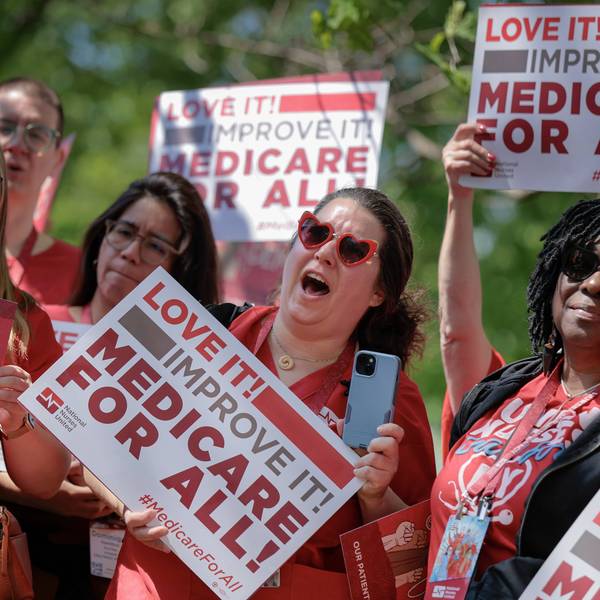
Mingling among the doctors, nurses and activists at the single payer conferences in Chicago this weekend was one Richard Master.
Master is the owner and CEO of MCS Industries Inc., the nation's leading supplier of wall and poster frames -- a $200 million a year company based in Easton, Pennsylvania.
Master has just produced a movie -- Fix It: Healthcare at the Tipping Point.
Mingling among the doctors, nurses and activists at the single payer conferences in Chicago this weekend was one Richard Master.
Master is the owner and CEO of MCS Industries Inc., the nation's leading supplier of wall and poster frames -- a $200 million a year company based in Easton, Pennsylvania.
Master has just produced a movie -- Fix It: Healthcare at the Tipping Point.
He was in Chicago to show it to the single payer advocates gathered there attending two conferences -- the Physicians for a National Health Program annual meeting and the Single Payer Strategy Conference put on by nurses and other labor unions.
In a way, Master was a fish out of water -- a businessman among activists.
But he had reached the same conclusion.
"My company now pays $1.5 million a year to provide access to healthcare for our workers and their dependents," Master said. "When I investigated where all the money goes, I was shocked."
What he found was that fully 33 cents of every health care premium dollar "has nothing to do with the delivery of health care." Thirty-three percent of the healthcare budget was being spent on administrative costs.
That's why he reached out to a couple of award winning filmmakers to produce Fix It -- which makes the corporate case for scrapping the current multi-payer system for a single payer.
The movie features interviews with some of the nation's leading health care experts, including Don Berwick, the former head of Medicare, and Ted Marmor, a professor of public policy at Yale.
"I came to realize that insurers comprise a completely unnecessary middleman that not only adds little if any value to our healthcare system, it adds enormous costs to it," Master said.
"As a result of this waste and inefficiency, our total spending on health care soared above $3 trillion in 2014. More than 17 percent of our national GDP is now eaten up by health care costs, far more than any other country."
The United States spends fully a third of its healthcare budget on administration -- that's $1 trillion out of the $3 trillion heathcare budget on administration.
The Fix It movie makers visit Taiwan, which switched to a single payer system in 1995 -- and found that just 1.6 percent of its total operating health care budget is spent on administration.
Master spent time in Canada, visiting doctors and nurses and conservative business executives, including Dann Konkin, president of a Canadian industrial screen printing company in British Columbia.
"I'm a member of the Conservative Party of Canada," Konkin said. "We stand for removing waste, being more efficient and finding ways to grow our businesses. And one of the greatest ways that we can grow our business is to reduce costs, and that's why we embrace the Canadian healthcare system. What I don't understand is why my fellow conservatives in the United States tend to fight this."
Konkin said that he decided against opening a facility in the United States after finding out how much he would have to pay to provide health insurance for his American workforce.
"If I had to increase my costs by over a million dollars in my company because of insurance coverage costs, that alone would probably drive me to bankruptcy," Konkin said.
The movie recounts that several years ago, Michael Grimaldi, then president of General Motors of Canada told reporters that the Canadian healthcare system "significantly reduces total labor costs for automobile manufacturing firms."
Back home, David Steil, a fellow Pennsylvania business owner and former Republican member of the state legislature for 16 years, told Master that "conservatives should be supportive of single payer because it costs less."
"When they look at a single payer model, they will come quickly to the conclusion that it is the least expensive, the most supportive of a free market, and will have the most direct effect on the costs of their operation."
Master is showing the movie to fellow businessmen and he says it's having an impact.
"It is time we realize we don't have to tolerate a system -- a $3 trillion system -- in which one of three dollars is wasted," Master said. "A system in which just a few sick employees can take down a company. A system that starves the rest of our economy to the point that we don't have enough money for our schools and roads. We can't afford to wait any longer."
Dear Common Dreams reader, It’s been nearly 30 years since I co-founded Common Dreams with my late wife, Lina Newhouser. We had the radical notion that journalism should serve the public good, not corporate profits. It was clear to us from the outset what it would take to build such a project. No paid advertisements. No corporate sponsors. No millionaire publisher telling us what to think or do. Many people said we wouldn't last a year, but we proved those doubters wrong. Together with a tremendous team of journalists and dedicated staff, we built an independent media outlet free from the constraints of profits and corporate control. Our mission has always been simple: To inform. To inspire. To ignite change for the common good. Building Common Dreams was not easy. Our survival was never guaranteed. When you take on the most powerful forces—Wall Street greed, fossil fuel industry destruction, Big Tech lobbyists, and uber-rich oligarchs who have spent billions upon billions rigging the economy and democracy in their favor—the only bulwark you have is supporters who believe in your work. But here’s the urgent message from me today. It's never been this bad out there. And it's never been this hard to keep us going. At the very moment Common Dreams is most needed, the threats we face are intensifying. We need your support now more than ever. We don't accept corporate advertising and never will. We don't have a paywall because we don't think people should be blocked from critical news based on their ability to pay. Everything we do is funded by the donations of readers like you. When everyone does the little they can afford, we are strong. But if that support retreats or dries up, so do we. Will you donate now to make sure Common Dreams not only survives but thrives? —Craig Brown, Co-founder |
Mingling among the doctors, nurses and activists at the single payer conferences in Chicago this weekend was one Richard Master.
Master is the owner and CEO of MCS Industries Inc., the nation's leading supplier of wall and poster frames -- a $200 million a year company based in Easton, Pennsylvania.
Master has just produced a movie -- Fix It: Healthcare at the Tipping Point.
He was in Chicago to show it to the single payer advocates gathered there attending two conferences -- the Physicians for a National Health Program annual meeting and the Single Payer Strategy Conference put on by nurses and other labor unions.
In a way, Master was a fish out of water -- a businessman among activists.
But he had reached the same conclusion.
"My company now pays $1.5 million a year to provide access to healthcare for our workers and their dependents," Master said. "When I investigated where all the money goes, I was shocked."
What he found was that fully 33 cents of every health care premium dollar "has nothing to do with the delivery of health care." Thirty-three percent of the healthcare budget was being spent on administrative costs.
That's why he reached out to a couple of award winning filmmakers to produce Fix It -- which makes the corporate case for scrapping the current multi-payer system for a single payer.
The movie features interviews with some of the nation's leading health care experts, including Don Berwick, the former head of Medicare, and Ted Marmor, a professor of public policy at Yale.
"I came to realize that insurers comprise a completely unnecessary middleman that not only adds little if any value to our healthcare system, it adds enormous costs to it," Master said.
"As a result of this waste and inefficiency, our total spending on health care soared above $3 trillion in 2014. More than 17 percent of our national GDP is now eaten up by health care costs, far more than any other country."
The United States spends fully a third of its healthcare budget on administration -- that's $1 trillion out of the $3 trillion heathcare budget on administration.
The Fix It movie makers visit Taiwan, which switched to a single payer system in 1995 -- and found that just 1.6 percent of its total operating health care budget is spent on administration.
Master spent time in Canada, visiting doctors and nurses and conservative business executives, including Dann Konkin, president of a Canadian industrial screen printing company in British Columbia.
"I'm a member of the Conservative Party of Canada," Konkin said. "We stand for removing waste, being more efficient and finding ways to grow our businesses. And one of the greatest ways that we can grow our business is to reduce costs, and that's why we embrace the Canadian healthcare system. What I don't understand is why my fellow conservatives in the United States tend to fight this."
Konkin said that he decided against opening a facility in the United States after finding out how much he would have to pay to provide health insurance for his American workforce.
"If I had to increase my costs by over a million dollars in my company because of insurance coverage costs, that alone would probably drive me to bankruptcy," Konkin said.
The movie recounts that several years ago, Michael Grimaldi, then president of General Motors of Canada told reporters that the Canadian healthcare system "significantly reduces total labor costs for automobile manufacturing firms."
Back home, David Steil, a fellow Pennsylvania business owner and former Republican member of the state legislature for 16 years, told Master that "conservatives should be supportive of single payer because it costs less."
"When they look at a single payer model, they will come quickly to the conclusion that it is the least expensive, the most supportive of a free market, and will have the most direct effect on the costs of their operation."
Master is showing the movie to fellow businessmen and he says it's having an impact.
"It is time we realize we don't have to tolerate a system -- a $3 trillion system -- in which one of three dollars is wasted," Master said. "A system in which just a few sick employees can take down a company. A system that starves the rest of our economy to the point that we don't have enough money for our schools and roads. We can't afford to wait any longer."
Mingling among the doctors, nurses and activists at the single payer conferences in Chicago this weekend was one Richard Master.
Master is the owner and CEO of MCS Industries Inc., the nation's leading supplier of wall and poster frames -- a $200 million a year company based in Easton, Pennsylvania.
Master has just produced a movie -- Fix It: Healthcare at the Tipping Point.
He was in Chicago to show it to the single payer advocates gathered there attending two conferences -- the Physicians for a National Health Program annual meeting and the Single Payer Strategy Conference put on by nurses and other labor unions.
In a way, Master was a fish out of water -- a businessman among activists.
But he had reached the same conclusion.
"My company now pays $1.5 million a year to provide access to healthcare for our workers and their dependents," Master said. "When I investigated where all the money goes, I was shocked."
What he found was that fully 33 cents of every health care premium dollar "has nothing to do with the delivery of health care." Thirty-three percent of the healthcare budget was being spent on administrative costs.
That's why he reached out to a couple of award winning filmmakers to produce Fix It -- which makes the corporate case for scrapping the current multi-payer system for a single payer.
The movie features interviews with some of the nation's leading health care experts, including Don Berwick, the former head of Medicare, and Ted Marmor, a professor of public policy at Yale.
"I came to realize that insurers comprise a completely unnecessary middleman that not only adds little if any value to our healthcare system, it adds enormous costs to it," Master said.
"As a result of this waste and inefficiency, our total spending on health care soared above $3 trillion in 2014. More than 17 percent of our national GDP is now eaten up by health care costs, far more than any other country."
The United States spends fully a third of its healthcare budget on administration -- that's $1 trillion out of the $3 trillion heathcare budget on administration.
The Fix It movie makers visit Taiwan, which switched to a single payer system in 1995 -- and found that just 1.6 percent of its total operating health care budget is spent on administration.
Master spent time in Canada, visiting doctors and nurses and conservative business executives, including Dann Konkin, president of a Canadian industrial screen printing company in British Columbia.
"I'm a member of the Conservative Party of Canada," Konkin said. "We stand for removing waste, being more efficient and finding ways to grow our businesses. And one of the greatest ways that we can grow our business is to reduce costs, and that's why we embrace the Canadian healthcare system. What I don't understand is why my fellow conservatives in the United States tend to fight this."
Konkin said that he decided against opening a facility in the United States after finding out how much he would have to pay to provide health insurance for his American workforce.
"If I had to increase my costs by over a million dollars in my company because of insurance coverage costs, that alone would probably drive me to bankruptcy," Konkin said.
The movie recounts that several years ago, Michael Grimaldi, then president of General Motors of Canada told reporters that the Canadian healthcare system "significantly reduces total labor costs for automobile manufacturing firms."
Back home, David Steil, a fellow Pennsylvania business owner and former Republican member of the state legislature for 16 years, told Master that "conservatives should be supportive of single payer because it costs less."
"When they look at a single payer model, they will come quickly to the conclusion that it is the least expensive, the most supportive of a free market, and will have the most direct effect on the costs of their operation."
Master is showing the movie to fellow businessmen and he says it's having an impact.
"It is time we realize we don't have to tolerate a system -- a $3 trillion system -- in which one of three dollars is wasted," Master said. "A system in which just a few sick employees can take down a company. A system that starves the rest of our economy to the point that we don't have enough money for our schools and roads. We can't afford to wait any longer."