SUBSCRIBE TO OUR FREE NEWSLETTER
Daily news & progressive opinion—funded by the people, not the corporations—delivered straight to your inbox.
5
#000000
#FFFFFF
To donate by check, phone, or other method, see our More Ways to Give page.
Daily news & progressive opinion—funded by the people, not the corporations—delivered straight to your inbox.
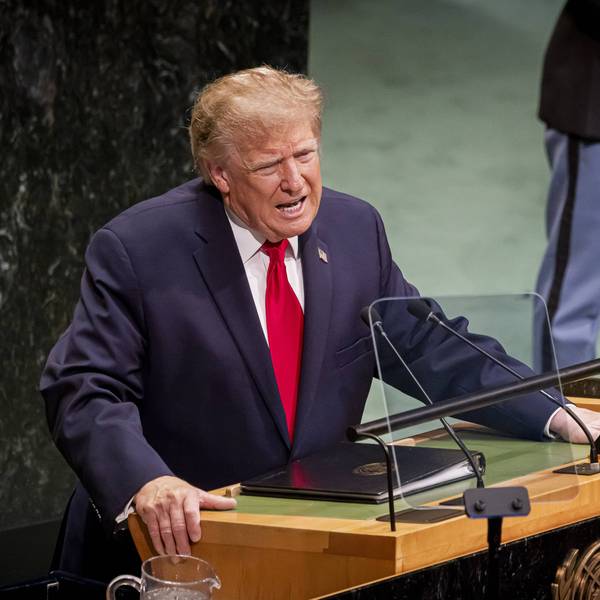
Donald Trump is a reckless fool. But the U.S. defense establishment is M.A.D.
And herein lies one of the darker problems with the Trump candidacy, and the reason why so many establishment conservatives are awkwardly distancing themselves from America's leading narcissist -- if not running screaming into the night in fear for their lives (and everyone else's).
Trump as commander in chief? Trump with his finger on the button?
Donald Trump is a reckless fool. But the U.S. defense establishment is M.A.D.
And herein lies one of the darker problems with the Trump candidacy, and the reason why so many establishment conservatives are awkwardly distancing themselves from America's leading narcissist -- if not running screaming into the night in fear for their lives (and everyone else's).
Trump as commander in chief? Trump with his finger on the button?
When the subject of nukes has come up in interviews, he has come across as creepily naive. For instance, according to MSNBC's Joe Scarborough, Trump allegedly hounded a foreign policy expert with the question: "If we have them, why can't we use them?"
And when Chris Matthews, in another interview, scolded Trump for even suggesting that maybe -- maybe -- launching a nuclear attack might be necessary someday, he shot back: "Then why are we making them? Why do we make them?"
America, America. This is why we're great. A clueless billionaire TV personality can get within screaming distance of the presidency and, in the process, push all sorts of (non-nuclear) buttons with his politically incorrect questions, implications and assertions. I have no doubt that a huge part of Trump's popularity is due to his aggressive naivete. He doesn't know any more about this than Joe Sixpack does, so the questions he asks are Average American questions. In the process, he yanks the geopolitics of nuclear deterrence -- the embedded insanity, you might say, of Mutually Assured Destruction -- out of the clutches of the deep state and its secret priesthood.
The last thing I want to see is Trump gaining admittance to this realm. But his banging at the door may serve a valuable purpose. At the very least, it brings certain realities into the consciousness of the American mainstream.
The planet has been trapped -- for the entirety of my lifetime -- in a nuclear standoff among various world powers. Even though the Cold War ended 25 years ago, some 16,000 nuclear weapons still infest the planet; the United States and Russia still have 2,000 nuclear weapons on hair-trigger alert.
"The president has basically unconstrained authority to use nuclear weapons, a seemingly insane system that flows pretty logically from America's strategic doctrine on nuclear weapons," Zack Beauchamp wrote recently at Vox. "The U.S. needs a system to launch weapons fast for deterrence to work properly, which means one person needs to be able to order the use of nukes basically unencumbered. The president is the only possible choice."
Beauchamp quotes Michael Dobbs, a former military aide to President Bill Clinton, who describes the target options contained within the "nuclear football" that a U.S. president has access to as "a 'Denny's breakfast menu,' allowing presidents to pick 'one (target) out of Column A and two out of Column B.'"
His point is to express well-justified horror at the idea of a President Trump having access to this "breakfast menu," but only a small amount of further reflection is required before one starts to tremble in terror that we have such a system in the first place and that anyone, elected or otherwise, could have such incomprehensible power -- to launch nuclear weapons either in first-strike aggression or retaliation.
How is it that the hair-trigger possibility of nuclear annihilation is still the global norm? And at the very least, how come such matters are not addressed with any seriousness in the presidential race?
We're still trapped, 71 years after the destruction of Hiroshima and Nagasaki, in a system of geopolitical "order" that depends on displaying the pretense of nuclear aggression as the primary means of staving off the other guy's nuclear aggression.
Georgetown University Professor Robert Gallucci, speaking last month at a symposium in Nagasaki, put it thus: "The paradox is clear: By making the use of a nuclear weapon plausible, easier for a decision maker to elect, deterrence is supposed to be enhanced, and the likelihood of use reduced."
Got it?
In essence, nuclear deterrence -- a.k.a., M.A.D. -- depends not only on having a nuclear arsenal ready to go, but having a president perceived by the other guys to be ready to use it, kind of like we imagine President Trump would be. But of course this is only supposed to be an illusion. The president is really supposed to be rational and sensible, willing to wage conventional wars only. So what could possibly go wrong?
Well . . . on Oct. 27, 1969, Richard Nixon, in collusion with his national security adviser, Henry Kissinger, pretended to launch a nuclear war, thinking this was a good way to end the Vietnam War.
Thus: "On the morning of October 27, 1969, a squadron of 18 B-52s -- massive bombers with eight turbo engines and 185-foot wingspans -- began racing from the western U.S. toward the eastern border of the Soviet Union," Jeremi Suri wrote for the magazine Wired in 2008. "The pilots flew for 18 hours without rest, hurtling toward their targets at more than 500 miles per hour. Each plane was loaded with nuclear weapons hundreds of times more powerful than the ones that had obliterated Hiroshima and Nagasaki."
This was Giant Lance, a long-classified secret Nixon plan to force North Vietnam and the Soviet Union to negotiate an end of the Vietnam War on U.S. terms. Suri, who tells the story in gripping detail, called it "a strategy of premeditated madness . . . Nixon's notion that faked, finger-on-the-button rage could bring the Soviets to heel."
There were several opportunities for unfathomable disaster to result from Giant Lance, including an in-flight fuel transfer operation "along the coast of Canada near the polar ice cap. Here, KC-135 planes -- essentially 707s filled with jet fuel -- carefully approached the bombers. They inched into place for transferring thousands of gallons from aircraft to aircraft through a long, thin tube. One unfortunate shift in the wind, or twitch of the controls, and a plane filled with up to 150 tons of fuel could crash into a plane filled with nuclear ordnance."
That didn't happen, nor did the Soviets panic and launch a nuclear counterattack. They asked in alarm what was going on, Nixon called back the B-52s . . . and the Vietnam War continued for another six years. In other words, the plan risked infinitely more than it accomplished.
My provisional thought here is that "a strategy of premeditated madness" is a small-minded, desperate grasp for victory -- not peace -- and the human race has to bring a larger consciousness to the negotiating table if it is to achieve the larger end of world peace. Could Donald Trump be the messenger boy, telling us, at long last, that the situation is urgent?
Dear Common Dreams reader, It’s been nearly 30 years since I co-founded Common Dreams with my late wife, Lina Newhouser. We had the radical notion that journalism should serve the public good, not corporate profits. It was clear to us from the outset what it would take to build such a project. No paid advertisements. No corporate sponsors. No millionaire publisher telling us what to think or do. Many people said we wouldn't last a year, but we proved those doubters wrong. Together with a tremendous team of journalists and dedicated staff, we built an independent media outlet free from the constraints of profits and corporate control. Our mission has always been simple: To inform. To inspire. To ignite change for the common good. Building Common Dreams was not easy. Our survival was never guaranteed. When you take on the most powerful forces—Wall Street greed, fossil fuel industry destruction, Big Tech lobbyists, and uber-rich oligarchs who have spent billions upon billions rigging the economy and democracy in their favor—the only bulwark you have is supporters who believe in your work. But here’s the urgent message from me today. It's never been this bad out there. And it's never been this hard to keep us going. At the very moment Common Dreams is most needed, the threats we face are intensifying. We need your support now more than ever. We don't accept corporate advertising and never will. We don't have a paywall because we don't think people should be blocked from critical news based on their ability to pay. Everything we do is funded by the donations of readers like you. When everyone does the little they can afford, we are strong. But if that support retreats or dries up, so do we. Will you donate now to make sure Common Dreams not only survives but thrives? —Craig Brown, Co-founder |
Donald Trump is a reckless fool. But the U.S. defense establishment is M.A.D.
And herein lies one of the darker problems with the Trump candidacy, and the reason why so many establishment conservatives are awkwardly distancing themselves from America's leading narcissist -- if not running screaming into the night in fear for their lives (and everyone else's).
Trump as commander in chief? Trump with his finger on the button?
When the subject of nukes has come up in interviews, he has come across as creepily naive. For instance, according to MSNBC's Joe Scarborough, Trump allegedly hounded a foreign policy expert with the question: "If we have them, why can't we use them?"
And when Chris Matthews, in another interview, scolded Trump for even suggesting that maybe -- maybe -- launching a nuclear attack might be necessary someday, he shot back: "Then why are we making them? Why do we make them?"
America, America. This is why we're great. A clueless billionaire TV personality can get within screaming distance of the presidency and, in the process, push all sorts of (non-nuclear) buttons with his politically incorrect questions, implications and assertions. I have no doubt that a huge part of Trump's popularity is due to his aggressive naivete. He doesn't know any more about this than Joe Sixpack does, so the questions he asks are Average American questions. In the process, he yanks the geopolitics of nuclear deterrence -- the embedded insanity, you might say, of Mutually Assured Destruction -- out of the clutches of the deep state and its secret priesthood.
The last thing I want to see is Trump gaining admittance to this realm. But his banging at the door may serve a valuable purpose. At the very least, it brings certain realities into the consciousness of the American mainstream.
The planet has been trapped -- for the entirety of my lifetime -- in a nuclear standoff among various world powers. Even though the Cold War ended 25 years ago, some 16,000 nuclear weapons still infest the planet; the United States and Russia still have 2,000 nuclear weapons on hair-trigger alert.
"The president has basically unconstrained authority to use nuclear weapons, a seemingly insane system that flows pretty logically from America's strategic doctrine on nuclear weapons," Zack Beauchamp wrote recently at Vox. "The U.S. needs a system to launch weapons fast for deterrence to work properly, which means one person needs to be able to order the use of nukes basically unencumbered. The president is the only possible choice."
Beauchamp quotes Michael Dobbs, a former military aide to President Bill Clinton, who describes the target options contained within the "nuclear football" that a U.S. president has access to as "a 'Denny's breakfast menu,' allowing presidents to pick 'one (target) out of Column A and two out of Column B.'"
His point is to express well-justified horror at the idea of a President Trump having access to this "breakfast menu," but only a small amount of further reflection is required before one starts to tremble in terror that we have such a system in the first place and that anyone, elected or otherwise, could have such incomprehensible power -- to launch nuclear weapons either in first-strike aggression or retaliation.
How is it that the hair-trigger possibility of nuclear annihilation is still the global norm? And at the very least, how come such matters are not addressed with any seriousness in the presidential race?
We're still trapped, 71 years after the destruction of Hiroshima and Nagasaki, in a system of geopolitical "order" that depends on displaying the pretense of nuclear aggression as the primary means of staving off the other guy's nuclear aggression.
Georgetown University Professor Robert Gallucci, speaking last month at a symposium in Nagasaki, put it thus: "The paradox is clear: By making the use of a nuclear weapon plausible, easier for a decision maker to elect, deterrence is supposed to be enhanced, and the likelihood of use reduced."
Got it?
In essence, nuclear deterrence -- a.k.a., M.A.D. -- depends not only on having a nuclear arsenal ready to go, but having a president perceived by the other guys to be ready to use it, kind of like we imagine President Trump would be. But of course this is only supposed to be an illusion. The president is really supposed to be rational and sensible, willing to wage conventional wars only. So what could possibly go wrong?
Well . . . on Oct. 27, 1969, Richard Nixon, in collusion with his national security adviser, Henry Kissinger, pretended to launch a nuclear war, thinking this was a good way to end the Vietnam War.
Thus: "On the morning of October 27, 1969, a squadron of 18 B-52s -- massive bombers with eight turbo engines and 185-foot wingspans -- began racing from the western U.S. toward the eastern border of the Soviet Union," Jeremi Suri wrote for the magazine Wired in 2008. "The pilots flew for 18 hours without rest, hurtling toward their targets at more than 500 miles per hour. Each plane was loaded with nuclear weapons hundreds of times more powerful than the ones that had obliterated Hiroshima and Nagasaki."
This was Giant Lance, a long-classified secret Nixon plan to force North Vietnam and the Soviet Union to negotiate an end of the Vietnam War on U.S. terms. Suri, who tells the story in gripping detail, called it "a strategy of premeditated madness . . . Nixon's notion that faked, finger-on-the-button rage could bring the Soviets to heel."
There were several opportunities for unfathomable disaster to result from Giant Lance, including an in-flight fuel transfer operation "along the coast of Canada near the polar ice cap. Here, KC-135 planes -- essentially 707s filled with jet fuel -- carefully approached the bombers. They inched into place for transferring thousands of gallons from aircraft to aircraft through a long, thin tube. One unfortunate shift in the wind, or twitch of the controls, and a plane filled with up to 150 tons of fuel could crash into a plane filled with nuclear ordnance."
That didn't happen, nor did the Soviets panic and launch a nuclear counterattack. They asked in alarm what was going on, Nixon called back the B-52s . . . and the Vietnam War continued for another six years. In other words, the plan risked infinitely more than it accomplished.
My provisional thought here is that "a strategy of premeditated madness" is a small-minded, desperate grasp for victory -- not peace -- and the human race has to bring a larger consciousness to the negotiating table if it is to achieve the larger end of world peace. Could Donald Trump be the messenger boy, telling us, at long last, that the situation is urgent?
Donald Trump is a reckless fool. But the U.S. defense establishment is M.A.D.
And herein lies one of the darker problems with the Trump candidacy, and the reason why so many establishment conservatives are awkwardly distancing themselves from America's leading narcissist -- if not running screaming into the night in fear for their lives (and everyone else's).
Trump as commander in chief? Trump with his finger on the button?
When the subject of nukes has come up in interviews, he has come across as creepily naive. For instance, according to MSNBC's Joe Scarborough, Trump allegedly hounded a foreign policy expert with the question: "If we have them, why can't we use them?"
And when Chris Matthews, in another interview, scolded Trump for even suggesting that maybe -- maybe -- launching a nuclear attack might be necessary someday, he shot back: "Then why are we making them? Why do we make them?"
America, America. This is why we're great. A clueless billionaire TV personality can get within screaming distance of the presidency and, in the process, push all sorts of (non-nuclear) buttons with his politically incorrect questions, implications and assertions. I have no doubt that a huge part of Trump's popularity is due to his aggressive naivete. He doesn't know any more about this than Joe Sixpack does, so the questions he asks are Average American questions. In the process, he yanks the geopolitics of nuclear deterrence -- the embedded insanity, you might say, of Mutually Assured Destruction -- out of the clutches of the deep state and its secret priesthood.
The last thing I want to see is Trump gaining admittance to this realm. But his banging at the door may serve a valuable purpose. At the very least, it brings certain realities into the consciousness of the American mainstream.
The planet has been trapped -- for the entirety of my lifetime -- in a nuclear standoff among various world powers. Even though the Cold War ended 25 years ago, some 16,000 nuclear weapons still infest the planet; the United States and Russia still have 2,000 nuclear weapons on hair-trigger alert.
"The president has basically unconstrained authority to use nuclear weapons, a seemingly insane system that flows pretty logically from America's strategic doctrine on nuclear weapons," Zack Beauchamp wrote recently at Vox. "The U.S. needs a system to launch weapons fast for deterrence to work properly, which means one person needs to be able to order the use of nukes basically unencumbered. The president is the only possible choice."
Beauchamp quotes Michael Dobbs, a former military aide to President Bill Clinton, who describes the target options contained within the "nuclear football" that a U.S. president has access to as "a 'Denny's breakfast menu,' allowing presidents to pick 'one (target) out of Column A and two out of Column B.'"
His point is to express well-justified horror at the idea of a President Trump having access to this "breakfast menu," but only a small amount of further reflection is required before one starts to tremble in terror that we have such a system in the first place and that anyone, elected or otherwise, could have such incomprehensible power -- to launch nuclear weapons either in first-strike aggression or retaliation.
How is it that the hair-trigger possibility of nuclear annihilation is still the global norm? And at the very least, how come such matters are not addressed with any seriousness in the presidential race?
We're still trapped, 71 years after the destruction of Hiroshima and Nagasaki, in a system of geopolitical "order" that depends on displaying the pretense of nuclear aggression as the primary means of staving off the other guy's nuclear aggression.
Georgetown University Professor Robert Gallucci, speaking last month at a symposium in Nagasaki, put it thus: "The paradox is clear: By making the use of a nuclear weapon plausible, easier for a decision maker to elect, deterrence is supposed to be enhanced, and the likelihood of use reduced."
Got it?
In essence, nuclear deterrence -- a.k.a., M.A.D. -- depends not only on having a nuclear arsenal ready to go, but having a president perceived by the other guys to be ready to use it, kind of like we imagine President Trump would be. But of course this is only supposed to be an illusion. The president is really supposed to be rational and sensible, willing to wage conventional wars only. So what could possibly go wrong?
Well . . . on Oct. 27, 1969, Richard Nixon, in collusion with his national security adviser, Henry Kissinger, pretended to launch a nuclear war, thinking this was a good way to end the Vietnam War.
Thus: "On the morning of October 27, 1969, a squadron of 18 B-52s -- massive bombers with eight turbo engines and 185-foot wingspans -- began racing from the western U.S. toward the eastern border of the Soviet Union," Jeremi Suri wrote for the magazine Wired in 2008. "The pilots flew for 18 hours without rest, hurtling toward their targets at more than 500 miles per hour. Each plane was loaded with nuclear weapons hundreds of times more powerful than the ones that had obliterated Hiroshima and Nagasaki."
This was Giant Lance, a long-classified secret Nixon plan to force North Vietnam and the Soviet Union to negotiate an end of the Vietnam War on U.S. terms. Suri, who tells the story in gripping detail, called it "a strategy of premeditated madness . . . Nixon's notion that faked, finger-on-the-button rage could bring the Soviets to heel."
There were several opportunities for unfathomable disaster to result from Giant Lance, including an in-flight fuel transfer operation "along the coast of Canada near the polar ice cap. Here, KC-135 planes -- essentially 707s filled with jet fuel -- carefully approached the bombers. They inched into place for transferring thousands of gallons from aircraft to aircraft through a long, thin tube. One unfortunate shift in the wind, or twitch of the controls, and a plane filled with up to 150 tons of fuel could crash into a plane filled with nuclear ordnance."
That didn't happen, nor did the Soviets panic and launch a nuclear counterattack. They asked in alarm what was going on, Nixon called back the B-52s . . . and the Vietnam War continued for another six years. In other words, the plan risked infinitely more than it accomplished.
My provisional thought here is that "a strategy of premeditated madness" is a small-minded, desperate grasp for victory -- not peace -- and the human race has to bring a larger consciousness to the negotiating table if it is to achieve the larger end of world peace. Could Donald Trump be the messenger boy, telling us, at long last, that the situation is urgent?