SUBSCRIBE TO OUR FREE NEWSLETTER
Daily news & progressive opinion—funded by the people, not the corporations—delivered straight to your inbox.
5
#000000
#FFFFFF
To donate by check, phone, or other method, see our More Ways to Give page.
Daily news & progressive opinion—funded by the people, not the corporations—delivered straight to your inbox.
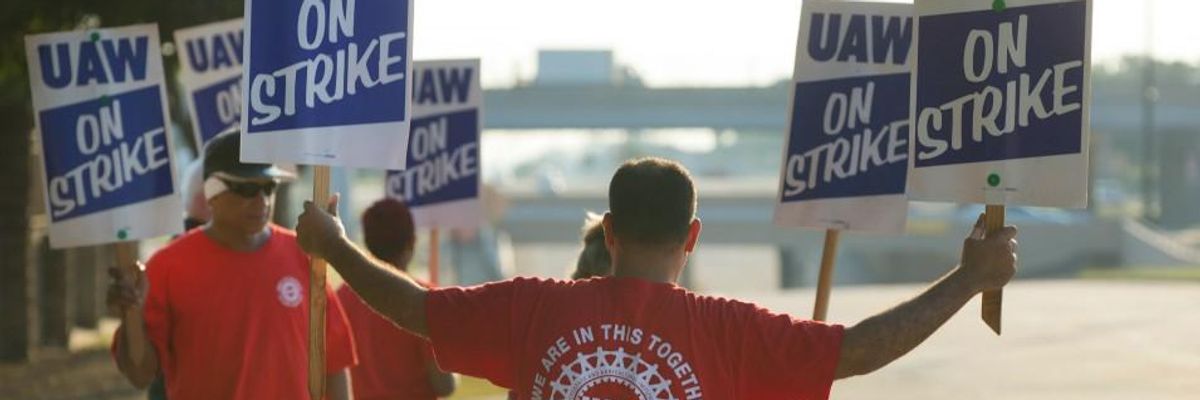
Last Friday, as four million young people marched in the world's capitals for action on climate, countless more were on the picket line supporting autoworkers who are out on strike. (Photo: Ron Jenkins/Getty Images)
Twenty years after turtles and teamsters teamed up to battle the WTO in Seattle, labor strikes and climate strikes are coinciding everywhere but in the media, and that's dangerous. If history is any guide, any minute now, some two-bit pundit or shameless president will pit workers against environmentalists so as to distract us from the real problem: the rich and the greedy and a value system that only cares about profits.
Last Friday, as four million young people marched in the world's capitals for action on climate, countless more were on the picket line supporting autoworkers who are out on strike. Both sets of strikers have guts and smarts and a righteous sense of urgency, but the latter had a fraction of the coverage, so let's be clear: they're all on the same side - the side of a future that we can actually inhabit.
Almost fifty thousand workers went on strike at General Motors Sept 16th after management and UAW negotiators failed to agree on a new contract. GM has bounced back from recession thanks to a taxpayer bailout, government tax breaks and contracts and a brutal restructuring of the workforce. Now, even though the company has made $35 billion in the last few years, they want concessions and yet more plant closures and layoffs.
This strike, the union's first in more than a decade, is about a contract - wages and healthcare and the exploitation of temps - but it's also about communities. When wages are driven into the floor, and the tax base shrivels or factories close, everything from the local school to the local fire department and the public water system takes a hit. The health and wealth of the place and its people are sucked out to make far-off CEOs and shareholders rich.
Working people all across this divided nation have seen it. And that's what's drawing them to round-the-clock picket lines in places like Flint and Detroit and Toledo and Buffalo and Canton, as well as Wentzville, Missouri, Bowling Green, Kentucky and Arlington Texas. Sure, there could be ways, and there are proposals, to transfer those closed plants to green production - light rail, electric batteries, buses, you name it. My personal favorite would transfer the plants to worker ownership. But the big point is, those places are dear to their residents, even if they're of no consequence to big money's media.
Know a union worker, or better yet, be one, and you've seen the toddlers on the line and the kids carrying signs - the same sort of signs, with the same sort of message you'll see all Climate Week. We want a future, a future we can live in, in a society that values people and planet, now and coming up. Call it climate protection or community protection; it's the same struggle, the same fight. And don't let anyone tell you different.
Dear Common Dreams reader, It’s been nearly 30 years since I co-founded Common Dreams with my late wife, Lina Newhouser. We had the radical notion that journalism should serve the public good, not corporate profits. It was clear to us from the outset what it would take to build such a project. No paid advertisements. No corporate sponsors. No millionaire publisher telling us what to think or do. Many people said we wouldn't last a year, but we proved those doubters wrong. Together with a tremendous team of journalists and dedicated staff, we built an independent media outlet free from the constraints of profits and corporate control. Our mission has always been simple: To inform. To inspire. To ignite change for the common good. Building Common Dreams was not easy. Our survival was never guaranteed. When you take on the most powerful forces—Wall Street greed, fossil fuel industry destruction, Big Tech lobbyists, and uber-rich oligarchs who have spent billions upon billions rigging the economy and democracy in their favor—the only bulwark you have is supporters who believe in your work. But here’s the urgent message from me today. It's never been this bad out there. And it's never been this hard to keep us going. At the very moment Common Dreams is most needed, the threats we face are intensifying. We need your support now more than ever. We don't accept corporate advertising and never will. We don't have a paywall because we don't think people should be blocked from critical news based on their ability to pay. Everything we do is funded by the donations of readers like you. When everyone does the little they can afford, we are strong. But if that support retreats or dries up, so do we. Will you donate now to make sure Common Dreams not only survives but thrives? —Craig Brown, Co-founder |
Twenty years after turtles and teamsters teamed up to battle the WTO in Seattle, labor strikes and climate strikes are coinciding everywhere but in the media, and that's dangerous. If history is any guide, any minute now, some two-bit pundit or shameless president will pit workers against environmentalists so as to distract us from the real problem: the rich and the greedy and a value system that only cares about profits.
Last Friday, as four million young people marched in the world's capitals for action on climate, countless more were on the picket line supporting autoworkers who are out on strike. Both sets of strikers have guts and smarts and a righteous sense of urgency, but the latter had a fraction of the coverage, so let's be clear: they're all on the same side - the side of a future that we can actually inhabit.
Almost fifty thousand workers went on strike at General Motors Sept 16th after management and UAW negotiators failed to agree on a new contract. GM has bounced back from recession thanks to a taxpayer bailout, government tax breaks and contracts and a brutal restructuring of the workforce. Now, even though the company has made $35 billion in the last few years, they want concessions and yet more plant closures and layoffs.
This strike, the union's first in more than a decade, is about a contract - wages and healthcare and the exploitation of temps - but it's also about communities. When wages are driven into the floor, and the tax base shrivels or factories close, everything from the local school to the local fire department and the public water system takes a hit. The health and wealth of the place and its people are sucked out to make far-off CEOs and shareholders rich.
Working people all across this divided nation have seen it. And that's what's drawing them to round-the-clock picket lines in places like Flint and Detroit and Toledo and Buffalo and Canton, as well as Wentzville, Missouri, Bowling Green, Kentucky and Arlington Texas. Sure, there could be ways, and there are proposals, to transfer those closed plants to green production - light rail, electric batteries, buses, you name it. My personal favorite would transfer the plants to worker ownership. But the big point is, those places are dear to their residents, even if they're of no consequence to big money's media.
Know a union worker, or better yet, be one, and you've seen the toddlers on the line and the kids carrying signs - the same sort of signs, with the same sort of message you'll see all Climate Week. We want a future, a future we can live in, in a society that values people and planet, now and coming up. Call it climate protection or community protection; it's the same struggle, the same fight. And don't let anyone tell you different.
Twenty years after turtles and teamsters teamed up to battle the WTO in Seattle, labor strikes and climate strikes are coinciding everywhere but in the media, and that's dangerous. If history is any guide, any minute now, some two-bit pundit or shameless president will pit workers against environmentalists so as to distract us from the real problem: the rich and the greedy and a value system that only cares about profits.
Last Friday, as four million young people marched in the world's capitals for action on climate, countless more were on the picket line supporting autoworkers who are out on strike. Both sets of strikers have guts and smarts and a righteous sense of urgency, but the latter had a fraction of the coverage, so let's be clear: they're all on the same side - the side of a future that we can actually inhabit.
Almost fifty thousand workers went on strike at General Motors Sept 16th after management and UAW negotiators failed to agree on a new contract. GM has bounced back from recession thanks to a taxpayer bailout, government tax breaks and contracts and a brutal restructuring of the workforce. Now, even though the company has made $35 billion in the last few years, they want concessions and yet more plant closures and layoffs.
This strike, the union's first in more than a decade, is about a contract - wages and healthcare and the exploitation of temps - but it's also about communities. When wages are driven into the floor, and the tax base shrivels or factories close, everything from the local school to the local fire department and the public water system takes a hit. The health and wealth of the place and its people are sucked out to make far-off CEOs and shareholders rich.
Working people all across this divided nation have seen it. And that's what's drawing them to round-the-clock picket lines in places like Flint and Detroit and Toledo and Buffalo and Canton, as well as Wentzville, Missouri, Bowling Green, Kentucky and Arlington Texas. Sure, there could be ways, and there are proposals, to transfer those closed plants to green production - light rail, electric batteries, buses, you name it. My personal favorite would transfer the plants to worker ownership. But the big point is, those places are dear to their residents, even if they're of no consequence to big money's media.
Know a union worker, or better yet, be one, and you've seen the toddlers on the line and the kids carrying signs - the same sort of signs, with the same sort of message you'll see all Climate Week. We want a future, a future we can live in, in a society that values people and planet, now and coming up. Call it climate protection or community protection; it's the same struggle, the same fight. And don't let anyone tell you different.