SUBSCRIBE TO OUR FREE NEWSLETTER
Daily news & progressive opinion—funded by the people, not the corporations—delivered straight to your inbox.
5
#000000
#FFFFFF
To donate by check, phone, or other method, see our More Ways to Give page.
Daily news & progressive opinion—funded by the people, not the corporations—delivered straight to your inbox.
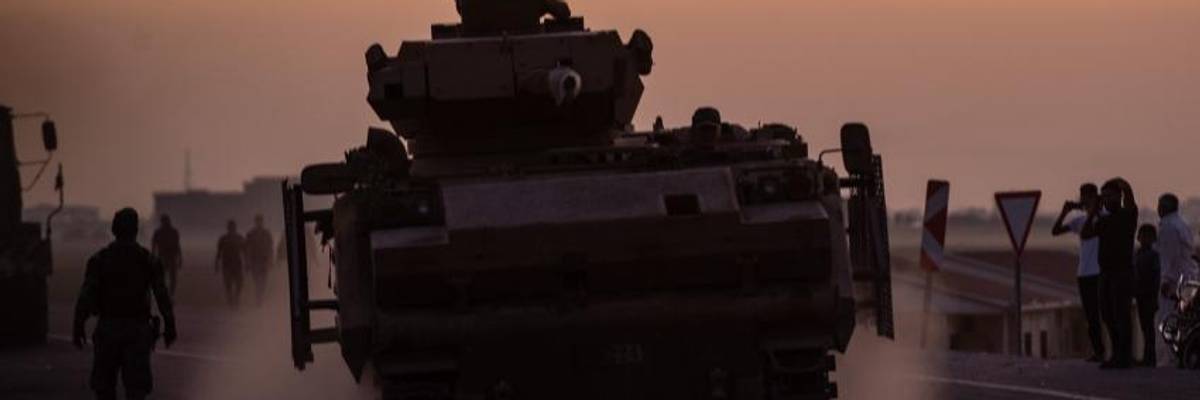
Turkish soldiers prepare to cross the border into Syria on October 09, 2019 in Akcakale, Turkey. The military action is part of a campaign to extend Turkish control of more of northern Syria. (Photo: Burak Kara/Getty Images)
The biggest problem with the U.S. withdrawal of forces from the Syrian border with Turkey is that they were there in the first place.
It is sickening that the U.S. would knowingly deliver the Kurds to Turkish violence again today. But our outrage should not lead us to embrace the U.S. presence in Syria.
Trump's decision hands over the Kurdish-run region of northern Syria to Turkey, a NATO ally with whom the U.S. has been conducting joint operations at the border. The move gave Turkey the green light to attack Kurdish communities in the region, which is currently held by the Kurdish YPG militia. The bombing has already begun, killing dozens and driving tens of thousands to flee the advancing Turkish assault. Meanwhile, the U.S. has ordered an additional 1,800 troops to Saudi Arabia, putting lie to Trump's claims that the withdrawal from northern Syria had anything at all to do with ending "endless wars" or troop deployments.
The Turkish government has long been awaiting an opportunity to attack this region of Kurdish autonomy, while some inside Turkey support the Kurdish struggle. The issue is also linked to the region's burgeoning refugee crisis: Turkey is preparing mass deportations of Syrian refugees currently in Turkey to the Syrian side of the border.
Trump's abandonment of the Kurds, U.S. allies who have fought ISIS at tremendous cost, has sparked bipartisan outrage -- from Hillary Clinton to Trump's own former UN ambassador Nikki Haley, who wrote on Twitter: "We must always have the backs of our allies, if we expect them to have our back. The Kurds were instrumental in our successful fight against ISIS in Syria. Leaving them to die is a big mistake." Republican senators Lindsey Graham and Mitch McConnell, usually strong Trump supporters, also broke ranks with the president.
Yet the U.S. betrayal of the Kurds did not begin with Trump's announcement. Trump is only writing the latest chapter in a shameful history.
Haley finished her tweet with the hashtag "#TurkeyIsNotOurFriend." But the fact is that Turkey, a NATO ally that has long provided airspace and collaborated in various ways with the U.S. military, has been an important ally of the United States for years. Turkey's violence toward the Kurdish people inside and outside its borders, and its government's escalating repression at home, has not complicated this.
According to the Security Assistance Monitor, from 2002 to this year, the U.S. has given Turkey more than $300 million in military aid. Through the ups and downs of the U.S.-Turkey relationship, the aid keeps flowing and joint operations between the countries' two militaries have continued. As Turkey begins its offensive in northern Syria, it is likely doing so with American weapons.
The Kurds are stateless people who have faced violence and discrimination in countries throughout the Middle East -- not just Turkey. The U.S. has signaled support for Kurdish freedom before, only to turn its back on their struggles.
In 1991, after the U.S. defeated Saddam Hussein's forces in Iraq, President George H.W. Bush encouraged Kurds and others oppressed by the Iraqi government to rise up and topple it -- only for U.S. forces to give a green light for Hussein to crush the rebellion and stand by while his forces mercilessly slaughtered tens of thousands, preferring to negotiate a separate U.S. ceasefire instead.
That 1991 catastrophe came after Hussein's forces used chemical weapons against the Kurdish city of Halabja in 1988 as part of the genocidal Anfal campaign, which was also a response to Kurdish resistance. Then too, thousands were killed. At the time, Hussein was an ally of the United States.
These atrocities should be seen in the context of broader U.S. violence in the region.
It is sickening that the U.S. would knowingly deliver the Kurds to Turkish violence again today. But our outrage should not lead us to embrace the U.S. presence in Syria. As in Iraq and beyond, that military presence -- aimed at both defeating ISIS and jockeying for a seat at the table in determining Syria's future alongside other regional powers -- has been disastrous.
Amnesty International has investigated, for example, the Pentagon's 2017 aerial siege of the city of Raqqa, where the Islamic State was headquartered. Amnesty concluded that U.S. forces acted with utter disregard for civilian life, killing and wounding thousands, and slaughtering whole families. Journalists Lama Al-Arian and Ruth Sherlock have documented the grim life for Raqqa residents since. The U.S. also abandoned these residents, freezing reconstruction funds after leaving 70 to 80 percent of the city's buildings destroyed.
Trump may be especially brutish in the nakedness of his power calculations, and shortsighted in his outlook on U.S. strategy and relationships. But the U.S. has always been guided by what will advance its power on the world stage -- and to the extent that there is a debate in Washington's halls of power about foreign policy at all, it is usually about that.
If the U.S. wants to help the Kurds today, the answer is not more permanent war -- that's part of what's made life so miserable for Kurds and so many others across the Middle East to begin with. Instead, it could suspend its military aid to Turkey, and end its racist exclusion of refugees.
Reversals and betrayals of allies are as common as long-term alliances. Patently uncommon are genuine commitments to democracy and human rights.
This article was produced in partnership with Foreign Policy In Focus.
Dear Common Dreams reader, It’s been nearly 30 years since I co-founded Common Dreams with my late wife, Lina Newhouser. We had the radical notion that journalism should serve the public good, not corporate profits. It was clear to us from the outset what it would take to build such a project. No paid advertisements. No corporate sponsors. No millionaire publisher telling us what to think or do. Many people said we wouldn't last a year, but we proved those doubters wrong. Together with a tremendous team of journalists and dedicated staff, we built an independent media outlet free from the constraints of profits and corporate control. Our mission has always been simple: To inform. To inspire. To ignite change for the common good. Building Common Dreams was not easy. Our survival was never guaranteed. When you take on the most powerful forces—Wall Street greed, fossil fuel industry destruction, Big Tech lobbyists, and uber-rich oligarchs who have spent billions upon billions rigging the economy and democracy in their favor—the only bulwark you have is supporters who believe in your work. But here’s the urgent message from me today. It's never been this bad out there. And it's never been this hard to keep us going. At the very moment Common Dreams is most needed, the threats we face are intensifying. We need your support now more than ever. We don't accept corporate advertising and never will. We don't have a paywall because we don't think people should be blocked from critical news based on their ability to pay. Everything we do is funded by the donations of readers like you. When everyone does the little they can afford, we are strong. But if that support retreats or dries up, so do we. Will you donate now to make sure Common Dreams not only survives but thrives? —Craig Brown, Co-founder |
The biggest problem with the U.S. withdrawal of forces from the Syrian border with Turkey is that they were there in the first place.
It is sickening that the U.S. would knowingly deliver the Kurds to Turkish violence again today. But our outrage should not lead us to embrace the U.S. presence in Syria.
Trump's decision hands over the Kurdish-run region of northern Syria to Turkey, a NATO ally with whom the U.S. has been conducting joint operations at the border. The move gave Turkey the green light to attack Kurdish communities in the region, which is currently held by the Kurdish YPG militia. The bombing has already begun, killing dozens and driving tens of thousands to flee the advancing Turkish assault. Meanwhile, the U.S. has ordered an additional 1,800 troops to Saudi Arabia, putting lie to Trump's claims that the withdrawal from northern Syria had anything at all to do with ending "endless wars" or troop deployments.
The Turkish government has long been awaiting an opportunity to attack this region of Kurdish autonomy, while some inside Turkey support the Kurdish struggle. The issue is also linked to the region's burgeoning refugee crisis: Turkey is preparing mass deportations of Syrian refugees currently in Turkey to the Syrian side of the border.
Trump's abandonment of the Kurds, U.S. allies who have fought ISIS at tremendous cost, has sparked bipartisan outrage -- from Hillary Clinton to Trump's own former UN ambassador Nikki Haley, who wrote on Twitter: "We must always have the backs of our allies, if we expect them to have our back. The Kurds were instrumental in our successful fight against ISIS in Syria. Leaving them to die is a big mistake." Republican senators Lindsey Graham and Mitch McConnell, usually strong Trump supporters, also broke ranks with the president.
Yet the U.S. betrayal of the Kurds did not begin with Trump's announcement. Trump is only writing the latest chapter in a shameful history.
Haley finished her tweet with the hashtag "#TurkeyIsNotOurFriend." But the fact is that Turkey, a NATO ally that has long provided airspace and collaborated in various ways with the U.S. military, has been an important ally of the United States for years. Turkey's violence toward the Kurdish people inside and outside its borders, and its government's escalating repression at home, has not complicated this.
According to the Security Assistance Monitor, from 2002 to this year, the U.S. has given Turkey more than $300 million in military aid. Through the ups and downs of the U.S.-Turkey relationship, the aid keeps flowing and joint operations between the countries' two militaries have continued. As Turkey begins its offensive in northern Syria, it is likely doing so with American weapons.
The Kurds are stateless people who have faced violence and discrimination in countries throughout the Middle East -- not just Turkey. The U.S. has signaled support for Kurdish freedom before, only to turn its back on their struggles.
In 1991, after the U.S. defeated Saddam Hussein's forces in Iraq, President George H.W. Bush encouraged Kurds and others oppressed by the Iraqi government to rise up and topple it -- only for U.S. forces to give a green light for Hussein to crush the rebellion and stand by while his forces mercilessly slaughtered tens of thousands, preferring to negotiate a separate U.S. ceasefire instead.
That 1991 catastrophe came after Hussein's forces used chemical weapons against the Kurdish city of Halabja in 1988 as part of the genocidal Anfal campaign, which was also a response to Kurdish resistance. Then too, thousands were killed. At the time, Hussein was an ally of the United States.
These atrocities should be seen in the context of broader U.S. violence in the region.
It is sickening that the U.S. would knowingly deliver the Kurds to Turkish violence again today. But our outrage should not lead us to embrace the U.S. presence in Syria. As in Iraq and beyond, that military presence -- aimed at both defeating ISIS and jockeying for a seat at the table in determining Syria's future alongside other regional powers -- has been disastrous.
Amnesty International has investigated, for example, the Pentagon's 2017 aerial siege of the city of Raqqa, where the Islamic State was headquartered. Amnesty concluded that U.S. forces acted with utter disregard for civilian life, killing and wounding thousands, and slaughtering whole families. Journalists Lama Al-Arian and Ruth Sherlock have documented the grim life for Raqqa residents since. The U.S. also abandoned these residents, freezing reconstruction funds after leaving 70 to 80 percent of the city's buildings destroyed.
Trump may be especially brutish in the nakedness of his power calculations, and shortsighted in his outlook on U.S. strategy and relationships. But the U.S. has always been guided by what will advance its power on the world stage -- and to the extent that there is a debate in Washington's halls of power about foreign policy at all, it is usually about that.
If the U.S. wants to help the Kurds today, the answer is not more permanent war -- that's part of what's made life so miserable for Kurds and so many others across the Middle East to begin with. Instead, it could suspend its military aid to Turkey, and end its racist exclusion of refugees.
Reversals and betrayals of allies are as common as long-term alliances. Patently uncommon are genuine commitments to democracy and human rights.
This article was produced in partnership with Foreign Policy In Focus.
The biggest problem with the U.S. withdrawal of forces from the Syrian border with Turkey is that they were there in the first place.
It is sickening that the U.S. would knowingly deliver the Kurds to Turkish violence again today. But our outrage should not lead us to embrace the U.S. presence in Syria.
Trump's decision hands over the Kurdish-run region of northern Syria to Turkey, a NATO ally with whom the U.S. has been conducting joint operations at the border. The move gave Turkey the green light to attack Kurdish communities in the region, which is currently held by the Kurdish YPG militia. The bombing has already begun, killing dozens and driving tens of thousands to flee the advancing Turkish assault. Meanwhile, the U.S. has ordered an additional 1,800 troops to Saudi Arabia, putting lie to Trump's claims that the withdrawal from northern Syria had anything at all to do with ending "endless wars" or troop deployments.
The Turkish government has long been awaiting an opportunity to attack this region of Kurdish autonomy, while some inside Turkey support the Kurdish struggle. The issue is also linked to the region's burgeoning refugee crisis: Turkey is preparing mass deportations of Syrian refugees currently in Turkey to the Syrian side of the border.
Trump's abandonment of the Kurds, U.S. allies who have fought ISIS at tremendous cost, has sparked bipartisan outrage -- from Hillary Clinton to Trump's own former UN ambassador Nikki Haley, who wrote on Twitter: "We must always have the backs of our allies, if we expect them to have our back. The Kurds were instrumental in our successful fight against ISIS in Syria. Leaving them to die is a big mistake." Republican senators Lindsey Graham and Mitch McConnell, usually strong Trump supporters, also broke ranks with the president.
Yet the U.S. betrayal of the Kurds did not begin with Trump's announcement. Trump is only writing the latest chapter in a shameful history.
Haley finished her tweet with the hashtag "#TurkeyIsNotOurFriend." But the fact is that Turkey, a NATO ally that has long provided airspace and collaborated in various ways with the U.S. military, has been an important ally of the United States for years. Turkey's violence toward the Kurdish people inside and outside its borders, and its government's escalating repression at home, has not complicated this.
According to the Security Assistance Monitor, from 2002 to this year, the U.S. has given Turkey more than $300 million in military aid. Through the ups and downs of the U.S.-Turkey relationship, the aid keeps flowing and joint operations between the countries' two militaries have continued. As Turkey begins its offensive in northern Syria, it is likely doing so with American weapons.
The Kurds are stateless people who have faced violence and discrimination in countries throughout the Middle East -- not just Turkey. The U.S. has signaled support for Kurdish freedom before, only to turn its back on their struggles.
In 1991, after the U.S. defeated Saddam Hussein's forces in Iraq, President George H.W. Bush encouraged Kurds and others oppressed by the Iraqi government to rise up and topple it -- only for U.S. forces to give a green light for Hussein to crush the rebellion and stand by while his forces mercilessly slaughtered tens of thousands, preferring to negotiate a separate U.S. ceasefire instead.
That 1991 catastrophe came after Hussein's forces used chemical weapons against the Kurdish city of Halabja in 1988 as part of the genocidal Anfal campaign, which was also a response to Kurdish resistance. Then too, thousands were killed. At the time, Hussein was an ally of the United States.
These atrocities should be seen in the context of broader U.S. violence in the region.
It is sickening that the U.S. would knowingly deliver the Kurds to Turkish violence again today. But our outrage should not lead us to embrace the U.S. presence in Syria. As in Iraq and beyond, that military presence -- aimed at both defeating ISIS and jockeying for a seat at the table in determining Syria's future alongside other regional powers -- has been disastrous.
Amnesty International has investigated, for example, the Pentagon's 2017 aerial siege of the city of Raqqa, where the Islamic State was headquartered. Amnesty concluded that U.S. forces acted with utter disregard for civilian life, killing and wounding thousands, and slaughtering whole families. Journalists Lama Al-Arian and Ruth Sherlock have documented the grim life for Raqqa residents since. The U.S. also abandoned these residents, freezing reconstruction funds after leaving 70 to 80 percent of the city's buildings destroyed.
Trump may be especially brutish in the nakedness of his power calculations, and shortsighted in his outlook on U.S. strategy and relationships. But the U.S. has always been guided by what will advance its power on the world stage -- and to the extent that there is a debate in Washington's halls of power about foreign policy at all, it is usually about that.
If the U.S. wants to help the Kurds today, the answer is not more permanent war -- that's part of what's made life so miserable for Kurds and so many others across the Middle East to begin with. Instead, it could suspend its military aid to Turkey, and end its racist exclusion of refugees.
Reversals and betrayals of allies are as common as long-term alliances. Patently uncommon are genuine commitments to democracy and human rights.
This article was produced in partnership with Foreign Policy In Focus.